CPT code 36589: Removal of tunneled CVAD without port or pump
CPT code 36589 is the procedure code for removal of a tunneled central venous ca...

Last Updated: Oct 21, 2026
90961 is the CPT code for monthly end-stage renal disease (ESRD) management in patients aged 20 and older. It applies when the patient has two or three face-to-face visits in the calendar month.
One capitation payment covers the month's outpatient ESRD care, including dialysis supervision, medication review and lab follow-up. Four or more visits move the claim to 90960, and a single visit moves it to 90962.
Let Pabau's smart automation suggest the right codes, reduce claim denials, and keep your practice compliant—effortlessly.
Automate repetitive tasks and focus on what matters most—your patients.
Reduce coding errors and ensure compliance with the latest regulations.
Clean claims, fewer denials, and faster reimbursements.
Powerful insights and reporting to help your practice thrive.
HIPAA compliant SOC 2 certified GDPR-compliant Trusted by 4,000+ clinics worldwide

CPT Code 90961 covers a month of outpatient ESRD management for patients aged 20 or older with two or three documented face-to-face visits.
Hemodialysis codes 90935 and 90937 are paid only for inpatient dialysis, because Medicare folds outpatient dialysis care into the 90961 payment.
Only one provider entity may bill the monthly capitation payment for a patient in a given month, so a second claim is denied.
Pabau, the practice management platform we build, validates 90961 claims before submission and sends CMS-1500 claims through Claim.MD.
CPT Code 90961 is the monthly capitation payment (MCP) code for outpatient end-stage renal disease (ESRD) services to a patient aged 20 or older.
A physician or qualified health care professional bills it once per month when two or three face-to-face visits took place. The American Medical Association (AMA) maintains the descriptor and updates the CPT code set every year.
The visit count decides the code. Billing 90960 when three visits occurred, or 90961 when only one visit was documented, is the most common coding error in nephrology billing. The table below sets out what a 90961 claim needs.
The 90961 payment bundles all outpatient ESRD management that the responsible nephrologist or practice delivers during the month. Billing any of these services separately is unbundling and invites an audit. Covered services include:
One monthly fee covers that whole list. Suppose the practice also bills a separate E/M visit for medication review in the same month. Without documentation of a distinct, non-ESRD problem, that claim faces denial and potential recoupment.
Three categories of service fall outside the 90961 payment and are billed with their own codes.
The ESRD Prospective Payment System (ESRD PPS) is a separate CMS bundled payment for dialysis facility costs. It runs in parallel with physician MCP billing. The facility bills under the ESRD PPS, and the physician bills under the 9096x family.
Choosing the wrong 9096x code is the leading cause of ESRD MCP claim denial. For adults, the codes differ only on the number of documented face-to-face visits in the month. Home dialysis codes work differently, with one flat monthly rate set by the patient’s age.
If a patient had three visits but one note is incomplete or undated, the supported count drops to two. The claim still supports 90961, but the coder should flag the incomplete note before submission. Four or more documented visits move the claim to 90960, and a single visit means 90962.
The map below shows how the dialysis setting, the visit count and the patient’s age narrow the choice to one code.
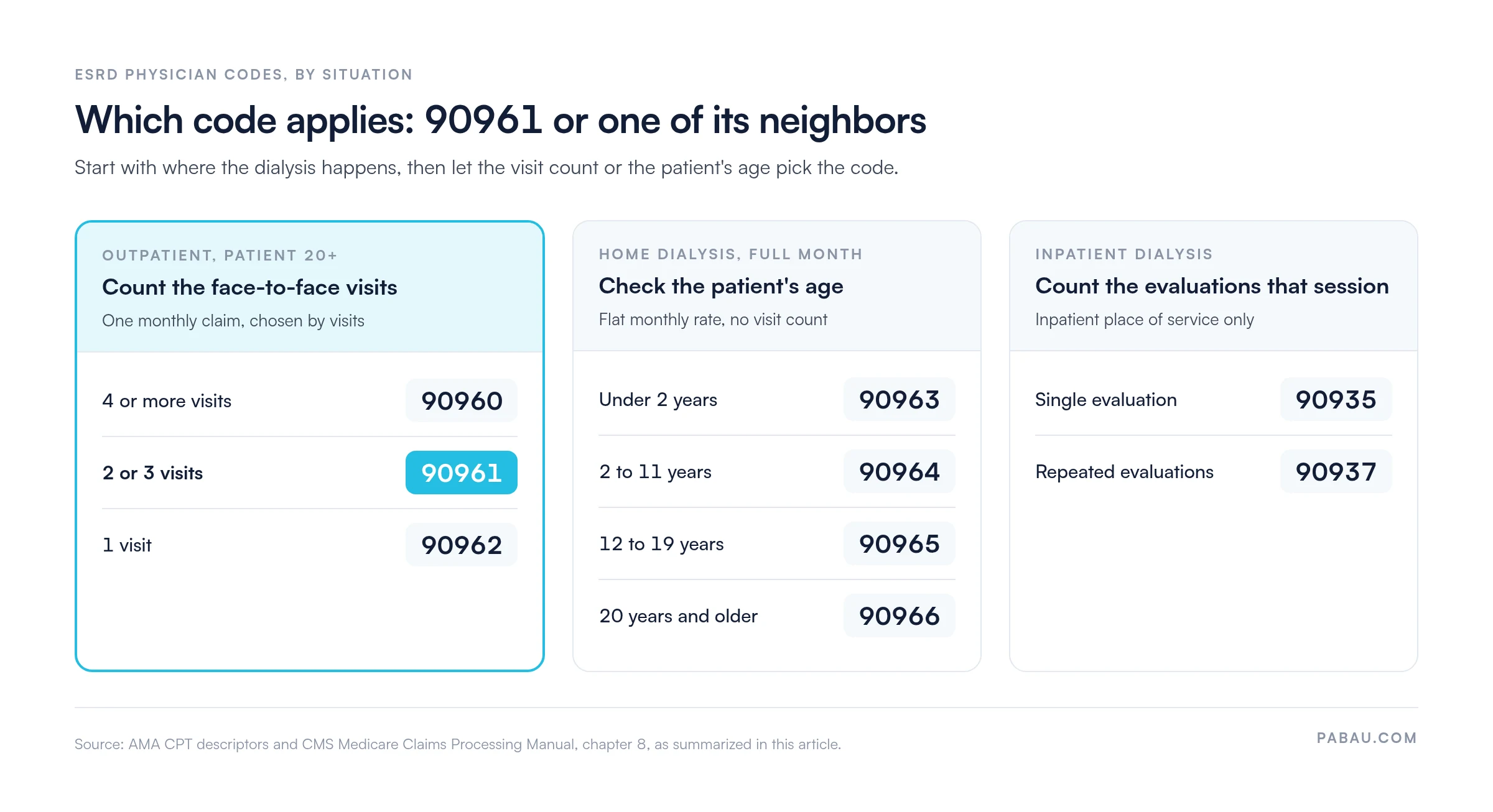
Hemodialysis codes 90935 and 90937 report the physician’s evaluation during a dialysis session. For an ESRD patient, Medicare pays them only when the place of service is an inpatient hospital.
The Medicare Claims Processing Manual gives the reason: all outpatient renal-related physician services are included in the monthly capitation payment.
A nephrologist billing 90961 for the month doesn’t add 90935 for routine outpatient sessions. If the patient is admitted and dialyzed in hospital, that inpatient session is reported with 90935 or 90937. Outpatient hemodialysis for acute kidney injury, which sits outside the MCP, uses the same codes.
Medicare covers about 79% of ESRD patients in the United States, according to the most recent USRDS prevalent-population data. Reimbursement for CPT Code 90961 is set each year through the CMS Physician Fee Schedule (PFS).
Rates vary by locality, and the figures below are national non-facility values for 2026. Check your own locality in the CMS lookup or the FastRVU 2026 RVU lookup tool.
At national rates, moving a month from 90961 to 90960 adds about $62 per patient. These figures use the 2026 conversion factor, so confirm the exact rate for your MAC locality in the CMS PFS lookup before billing. Practices that receive electronic remittance advice can check each 90961 payment against these benchmarks line by line.
Under Medicare rules, physicians, nurse practitioners (NPs), physician assistants (PAs) and other qualified health care professionals (QHCPs) may bill CPT Code 90961.
Incident-to billing for NPs and PAs follows MAC-specific guidance. Confirm the requirements with your Medicare Administrative Contractor before billing incident-to.
One rule applies everywhere. Only one provider entity may bill the monthly capitation payment for a patient in a given month. If the patient moves to another nephrology group mid-month, the two groups agree which one bills 90961. The second MCP claim received for the same beneficiary and month is denied.
The medical record must support every element of the 90961 descriptor before the claim goes out. Each requirement below answers a question an auditor will ask.
Track face-to-face visit counts throughout the month. A practice that reaches month-end with one documented visit can’t bill 90961 retroactively. Check visit counts around the 15th, and book the second visit if only one has happened.
Missing or incorrect diagnosis codes are a leading cause of 90961 denials. The primary diagnosis on every 90961 claim must be N18.6. Pabau’s error-catching claims software runs claim validation that catches missing or invalid details before the claim is submitted.
Enter N18.6 in box 21 of the CMS-1500 as diagnosis A. Then enter the pointer A in box 24E on each 90961 service line. List actively managed comorbidities, such as hypertension, diabetes or anemia, as secondary diagnoses.
A claim without N18.6 is denied. Using N18.5, chronic kidney disease stage 5, in its place is also incorrect and will deny. Check any secondary code against the ICD-10-CM code library before it goes on the claim.
Nephrology billing staff familiar with denial management workflows will recognize these patterns. Each one has a clear fix.
The steps below follow a 90961 claim from the eligibility check to payment. Practices that submit through a clearinghouse such as Claim.MD can catch many of these errors before a claim reaches the payer. For the wider workflow, see our guide to medical billing basics.
Medicare does not require prior authorization for CPT Code 90961. Payment follows the annual Physician Fee Schedule and any MAC-specific local coverage determinations for ESRD services. CGS Medicare and Noridian Medicare are among the MACs that publish ESRD billing guidance on their provider portals.
Commercial payers may apply different rules. Some require prior authorization for monthly ESRD management or set their own visit-count thresholds. Review each payer’s ESRD policy every year, especially after plan-year resets. Strong revenue cycle management builds that payer-policy review into the start of each calendar year.
Many nephrology billing teams track visit counts in the chart, key the MCP claim into a clearinghouse portal, and match remittances by hand. Each handoff is a chance to drop N18.6 or bill the wrong visit-count code.
In Pabau, the claim is raised from the patient’s invoice with the insurer and policy details already filled in. Claim validation then checks for missing or invalid details before the CMS-1500 goes to Claim.MD. If a claim comes back rejected, Pabau flags it as Needs action and shows the reason.
Eligibility checks run before the visit, and payments settle straight from ERA files. Secondary claims are covered too, including months when Medicare is the secondary payer. Your billing staff can follow every 90961 claim from Pending to Paid in one dashboard.

Pabau raises each ESRD claim from the invoice, validates it before submission and sends it through Claim.MD. Payments then settle straight from ERA files.

The safest way to bill 90961 is to settle the visit count in the middle of the month. A check around the 15th leaves time to book a second visit, so a one-visit 90962 month doesn’t replace a 90961 claim.
The trade-off is a little scheduling effort for a predictable payment. A fourth documented visit moves the claim to 90960 and adds about $62 at national rates, so count every note that qualifies. Keep N18.6 in box 21 on every claim, and keep 90935 and 90937 for inpatient sessions.
Book a demo to see how Pabau validates each ESRD capitation claim before it reaches Medicare.

Need to understand what clean claims look like before submission? Clean claim requirements in medical billing covers the mandatory fields and common rejection triggers across payer types.
Want to see how the Claim.MD clearinghouse works for nephrology claims? Claim.MD clearinghouse overview explains real-time eligibility, 837P submission, and ERA reconciliation in one place.
Looking for a broader guide to ESRD and nephrology billing compliance? Medical billing compliance guide covers audit triggers, documentation standards, and payer policy monitoring.
CPT Code 90961 covers a month of outpatient ESRD management for a patient aged 20 or older with two or three face-to-face visits. It includes dialysis regimen management and supervision, medication oversight, lab review, complication management and patient education. Inpatient dialysis sessions are billed separately with 90935 or 90937.
CPT 90961 requires two or three documented face-to-face visits in the calendar month. If only one visit occurred, use CPT 90962. If four or more visits occurred, use CPT 90960. Each visit must be dated, in person and documented with ESRD management content.
CPT 90960 applies when four or more face-to-face visits occur in the month, and CPT 90961 applies to two or three. Both are for ESRD patients aged 20 or older. In 2026, 90960 carries 6.77 work RVUs against 5.52 for 90961, because it reflects more direct patient contact.
Only for inpatient dialysis. Medicare pays 90935 and 90937 for ESRD patients only when the place of service is an inpatient hospital. Outpatient dialysis supervision is already included in the 90961 monthly payment, so billing those codes for routine outpatient sessions is unbundling.
The 2026 Medicare national non-facility payment for CPT 90961 is about $310.63, based on 9.30 total RVUs. Geographic locality adjustments apply, so your practice’s rate may differ. Confirm the current figure in the CMS Physician Fee Schedule lookup for your MAC jurisdiction.
The most common reasons are the wrong visit-count code and a missing N18.6 primary diagnosis. Duplicate MCP billing by two providers, a patient under 20, and unbundled services cause denials too. Auditing visit counts and diagnosis codes before submission prevents most of them.
If only one face-to-face visit is documented in the month, the correct code is CPT 90962. A 90961 claim with one supporting note will be denied for medical necessity if it is reviewed. Visits can’t be added to a month that has already closed.