HCPCS Code L0472: Hyperextension TLSO billing guide
HCPCS code L0472: Official descriptor and device definition HCPCS code L0472 des...

Last Updated: Nov 5, 2026
CPT code 90696 is the product code for the DTaP-IPV vaccine, which protects against diphtheria, tetanus, pertussis and polio. It applies to children 4 through 6 years old, given as an intramuscular injection. The code pays for the vaccine only, never for the shot itself.
That split is what trips coders up. The injection bills on its own lines, as 90460 with 90461 add-ons or as 90471. Two brands fit the code, GSK's Kinrix and Sanofi's Quadracel. Below, we walk through how the claim is built and what gets it denied.
Let Pabau's smart automation suggest the right codes, reduce claim denials, and keep your practice compliant—effortlessly.
Automate repetitive tasks and focus on what matters most—your patients.
Reduce coding errors and ensure compliance with the latest regulations.
Clean claims, fewer denials, and faster reimbursements.
Powerful insights and reporting to help your practice thrive.
HIPAA compliant SOC 2 certified GDPR-compliant Trusted by 4,000+ clinics worldwide

CPT 90696 reports the DTaP-IPV vaccine product only, for children 4 through 6, and fits both Kinrix and Quadracel.
The injection bills separately: 90460 plus three 90461 units when a physician or QHP counsels, or 90471 when no one does.
At a well-child visit, list Z00.129 or Z00.121 first and Z23 second. At a vaccine-only visit, Z23 goes first.
For VFC doses, bill the administration and, where your state asks, report 90696 at $0 with modifier SL.
Pabau, the practice software we build, pre-fills claims from the patient record and checks required fields before they go out.
CPT code 90696 reports one item: the DTaP-IPV vaccine product given to a child aged 4 through 6. The shot itself bills on separate lines. The American Medical Association’s CPT code set holds the official descriptor, so check it for year-end updates.
In the medical billing process, a vaccine always splits into two charges. The product goes on one line, and the act of giving it goes on another.
The code covers the vaccine supply for a four-antigen DTaP-IPV shot, given intramuscularly to children 4 through 6. It doesn’t cover the injection, the office visit, or extra antigens such as hepatitis B or Haemophilus influenzae type b (Hib).
The 4-through-6 age range is written into the CPT descriptor itself. It applies to every DTaP-IPV product, so Kinrix and Quadracel both qualify. If the ACIP schedule changes, check the AAPC CPT code reference and the manufacturer’s prescribing information.
Payers audit vaccine claims against a short list of chart details. Each one takes seconds to capture at the injection and far longer to rebuild later.
Good medical billing compliance starts at the injection. Capture the NDC and lot number in the EHR when the shot is given, not from a vial log days later.
Every 90696 line needs an administration code beside it. Which one you use depends on the patient’s age and on who counseled the family. A wrong pick here is a common reason for edits and denials.
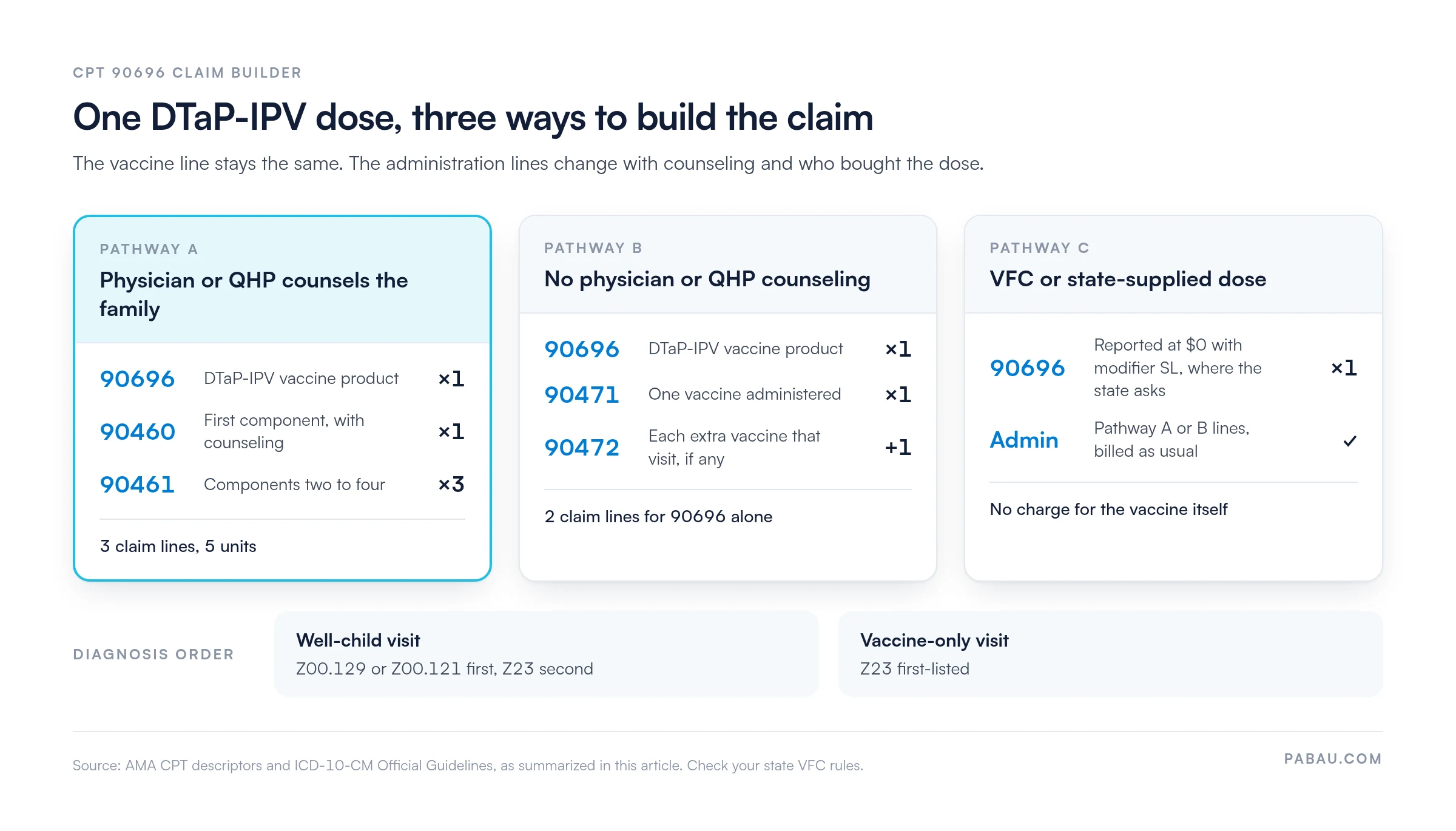
Because 90696 covers four antigens, the counseled pathway produces three claim lines and five units. That’s 90696 ×1 for the product, 90460 ×1 for the first antigen, and 90461 ×3 for the other three. Some payers don’t recognize 90460 at all and want 90471 instead, counseling or not.
Say an established 5-year-old comes in for a well-child check. The pediatrician counsels the parent, and a nurse gives Quadracel. The claim carries 99393 for the preventive visit, plus 90696 ×1, 90460 ×1 and 90461 ×3. Z00.129 goes first and Z23 second.
The diagram below shows all three ways the same dose can land on a claim.
Before you bill 90460 and 90461 with 90696, check the counseling note. Payers can take payment back if only a nurse saw the family, so record who counseled.
Five codes get mixed up with 90696 most often. The antigen mix and the age range set them apart, not the route.
The quickest check is the vial. Kinrix and Quadracel both code to 90696, while Pediarix codes to 90723. If the brand is unfamiliar, read the antigen list on the label and match it to the table.
Older children who need a tetanus-diphtheria booster without pertussis are billed under 90714 instead.
Three payer routes apply to 90696, and each one changes what you submit.
Medicare Part B doesn’t cover routine DTaP-IPV shots. Its vaccine benefit covers flu, pneumococcal, hepatitis B and COVID-19 shots, plus tetanus after an injury. Medicare patients are also rarely 4 to 6 years old.
If you need a CMS reference rate for your charge master, use the CMS MPFS lookup tool. Rates update each January, so don’t hard-code a dollar figure.
State Medicaid and CHIP programs usually cover DTaP-IPV for children in the age range. Rules and rates differ by state. Many Medicaid-enrolled children get the vaccine through the Vaccines for Children (VFC) program, which changes the claim.
Under VFC, eligible children get the vaccine free from a publicly funded supply. Your practice didn’t buy the dose, so you don’t charge for it. You still bill the administration with 90460 and 90461, or with 90471.
Many states also want the product code on the claim. In that case, report 90696 at $0, or a nominal amount, with modifier SL for a state-supplied vaccine. Document VFC eligibility and the lot number too.
The compliance problem is charging for a VFC product, not listing its code. Rules differ, so check your state VFC program before you set up the claim template.
Z23 (Encounter for immunization) can be first-listed or secondary under the ICD-10-CM Official Guidelines. Its position depends on why the child came in.
At a sick visit where you also give the vaccine, first-list the main reason for the visit, such as otitis media. Add Z23 after it. Set your EHR templates up the same way, so a default order never overrides the chart.
Most 90696 denials trace back to a handful of upstream mistakes. Fix them at documentation, and they rarely reach rework.
Strong denial management workflows start with a clean claim, not an appeal. When a 90696 claim does come back, the remittance’s denial codes point you to the cause.
Run through these six checks before the claim leaves. Each one maps to a denial reason above.
Build these into your superbill as required fields, and the checklist mostly runs itself. Our guide to submitting a clean claim covers the same habits for every code you bill.
Most of the checklist above is data entry, and data entry is where claims slip. Pabau, the practice management platform we build, pre-fills the claim form from the patient record. CPT codes attached to the visit land on the charge lines, and ICD-10 codes come from the recorded problem list.
Its claims management software includes CPT and ICD-10 lookup libraries, and it won’t unlock Send until required claim fields are complete. US claims go through Claim.MD, with eligibility checks, ERA posting and claim-status tracking. The administration pathway is still your coder’s call.
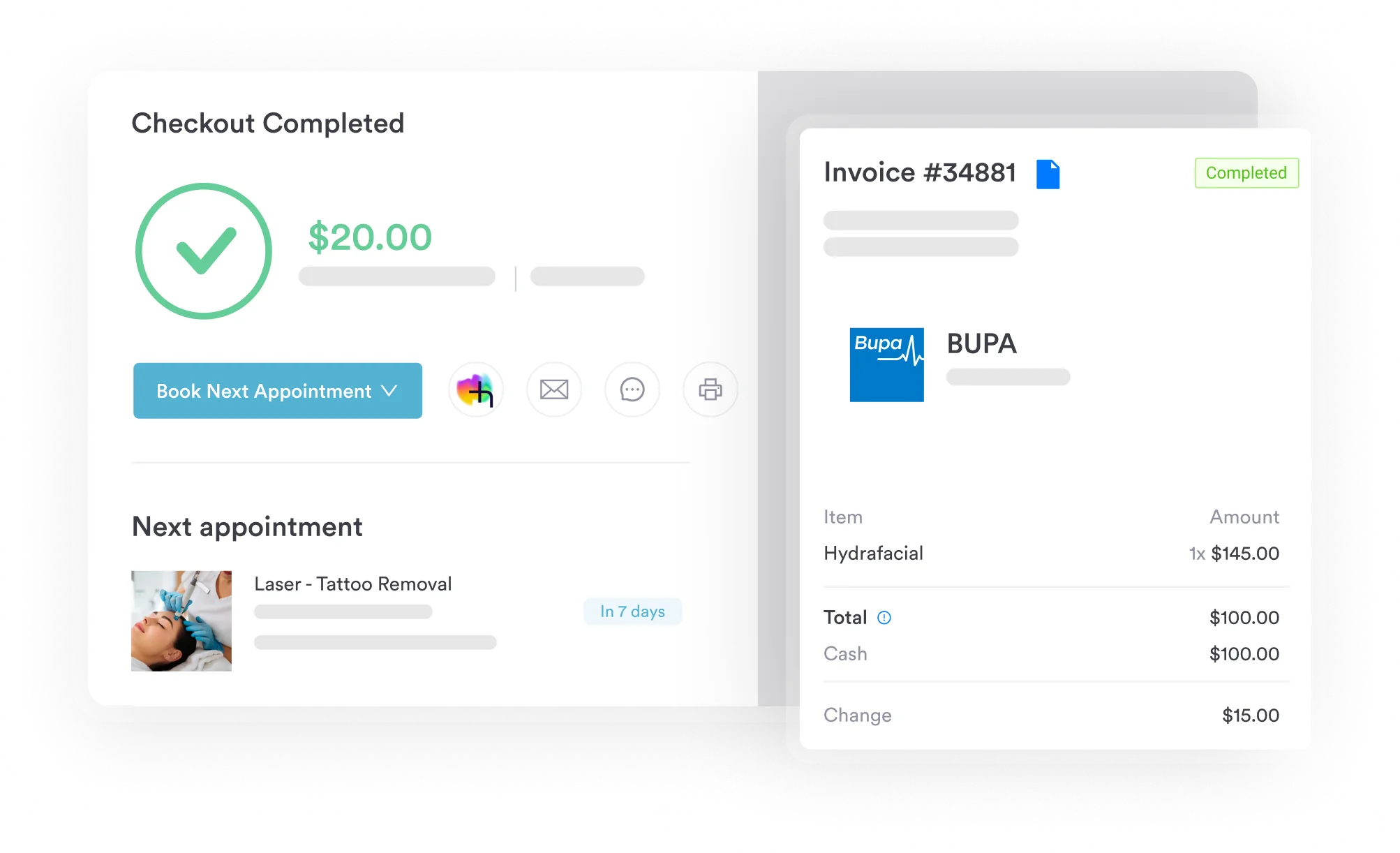

Pabau pre-fills claims from the patient record, checks required fields before you send, and submits US claims through Claim.MD with eligibility checks and ERA posting.

CPT code 90696 is simple once the claim is split correctly. The vaccine goes on one line, and the shot goes on its own lines.
The hard part happens upstream. Record the counseling, the NDC and the VIS date at the injection, and let the visit type pick the Z code. Do that, and most of the denials in this guide never reach your desk.
Want vaccine claims pre-filled from the chart and checked for missing fields before they go out? Book a demo and we’ll walk you through the workflow.

Need a reference for denial code meanings? Denial codes in medical billing explains the most common CARC and RARC codes that appear on vaccine claim remittances.
Want to understand how the clearinghouse processes your claims? Medical claims clearinghouse guide covers how 837P files flow from practice to payer and what triggers an edit.
Looking to reduce claim rework across all procedure codes? Electronic remittance advice (ERA) guide explains how to read 835 files and map denial patterns back to documentation gaps.
It covers the DTaP-IPV vaccine product for children 4 through 6: diphtheria toxoid, tetanus toxoid, acellular pertussis and inactivated poliovirus. The administration bills separately.
90723 adds hepatitis B, for five antigens. Pediarix bills under 90723, while Kinrix and Quadracel bill under 90696.
Yes, for patients through 18 when a physician or QHP counsels face to face. Bill 90460 once and 90461 three times.
The descriptor covers children 4 through 6 years old. Outside that range, check the product label and payer policy before you code.
Bill the administration only. Many states also want 90696 reported at $0 with modifier SL, so check your state VFC rules.
Only at a vaccine-only visit. At a well-child visit, list Z00.129 or Z00.121 first and Z23 second.
Not for routine use. Part B covers flu, pneumococcal, hepatitis B and COVID-19 vaccines, plus tetanus after an injury.
It varies by payer and state, so check your Medicaid fee schedule or payer contract. For a CMS reference, the MPFS lookup tool updates each January.
Kinrix is one brand billed under 90696. Quadracel, a Sanofi DTaP-IPV vaccine for ages 4 to 6, uses the same code.