

HCPCS code E0198: Water pressure pad billing guide
HCPCS code E0198 is a water pad for a standard mattress HCPCS code E0198 is the ...

Last Updated: Oct 13, 2026
90714 is the CPT code for tetanus and diphtheria toxoids adsorbed (Td), preservative free, when administered to individuals 7 years or older, for intramuscular use. It reports the vaccine product only, so the injection itself is billed with a separate administration code such as 90471.
The most common billing mistake with this code is submitting 90714 when the patient received Tdap, which adds pertussis and is coded 90715. Check the NDC on the vial before you code the claim.
Let Pabau's smart automation suggest the right codes, reduce claim denials, and keep your practice compliant—effortlessly.
Automate repetitive tasks and focus on what matters most—your patients.
Reduce coding errors and ensure compliance with the latest regulations.
Clean claims, fewer denials, and faster reimbursements.
Powerful insights and reporting to help your practice thrive.
HIPAA compliant SOC 2 certified GDPR-compliant Trusted by 4,000+ clinics worldwide

CPT code 90714 covers the Td vaccine product only (tetanus and diphtheria, no pertussis) for patients 7 and older. The injection itself is billed separately.
Always pair 90714 with an administration code: 90471 for the first vaccine, or 90460 when a physician or QHP counsels a patient through age 18.
Billing 90714 for a patient who received Tdap (90715) is the leading denial trigger for this vaccine family, so confirm the vial before you code.
Medicare Part B covers Td when it is medically necessary, such as wound prophylaxis. Routine adult boosters are generally not a Part B preventive benefit.
Claims software such as Pabau checks eligibility in real time and tracks each 90714 claim from submission to payment, flagging denials for rework.
CPT code 90714 is defined as “Tetanus and diphtheria toxoids adsorbed (Td), preservative free, when administered to individuals 7 years or older, for intramuscular use.” The code covers the vaccine product only. It does not include the act of giving the injection.
Three clinical facts the descriptor encodes:
What the code does not include: The immunization administration service. That service is billed separately every time, with an administration code from the 9046x or 9047x family.
Understanding exactly where 90714’s scope ends prevents unbundling errors and wrong-code denials. The table below shows what is covered, what must be billed separately, and what is excluded entirely.
Billing 90715 for a patient who received Td, or 90714 for a Tdap patient, is the most common denial trigger in this vaccine family. The clinical difference is one antigen, pertussis. Get it wrong and the claim comes back rejected.
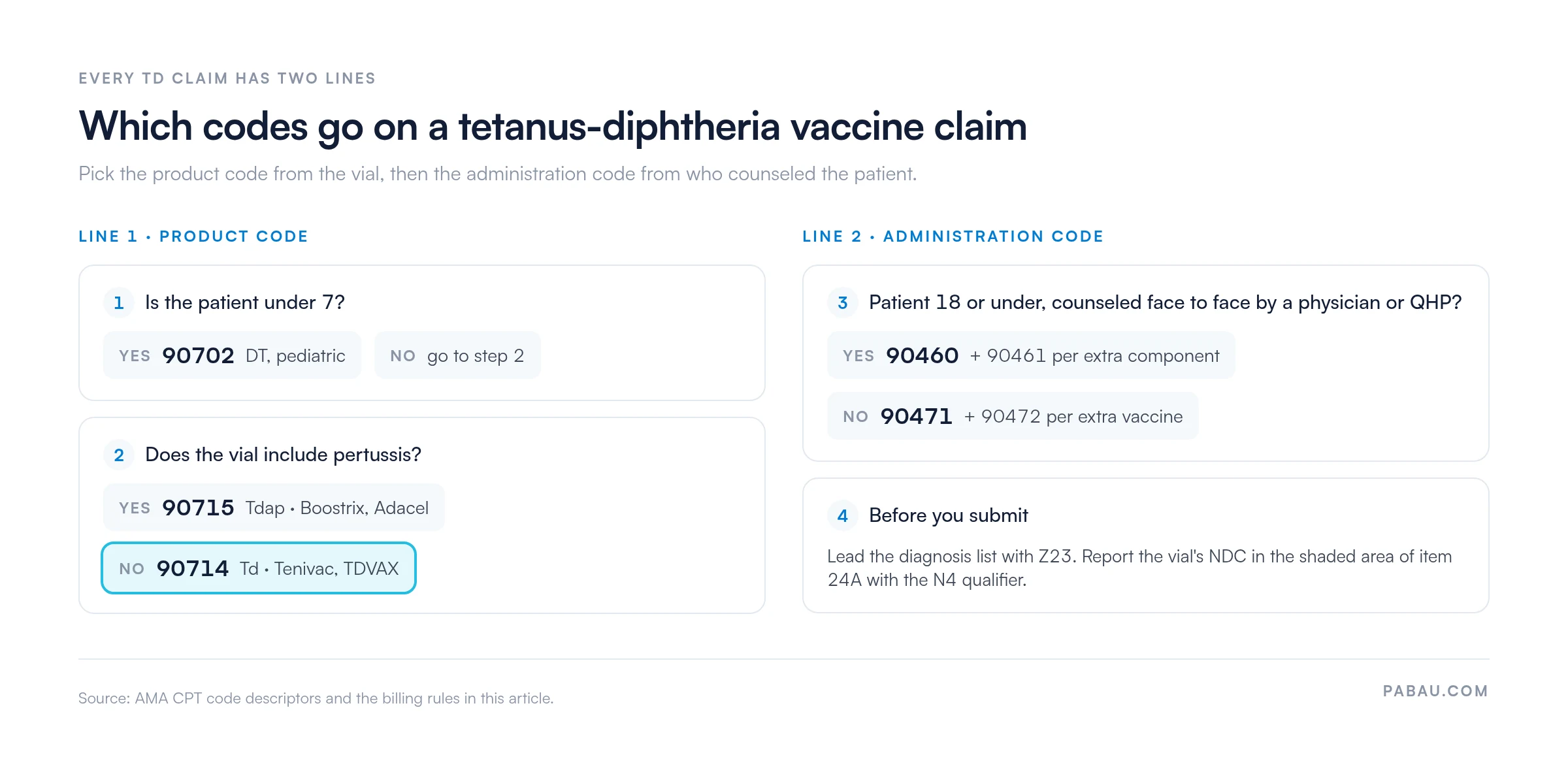
The decision rule is simple: Check the vaccine administered record, not the vaccine order or the patient’s reported history. If the lot number and NDC on the vial match a Td product (Tenivac or TDVAX), 90714 is correct. If they match Boostrix or Adacel, 90715 is correct. No clinical scenario puts both codes on the same date for the same patient.
The diagram below runs that check in order, then picks the administration line that goes with it.
Every 90714 claim requires an accompanying administration code. The product and the service are always billed on separate lines. According to the AMA’s CPT code set, vaccine administration codes are designed to be reported in addition to the vaccine product code.
For most adult Td booster encounters, the claim lines are 90714 + 90471. If the patient also receives another vaccine at the same visit, such as influenza, add 90472 for the second administration. Use 90460 only when a physician or qualified health professional (QHP) counsels a patient aged 18 or under face to face. The chart must show that counseling happened, not just that the vaccine was given.
Flag your billing workflow: If 90460 is selected as the administration code, the chart must show who did the counseling. It has to be the physician or QHP, not clinical support staff. Payers audit this distinction on pre-payment review. A vaccination record alone, without a counseling note, supports 90471, not 90460.
Vaccine product codes require more chart documentation than most procedure codes. Payers that conduct pre-payment review on immunization claims look for every element listed below. Missing even one can halt adjudication.
Report the NDC in the shaded area of item 24A on the CMS-1500, with the N4 qualifier, or in the 837P electronic equivalent. Capture the NDC and lot number at the point of care, while the vial is still in hand. Back-filling them at the billing step is where they go missing.
A 90714 claim without a valid diagnosis code is denied outright. According to the CDC/NCHS ICD-10-CM tool, Z23 is the primary encounter code for immunization visits and should lead the diagnosis list on routine vaccination claims.
A symptom-only code without Z23 is a common denial trigger. For example, a wound S-code billed without Z23 tells the payer the visit was for wound treatment, not vaccination. That can push the claim into a medical necessity review with a different coverage threshold. Lead with Z23 and add the situational code as a secondary diagnosis.
Medicare Part B covers CPT code 90714 when the Td vaccine is medically necessary, such as wound prophylaxis following an injury with tetanus exposure risk. Routine decennial Td boosters, however, are generally not covered as a Part B preventive benefit. According to the CMS Physician Fee Schedule, the reimbursement allowable for 90714 is published annually and varies by geographic locality. Check the current fee schedule lookup before quoting patients an out-of-pocket estimate.
For practices that submit immunization claims electronically, Pabau connects to the Claim.MD clearinghouse. It runs real-time eligibility checks and posts ERA remittances back against each claim. Checking coverage before the encounter heads off the denial that routine Td booster claims hit most often.
Review the electronic remittance advice codes returned on denied Medicare Td claims. CARC 96 (non-covered charge) or CARC 167 (this diagnosis is not covered) on the 835 remittance separates a benefits denial from a coding error. Each one needs a different fix.
Three modifiers see regular use on 90714 claims. Using the wrong one, or omitting a required one, causes payment discrepancies or compliance exposure.
Modifier SL is the most frequently missed. When the practice is enrolled in VFC and the vaccine came from the state-supplied stock, SL must be appended to 90714. The practice paid nothing for that vial. Billing the product code at the full allowable is an overpayment, and it creates compliance risk. Do not append SL if the practice purchased the vaccine commercially, even if the patient is VFC-eligible.
Most 90714 denials fall into five categories. Each one has its own fix, and rebilling without fixing the root cause brings the same denial back.
Effective denial management workflows sort these patterns by CARC code on the remittance. CARC 6 (the procedure code is inconsistent with the patient’s age) maps directly to the age-mismatch row. CARC 16 (claim lacks information) maps to the missing NDC. Counting denials by CARC code shows which step of the process to fix first.
For practices seeing repeat NDC denials, a clean claim submission checklist shows where the NDC gets captured and whether that happens before the encounter closes. Our list of denial codes for billers explains what each CARC means and how to clear it.
Run a quarterly audit of your 90714 claims by checking the vaccine administered record against the CPT code billed. Look for encounters where the lot number is charted but the NDC never reached the claim. Fix the capture step behind each one before the next remittance repeats it.
Vaccine claim denials usually trace back to details entered after the visit. The usual culprits are the wrong vaccine code, a missing NDC, or a diagnosis that doesn’t support the claim. Catching them on the remittance means correcting and resubmitting a claim you already sent.
With Pabau’s claims management for practices, each claim is built from the invoice raised at checkout. The patient’s insurer and policy come from their record, so the claim routes to the right payer automatically. Validation checks confirm that details such as membership numbers and authorization codes are in place before it goes out.
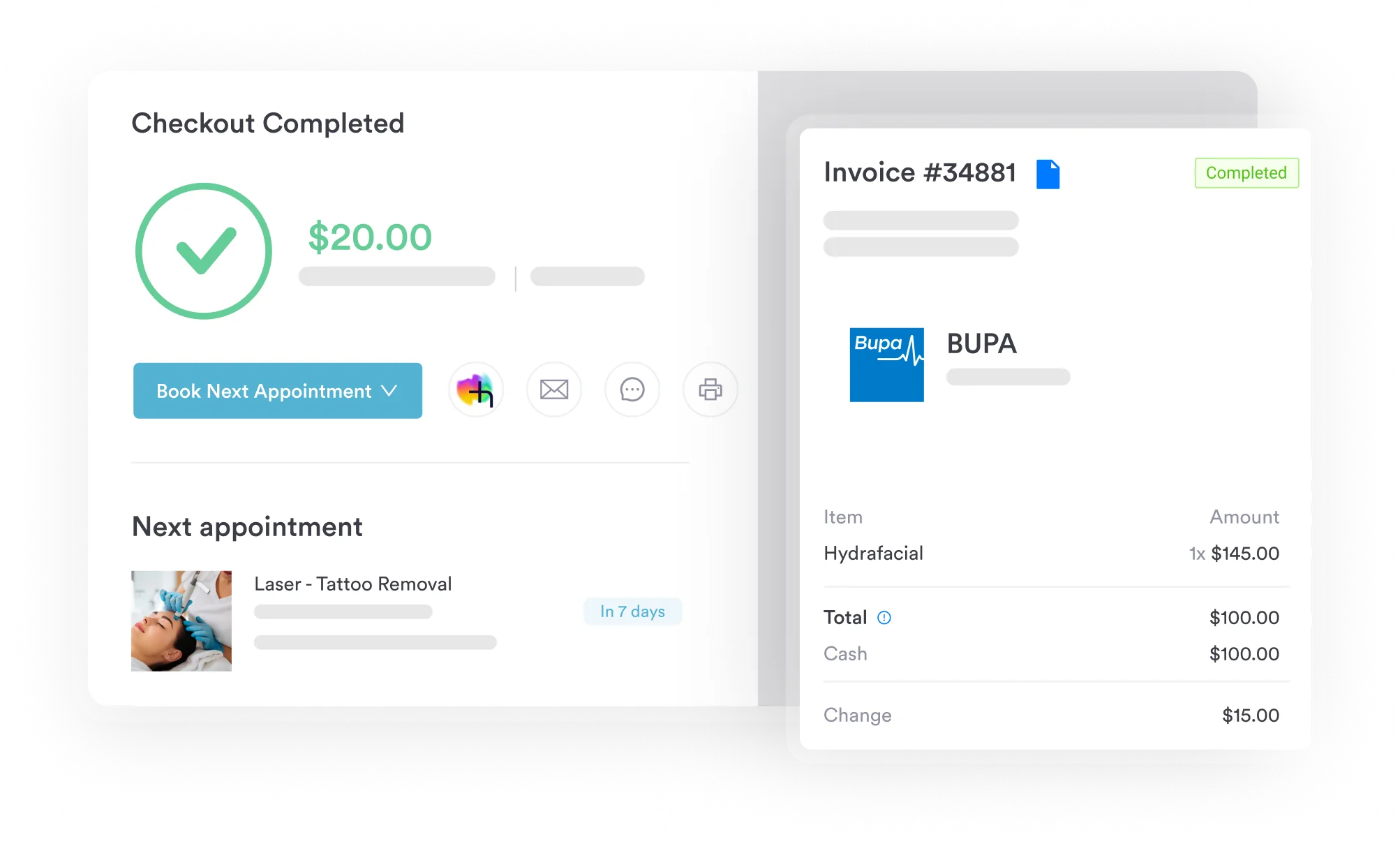
Through Claim.MD, each claim moves from submitted to paid in one dashboard, with statuses updated from the payer. Denied claims are flagged for rework, and ERA remittances post back against the claims they settle. Your billing team sees which vaccine line was denied without logging in to a clearinghouse portal.

Pabau turns the invoices you already raise into electronic claims and checks eligibility in real time through Claim.MD. Denied 90714 lines are flagged for rework, so they get corrected before they age.

Treat every 90714 claim as three checks that have to agree: The vial, the administration line, and the diagnosis. The vial decides between 90714 and 90715. Who counseled the patient decides between 90471 and 90460.
The cheapest place to get all three right is the treatment room, with the vial still in hand and the NDC still readable. Once the claim is out, each fix costs a resubmission and another wait for the remittance.
Are your vaccine claims coming back on the same CARC? Book a demo to see how Pabau tracks each claim to ERA and flags denials for rework.

Need guidance on managing denied immunization claims? Denial codes in medical billing explains the most common CARC codes and how to action each one.
Billing a Tdap dose instead? CPT code 90715 covers the Tdap product code, its age rules and the pairings that go with it.
Unsure which administration code to pair? CPT code 90471 walks through the first-vaccine administration code and when 90472 joins it.
Looking for a clearinghouse that handles vaccine claims? Claim.MD clearinghouse overview covers how Pabau’s US clearinghouse partner processes 837P claims and returns 835 remittances.
Want to see where immunization billing sits in the bigger picture? What is revenue cycle management walks through the process from eligibility check to payment posting.
CPT code 90714 is the vaccine product code for tetanus and diphtheria toxoids (Td), without pertussis, for patients aged 7 years and older. It covers only the vaccine itself; immunization administration must be billed separately using 90471 or 90460.
CPT 90714 is for the Td vaccine (tetanus and diphtheria only, no pertussis). CPT 90715 is for Tdap (tetanus, diphtheria, and acellular pertussis). Check the administered vaccine’s NDC to confirm which code applies; using the wrong code is the leading denial trigger for this vaccine family.
Medicare Part B covers 90714 when the Td vaccine is medically necessary, such as for wound prophylaxis. Routine decennial boosters are generally not a covered Part B preventive benefit. Verify coverage before the encounter and document the clinical indication in the chart.
For most adults, bill 90471 for the first vaccine administration and 90472 for each additional vaccine at the same encounter. Use 90460 instead when a physician or qualified health professional counsels a patient through age 18 face to face. The chart must document that counseling, not just the shot.
Yes, but the E&M service must be separate and significant, not just the immunization encounter. Append modifier 25 to the E&M code, not to 90714. Then document the separate problem or medical decision-making that justified the office visit.
Z23 (encounter for immunization) is the primary diagnosis for routine Td vaccination. For wound prophylaxis, add the relevant wound S-code as a secondary diagnosis. Missing Z23 and leading with a symptom or wound code alone is a common denial cause for this claim type.



