HCPCS code J7190: Factor VIII billing, units and reimbursement
HCPCS code J7190 bills human Factor VIII by the unit HCPCS code J7190 describes ...

Last Updated: Nov 10, 2026
J7040 is the HCPCS Level II code for infusion, normal saline solution, sterile (500 ml = 1 unit). Each 500 mL infused is one unit, so a 1,000 mL infusion bills 2 units.
J7040 is easily confused with J7030, its 1,000 mL counterpart. Billing the wrong code, or the wrong unit count, overbills or underbills the claim.
Let Pabau's smart automation suggest the right codes, reduce claim denials, and keep your practice compliant—effortlessly.
Automate repetitive tasks and focus on what matters most—your patients.
Reduce coding errors and ensure compliance with the latest regulations.
Clean claims, fewer denials, and faster reimbursements.
Powerful insights and reporting to help your practice thrive.
HIPAA compliant SOC 2 certified GDPR-compliant Trusted by 4,000+ clinics worldwide

HCPCS code J7040 bills normal saline 0.9% at 500 mL per unit, so the claim quantity is the volume infused divided by 500.
J7030 bills the same solution at 1,000 mL per unit, and swapping the two codes overbills or underbills the claim.
Medicare Part B pays J7040 at ASP plus 6%, updated quarterly, while hospital outpatient departments may package it into the APC.
JW and JZ apply only if J7040 is on the CMS single-dose container list, so check the current list and MAC guidance.
Pabau, the practice management platform we build, supports HCPCS code entry and electronic claim submission through its claims management software.
HCPCS code J7040 is the CMS code for “Infusion, normal saline solution, sterile (500 ml = 1 unit).” The solution is isotonic sodium chloride 0.9%, given intravenously for hydration or as a vehicle for another drug. It reports the drug only, so the administration goes on its own CPT line.
J7040 is a per-unit code, not a per-encounter code. The quantity field shows how many 500 mL increments were infused, so a 1,000 mL infusion bills 2 units.
The CMS HCPCS overview publishes the quarterly updates and the annual Alpha-Numeric HCPCS file, which lists J7040 with its descriptor and effective dates.
Each step below adds a fact the claim depends on. A miss at any one of them shows up later as a denial or a request for records.
Steps 2 and 3 are where the chart and the claim have to agree, so the next section starts there.
The quantity on a J7040 line equals the 500 mL units infused, not the number of bags or the encounter. A 1,000 mL infusion is 2 units, and 1,500 mL is 3 units.
A 250 mL infusion works out to 0.5 units, or bill J7050 where the payer accepts it for 250 mL. Many payers don’t accept fractional units, so check payer policy before billing below 1 unit. The chart below shows where each common volume lands.
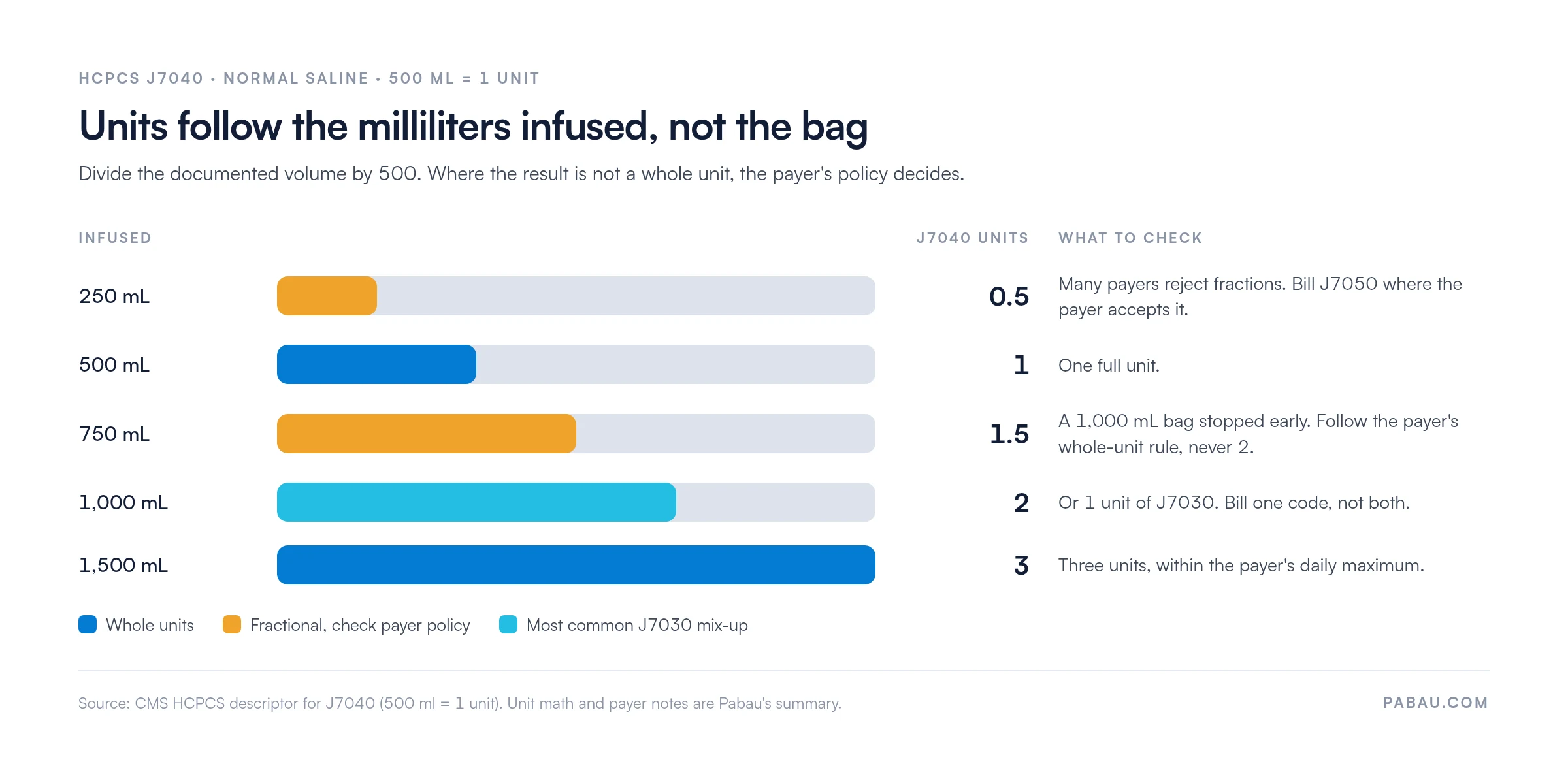
Document the exact volume administered, not the volume ordered or the bag size stocked. If a 1,000 mL bag stops at 750 mL, the claim shows 1.5 units, or the nearest whole unit the payer accepts. It never shows 2. Billing the full bag when less was delivered is a common audit trigger.
Run a quarterly audit of J7040 claims, comparing the units billed with the volume in the start and stop nursing notes. Discrepancies between the chart and the claim are a common trigger for J7040 post-payment review. Build a reconciliation step into charge capture before claims batch.
Here’s how one illustrative visit codes out. A patient arrives dehydrated, and the physician orders 1,000 mL of normal saline. The infusion runs 50 minutes and stops at 750 mL once symptoms settle.
Billing 2 units because the bag held 1,000 mL would overstate the drug by 250 mL. One unit of J7030 makes the same mistake under a different code.
J7030 covers normal saline 0.9% at 1,000 mL per unit, double the volume of J7040. At the same unit count, billing J7030 in place of J7040 doubles the implied volume and can draw overpayment review. The reverse understates the volume and underpays the practice.
Pick the code from the documented volume alone. A practice that stocks only 1,000 mL bags can bill J7030 whenever the full liter runs. Billing J7030 for 500 mL infusions becomes a systematic overpayment pattern, the kind Medicare Administrative Contractor (MAC) audits look for.
A J7040 claim needs a physician order and a documented clinical indication. The indications that most often support normal saline hydration include:
Practices running IV hydration programs should record the indication on the intake form. That way the diagnosis is in the chart before the bag is hung.
J7040 covers the saline itself. The administration is billed separately with codes such as CPT 96360, so a hydration encounter usually carries both.
Where J7040 isn’t paid on its own line, look at the setting and the payer first. Bundling comes from OPPS packaging at hospital outpatient departments, or from payer policy where saline is only a vehicle.
CMS and most commercial payers need specific elements in the record before a J7040 claim pays. A missing element triggers denial, and appeals rarely succeed without the required documentation.
Capture start and stop times and the infused volume at the point of care, in the note template itself. Reconstructing them at billing time is where the chart and the claim drift apart. Meeting medical billing compliance standards means every element is present before the claim leaves the practice.
Medicare Part B pays J7040 under the Average Sales Price (ASP) method at ASP plus 6%, per the CMS Medicare Claims Processing Manual, Chapter 17. Normal saline has a very low ASP, so the per-unit payment is small. Most of a saline encounter’s value sits in the administration code.
CMS updates ASP payment limits quarterly, and the file in effect on the date of service applies. Don’t write a fixed dollar figure into billing policies. Check the CMS quarterly ASP Drug Pricing File for the current J7040 payment limit.
Hospital outpatient departments bill on the UB-04 under OPPS, the Outpatient Prospective Payment System. Its packaging rules may fold the saline cost into the APC for the accompanying procedure. Physician offices (POS 11) bill on the CMS-1500 and are paid at ASP plus 6% per unit.
Freestanding infusion centers may bill on either form, depending on their enrollment type. Home health agencies usually have saline bundled into the episode payment. Mixing up these systems is a common error when a practice bills across settings.
A superbill that captures the place of service at charge entry helps prevent POS-related denials. Pre-populating the POS code by location removes one of the most correctable errors in infusion billing.
CMS Change Request 12603 (effective July 1, 2023) made JW and JZ reporting mandatory for drugs from single-dose containers. The modifiers apply only to drugs on CMS’s single-dose container list. J7040 saline bags are not confirmed on that list, so check the current CMS list and your MAC’s guidance.
If the payer does treat your saline as a single-dose container drug, report JZ when none was discarded. Where it doesn’t, neither modifier is required on the J7040 line.
Medicare Part B does not generally require prior authorization for J7040 hydration in a physician office. Many commercial plans and Medicaid managed care organizations do, and their rules vary by plan year and contract.
The AAPC HCPCS code lookup and payer portals are the fastest way to check a plan before the visit. For commercial plans, read the infusion therapy policy rather than the general prior authorization list. Hydration rules are sometimes buried in infusion coverage policies.
Check prior authorization at insurance verification, not at claim submission. For commercial and Medicaid managed care patients, build a J7040 check into eligibility verification. Record the PA number in the chart and in the claim’s prior authorization field. Retroactive approval after a denial is slow and not guaranteed.
J7040 claims fail for predictable reasons. Most trace back to unit errors, missing medical necessity documentation, or saline billed where the setting packages it. The denial codes on a J7040 remittance advice usually map to one of these root causes.
In many infusion practices, the nurse records the volume on paper and the biller re-keys it days later. That handoff is where 750 mL turns into 2 units.
Pabau, the practice management platform we build, keeps the infusion note and the claim on one patient record. With claims management built in, the biller enters J7040 and its units from that record. Claims then go out electronically, through Claim.MD as CMS-1500 claims in the US.
Digital forms capture the order, start and stop times and volume at the chair. Prior authorization codes, dates and sessions sit on the patient’s case, with a warning when one is missing. ERA remittances post back to Pabau, so payments land beside the claim they settle.
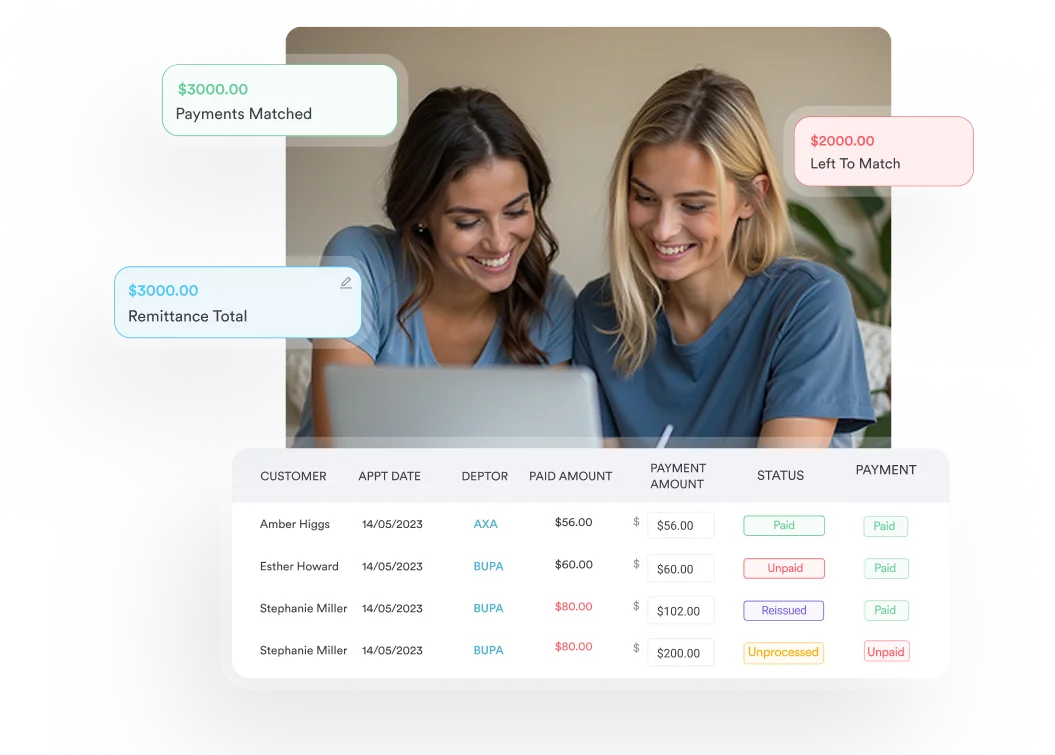

Pabau’s claims management supports HCPCS code entry and electronic claim submission, with infusion notes and prior authorizations on the same record. See how it fits your billing workflow.

J7040 rewards one habit above the rest: bill the milliliters the chart shows. Get that right and the J7030 swap, the partial-bag overbill and most unit denials become rare.
The harder calls sit with the payer. Settings that package saline, payers that reject fractional units and the single-dose list all need checking, not assuming. Build those checks into charge capture rather than the appeals queue.
Book a demo to see how Pabau links the infusion note to the J7040 claim line, so the units match the chart before submission.

Running past the first hour? CPT code 96361 covers each additional hour of hydration and when the add-on applies.
Hanging lactated Ringer’s instead? HCPCS code J7120 walks through billing for Ringer’s lactate infusion.
Need to understand how clearinghouse submission works? Medical claims clearinghouse guide explains how electronic claims are validated before reaching payers.
Looking up another J-code? HCPCS code library collects Level II codes with a billing guide for each.
No. Saline used to flush a line or keep it open is bundled, so it isn’t billed as J7040. J7040 is for saline infused as ordered, with its own documented volume.
Bill 4 units of J7040 or 2 units of J7030, matching the volume infused. Use one code for the saline, not both, and check the payer’s daily unit maximum.
It depends on why the patient needed IV fluid. Dehydration is E86.0, for example. Link the diagnosis to the J7040 and administration lines, and document why oral hydration wasn’t enough.
No. J7040 is normal saline only. Lactated Ringer’s has its own code, J7120, and 5% dextrose in normal saline bills as J7042.
Not always. Hospital outpatient departments bill on the UB-04 under OPPS, where packaging rules may fold the saline into the APC for the main procedure.