

HCPCS Code L0472: Hyperextension TLSO billing guide
HCPCS code L0472: Official descriptor and device definition HCPCS code L0472 des...

Last Updated: Nov 5, 2026
Billable Code
87799 is the CPT code for infectious agent detection by nucleic acid (DNA or RNA); not otherwise specified, quantification, each organism. Labs report it when an assay measures an organism's load and no organism-specific quantification code exists.
It is a Category I not otherwise specified code with a published Medicare CLFS rate, billed one unit per organism. Claims can draw closer payer review than organism-specific codes, so the note should name the organism, the method and the medical necessity.
Let Pabau's smart automation suggest the right codes, reduce claim denials, and keep your practice compliant—effortlessly.
Automate repetitive tasks and focus on what matters most—your patients.
Reduce coding errors and ensure compliance with the latest regulations.
Clean claims, fewer denials, and faster reimbursements.
Powerful insights and reporting to help your practice thrive.
HIPAA compliant SOC 2 certified GDPR-compliant Trusted by 4,000+ clinics worldwide

CPT code 87799 covers quantification of an infectious agent by nucleic acid when the organism has no specific CPT code of its own.
87798 is the amplified probe NOS code, while 87799 is the quantification NOS code.
87799 is a Category I not otherwise specified code with a published Medicare CLFS rate, not an unlisted code.
Payers still review 87799 claims closely, so the note should name the organism, the method and the medical necessity.
Pabau’s practice management software validates each claim before submission and carries prior authorization codes from the appointment through to the claim.
CPT code 87799 is defined by the AMA as: “Infectious agent detection by nucleic acid (DNA or RNA); not otherwise specified, quantification, each organism.” In practice, it is the code for a lab test that measures how much of an organism is present. It applies only when that organism has no quantification code of its own. Four elements of the descriptor decide when it applies.
When to use 87799: Confirm that the organism has no specific CPT code before billing 87799. The code set includes quantification codes for Chlamydia trachomatis (87492), gonorrhea (87592), HIV-1 (87536), hepatitis C (87522), CMV (87497) and many more. If the organism has its own quantification code, bill that code instead. The chart below maps that first check and the four sibling codes in the family.
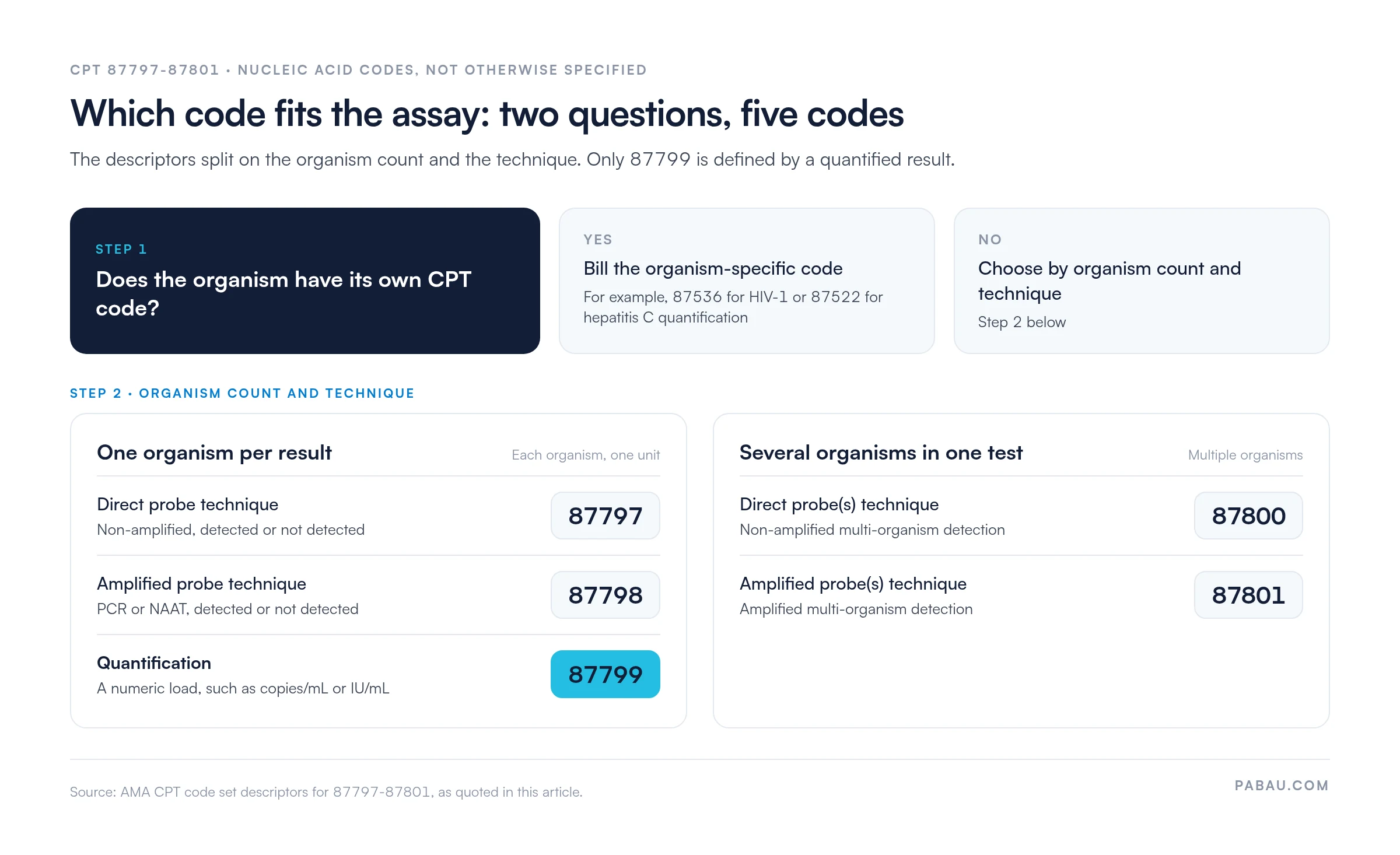
Several clinical scenarios land on CPT code 87799 rather than a specific code. Most involve measuring the load of an organism that the CPT code set has not given a dedicated code.
CPT 87798 is the amplified probe technique code, and CPT 87799 is the quantification code. Both are not otherwise specified codes for a single organism, reported per organism. Mixing the two up is a frequent source of miscoding in this range.
A practical billing check: Look at the laboratory report. A “detected” or “not detected” result from an amplified assay points to 87798. A copy number, IU/mL or log value points to CPT code 87799. This is a working rule rather than descriptor text, since the descriptors split on technique and quantification. Billing 87799 for a qualitative result overstates the service and carries compliance risk.
Before choosing 87799 over 87798, pull the lab report and confirm the result format. A log10 value or copy number supports 87799, while a detected or not detected result supports 87798. Record the result format in the clinical note, because auditors check that the two match.
Medicare reimburses CPT code 87799 under the Clinical Laboratory Fee Schedule (CLFS), which CMS publishes annually. The code is a Category I not otherwise specified code rather than an unlisted code, so it carries its own published CLFS rate. Commercial payers set their own rates, often with the CLFS figure as a reference point.
Several practical reimbursement considerations apply specifically to this code:
A not otherwise specified code can draw closer payer review than an organism-specific one, because the code itself does not name the organism. For medical billing compliance, every 87799 claim needs the following elements in the medical record.
Complete this checklist before the claim goes out. Payers reviewing 87799 claims often request the ordering note and the laboratory report together, so having both ready speeds up any records request. The guide to submitting a clean claim covers the broader claim preparation process.
The CDC ICD-10-CM tool is the authoritative source for selecting supporting diagnosis codes. Common ICD-10 pairings by clinical scenario are shown below.
The ICD-10 code has to show why quantitative testing was medically necessary for this patient. “Viral infection, unspecified” alone is weaker support than a specific organism code with a note on how the load result changes management. Payer reviewers look for that clinical logic.
Prior authorization rules for molecular tests billed under 87799 differ by payer type. Completing insurance eligibility verification before ordering the test is the surest way to catch a prior auth requirement before the service is performed.
When prior auth is required, payers typically ask for the organism, the assay method and the clinical indication tied to a diagnosis code. Most also want a note explaining why no specific CPT code applies. Build a standard prior auth request template for 87799 submissions to streamline the process.
Claims for CPT code 87799 can draw closer payer review than organism-specific codes, because the code does not name the organism. Effective denial management workflows for this code start with the most frequent denial reasons and their fixes.
A structured appeal works better than a generic reconsideration request. For a denied 87799 claim, follow these steps.
Run a quarterly audit of all 87799 claims submitted in the prior 90 days. Pull denial rate by payer, calculate average days to payment, and identify which denial reason codes appear most often. That data drives targeted prior auth and documentation improvements for the next quarter.
An 87799 claim needs the organism, the method and the medical necessity rationale to travel together. In many practices those details sit in the order, the lab report and a billing note. Each missing piece gives a payer a reason to deny or request records.
Pabau’s claims management software scrubs each claim for missing or invalid details before it is submitted. Prior authorizations are stored as cases, so the authorization code follows the appointment through to the claim. A claim still missing its code is flagged so your team can assign one.
In the US, Pabau submits CMS-1500 claims through Claim.MD to thousands of payers. You can run a real-time eligibility check before the test is ordered, and remittance advice flows back into the same claims dashboard. A coverage exclusion found at that point costs a phone call rather than an appeal.

Pabau’s claims management software validates each claim before it goes out and keeps prior authorization codes attached from booking to claim. Your billing team spends less time on resubmissions and appeals.

CPT code 87799 is the right choice for a quantified nucleic acid result when the organism has no code of its own. It has a published CLFS rate, so the payment risk sits in the record rather than the rate.
Before each 87799 claim, make two checks. Confirm that no organism-specific quantification code exists, and confirm that the lab report shows a numeric result. A claim that passes both, with the indication written into the note, gives a payer little reason to ask for more.
Pabau’s Claim.MD clearinghouse integration runs real-time eligibility checks before the visit and returns remittance advice to your claims dashboard. Book a demo to see how Pabau carries a lab claim from order to payment.

Need to understand how clearinghouse submission works? Medical claims clearinghouse guide explains how clearinghouses validate, route, and report on claims before they reach payers.
Building a denial prevention workflow? Electronic remittance advice explained covers how to read ERA files, interpret CARC codes, and feed denial data back into your billing process.
Looking for a complete billing compliance framework? What is medical billing walks through the full claim lifecycle from patient registration to payment posting.
CPT code 87799 bills quantification of an infectious agent by nucleic acid (DNA or RNA) when the organism has no specific CPT code. Common uses include viral load monitoring for less common viruses such as parvovirus B19 and bacterial load tracking during antibiotic treatment. It also covers new molecular assays that the AMA has not yet given a dedicated code.
CPT 87799 is the quantification code, and CPT 87798 is the amplified probe technique code. Both are not otherwise specified codes, reported per organism, for organisms without their own CPT code. As a billing check, a numeric load on the lab report points to 87799. A detected or not detected result from an amplified assay points to 87798.
Medicare covers CPT code 87799 under the Clinical Laboratory Fee Schedule, which publishes a rate for it. Payment depends on medical necessity under the local Medicare Administrative Contractor’s Local Coverage Determinations. The clinical indication must be documented and backed by an ICD-10 code that supports quantitative testing. Medicare Advantage plans may add prior authorization and other restrictions.
At minimum, billing CPT code 87799 requires a clinical note stating the indication and the organism targeted. It should also record the method used, confirm that the result was quantitative, and explain why no specific CPT code applies. Many payers also ask for a letter of medical necessity. The laboratory report showing the quantitative result should be available for payer review on request.
Prior authorization requirements for CPT 87799 vary by payer. Traditional Medicare does not routinely require prior auth for lab tests paid under the CLFS, but Medicare Advantage plans often do. Commercial insurers frequently require prior auth for molecular assays above certain cost thresholds. Check the payer’s policy before the test is performed, because retroactive authorization is rarely granted.
Serial quantitative PCR assays measure whether a bacterial pathogen’s load falls during antibiotic therapy. For an organism without a dedicated quantification code, each serial assay bills as one unit of CPT code 87799. The clinical note for each encounter should record the treatment phase and how the load result informs ongoing management.



