HCPCS code P9058: Red blood cells, leukocytes reduced, CMV-negative, irradiated
HCPCS code P9058: Official descriptor and key attributes HCPCS code P9058 report...

Last Updated: Oct 26, 2026
87641 is the CPT code for infectious agent detection by nucleic acid (DNA or RNA); Staphylococcus aureus, methicillin resistant, amplified probe technique. It covers PCR and NAAT assays that detect MRSA and report methicillin resistance, not culture or antigen testing.
Its closest neighbor is CPT 87640, which is also amplified but detects S. aureus without reporting resistance. Medicare pays 87641 only for diagnostic testing, never for screening, and only when the lab holds a moderate- or high-complexity CLIA certificate.
Let Pabau's smart automation suggest the right codes, reduce claim denials, and keep your practice compliant—effortlessly.
Automate repetitive tasks and focus on what matters most—your patients.
Reduce coding errors and ensure compliance with the latest regulations.
Clean claims, fewer denials, and faster reimbursements.
Powerful insights and reporting to help your practice thrive.
HIPAA compliant SOC 2 certified GDPR-compliant Trusted by 4,000+ clinics worldwide

CPT code 87641 reports amplified probe (PCR/NAAT) detection of MRSA. CPT 87640 is also amplified, but it detects S. aureus without reporting methicillin resistance.
The test is not CLIA-waived and requires a CLIA-certified moderate- or high-complexity laboratory. Claims without a valid CLIA certificate fail at the payer level.
Medicare pays 87641 only as a diagnostic test for a patient with signs or symptoms of infection, such as an A49.02 (MRSA infection) workup. Screening, including Z22.322 (MRSA carrier) claims, is statutorily excluded and denied.
Most 87641 denials trace back to five causes, and each one has its own fix, from correcting the ICD-10 pairing to confirming the CLIA certificate.
Pabau’s claims management software connects to the Claim.MD clearinghouse, giving labs and practices real-time eligibility checks and automated 837P submission for molecular diagnostic claims.
CPT code 87641 is an infectious agent detection code in the microbiology section of the AMA’s CPT code set, maintained by the American Medical Association.
The full official descriptor is: Infectious agent detection by nucleic acid (DNA or RNA); Staphylococcus aureus, methicillin resistant, amplified probe technique.
The code sits within the 87471-87801 range of nucleic acid detection codes, alongside related organism-specific tests. Several adjacent codes cover related organisms or different detection methods. Using the wrong one is a coding risk even when the clinical intent is correct.
The code covers one specific test: a PCR or NAAT assay that confirms methicillin resistance in Staphylococcus aureus through mecA or a related resistance determinant. It does not cover S. aureus detection that stops short of a resistance result (CPT 87640), general S. aureus culture, or antigen-based rapid testing.
The exclusion that causes the most audits is billing 87641 when MRSA was detected as part of a comprehensive infectious disease panel. If the panel code bundles MRSA, billing 87641 alongside it is a duplicate claim. The exception is an MRSA test ordered independently, where the panel code’s descriptor does not include it.
Specimen collection, laboratory workflow, and documentation quality all affect whether a 87641 claim holds up to payer review. Weak documentation is the most common reason a medically justified test still gets denied on appeal.
Acceptable specimen types include anterior nasal swabs (the most common for screening), wound swabs, blood cultures flagging S. aureus, and skin/soft tissue aspirates. The ordering provider’s documentation must specify the collection site and the clinical reason for testing.
“Rule out MRSA” is insufficient without a supporting ICD-10 code that establishes why ruling out MRSA was medically necessary at that encounter.
The assay targets the mecA gene (or mecC in some platforms), which encodes the penicillin-binding protein PBP2a responsible for methicillin resistance. The FDA has cleared several commercial platforms for this test, including the Cepheid Xpert MRSA and BD MAX MRSA assays.
All are classified as moderate- or high-complexity by FDA under CLIA regulations. A laboratory performing 87641 must hold a CLIA certificate for at least moderate complexity.
The lab report must include: the assay platform used, the gene target detected (mecA or mecC), the specimen source, and the result (detected/not detected). The ordering provider’s chart note must document why the test was ordered and the corresponding ICD-10 code.
For Medicare, that reason has to be diagnostic: signs or symptoms of a suspected MRSA infection. A pre-surgical, ICU admission, or contact precaution screen does not qualify. These two documents together establish medical necessity. Missing either one means the claim rests on the lab report alone, which won’t hold up on review.
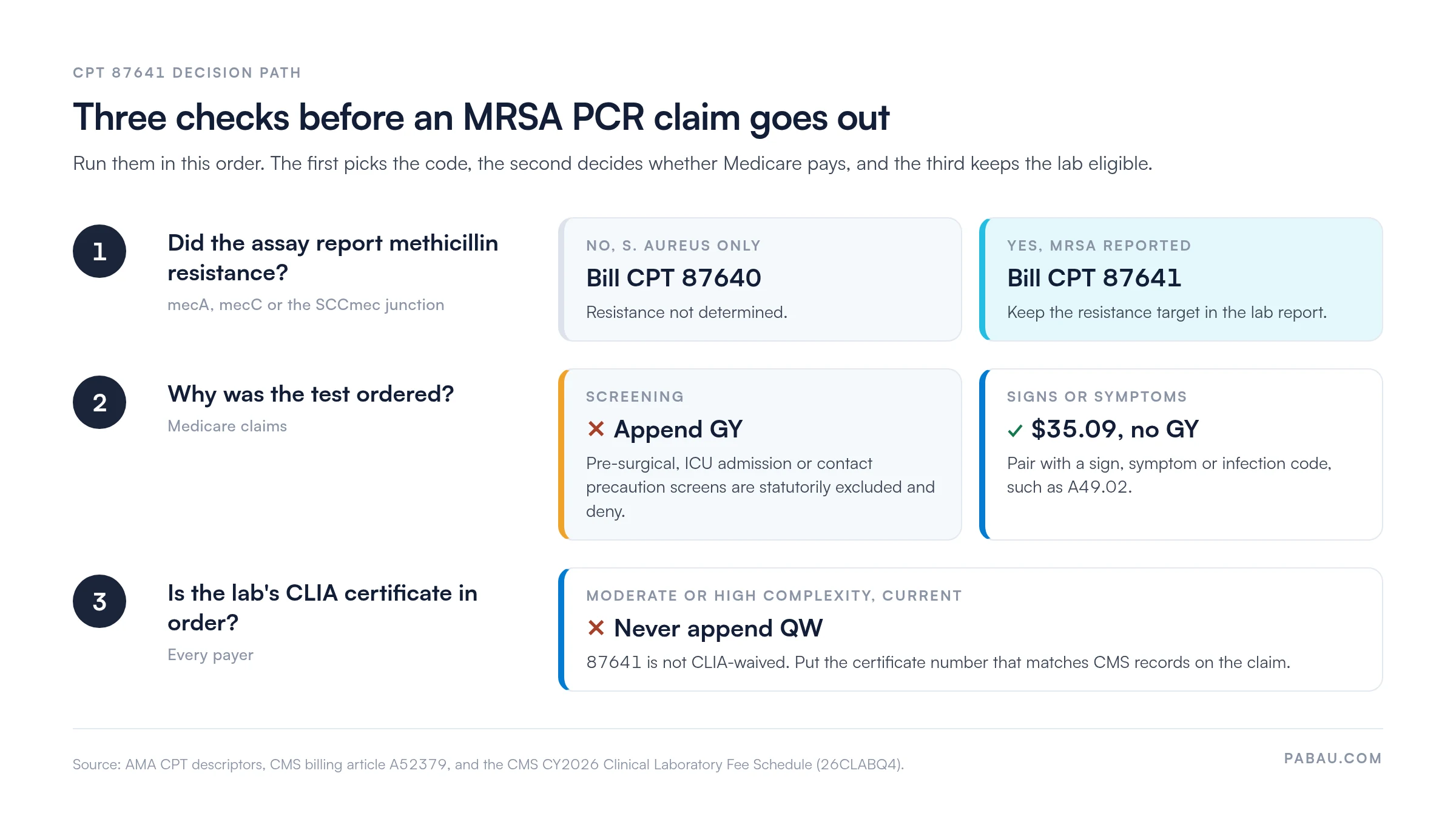
Both codes use amplified probe technique (PCR or NAAT), so amplification never separates them. The difference is what the assay detects and reports. CPT 87640 covers detection of Staphylococcus aureus, with methicillin resistance not determined. CPT 87641 covers methicillin-resistant S. aureus, so the assay must specifically detect and report resistance.
Assays usually show resistance through a target such as the mecA or mecC gene, or the SCCmec junction. No CPT code exists for non-amplified (direct probe) S. aureus or MRSA detection.
Billing 87641 for an assay that only identifies S. aureus misrepresents the service and invites an audit. Billing 87640 for an assay that reports MRSA under-reports the test the lab performed.
The practical test: read the assay’s package insert or the result line in the LIS. If the assay detects a resistance target such as mecA, mecC, or the SCCmec junction and reports MRSA, bill 87641. If it identifies S. aureus without reporting methicillin resistance, bill 87640.
The words “PCR” or “NAAT” in the assay name don’t settle it, because both codes cover amplified tests.
Several codes appear on the same claim as 87641 depending on the testing context. Knowing which pairs need a modifier, and which create a bundling problem, keeps those claims from cycling back as denials.
The superbill documentation for MRSA testing encounters should capture the ordering provider, collection site, collection date, and each analyte tested separately. When 87641 and 87635 appear on the same claim, current NCCI edits allow the combination. Edits change quarterly, so confirm the edit table for the active quarter before billing.
The ICD-10 pairing is what establishes medical necessity. For Medicare, the diagnosis has to describe a suspected or confirmed infection, because a screening or carrier diagnosis is denied. These are the codes most often reported with 87641, with the claim context for each:
Two patterns trigger denials or payer scrutiny. One is a screening code such as Z22.322 or Z13.88 on a Medicare claim, which denies whatever the facility’s protocol says. The other is a vague code like R68.89 (other general symptoms) without a more specific primary.
When in doubt, use the most specific site and etiology code available and document the clinical rationale in the chart note.
Before submitting a Medicare claim, check why the test was ordered. A pre-surgical, ICU admission, or contact precaution screen is statutorily excluded, so it takes modifier GY and will deny. A test for a patient with signs or symptoms of infection goes out without GY, paired with the matching sign, symptom, or infection code.
Medicare pays CPT code 87641 under the Clinical Laboratory Fee Schedule only when the test is a medically necessary diagnostic service.
Screening falls outside Part B, because Section 1862(a)(1)(A) of the Social Security Act limits payment to services that diagnose or treat an illness. No National or Local Coverage Determination covers MRSA screening.
CMS Billing and Coding Article A52379, published by National Government Services (NGS), applies that rule to 87641 directly. It states that 87641 billed for screening is not payable under Part B and will be denied. NGS covers states including New York, Illinois, and New England, but the statutory exclusion applies in every MAC jurisdiction.
Meeting medical billing compliance requirements for this code comes down to four points:
The decision path below puts the code choice, the reason for the order, and the CLIA check in the sequence a biller runs them.
Prior authorization is not routinely required under Medicare for 87641, but commercial payers frequently impose it for molecular diagnostic testing. Commercial screening policies also vary, so check the payer’s policy before testing when the order is a screen rather than a diagnostic workup.
CPT code 87641 appears on the Medicare Clinical Laboratory Fee Schedule, not the Physician Fee Schedule. The 2026 national Medicare rate for 87641 is $35.09, according to the CMS CY2026 CLFS public-use file (26CLABQ4, effective January 1, 2026). That matches the 2026 rate for CPT 87640.
Since 2018, the CLFS has paid one national rate per code, so the figure doesn’t vary by MAC locality. Medicare pays it only on a diagnostic claim, never on a screening claim billed with GY.
Commercial payer rates vary significantly by contract. Some payers reimburse molecular diagnostic codes at a multiple of the Medicare rate; others apply a fee schedule that was last updated years ago.
Never treat a single published commercial rate as authoritative in contract negotiations. Pull your contracted rate from the payer portal or the explanation of benefits (EOB).
Most 87641 claims submit without a modifier. Three modifiers come into play in specific scenarios:
The most common modifier error is applying QW to 87641 for a rapid MRSA test the clinician sees as “point-of-care.” In fact, the test ran on an FDA-cleared moderate-complexity platform. The platform being rapid and bedside does not make the test CLIA-waived.
Denials for 87641 cluster around five root causes. Each has a distinct corrective action and, where applicable, an appeal path. The payer reports most of them as a claim adjustment reason code (CARC) on the remittance. Our guide to medical billing denial codes covers the CARCs this table leaves out.
To audit 87641 claim performance, pull the prior 90 days of 87641 claims and categorize denials by CARC. If CARC 50 (non-covered service) accounts for more than 20% of denials, the ICD-10 pairing workflow needs tightening. Start by counting the screening orders billed without GY.
If CARC 150 (information doesn’t support the service) is the primary driver, the ordering provider note template needs updating to record signs and symptoms explicitly.
Submitting a clean claim from the start is always faster than the appeal cycle. That means the correct CLIA number, a diagnosis that supports a diagnostic test, and the right modifier where applicable.
Without integrated billing, a biller reads each remittance by hand, matches the CARC to a fix, and re-keys the corrected claim in a clearinghouse portal. On a high-volume molecular test like 87641, that work piles up fast.
Pabau, the practice and billing software we build, sends claims through its Claim.MD clearinghouse integration. It connects to thousands of US payers and supports CMS-1500 and 837P claim formats. A real-time eligibility check runs before submission, so inactive coverage and non-covered indications surface before they turn into denials.
After adjudication, electronic remittance advice (ERA/835 files) posts the allowed amount and any adjustments back automatically. Pabau’s claims management software then flags each CARC on the ERA and sends denied claims back for rework. Billing staff no longer review every remittance line by hand.
The Claim.MD integration also supports denial management workflows that categorize CARC codes, surface the claim details, and track appeal status. That helps most in labs running high volumes of molecular diagnostic tests.
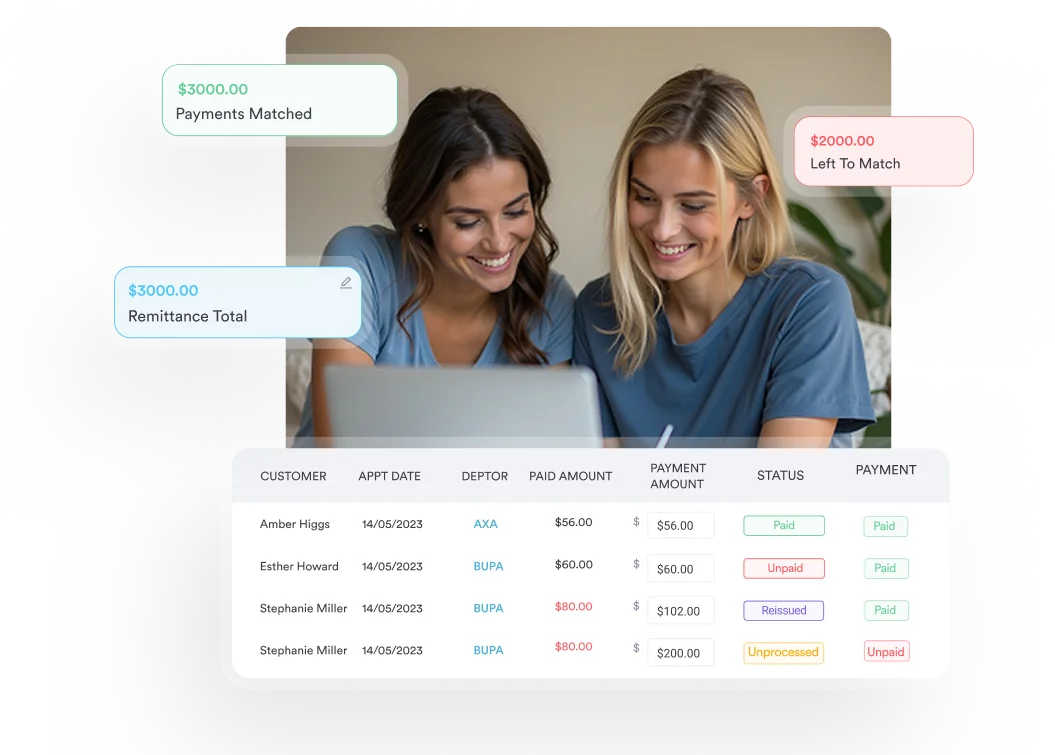

Pabau connects to Claim.MD to support 837P submission, real-time eligibility checks, and ERA posting for molecular diagnostic codes including CPT 87641. See how it works for your practice.

CPT code 87641 is rarely denied because of its descriptor. Claims fail when the assay result, the diagnosis, and the reason for the order don’t agree, so the check belongs at the point of order. Confirm the assay reported methicillin resistance before choosing 87641 over 87640.
For Medicare, pair the code with a sign, symptom, or infection code, and send every screening order out with GY. Keep the lab’s CLIA certificate current on each claim. With those three checks in place, the denials left over are the ones worth appealing.
If your billing team still matches CARC codes to fixes by hand, Pabau can take submission and ERA posting off their plate. Book a demo to see how it handles molecular lab claims like 87641.

Need to understand how clearinghouse connections work? Medical claims clearinghouse guide explains how 837P claims move from practice to payer and back.
Want to verify your lab’s billing before claims go out? Insurance eligibility verification covers how real-time eligibility checks flag inactive coverage before submission.
Billing Medicare for lab work? Medicare billing for practices explains the claiming channels and compliance rules behind every Part B claim.
Testing for another organism alongside MRSA? CPT code 87798 covers amplified detection of organisms that have no specific code.
CPT code 87641 covers amplified probe detection (PCR or NAAT) of methicillin-resistant Staphylococcus aureus (MRSA), where the assay reports methicillin resistance. It does not cover S. aureus detection without a resistance result (87640), culture-based testing, or antigen assays.
The 2026 national Medicare rate for CPT 87641 is $35.09 on the Clinical Laboratory Fee Schedule, the same as CPT 87640. The CLFS pays one national rate, so it does not vary by MAC jurisdiction. Commercial payer rates vary by contract and are not published centrally.
For Medicare, pair 87641 with a code for a suspected or confirmed infection, such as A49.02 (MRSA infection, unspecified site) or a site-specific code. B95.62 is used as a secondary code when MRSA causes a named infection classified elsewhere. Z22.322 (carrier of MRSA) signals screening, which Medicare denies.
Both codes use an amplified probe technique such as PCR or NAAT. CPT 87640 detects Staphylococcus aureus without determining methicillin resistance. CPT 87641 detects MRSA and reports resistance, typically through mecA, mecC, or the SCCmec junction. The assay’s reported result, not the amplification method, decides which code applies.
No. Medicare does not cover CPT 87641 for MRSA screening, including pre-surgical, ICU admission, and contact precaution screens. Screening is excluded by Section 1862(a)(1)(A) of the Social Security Act, and no NCD or LCD covers it. NGS billing article A52379 says these claims will be denied and should carry modifier GY. Medicare pays 87641 only as a diagnostic test for a patient with signs or symptoms of infection.
Modifier 59 or XU applies when 87641 is billed with a related nucleic acid code on the same date of service for a distinct test. Modifier 91 applies for a repeat test on the same date. The QW modifier does not apply, because 87641 is not CLIA-waived.
The most common denial reasons are a non-covered ICD-10 pairing (CARC 50) and missing medical necessity documentation (CARC 150). Bundling with a panel code (CARC 97) and an invalid or mismatched CLIA certificate number (CARC B7) follow close behind.
Yes, 87641 and 87635 can be billed together when both tests are ordered independently on the same date. Check current NCCI edits for the active quarter, since modifier 59 or XU may be required depending on the edit status.