

HCPCS Code Q4185: Cellesta flowable amnion billing guide
HCPCS Code Q4185: definition and official descriptor HCPCS Code Q4185 is the Lev...

Last Updated: Nov 20, 2026
87511 is the CPT code for infectious agent detection by nucleic acid (DNA or RNA); Gardnerella vaginalis, amplified probe technique. It applies when the lab detects G. vaginalis with a nucleic acid amplification test (NAAT), such as PCR or TMA.
Its sibling code 87510 covers the same organism by non-amplified probe. The methodology statement on the lab report decides which of the two codes goes on the claim.
Let Pabau's smart automation suggest the right codes, reduce claim denials, and keep your practice compliant—effortlessly.
Automate repetitive tasks and focus on what matters most—your patients.
Reduce coding errors and ensure compliance with the latest regulations.
Clean claims, fewer denials, and faster reimbursements.
Powerful insights and reporting to help your practice thrive.
HIPAA compliant SOC 2 certified GDPR-compliant Trusted by 4,000+ clinics worldwide

CPT 87511 covers detection of Gardnerella vaginalis DNA or RNA by an amplified method such as NAAT or PCR, not by non-amplified probe or culture.
Its sibling code 87510 covers the same organism by non-amplified probe, and billing both for one specimen triggers an NCCI edit.
N76.0 and N76.1 are the main ICD-10 pairings, while some MAC policies reject Z11.3 screening as the only diagnosis.
Each organism on a vaginal pathogen panel goes on its own claim line, such as 87481 for Candida and 87661 for Trichomonas.
Pabau, a practice management platform, checks eligibility and sends 837P claims through Claim.MD, so coverage problems show up before the swab is collected.
CPT Code 87511 describes infectious agent detection by nucleic acid (DNA or RNA) for Gardnerella vaginalis, using an amplified probe technique. The CPT Editorial Panel maintains the AMA’s CPT code set, which files 87511 among its organism-specific nucleic acid detection codes. Within that family, the amplification method is the main selection criterion.
The table below sets out how the code is built.
CPT 87511 covers only the organism-detection step. It does not capture a full bacterial vaginosis (BV) diagnosis, specimen collection or the physician’s interpretation. Specimen collection is billed separately where it applies.
Each analyte on a multi-organism vaginal panel goes on its own line under its own CPT code. Sexual health panels often combine 87511 with Candida and Trichomonas codes, and each line needs its own medical necessity documentation.
CPT 87511 covers detection of Gardnerella vaginalis DNA or RNA by an amplified nucleic acid method only. The test must amplify the nucleic acid before detection. Without amplification, the code is 87510.
The amplified/non-amplified split is the most consequential distinction in this code family. Billing 87511 when the lab report confirms a hybridization-only method is overcoding, and it exposes the practice to audit liability. Check the lab’s methodology statement before you assign the code.
CPT 87511 follows a fixed path from swab to result. Each step leaves a record that the chart must reflect.
The chart note must connect the clinical presentation to the test order. A note documenting abnormal vaginal discharge, odor or a pH abnormality justifies ordering an amplified NAAT. If the note says only “BV workup” with no clinical indicators, payer auditors have grounds to deny on medical necessity.
Most miscoding in this family comes from confusing amplified and non-amplified methods, or from billing the wrong organism code. The table below sets out the selection logic.
Bundling rule: National Correct Coding Initiative (NCCI) edits prohibit billing CPT 87511 and CPT 87510 together for the same specimen. The two codes describe different methods for the same organism, so billing both implies the specimen was tested twice. If the payer processes both, it will pay only the lower-valued code.
Check the current tables on the CMS NCCI edits page before submitting. The diagram below maps each lab method to the code it takes.
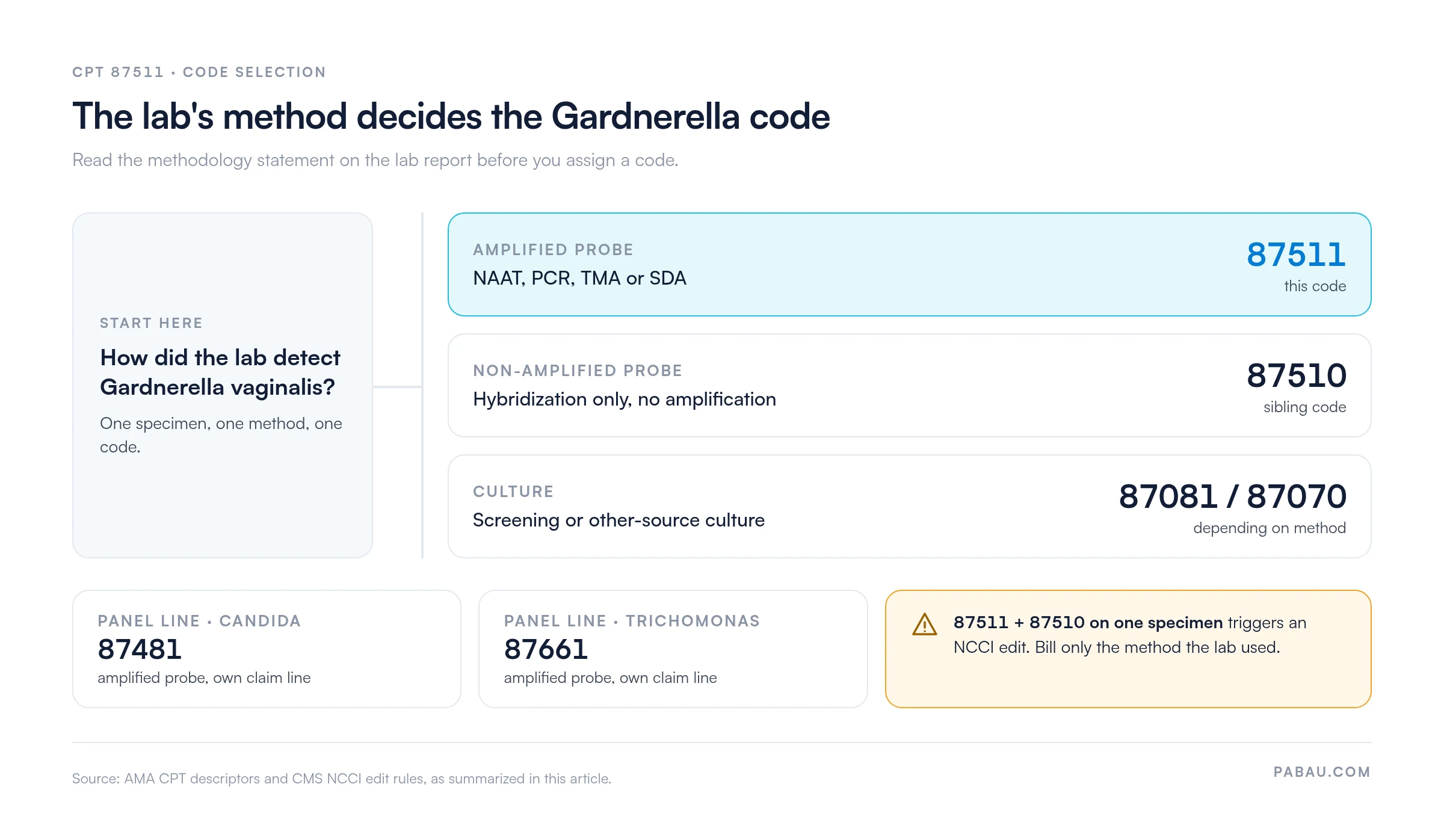
Check the laboratory report’s methodology section before assigning 87510 or 87511. Lab reports from NAAT platforms (Hologic Aptima, BD MAX, Roche cobas) confirm amplified probe method. Reports from BD Affirm VPIII typically confirm non-amplified hybridization. When the method is ambiguous, call the reference lab before billing.
Pairing CPT Code 87511 with the right ICD-10 code is what establishes medical necessity for the payer. Acute vaginitis, coded N76.0, is the pairing payers accept most widely. A code outside the payer’s accepted list is one of the top denial triggers for this CPT.
Confirm accepted pairings against your MAC’s Local Coverage Determination (LCD) for molecular diagnostic testing before submitting. The CMS Medicare Coverage Database lets you search each MAC’s LCDs and billing articles by CPT code.
CPT Code 87511 is reimbursed under the Medicare Clinical Laboratory Fee Schedule (CLFS), not the Physician Fee Schedule. CMS administers the CLFS and updates it every January.
The national CLFS rate for 87511 has historically sat between about $14 and $20, and the exact figure changes with each annual update. Don’t rely on a static figure in any reference article, this one included. Check the current amount on the CMS Clinical Laboratory Fee Schedule page before you submit.
Coverage for CPT Code 87511 varies by payer, jurisdiction and clinical context. Medicare coverage is governed by MAC Local Coverage Determinations (LCDs), which define when molecular diagnostic tests are covered.
Reviewing your medical billing compliance protocols before ordering molecular panels helps the practice document the clinical indication clearly. That is the most effective way to prevent coverage denials on 87511.
Medical necessity for CPT Code 87511 depends on a chart note that gives a clinical reason for ordering an amplified NAAT over a cheaper alternative. Payers audit molecular diagnostic claims, and a vague chart note is the fastest route to a denial or a recoupment demand.
The chart note behind a 87511 claim should include these elements.
Most CPT Code 87511 denials fall into five categories, each with its own appeal approach. Effective denial management in healthcare starts with reading the denial reason code correctly before you draft an appeal.
When you appeal, send these four items together.
The guide to medical billing denial codes maps each Claim Adjustment Reason Code (CARC) on the electronic remittance advice (ERA) to an appeal type. Tracking denials by code and payer then shows which documentation problems keep coming back.
CPT Code 87511 is most often billed as one line on a multi-analyte vaginal pathogen panel. The other lines usually cover Candida with 87481 and Trichomonas vaginalis with 87661. No single bundled CPT code exists for a standard three-analyte vaginal panel, so each analyte is billed separately.
Candida also has a direct probe code, 87480, so the same method check applies to that line.
Getting panel claims through as clean claims on the first pass takes accurate code selection, complete documentation and confirmed coverage for each analyte. Practices that run these panels often benefit from a standard order set. It maps each analyte to its CPT code and carries a documentation checklist for the ordering provider.
Run a quarterly audit of your 87511, 87481, and 87661 claims together. Filter by denial reason code. NCCI bundling edits that cluster on specific dates usually point to one requisition. It pre-populates both 87511 and 87510 when a provider orders the panel. Update the order set to remove the non-amplified code if the lab only runs amplified methods.
Lab claims like 87511 tend to break at three points: the eligibility check, the claim line and the remittance. Pabau, a practice management platform with built-in insurance billing, keeps all three on the patient record.
Before the swab is collected, the front desk runs an eligibility check through Claim.MD, Pabau’s US clearinghouse. Pabau’s claims management software then sends the 837P claim, with each analyte on its own line. ERA remittances come back against the same claim, so a denied 87511 line sits next to the record it came from.
Practices that switch on labs can also order Quest tests from the patient record, and the results import automatically. The order, the result and the claim then sit in one place when a payer asks for documentation.

Pabau connects with Claim.MD to handle electronic claim submission, real-time eligibility checks, and ERA processing for CPT codes including 87511. See how practices reduce denials and speed up reimbursement.

Get the method right and the rest of an 87511 claim follows. Read the lab’s methodology statement before you code, because no ICD-10 pairing rescues a claim built on the wrong method.
The trade-off is effort up front. Building the method check and per-analyte documentation into your order set takes an afternoon. Fixing them after the denials arrive takes an appeal for every claim they touched.
Book a demo to see how Pabau keeps eligibility, panel claims and remittances on one record for your lab billing team.

Coding a noninflammatory vaginal disorder instead? ICD-10 code N89.8 covers other specified noninflammatory disorders of the vagina, a pairing some payers accept for 87511.
Seeing recurring denials on lab claims? Denial management in healthcare covers CARC-based workflows for finding and resolving claim rejections systematically.
Want to read denial codes off a lab remittance? Electronic remittance advice explains how ERA files carry denial reason codes back from payers for 87511 and similar lab codes.
CPT Code 87511 covers detection of Gardnerella vaginalis DNA or RNA by an amplified probe technique. It applies when a NAAT or PCR-based method tests a clinical specimen, typically a vaginal swab. It does not cover non-amplified probe testing (use 87510), culture methods or the clinical bacterial vaginosis diagnosis itself.
CPT 87510 covers Gardnerella vaginalis detection by a non-amplified probe, using hybridization only. CPT 87511 covers detection by an amplified technique such as PCR or NAAT. The lab’s method decides which code applies. Billing both for the same specimen triggers an NCCI edit, so submit one code per specimen per organism.
The most widely accepted pairings are N76.0 (acute vaginitis) and N76.1 (subacute and chronic vaginitis). Some payers accept N89.8 (other specified noninflammatory disorders of vagina). Z11.3 (encounter for screening for infections with a predominantly sexual mode of transmission) may fit a screening visit. Some MAC LCDs restrict 87511 to diagnostic use, so check your MAC’s current LCD first.
Yes. Medicare pays for CPT Code 87511 under the Clinical Laboratory Fee Schedule (CLFS). The claim needs documented medical necessity and must meet the MAC’s LCD criteria. MolDX jurisdictions (Palmetto GBA, Noridian) may add requirements such as test registration. A pure screening claim, with Z11.3 as the only diagnosis, may not be covered under some LCDs.





