CPT code 59120: Surgical treatment of ectopic pregnancy
CPT code 59120: Definition and official AMA descriptor CPT code 59120 is defined...

Last Updated: Nov 26, 2026
Billable Code
87505 is the CPT code for infectious agent detection by nucleic acid (DNA or RNA) on a gastrointestinal pathogen panel. It covers multiplex amplified probe testing for multiple types or subtypes, 3-5 targets, including multiplex reverse transcription when performed.
It applies to multiplex PCR panels for acute infectious diarrhea. Larger panels take 87506 (6-11 targets) or 87507 (12-25 targets). A test of 1 or 2 targets is not 87505. It is reported with individual-organism codes. Count the targets on the lab report before the claim goes out.
Let Pabau's smart automation suggest the right codes, reduce claim denials, and keep your practice compliant—effortlessly.
Automate repetitive tasks and focus on what matters most—your patients.
Reduce coding errors and ensure compliance with the latest regulations.
Clean claims, fewer denials, and faster reimbursements.
Powerful insights and reporting to help your practice thrive.
HIPAA compliant SOC 2 certified GDPR-compliant Trusted by 4,000+ clinics worldwide

CPT code 87505 covers multiplex nucleic acid detection of GI pathogens in stool for panels testing 3-5 targets. Panels testing 6-11 targets use 87506 and 12-25 targets use 87507.
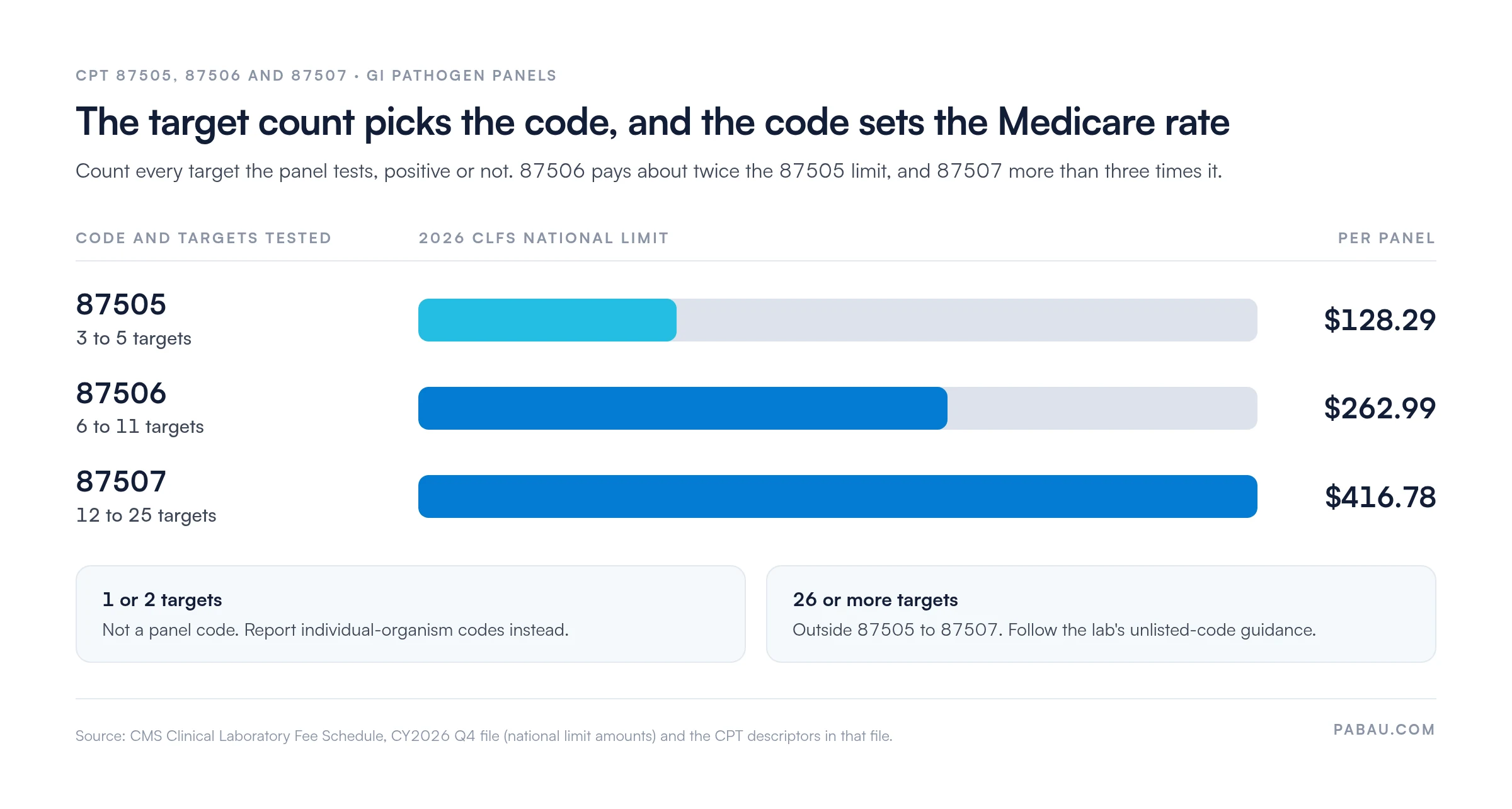
The 2026 Medicare CLFS national limit for 87505 is $128.29, against $262.99 for 87506 and $416.78 for 87507.
Medicare allows one GI panel code per patient per day, with every target that day summed. Novitas billing article A56642 lists R19.7 as the diagnosis supporting 87505.
Most PCR-based GI pathogen panels need a CLIA moderate- or high-complexity certificate. Modifier -QW does not apply to these molecular panels.
Pabau, a practice management platform, routes electronic claims to Medicare and thousands of US payers through Claim.MD, with eligibility checks and ERA remittances.
CPT code 87505 reports a multiplex nucleic acid test for gastrointestinal pathogens in a stool specimen, when the panel tests 3 to 5 targets. CMS’s 2026 Clinical Laboratory Fee Schedule lists it under the official descriptor ending “multiple types or subtypes, 3-5 targets.” The American Medical Association (AMA), which maintains the CPT code set, makes 87505 the base tier of a three-code family defined by target count.
The defining characteristic is the 3-5 target threshold. A panel of 6 or more targets is never 87505, whichever pathogens it includes. Panels of 6-11 targets take 87506, and panels of 12-25 targets take 87507.
CPT 87505 covers molecular detection of gastrointestinal pathogens from a single stool specimen, on a panel of 3 to 5 targets. Because target count drives code selection, any mix of bacteria, viruses or parasites totaling 3-5 targets qualifies. Tests of 1 or 2 targets are not panels, and they are reported with individual-organism codes. A microscopic parasite exam is a separate test, and a stool concentration done alone for one bills as CPT 87015. A bacterial stool culture for Salmonella and Shigella is a separate test too, reported with CPT code 87045.
Common pathogens a 3-5 target panel might include:
Clinicians typically order 87505 for:
The clinical indication must appear in the medical record and map to an accepted ICD-10-CM diagnosis code. Payers validate medical necessity at the diagnosis level.
Target count determines which tier to bill. Billing 87505 when the lab runs a 12-target panel is downcoding. Billing 87507 for a 4-target panel is upcoding, and both create audit exposure.
Count the analytes tested, not the analytes that returned a positive result. A panel that runs 10 targets but detects only 2 pathogens is still a 10-target panel billed as 87506. A panel of 26 or more targets is not described by 87507 either. Follow the lab’s unlisted-code guidance for it rather than reporting 87505, 87506 or 87507.
Every 87505 claim needs at least one ICD-10-CM diagnosis code that establishes medical necessity. Payers check the diagnosis against their coverage policy, so a mismatched code is a common reason these claims are first denied. The ICD-10-CM library for coders gives each code’s full descriptor before you pair it.
Coverage lists differ sharply by contractor. Under Novitas’s billing article A56642, R19.7 is the only diagnosis listed as supporting 87505 and 87506. Code 87507 needs R19.7 plus a secondary immunosuppression code, such as B20 or a code from D80-D84. Other MACs and commercial payers publish their own lists, so check whether A09 or a pathogen-specific code is accepted before you rely on it.
Coverage lists are updated periodically. The CrossCoder CPT-to-ICD-10 crosswalk tool can help identify payer-accepted diagnosis pairings for this code family.
CPT code 87505 is priced on the Medicare Clinical Laboratory Fee Schedule (CLFS), not the Physician Fee Schedule. CMS updates the CLFS every calendar year, so check the current file before you set charges.
The 2026 CLFS national limit for 87505 is $128.29. For 87506 it is $262.99, and for 87507 it is $416.78, so a tier error moves the payment a long way. The CLFS sets one national limit per code, so the Medicare figure does not change by locality. Commercial plans vary, with some paying at or above Medicare and others capping payment at the Medicare rate.
Pabau routes electronic claims to Medicare and thousands of US payers through Claim.MD, with eligibility checks and ERA remittances. This Claim.MD clearinghouse guide shows where in the submission path a denial originates.
Verify CPT 87505 rates each January when CLFS updates take effect. Pull the current-year CLFS file from CMS, filter for code 87505, and update your charge master before submitting Q1 claims. Missing the annual update is a common source of under-collection on lab codes.
Medical necessity for CPT 87505 requires documented clinical indicators in the chart. Most MAC LCDs require that at least one of the following conditions is present:
Novitas’s billing article A56642, which applies LCD L38229, adds four Medicare billing rules for GI panels:
Prior authorization requirements vary by payer and geography. Medicare does not currently require PA for 87505 under most MACs, but commercial plans frequently do, particularly in outpatient and urgent care settings. Before ordering a GI pathogen panel for a commercially insured patient, check the payer’s portal or call its authorization line. Submitting without required PA typically results in a CO-197 denial that cannot be billed to the patient.
MAC LCDs are the governing policy documents for Medicare coverage. The major MACs covering CPT 87505 include Noridian, Novitas, CGS, Palmetto GBA, and WPS. Each publishes its LCD on the CMS LCD database, and covered indications may differ by jurisdiction.
Incorrect modifier use is a consistent audit trigger for laboratory claims. The table below covers modifiers relevant to billing this code.
Molecular GI pathogen panels run by PCR are classified as moderate-complexity or high-complexity tests under the Clinical Laboratory Improvement Amendments (CLIA), administered by CMS. This classification matters because it determines who can legally perform the test and bill for it.
Physician offices that send specimens to a reference laboratory are not performing the test. The reference lab’s CLIA certificate requirements therefore do not fall on them. The claim must show whether you are billing the reference lab’s service, with modifier -90, or a test run in-house under your own CLIA certificate. Keep a copy of the CLIA certificate and the lab’s complexity classification on file for payer audits.
Molecular GI panel claims sit where medical necessity review, CLIA compliance and same-day panel limits meet, so denials come from several directions. The table below maps the most common triggers to corrective actions.
A structured denial management workflow categorizes each CO/PR code and routes it to the right staff member. That shortens the lag between denial receipt and appeal submission.
The chart must support both the order and the medical necessity decision. Auditors look for these elements on molecular GI panel claims:
Meeting clean claim requirements from the outset means the lab report, diagnosis code, and ordering documentation agree before the claim is transmitted. A structured superbill that captures the number of panel targets at the point of order removes a common downstream coding error.
Add a mandatory ‘number of targets’ field to your lab order template for GI pathogen panels. When the coder sees the order, the target count is already captured. They do not need the lab report to decide between 87505, 87506, and 87507. This one workflow change prevents a common tier-selection error.
Medicare pays one GI panel code per patient per day, so 87505 is not billed alongside 87506 or 87507 for the same date. Novitas’s A56642 states the rule directly and sums every target tested that day. Applying modifier -59 to get past this edit is not appropriate when the codes describe the same testing.
What this means in practice: If your lab runs a 15-target GI panel (87507), you cannot also bill 87505 for a “subset” of those targets. The panel code covers the whole panel, and A56642 bars billing its components as individual codes. NCCI edits update quarterly. For current edit pairs, check the AAPC Codify CPT lookup, which incorporates current-quarter edit tables.
Billing staff who know how NCCI edits work can tell a legitimate -59 scenario from an attempt to get around a bundling rule. When in doubt, review the NCCI Policy Manual for Medicare Services, which CMS updates annually.
In most practices, the panel’s target count lives on the lab report. The biller reads it days later and picks between 87505, 87506 and 87507. Same-day panels, repeat tests and the R19.7 rule all add checks done by hand.
Pabau’s claims software for billers keeps the patient record, the diagnosis and the claim in one place. Claims go out electronically through Claim.MD to Medicare and thousands of US payers. Eligibility checks and ERA remittances come back to the same record.
Your biller checks the tier and the diagnosis before the claim leaves, not after a denial arrives. The remittances then show which 87505 lines paid and which need an appeal.

Pabau sends your lab claims through Claim.MD to Medicare and thousands of US payers, with eligibility checks and ERA remittances. See how practices billing molecular diagnostics keep GI panel claims moving.

Bill 87505 only when the lab report lists 3 to 5 targets. Sum every panel run for the patient that day before you choose the code. Under Novitas’s rules, pair it with R19.7 and hold any repeat inside seven days.
The trade-off is a minute of counting at the order stage against a denied or downcoded claim worth $128.29 or more at Medicare rates. A target-count field on the order form makes that check routine.
Book a demo to see how Pabau sends GI panel claims to Medicare and US payers with eligibility checks built in.

Need to understand how claims move through a clearinghouse? Medical claims clearinghouse guide explains the submission path from practice to payer and where GI panel claims commonly stall.
Seeing recurring CO-97 denials on lab claims? Denial codes in medical billing breaks down the most common CARC codes and the appeal steps for each.
Want to verify eligibility before ordering a GI panel? Insurance eligibility verification covers how to check payer coverage and PA requirements before specimen collection.
Billing CPT codes through an 837P claim file? 837 file guide explains the electronic claim format used for professional claims including laboratory services.
CPT code 87505 covers molecular (PCR or similar) detection of gastrointestinal pathogens in a stool specimen when the panel tests 3 to 5 targets. Any mix of bacterial, viral, and parasitic targets within that range qualifies. Medicare allows one panel code per patient per day.
The three codes differ only by the number of targets tested. Code 87505 covers 3-5 targets, 87506 covers 6-11 targets, and 87507 covers 12-25 targets. Code selection follows the total number of analytes on the lab report, not the number that returned positive results.
Under Novitas billing article A56642, R19.7 (diarrhea, unspecified) is the diagnosis that supports 87505. Other payers may accept codes such as A09, A04.71 or A04.72 (C. difficile enterocolitis), A08.0 (rotaviral enteritis), and A08.11 (Norwalk agent gastroenteropathy). Coverage lists vary by MAC, so check your contractor’s current policy.
The most common denial reasons are a non-covered diagnosis code (CO-50), missing medical necessity documentation, and missing prior authorization from a commercial payer (CO-197). Billing two panel codes for the same patient on the same date also triggers denials. So does modifier -QW on a non-waived molecular test.
Most PCR-based GI pathogen panels need a CLIA moderate- or high-complexity certificate at the performing laboratory. Standard molecular GI panels are not CLIA-waived, so modifier -QW applies only when the specific test kit holds an FDA CLIA waiver. A physician office billing a reference lab’s service uses modifier -90.
No. Medicare allows one GI panel code per patient per day, with the targets from every panel that day summed into one code. Only the tier matching the total target count is billed. Modifier -59 does not override this when the codes describe the same testing.