CCSD code XR940: Radiology billing guide for UK private practice
CCSD code XR940 is a UK private healthcare radiology procedure code used to bill...

Last Updated: Nov 26, 2026
87045 is the CPT code for culture, bacterial; stool, aerobic, with isolation and preliminary examination (eg, KIA, LIA), Salmonella and Shigella species. It covers the Salmonella and Shigella screen on an aerobic stool culture.
Each additional pathogen the lab cultures, such as Campylobacter, Yersinia, Vibrio or STEC, is reported with 87046. That is a separate code, not an add-on, billed once per plate. Medicare pays 87045 under the Clinical Laboratory Fee Schedule.
Let Pabau's smart automation suggest the right codes, reduce claim denials, and keep your practice compliant—effortlessly.
Automate repetitive tasks and focus on what matters most—your patients.
Reduce coding errors and ensure compliance with the latest regulations.
Clean claims, fewer denials, and faster reimbursements.
Powerful insights and reporting to help your practice thrive.
HIPAA compliant SOC 2 certified GDPR-compliant Trusted by 4,000+ clinics worldwide

CPT code 87045 reports an aerobic stool culture for Salmonella and Shigella species, with isolation and preliminary examination such as KIA or LIA.
CPT 87046 is a separate code, not an add-on, reported once per plate for each additional pathogen such as Campylobacter, Yersinia, Vibrio or STEC.
Medicare pays 87045 under the Clinical Laboratory Fee Schedule only, so there is no physician fee schedule rate and no facility split.
Every 87045 claim needs a linked ICD-10-CM diagnosis and a lab holding a non-waived CLIA certificate.
A GI PCR panel (87505 to 87507) on the same date of service raises most bundling questions, so check NCCI edits first.
The American Medical Association defines CPT code 87045 as “Culture, bacterial; stool, aerobic, with isolation and preliminary examination (eg, KIA, LIA), Salmonella and Shigella species.” AAPC’s stool culture coding guidance gives the same descriptor and keeps the Salmonella and Shigella screen apart from the extra pathogen plates billed under 87046.
KIA (Kligler iron agar) and LIA (lysine iron agar) are the preliminary biochemical screens the descriptor names. They sort suspicious colonies before the lab confirms an organism. Anaerobic, fungal, viral and parasitic testing of the same specimen all sit outside 87045.
The descriptor holds three elements together. The specimen is stool, the method is aerobic bacteriology, and the lab isolates colonies and runs a preliminary examination for Salmonella and Shigella. Plating a specimen without that examination does not meet the descriptor.
The 87045 descriptor names two genera, and only those two. A routine enteric culture usually looks for more, so each additional pathogen the lab plates for is reported separately.
Covered by 87045:
Reported under 87046, one unit per plate for each additional pathogen:
Parasites such as Giardia and Cryptosporidium fall outside both codes. Ova and parasite exams use 87177, and antigen tests carry their own codes. Viruses such as norovirus and rotavirus use molecular or antigen codes, and anaerobic bacteria need anaerobic culture codes.
CPT 87046 reads “Culture, bacterial; stool, aerobic, additional pathogens, isolation and presumptive identification of isolates, each plate.” It is a separate code with its own descriptor, not a CPT add-on code. It carries no add-on symbol and is reported once for each plate the lab sets up for an extra pathogen.
Take a routine culture set up on Hektoen enteric and MacConkey agar. Those plates screen for Salmonella and Shigella, so they report as one unit of 87045. If the lab adds a Campylobacter plate, report one unit of 87046 for it.
If it also adds sorbitol-MacConkey for STEC, report a second unit of 87046. Some payers want modifier 59 or 91 on the second unit, so check the payer policy. Never report 87046 for the media that make up the Salmonella and Shigella screen.
Definitive identification and serotyping are separate steps with their own codes, such as 87077 and 87147. Report them only when the lab performs them. The map below sets each plate and test against the code it bills under.
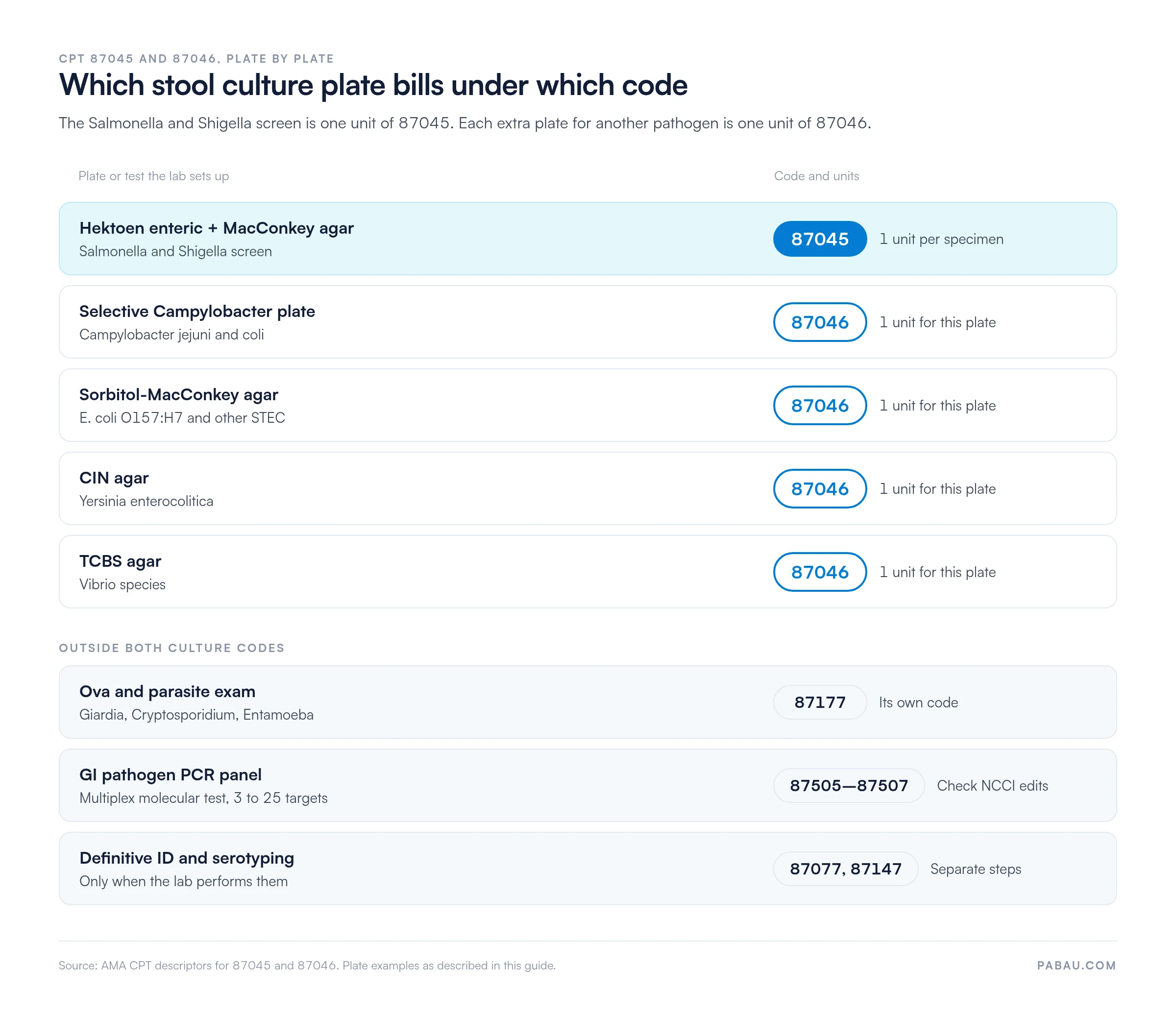
Several codes cover GI pathogen testing from stool. The wrong one produces a denial or an NCCI edit, most often when a GI PCR panel shares the date of service.
Many payers question a culture and a PCR panel on the same date as duplicative. Check the current National Correct Coding Initiative (NCCI) edit table on the CMS website before billing both. NCCI edits update quarterly, and so do the rules on which edits a modifier can bypass.
Medicare pays CPT 87045 under the Clinical Laboratory Fee Schedule (CLFS), not the Physician Fee Schedule. CMS sets one national limitation amount for each lab code, so the CLFS has no relative value units. It also has no facility or non-facility split.
Four factors decide what an 87045 line pays and how it fits your wider revenue cycle management.
The CLFS amount changes every year, so this guide quotes no dollar figure. Use the CMS CLFS file to confirm the current national limitation amount before you bill.
Download the CLFS file when CMS posts it for the January update, filter for 87045 and 87046, and update your charge-master before the new year. Set charges from your own costs and payer contracts, then let the CLFS decide what Medicare pays.
CPT 87045 is a non-waived test under the Clinical Laboratory Improvement Amendments (CLIA). Bacterial stool culture is not on the CLIA-waived test list. Only labs holding a certificate of compliance or a certificate of accreditation may perform and bill it.
Every CPT 87045 claim needs an ICD-10-CM diagnosis that establishes medical necessity. Use the CDC/NCHS ICD-10-CM web tool to confirm a code is active before billing. The codes below are commonly accepted, but confirm coverage against any local coverage determination your MAC publishes.
Most first-time orders pair with one of two codes. R19.7 fits diarrhea alone, before the provider names a cause, and A09 fits infectious gastroenteritis whose pathogen is not yet known.
Payers reviewing 87045 claims look for a clinical reason that links the stool culture to a documented symptom or exposure. Medical billing compliance starts with the chart note written when the test is ordered, not when it is billed.
The chart note supporting an 87045 order should document:
Three modifiers come up on CPT 87045 claims. Most claims need none of them, and the wrong one is a frequent cause of rejection.
Before you append 59 or XU to get past an NCCI edit, look up the edit pair and its modifier indicator. An indicator of 1 allows a modifier bypass when the services are genuinely distinct. An indicator of 0 does not, so the modifier only earns a second denial.
Most 87045 denials trace back to six causes. Knowing the root cause shortens the appeal timeline, which is the core of denial management in healthcare.
Keep our guide to medical billing denial codes beside your remittance data. It shows whether a denial is technical, fixed by resubmission, or clinical, which needs an appeal.
Most 87045 denials start before the claim is built. The NPI is missing, the diagnosis is unlinked, or a culture sits beside a PCR panel on the same date. Pabau, a practice management and billing platform, keeps the order, the codes and the claim on one patient record. Your billers can catch those errors while the claim is still a draft.
Your team records 87045, each 87046 unit and the linked diagnosis against the visit, so the claim matches the lab worksheet. Pabau’s claims management submits CMS-1500 and 837P claims through Claim.MD, our US clearinghouse partner, and runs eligibility checks before the visit.
Remittances come back into the same workflow with their denial reason codes attached. A billing team can correct a rejected 87045 claim the day it arrives instead of weeks later.

Pabau keeps the order, the CPT and ICD-10-CM codes and the claim on one patient record. Claims go out through Claim.MD, and remittances come back with their denial codes attached.

CPT 87045 is a narrow code. It pays for the Salmonella and Shigella screen on a stool culture. Every additional pathogen plate the lab sets up belongs on 87046, one unit per plate. Get that split right and most of the overbilling and underbilling risk on stool cultures disappears.
The rest comes down to the claim itself. It needs a supporting diagnosis and the right CLIA certificate, and an NCCI check whenever a PCR panel shares the date. Book a demo to see how Pabau keeps lab claims like these clean from order to remittance.

Need a framework for managing lab claim rejections? Denial management in healthcare covers the end-to-end appeal process for denied lab and procedure claims.
Want to understand what makes a lab claim pay first time? Clean claim submission outlines the data elements payers check before processing any lab code.
Looking for the broader billing compliance picture? Medical billing compliance covers HIPAA, payer rules, and documentation standards that apply across CPT lab codes.
Billing a GI PCR panel on the same date? CPT code 87507 explains how the 12-25 target panel is reported and where it overlaps with culture.
CPT code 87045 covers an aerobic stool culture for Salmonella and Shigella species, with isolation and preliminary examination such as KIA or LIA. Other enteric pathogens, such as Campylobacter, Yersinia, Vibrio or STEC, are reported with 87046, one unit per plate. The code does not cover parasitology (87177), viral testing, or GI PCR panels (87505-87507).
CPT 87045 reports the aerobic stool culture for Salmonella and Shigella. CPT 87046 is a separate code, not an add-on, for each additional pathogen the lab cultures, reported once per plate. Typical 87046 targets are Campylobacter, Yersinia, Vibrio and E. coli O157 or other STEC.
Commonly accepted diagnosis codes include A02.0 (Salmonella enteritis), A03.9 (Shigellosis, unspecified), A04.5 (Campylobacter enteritis), A04.3 (Enterohemorrhagic E. coli infection), A09 (infectious gastroenteritis) and R19.7 (Diarrhea, unspecified). Check payer policy and any MAC local coverage determination, because accepted diagnoses vary.
Yes. CPT 87045 is a non-waived test, so the lab needs a CLIA certificate of compliance or accreditation. Labs with only a Certificate of Waiver or a Provider-Performed Microscopy certificate cannot perform or bill it, and modifier QW does not apply.
Sometimes. Billing 87045 with 87505, 87506 or 87507 on the same date can hit an NCCI edit or a payer duplicate-testing policy. A modifier bypass works only when the edit carries a modifier indicator of 1 and both tests were clinically justified. Check the current NCCI table first, because edits update quarterly.