CPT Code 25210: Excision of a single carpal bone
CPT Code 25210: Official descriptor and quick-reference data CPT Code 25210 is a...

Last Updated: Nov 26, 2026
87015 is the CPT code for concentration (any type) of a specimen for infectious agents. It reports the lab step that enriches a sample, by sedimentation, flotation or centrifugation, before it is examined for parasites, mycobacteria or other organisms.
Concentration is a preparation step, so 87015 sits beside the exam code that follows it. A complete ova and parasite exam (87177) already includes concentration, so the two are not billed for the same specimen.
Let Pabau's smart automation suggest the right codes, reduce claim denials, and keep your practice compliant—effortlessly.
Automate repetitive tasks and focus on what matters most—your patients.
Reduce coding errors and ensure compliance with the latest regulations.
Clean claims, fewer denials, and faster reimbursements.
Powerful insights and reporting to help your practice thrive.
HIPAA compliant SOC 2 certified GDPR-compliant Trusted by 4,000+ clinics worldwide

CPT 87015 reports the concentration of a specimen for infectious agents, by any method, as a preparation step before the exam.
A complete ova and parasite exam (87177) already includes concentration, so 87015 is not added for the same stool specimen.
The code is billed most often with acid-fast smears and mycobacterial cultures, where concentration is a separate step.
The 2026 Medicare Clinical Laboratory Fee Schedule pays $6.68 for 87015, at one national rate.
Pabau, a practice management platform, sends lab claims through the Claim.MD clearinghouse and posts remittances against the patient record.
CPT Code 87015 reports the concentration of a specimen, by any method, so infectious agents are easier to find on the exam that follows. The official descriptor in CMS’s 2026 lab fee schedule reads Concentration (any type), for infectious agents.
The phrase “any type” means the method doesn’t change the code. Formalin-ethyl acetate (FEA) sedimentation and zinc sulfate flotation both qualify for stool. So does centrifuging a digested sputum sample before mycobacterial testing.
Older references still describe 87015 as an ova and parasite (O&P) code. The current descriptor covers any infectious agent. That matters, because O&P is where 87015 is billed least often on its own.
The code sits within the Microbiology subsection (87003-87999) of the Pathology and Laboratory chapter (80047-89398). It describes a lab technique, not a diagnosis or an exam result. That distinction decides which code covers which part of the workflow.
The scope of 87015 is narrow by design. It covers the physical concentration of the specimen only, and the exam that follows is always a separate code.
Included under 87015:
Not included, so bill separately or not at all:
The most consequential boundary is between 87015 and 87177. The 87177 descriptor reads “Ova and parasites, direct smears, concentration and identification,” so concentration is already part of it. Adding 87015 for the same stool specimen bills that step twice. Check current NCCI edits before the two codes share a date of service.
The documentation behind 87015 has to show the concentration as a distinct lab step. A passing mention inside another test’s report won’t support it.
The lab workflow that supports billing 87015 follows this sequence:
The written report is what payers look for in a records request. If it notes only “O&P pending” with no concentration step, the coder can’t support 87015 as its own line. Work with the lab director so the LIS template captures the concentration method, which also supports medical billing compliance.
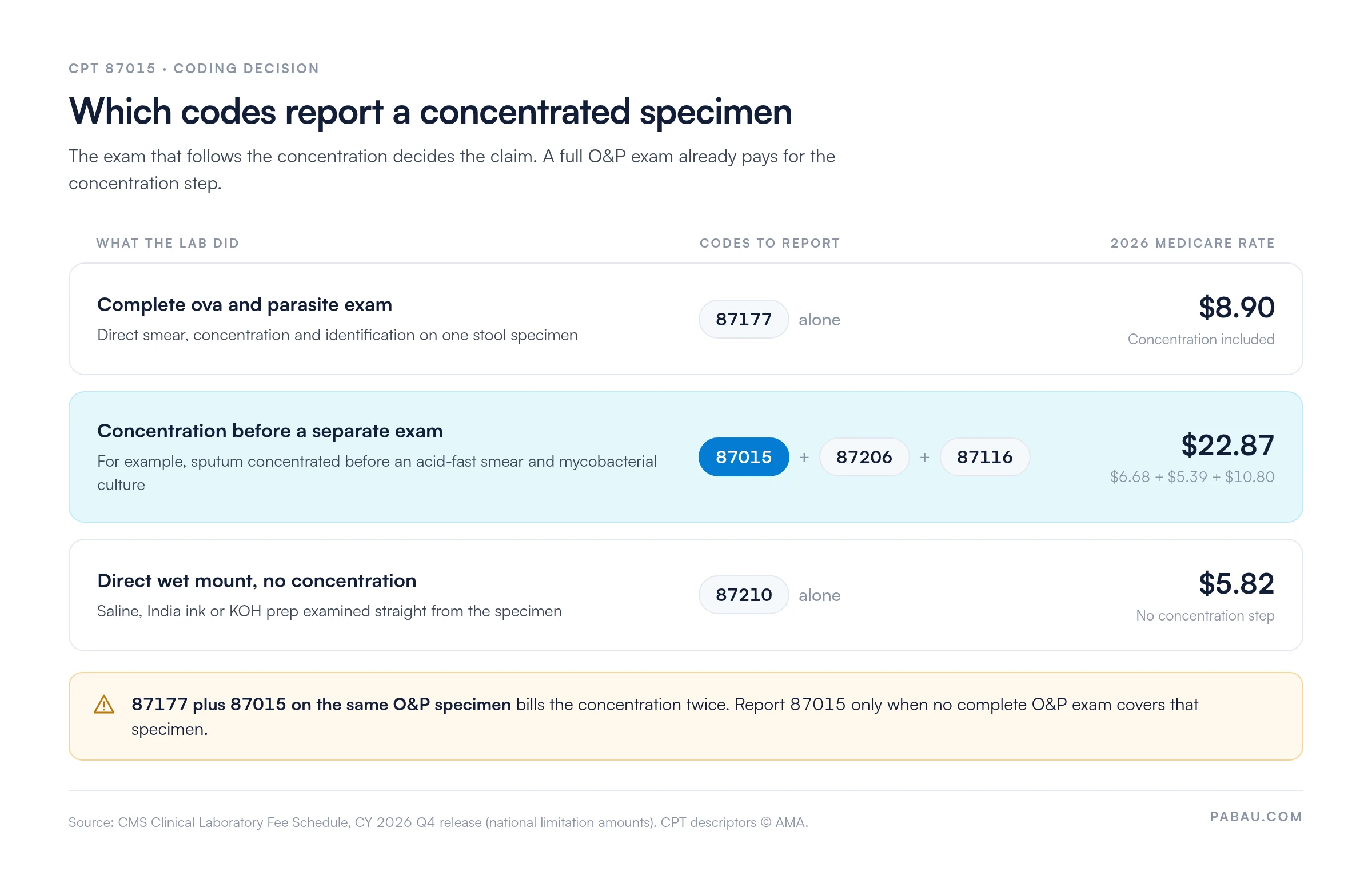
CPT 87015 and CPT 87177 describe different scopes of work on a concentrated specimen. Billing them correctly depends on knowing which exam the lab ran.
The practical rule is simple. If the lab ran a full O&P workup, bill 87177 alone. Reserve 87015 for a concentration that feeds a different exam.
The classic case is sputum concentrated before an acid-fast smear (87206) and a mycobacterial culture (87116). The Wisconsin State Laboratory of Hygiene lists 87015 with exactly those two codes on its AFB smear and culture test. A concentrated stool read only with a modified acid-fast stain for Cryptosporidium follows the same logic.
The chart below sets the three common scenarios side by side, with the 2026 Medicare rate for each combination.
CPT 87210 covers a wet mount for infectious agents examined straight from the primary source, such as a saline, India ink or KOH prep. There is no concentration step. It is faster but less sensitive, so it suits a quick look when a heavy parasite load is likely.
87015 and 87210 describe different procedures, because one concentrates the specimen and the other examines it directly. When both are performed on the same date, check the current NCCI procedure-to-procedure edits for the pair.
If an edit allows a modifier, -59 applies only when the record shows two distinct services, never as a routine way past the edit.
CPT 87015 rarely stands alone on a microbiology claim. The codes below appear as companion codes, comparison codes or bundled alternatives, and knowing their descriptors prevents both undercoding and unbundling.
Every 87015 claim needs at least one ICD-10-CM code that explains why the specimen was tested. Supporting codes fall into four groups. They cover confirmed or suspected infection, gastrointestinal or respiratory symptoms, exposure history and immunocompromised status.
The chart must support the ICD-10 code selected. Per CMS ICD-10 coding guidance and the applicable MAC local coverage determinations (LCDs), the documentation should include:
ICD-10 pairings that support medical necessity vary by MAC jurisdiction. R19.7 is accepted by some MACs and may trigger review by others that want a more specific diagnosis. Check your MAC’s LCD before submitting claims with symptom-only codes.
Medicare pays $6.68 for CPT 87015 in 2026, under the Clinical Laboratory Fee Schedule (CLFS). That is the national limitation amount in the CY 2026 Q4 release. CLFS rates are national, so no locality adjustment applies.
CMS updates the CLFS every quarter. Download the current file from the CMS CLFS files page before you change your chargemaster.
Key reimbursement context for CPT 87015:
Labs bill 87015 for Medicare beneficiaries on the CMS-1500 form or its 837P electronic equivalent. POS 81 (independent laboratory) is the standard setting for a standalone lab claim.
Pull the 87015 rate from the CMS CLFS file itself before you update your chargemaster. Third-party billing sites can lag the quarterly release, and an audit trail that points to an unofficial source invites questions.
A correct code on a claim with a payer-side error will still deny. Verify each of these elements before you submit 87015. Getting a clean claim through on the first attempt is the most reliable denial prevention for lab codes.
CPT 87015 denials follow recognizable patterns, and each one maps to a fix you can build into the pre-submission workflow. Good denial management workflows start with knowing which claim adjustment reason code (CARC) the payer used.
Reviewing your remittances against a denial codes reference is the fastest way to spot patterns. The same CARC 97 across several claims points to a workflow error, not a one-off mistake.
Three modifiers come up on 87015 claims. Apply them accurately, because incorrect modifier use is itself an audit flag.
Run a 90-day denial trend report filtered to CPT 87015 before you change your billing workflow. If CARC 97 dominates, the fix is upstream, at code selection. If CARC 50 dominates, the fix is in documentation: order clarity and ICD-10 specificity.
Most 87015 denials start before the claim is built. The usual causes are a missing order, a symptom code the MAC won’t accept, or 87015 stacked on top of 87177. Catching them by hand means checking each lab line against the order and the chart.
Pabau, a practice management platform with built-in claims management, keeps the order, the chart and the claim in one patient record. US claims go out as 837P through the Claim.MD clearinghouse, with eligibility checks before submission. Electronic remittance advice (ERA) comes back against the same record, so a CARC 97 on an 87015 line is visible the day it posts.
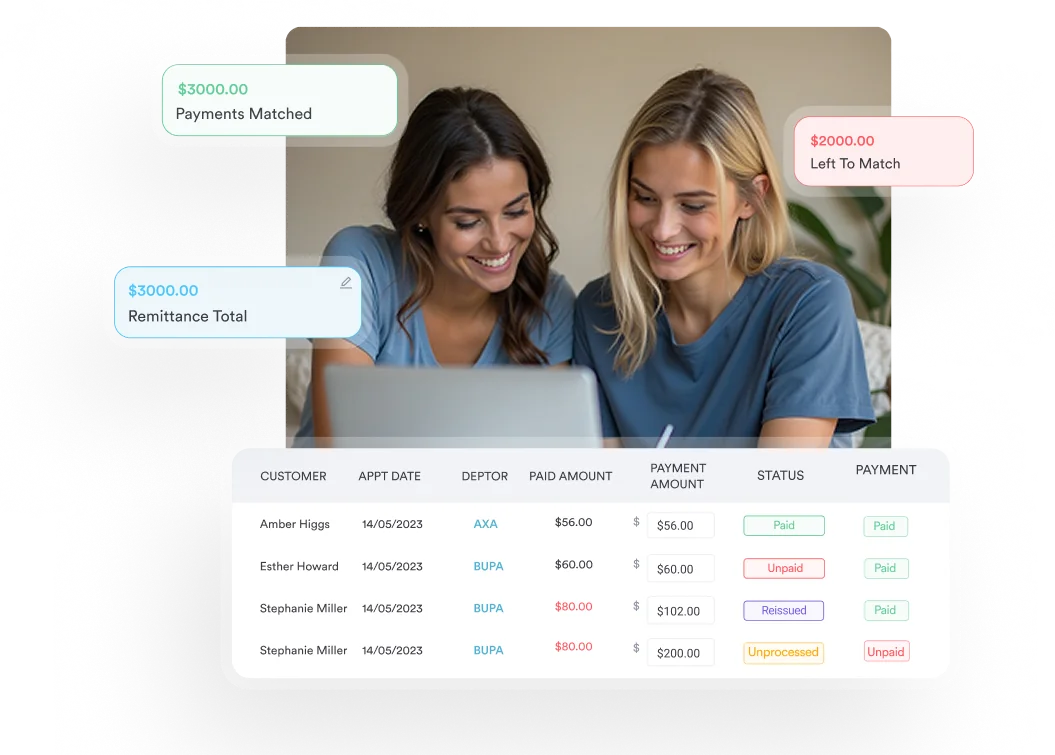
Practices that order stool or sputum testing can also switch on lab ordering. Quest tests are ordered from the patient record and the results import automatically. Labcorp orders are placed in Labcorp Link, and results sync back the same way. The indication and the result then sit next to the diagnosis code on the claim.

Pabau’s claims management submits 837P claims through Claim.MD, checks eligibility first and posts remittances to the patient record. See how it handles microbiology billing.

Treat 87015 as a question about the exam, not the specimen. If a complete O&P exam covered the stool, the concentration is already paid inside 87177. If the concentrate fed an acid-fast smear or a culture, 87015 belongs on the claim beside those codes.
Build that rule into the order and the lab report, and the claim follows from the record instead of from memory. Book a demo to see how Pabau keeps lab orders, results and claims in one place for your billing team.

Need a clearinghouse for lab claims? Claim.MD clearinghouse overview explains how Pabau routes 837P claims with eligibility checks and ERA retrieval.
Getting repeat denials with no clear pattern? Electronic remittance advice explained shows how to read 835 ERAs and map CARC and RARC codes back to correctable claim errors.
Comparing billing platforms for your practice? Best medical billing software for US practices sets the main options side by side.
CPT 87015 covers the concentration of a specimen for infectious agents, by any method, such as formalin-ethyl acetate sedimentation or zinc sulfate flotation. It reports the preparation step only. The exam that follows, such as an acid-fast smear or an O&P exam, is a separate code.
Medicare pays $6.68 for CPT 87015 in 2026. That is the national limitation amount in the CMS Clinical Laboratory Fee Schedule, CY 2026 Q4 release. CMS updates the file quarterly, so confirm the figure in the current file before you update your chargemaster.
CPT 87015 covers the concentration step only. CPT 87177 covers the complete ova and parasite exam, and its descriptor already includes concentration along with direct smears and identification. Bill 87177 alone for a full O&P exam, and don’t add 87015 for the same specimen.
Common pairings include B82.9 (intestinal parasitism, unspecified), A07.1 (giardiasis), A06.0 (acute amebic dysentery), A07.3 (isosporiasis), K52.9 and R19.7 (diarrhea, unspecified). For mycobacterial testing, A15.0 (tuberculosis of lung) is a common pairing. Accepted codes vary by MAC, so check your MAC’s local coverage determination before submitting.
Yes, in some cases. Concentration (87015) and a direct wet mount (87210) are different procedures, so both can be reported when both were performed. Check the current CMS NCCI procedure-to-procedure edits for the pair first. If an edit applies and allows a modifier, use -59 only when the record supports a distinct service.
The most common cause is a missing or unsupported diagnosis (CARC 11 or 50). Next come 87015 billed with 87177 on the same specimen (CARC 97) and a missing ordering provider (CARC 16 with RARC N264 or N265). A wrong place of service (CARC 5) and duplicate lines without a modifier (CARC 18) follow. Run NCCI checks and confirm the diagnosis against your MAC’s LCD before every submission.
CPT 87015 may be billed more than once on a date of service when separate specimens were each concentrated. Document each specimen in the lab report, and apply the modifier your payer requires for the additional units, usually -59 or -91. Units billed without distinct specimens in the record deny as duplicates (CARC 18).