

HCPCS code E0198: Water pressure pad billing guide
HCPCS code E0198 is a water pad for a standard mattress HCPCS code E0198 is the ...

Last Updated: Oct 13, 2026
Billable Code
86780 is the CPT code for a Treponema pallidum antibody test, whose official AMA descriptor is "Antibody; Treponema pallidum". The code covers treponemal immunoassays such as EIA, CIA, TPPA, and FTA-ABS, reported as a qualitative or semiquantitative result.
The non-treponemal RPR and VDRL tests are billed under CPT 86592 instead. Denials on 86780 usually start there, so match the code to the methodology printed on the laboratory report.
Let Pabau's smart automation suggest the right codes, reduce claim denials, and keep your practice compliant—effortlessly.
Automate repetitive tasks and focus on what matters most—your patients.
Reduce coding errors and ensure compliance with the latest regulations.
Clean claims, fewer denials, and faster reimbursements.
Powerful insights and reporting to help your practice thrive.
HIPAA compliant SOC 2 certified GDPR-compliant Trusted by 4,000+ clinics worldwide

CPT code 86780 covers the treponemal antibody test for Treponema pallidum, run as an EIA, CIA, TPPA or FTA-ABS assay.
The RPR and VDRL non-treponemal tests belong to CPT 86592, and billing the wrong one is the most common denial trigger.
Medicare covers 86780 under NCD 210.10 for pregnant patients and high-risk adults, with Z11.3 as the preventive code that removes cost-sharing.
Billing 86780 and CPT 86592 on the same date triggers NCCI edit scrutiny, so check the current quarterly edit tables first.
Practice management software like Pabau links lab orders to the correct CPT codes, so miscoded claims get caught before submission.
CPT code 86780 is the five-digit procedure code the American Medical Association publishes as “Antibody; Treponema pallidum”. It covers detection of antibodies specific to Treponema pallidum, the bacterium that causes syphilis, using treponemal immunoassays.
Many code lookups display “Qualitative or Semiquantitative Immunoassays” next to 86780. That is the title of the 86000-86804 category the code sits inside, not the descriptor for 86780 itself. The distinction matters on appeal, where a payer reads the official descriptor rather than the category heading.
Covered laboratory methodologies include enzyme immunoassay (EIA), chemiluminescent immunoassay (CIA), and Treponema pallidum particle agglutination (TPPA). The result is reported as reactive or non-reactive, so the code is billed once per test rather than once per titer value.
The code sits in the CPT Immunology subsection (80000 series) alongside related serology codes. It does not carry a global period and is billed per test occurrence, not per date-of-service interpretation.
The most common coding error in syphilis serology is interchanging CPT code 86780 with 86592. They test different analytes with different clinical implications, and payers treat them as distinct services.
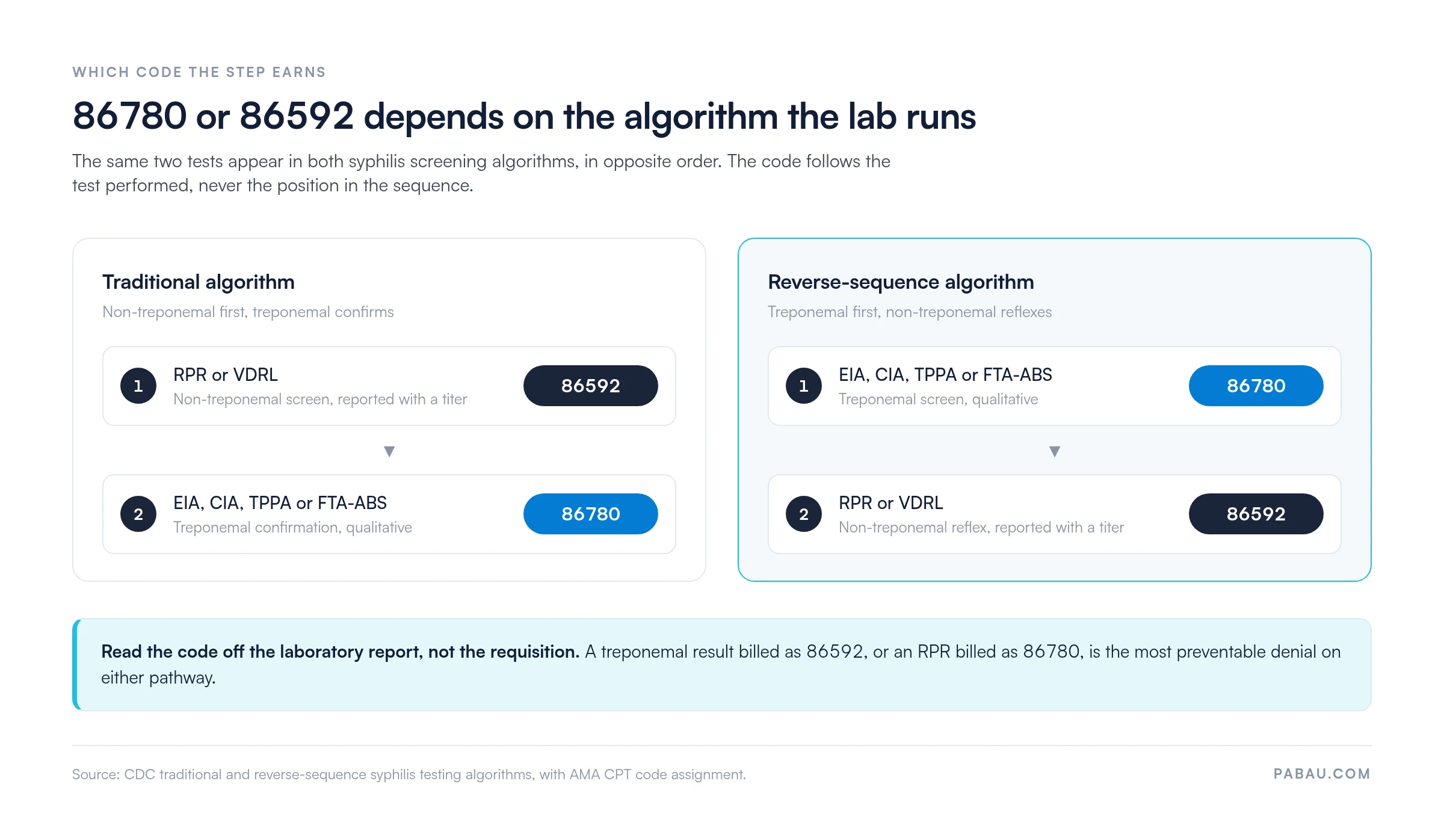
The CDC describes both a traditional algorithm (RPR first, treponemal confirmatory) and a reverse-sequence algorithm (treponemal EIA/CIA first, then RPR reflex). Which algorithm the laboratory runs decides which code is billed first, as the two pathways below show. Some payers still require the traditional sequence, so verify with each MAC or commercial plan before assuming reverse-sequence coverage.
Syphilis serology rarely travels alone. Both prenatal panels and comprehensive STI panels routinely bundle CPT code 86780 with several other codes. Knowing the co-billing landscape prevents bundling denials and NCCI edit triggers.
The American College of Obstetricians and Gynecologists recommends syphilis screening at the first prenatal visit for every pregnant patient. Repeat testing in the third trimester applies in high-prevalence areas, or where risk factors continue.
Each test in the panel is separately reportable. NCCI edits do apply when 86780 and 86592 are billed together by the same provider on the same date. Check the current quarterly NCCI edit tables on the CMS coding and billing page before submitting both on one claim.
Flag STI panel orders in your lab order workflow with a pre-bill review step. The most preventable denial on 86780 is a treponemal test billed as an RPR. The second is two syphilis codes submitted without an NCCI modifier on file. A 60-second check against the lab report before submission catches both.
Payers require a supporting diagnosis code that justifies ordering the treponemal antibody test. The right ICD-10-CM code also decides whether the patient owes cost-sharing, or whether the visit qualifies for preventive coverage.
Cross-check the CDC tool against your MAC’s local coverage determination before you finalize the claim. A code that satisfies one payer’s medical-necessity list can still fail another’s.
Clean claim submission for CPT code 86780 requires five documentation elements to be in place before the claim leaves your billing system. Missing any one of them is enough for a CO-4 or CO-97 denial.
Build these five fields into the lab order template so a missing element surfaces at order entry rather than at billing. Practice management software like Pabau adds claims management that checks the code against the order before the claim goes out.
Medicare covers syphilis screening under National Coverage Determination (NCD) 210.10, titled Screening for Sexually Transmitted Infections (STIs) and High-Intensity Behavioral Counseling (HIBC). Two populations qualify: Pregnant beneficiaries in any trimester, and non-pregnant adults at increased risk for sexually transmitted infections.
Coverage databases list this policy as record 352, which is a database record ID rather than the NCD number. Quote 210.10 on an appeal. Coverage is also limited to the frequency the NCD specifies, and exceeding it without extra medical necessity documentation will deny the claim.
STI screening codes sit where federal NCD rules, MAC local coverage determinations, and state Medicaid policies all meet. Each of the three changes on its own schedule, so a coverage rule you verified last quarter may no longer hold.
Medicare reimbursement for CPT code 86780 is set by the Clinical Laboratory Fee Schedule (CLFS), not the Physician Fee Schedule. Laboratory codes in the 80000 series are priced under the CLFS, which CMS updates annually. Verify the current rate through the CMS fee schedule lookup for the applicable payment year.
Commercial contracted rates for CPT code 86780 usually sit above the Medicare CLFS allowable, though the spread varies by payer and region. Because 86780 is priced under the CLFS rather than the physician fee schedule, the usual conversion-factor math does not apply to it.
The denial patterns below come from NCCI edit logic and standard payer audit criteria as they apply to syphilis serology. Each one has a specific corrective action, so match the remark code on the remittance to the row before you resubmit.
Every row above maps to a remark code. The full denial codes reference explains the CARC framework and the appeal workflow behind each one. Reading the remittance systematically, rather than only checking the dollar amount, catches a recurring 86780 pattern early. Otherwise the same error repeats across a whole billing period.
ACOG recommends syphilis serology at the first prenatal visit for every patient. A repeat screen at 28 to 32 weeks applies in high-prevalence areas. The billing question that follows is whether 86780 sits inside the obstetric global package or outside it.
Pregnancy is one of the indications for an RBC antibody screen, billed under CPT code 86850. That claim carries its own diagnosis pairing, such as O36.0110 for maternal anti-D antibodies in the first trimester.
Cross-referencing bundling notes against the AAPC CPT code lookup while you design the order set is a one-time step that prevents repeat denials. Do it once per panel, not once per claim.
Build a trimester-flagged prenatal lab order set in your EHR or practice management system. Map each test in the ACOG first-trimester panel (86780, 87389, 87340, 87491, 86803, 86706) to its CPT code and default ICD-10 pairing. When the order fires, the codes go with it. That removes the manual code-matching step behind most prenatal STI panel claim errors.
Today the chain breaks in the handoff. The lab report names the methodology, the biller reads the requisition, and the CPT code is chosen from memory. When the requisition says syphilis screen and the report says RPR, 86780 goes out on a claim that 86592 should have carried.
Pabau closes that loop by holding the order, the result and the code on one patient record. The lab order carries its CPT code from the moment it is raised, so the biller is confirming a code rather than choosing one.
The same record carries the diagnosis code, so a prenatal panel leaves with Z11.3 attached rather than picked up later in a denial review. Claim status returns to the same screen, which means a CO-97 bundling edit on 86780 surfaces while the encounter is still fresh.

Pabau links your lab orders to CPT codes, tracks claim status, and flags common denial triggers before submission. See how practices billing STI and prenatal panels use Pabau to reduce rework.

Two decisions carry almost all the denial risk on this code. The first is treponemal against non-treponemal: 86780 or 86592, read off the lab report rather than the requisition. The second is the diagnosis code, where Z11.3 buys preventive coverage and a vague A53.9 rarely does.
Settle both at order entry and the rest of the claim mostly looks after itself. Settle them at appeal and you are paying twice for the same test. Frequency limits and MAC variations matter, but they are second-order next to those two.
Book a demo to see how Pabau keeps the lab order, the result and the CPT code on one record.

List Item #1
List Item #2
CPT code 86780 covers treponemal antibody testing for Treponema pallidum using specific immunoassay methodologies including EIA, CIA, TPPA, and FTA-ABS. It reports a qualitative or semiquantitative result, reactive or non-reactive. It is used for syphilis screening, confirmatory testing after a reactive RPR, and prenatal panels. It does not cover non-treponemal tests such as RPR or VDRL, which use CPT 86592.
CPT 86780 detects antibodies specific to Treponema pallidum, the syphilis bacterium, and stays reactive even after successful treatment. CPT 86592 detects non-specific cardiolipin antibodies via RPR or VDRL. It is used to monitor treatment response, because the titer declines with cure. In the traditional algorithm, 86592 is the initial screen and 86780 confirms a reactive result. In the reverse-sequence algorithm, the order is reversed.
The most common supporting ICD-10 codes are Z11.3 for an STI screening encounter and A53.9 for unspecified syphilis. Stage-specific A51.xx codes apply to confirmed primary-stage disease, and O98.11 to O98.13 cover syphilis complicating pregnancy by trimester. Using Z11.3 for asymptomatic screening triggers the Medicare preventive benefit under NCD 210.10 and removes patient cost-sharing.
Yes, Medicare covers CPT code 86780 under National Coverage Determination 210.10 for pregnant beneficiaries and for non-pregnant adults at increased risk for STIs. Preventive coverage with no cost-sharing requires Z11.3 as the primary diagnosis. Frequency limits apply. Screening beyond the covered frequency needs medical necessity documentation in the chart to support an appeal.
Modifier 90 applies when the ordering practice bills for a treponemal antibody test performed at a reference laboratory. The QW modifier applies only if the treponemal assay platform holds a CLIA-waiver certificate for that methodology. Not all platforms qualify, so verify the CLIA waiver status of the instrument before appending QW. Modifier 59 or XU may be needed to bypass an NCCI edit when 86780 and 86592 are both medically necessary on the same date.
The most common cause is a missing or incorrect ICD-10 code, particularly the wrong O98.xx trimester. Next come frequency limits under Medicare NCD 210.10 exceeded without medical necessity documentation, and a place of service mismatch. NCCI bundling edits also fire when 86780 and 86592 are billed on the same date. Reference lab billing errors, specifically a missing lab NPI or an absent modifier 90, are also a frequent CO-16 trigger.



