HCPCS code E0280: Bed cradle Medicare billing guide
HCPCS code E0280 describes the cradle frame, not the bed HCPCS code E0280 is the...

Last Updated: Oct 15, 2026
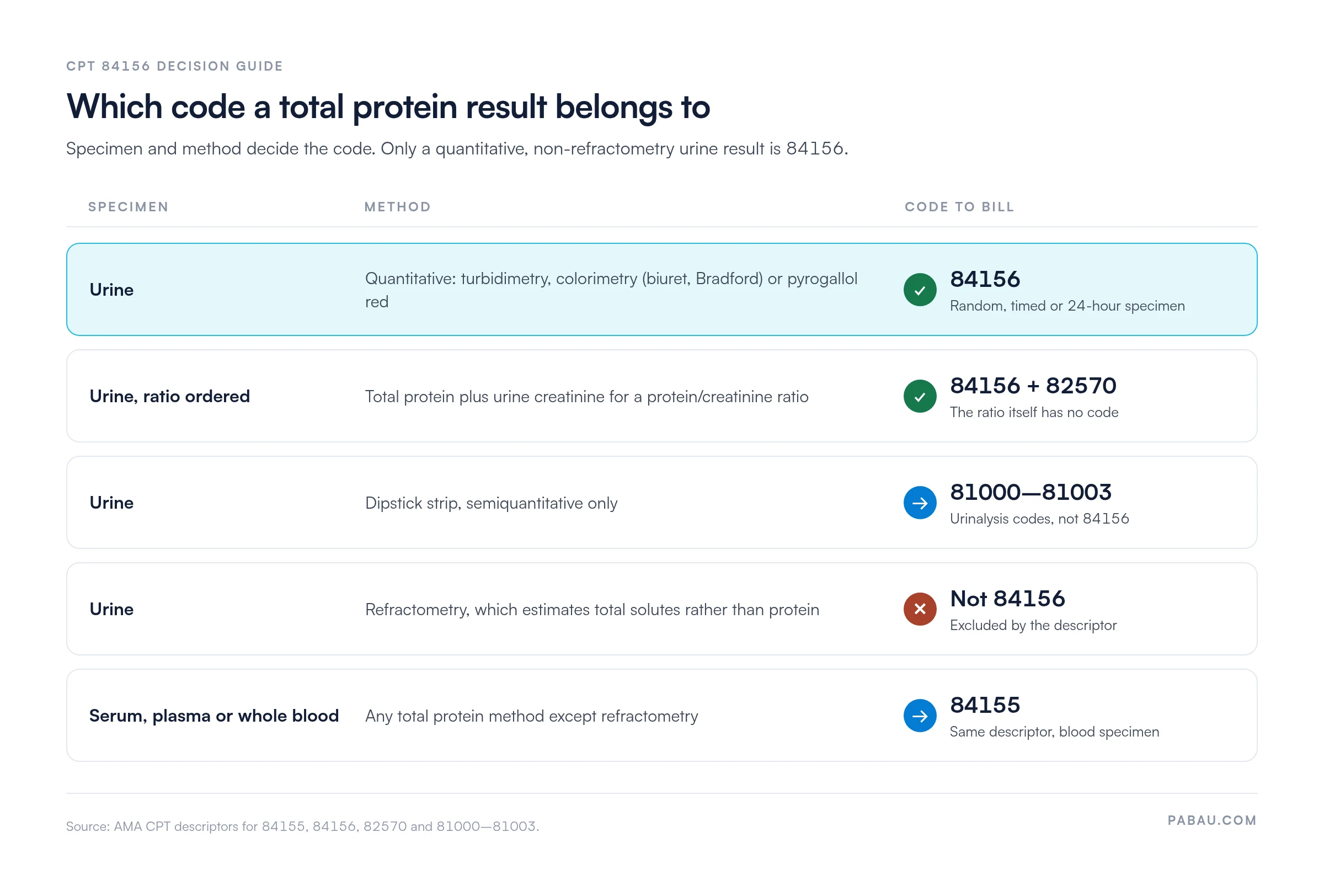
84156 is the CPT code for protein, total, except by refractometry; urine. It reports a quantitative total protein measurement on a random, timed or 24-hour urine specimen, using a method such as turbidimetry or colorimetry.
Medicare pays 84156 under the Clinical Laboratory Fee Schedule. A clean claim needs a supporting ICD-10-CM diagnosis, a non-refractometry method and the performing lab's CLIA number. When 84156 shares a date with urinalysis codes 81001 or 81003, confirm the current quarter NCCI table for the pair.
Let Pabau's smart automation suggest the right codes, reduce claim denials, and keep your practice compliant—effortlessly.
Automate repetitive tasks and focus on what matters most—your patients.
Reduce coding errors and ensure compliance with the latest regulations.
Clean claims, fewer denials, and faster reimbursements.
Powerful insights and reporting to help your practice thrive.
HIPAA compliant SOC 2 certified GDPR-compliant Trusted by 4,000+ clinics worldwide

CPT code 84156 covers quantitative total protein in a urine specimen only, while serum or plasma protein uses CPT 84155.
Refractometry is excluded by the AMA descriptor. Billing 84156 for a refractometer result is a miscoded claim that misrepresents the test performed and risks denial or recoupment.
Most Medicare Administrative Contractors require a supporting ICD-10-CM diagnosis, such as CKD, nephrotic syndrome, diabetic CKD, gestational proteinuria (O12.x) or preeclampsia (O14.x).
Medicare pays 84156 under the Clinical Laboratory Fee Schedule at a single national limit of $3.67 in CY2026, with no regional variation.
Pabau’s claims management software submits claims electronically through Claim.MD and tracks their status.
CPT code 84156 reports a quantitative measurement of total protein in a urine specimen. The American Medical Association describes it as: Protein, total, except by refractometry; urine. That descriptor names the analyte (total protein), the specimen (urine), and the one method that does not qualify (refractometry).
Clinically, the test quantifies total protein excreted in urine. Providers order it on a random spot urine sample, a timed specimen such as a 4-hour or 12-hour collection, or a 24-hour urine collection. All three specimen types use the same CPT code. The distinction between them belongs in the provider’s order and the lab report, not in the procedure code.
Three codes sit close enough to 84156 that coders regularly confuse them or question whether they can be billed together. The table below lays them out side by side.
The most common mix-up is 84156 versus 84155. Both describe “protein, total, except by refractometry,” and the only difference is the specimen. Urine goes to 84156, while serum or plasma goes to 84155. Submitting the wrong code for the specimen type is one of the top denial reasons for this code family. The guide below maps each specimen and method to its code.
Payers require a valid ICD-10-CM diagnosis linked to 84156 to approve the claim. Many Medicare Administrative Contractors (MACs) publish Local Coverage Determinations (LCDs) that apply to urine chemistry codes. The list below reflects commonly accepted diagnoses, but verify the specific LCD for your payer before treating any list as universal.
Use the CDC/NCHS ICD-10-CM lookup tool to confirm current code validity for the service date being billed.
Payers commonly deny 84156 when the supporting ICD-10 code is too non-specific, such as a general hypertension code without the renal complication subcode. They also deny it when the diagnosis is missing from the provider’s note for that date of service. The ordering provider’s note must state the clinical indication that justifies the test.
Medicare pays CPT code 84156 under the Clinical Laboratory Fee Schedule (CLFS), not the Physician Fee Schedule. Clinical laboratory tests such as 84156 are paid under the CLFS, while anatomic pathology services such as 88305 are paid under the Physician Fee Schedule. CMS sets CLFS rates using the Protecting Access to Medicare Act (PAMA) pricing methodology.
The CY2026 CLFS file lists a national limit of $3.67 for 84156. The CLFS pays one national rate, with no regional adjustment by Medicare Administrative Contractor. Download the current quarter’s file from the CMS Clinical Laboratory Fee Schedule page to confirm the rate for your date of service.
PAMA rates reflect private-payer market data collected from clinical laboratories. As a result, rates for high-volume, low-complexity codes like 84156 have trended downward since PAMA implementation began in 2018. Practices billing 84156 frequently should monitor annual CLFS updates and build rate checks into their lab billing workflows.
Run your 84156 claims against the current CMS CLFS rate before the start of each calendar year. A rate drop on January 1 can create an unexpected revenue shortfall. Update your payment posting expectations at the same time.
Billing CPT code 84156 correctly means getting five elements right on the same claim. A payer can deny or pend the claim when any one of them is missing.
For practices submitting a superbill that includes 84156, confirm the superbill template carries the ICD-10 linkage fields. The billing team then receives the diagnosis alongside the procedure code instead of chasing it from the clinical note.
Denials on 84156 cluster around six root causes. The table pairs each one with the fix that prevents it.
Good denial management workflows catch most of these before transmission by running pre-submission edits against current NCCI tables and payer LCD policies. A clean claim for a lab code carries the diagnosis, the CLIA number and the specimen detail on its first submission.
When a denial does occur, match the CARC code on the electronic remittance advice to the root cause table above. Our guide to denial codes maps each CARC and RARC to its usual fix.
Whether 84156 can share a date of service with other urine chemistry codes depends on the specific pairing. Some combinations are routinely billed together, while others need an NCCI check before both codes go on the claim.
These two codes have no CCI edit conflict. When a provider orders a urine protein/creatinine ratio, the lab runs total protein (84156) and urine creatinine (82570). It may bill both on the same date. The ratio itself is a calculated value derived from these two results and does not have its own billable CPT code. Quest Diagnostics and Cleveland Clinic Laboratories both list protein/creatinine ratio panels using this code pairing in their test directories.
Microalbumin (82043) and total urine protein (84156) measure different analytes. A provider may order both when distinguishing selective proteinuria (albuminuria) from total protein loss, such as in early versus advanced diabetic nephropathy. No CCI edit blocks this combination as of current CCI tables. CCI edits are updated quarterly, so confirm the current quarter edit file before billing.
Automated urinalysis codes 81001 (with microscopy) and 81003 (without microscopy) include a protein component in their methodology. Before billing either one with 84156 on the same date, confirm the current quarter NCCI table for the pair. If both tests were clinically necessary and distinctly ordered, modifier 59 (distinct procedural service) may be appropriate. Its use must be supported by documentation showing separate medical necessity for each test.
Pull your CCI edit table every quarter and run it against your most frequently billed urine chemistry combinations. A change that takes effect in a new quarter can turn a previously clean pairing into a bundling denial. You will not see it until the remittances come back.
Most 84156 denials start with data entered before the claim leaves the lab: the diagnosis, the CLIA number and the specimen detail. When the billing team re-keys that data from a paper requisition into a separate system, each transfer is another chance for an error.
Pabau, the practice management platform we build, includes claims management software that keeps billing next to the patient record. It submits claims electronically through the Claim.MD clearinghouse and tracks their status.
Claim.MD runs its own front-end edits against payer rules before transmission. Your team still enters the diagnosis and the CLIA number, so the documentation checks above stay part of the workflow. What changes is that every 84156 claim can be followed from submission to payment in one place.

Pabau’s claims management software submits your 84156 claims electronically through Claim.MD. It then tracks each claim’s status, so your billing team can follow it to payment.

CPT code 84156 has a narrow scope: total protein in urine, by any quantitative method except refractometry. Whether the claim gets paid depends less on the code than on what travels with it.
Before you submit, check for a supporting diagnosis in the provider’s note, the performing lab’s CLIA number, and a non-refractometry method on the lab report. Whenever 84156 shares a date with 81001 or 81003, confirm the current quarter NCCI table first.
At a CY2026 national limit of $3.67, an 84156 claim leaves almost no margin for rework. These checks pay off across volume rather than per test. Book a demo to see how Pabau submits and tracks your lab claims through Claim.MD.

Need to understand what clearinghouse partners actually do? Medical claims clearinghouse guide explains how electronic claims are validated, scrubbed, and transmitted to payers before reimbursement.
Seeing denials with CARC codes you cannot decode? Denial codes in medical billing maps the most common CARC and RARC codes to their root causes and corrective actions.
Ordering a protein/creatinine ratio? CPT code 82570 covers billing for creatinine measured in urine and other non-blood sources.
Running automated urinalysis on the same date? CPT code 81003 covers automated urinalysis without microscopy, the pairing to check against 84156.
Comparing billing tools for lab-heavy practices? Best medical billing software covers the features that reduce claim errors for labs and practices billing high-volume lab codes.
CPT code 84156 covers quantitative measurement of total protein in a urine specimen using a laboratory method other than refractometry, such as turbidimetry or colorimetry. It applies to random spot urine, timed specimens, and 24-hour collections. Dipstick results and refractometer-based estimates are not billable under this code.
The top denial reasons are a missing or non-specific ICD-10 diagnosis, refractometry billed as 84156, and a missing CLIA number on the claim. Same-date billing with automated urinalysis codes 81001 or 81003 can also cause denials, so confirm the current quarter NCCI table for the pair. A smaller but recurring cause is specimen mismatch, where a serum result is billed as 84156 instead of 84155.
No. CPT 82043 measures albumin specifically at low concentrations (microalbumin), which helps detect early diabetic nephropathy before total proteinuria becomes measurable. CPT 84156 measures all urinary proteins combined. Both can be billed on the same date when the provider needs to tell early selective albuminuria from total protein loss. Confirm the current quarter NCCI table before billing the pair.
Yes. Medicare covers CPT 84156 under the Clinical Laboratory Fee Schedule when a CLIA-certified laboratory bills it with a qualifying ICD-10-CM diagnosis. The CY2026 national limit is $3.67, a single rate with no regional variation. Check the current CMS CLFS file before projecting lab revenue.