CPT code 86481: TB IGRA billing guide
CPT code 86481: Official descriptor and procedure description CPT code 86481 des...

Last Updated: Nov 2, 2026
Billable Code
86334 is the CPT code for immunofixation electrophoresis; serum. It covers the lab test that identifies the heavy-chain class and light-chain type of a monoclonal protein in a serum sample.
The code sits in the Immunology subsection (86000-86849) of the Pathology and Laboratory section. Immunofixation on urine, CSF or other fluids is billed with 86335, and the serum protein electrophoresis (SPEP) that usually comes first with 84165.
Let Pabau's smart automation suggest the right codes, reduce claim denials, and keep your practice compliant—effortlessly.
Automate repetitive tasks and focus on what matters most—your patients.
Reduce coding errors and ensure compliance with the latest regulations.
Clean claims, fewer denials, and faster reimbursements.
Powerful insights and reporting to help your practice thrive.
HIPAA compliant SOC 2 certified GDPR-compliant Trusted by 4,000+ clinics worldwide

CPT code 86334 covers immunofixation electrophoresis on serum only. Urine, CSF and other fluids take 86335, and mixing the two up is the most frequent coding error on this code.
Medical necessity must be documented on every claim, including reflex orders triggered by an abnormal SPEP result. The automatic reflex workflow does not waive the ICD-10 requirement.
Medicare pays 86334 under the Clinical Laboratory Fee Schedule (CLFS), at the lesser of the lab’s charge or the CLFS rate. CMS updates that rate every year.
Pabau’s claims management software validates each claim for missing or invalid details before submission and flags any rejected claim for a quick fix.
CPT code 86334 is classified under the Pathology and Laboratory section of the American Medical Association’s CPT code set, specifically within the Immunology subsection (86000-86849). The official descriptor reads: Immunofixation electrophoresis; serum. The code covers the lab test that identifies the heavy-chain class and light-chain type of a monoclonal protein in serum.
The specimen qualifier, serum, is the word that separates 86334 from its neighbor 86335. Get it wrong and the claim denies. The table below captures the key reference fields coders need at a glance.
CPT 86334 covers immunofixation electrophoresis on a serum sample. The test separates blood proteins with an electrical current, then overlays antisera specific to each immunoglobulin class to characterize any abnormal band.
It confirms whether an M-protein (a monoclonal immunoglobulin, also called a paraprotein or M-spike) is present. It also determines that protein’s heavy-chain class and light-chain type.
What the test identifies specifically:
What 86334 does not cover: Immunofixation performed on urine or any body fluid other than serum. That work is billed under CPT 86335. A urine specimen on an 86334 claim is a specimen-mismatch denial waiting to happen.
Medical necessity for CPT code 86334 requires a documented clinical indication in the ordering provider’s record. Payers, especially Medicare, check the indication against their applicable LCD before approving payment.
Accepted indications include:
Each indication must map to a covered ICD-10-CM code on the claim. Ordering 86334 for routine screening without a specific indication is not covered under Medicare or most commercial LCDs.
The ICD-10-CM codes below are the ones MAC LCDs cite most often as supporting medical necessity for serum immunofixation electrophoresis. Coverage lists change periodically, so confirm the current list in the LCD for your billing jurisdiction before submitting.
Select the ICD-10 code that reflects the ordering provider’s documented clinical finding at the time of the order. A code more specific than the clinical evidence supports creates audit risk. An overly vague code may not satisfy the LCD’s covered-indication requirements.
The specimen source is the only distinction between these two codes. A coder who misses it submits the wrong code and triggers a denial, which means a corrected claim, delayed payment and staff rework. The table below makes the split explicit.
A myeloma workup often includes both codes on the same date of service: 86334 for the serum IFE and 86335 for the urine IFE. When billing both, document each specimen type clearly in the lab report and on the requisition.
The flow below shows where each code sits in a typical M-protein workup, and what the claim needs before it goes out.
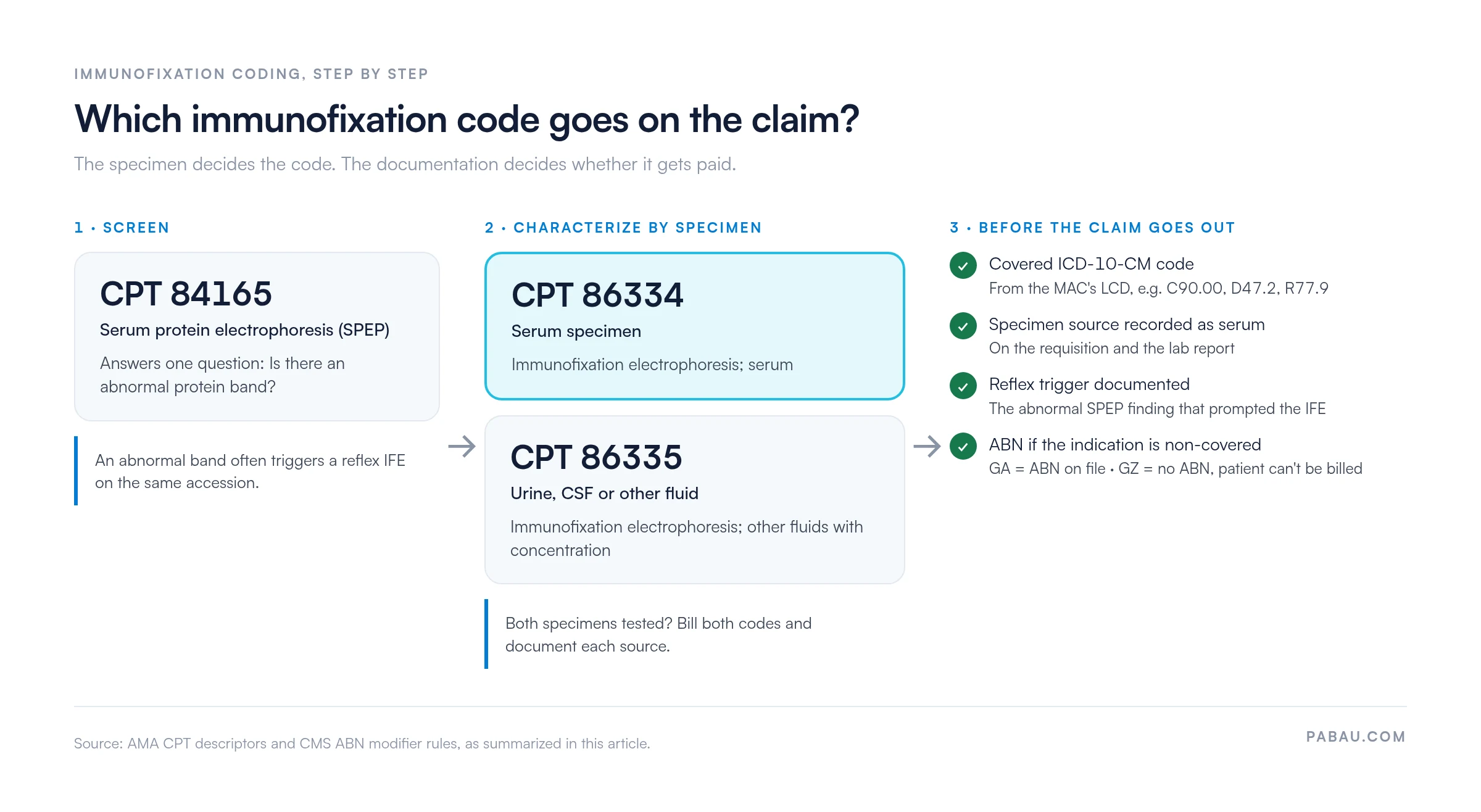
These two codes describe sequential steps in an M-protein workup, not alternatives. Serum protein electrophoresis (SPEP, billed as CPT 84165) detects whether an abnormal protein band exists. Immunofixation electrophoresis (IFE, billed as CPT 86334) then identifies the band’s immunoglobulin class and light-chain type.
Billing 84165 and 86334 together on the same claim is standard practice in a comprehensive myeloma workup. The key documentation requirement: The ordering note must justify both tests, whether ordered simultaneously or as a reflex sequence.
Reflex ordering is one of the most common workflows for CPT code 86334, and one of the most common causes of incomplete documentation. When an SPEP result shows an abnormal band, many labs automatically add IFE to the same accession. The billing implication: The reflex does not waive the medical necessity requirement.
How to bill a reflex IFE correctly:
Medicare reimburses CPT 86334 under the Clinical Laboratory Fee Schedule (CLFS), not the Physician Fee Schedule. The Centers for Medicare & Medicaid Services (CMS) publishes the national limitation amount every year. Verify the current calendar-year rate in the CMS CLFS files before quoting a figure to a patient or payer.
How Medicare pays for lab codes:
Medicare Administrative Contractors (MACs) issue LCDs that define the covered indications, covered ICD-10 codes and documentation requirements for immunofixation electrophoresis in their jurisdiction. No single national coverage determination (NCD) governs 86334, so coverage is MAC-specific.
Key MACs with relevant LCDs include Novitas Solutions, CGS Administrators, Palmetto GBA, and Noridian Healthcare Solutions. Each publishes its LCD through the CMS LCD search database. To locate the applicable LCD for a specific claim:
Good medical billing compliance means reviewing the applicable LCDs when you onboard a new test code, and whenever a MAC issues a proposed revision notice. A policy change applies from its effective date, not from the date you notice it.
Set a calendar reminder for the first week of each new year. Use it to check your MAC’s LCD updates and the new CMS CLFS rates for codes you bill regularly, including CPT 86334. Many ‘policy change’ denials trace back to rate or coverage updates the billing team missed at the year boundary.
Every CPT 86334 claim needs a documentation trail that connects the ordered test to a specific clinical indication. A lab report alone is not enough, because the ordering provider’s record carries the weight of the medical necessity determination.
Required documentation checklist:
Strong medical billing documentation habits reduce audit exposure and are the fastest path to first-pass claim acceptance. Generating a complete superbill with every required field before the claim leaves the lab costs far less than working a denial.
Most 86334 denials fall into a small number of categories. The table below maps each denial type to its root cause and the steps that prevent or correct it.
A structured denial management workflow categorizes each denial by root cause and tracks resolution time. It is the most reliable way to cut the recurring denials that drain lab billing revenue.
Tracking denial codes by frequency shows which coding or documentation error costs the most, so you can fix it at the source. A clean claim on the first pass carries the correct code, a covered ICD-10 code and complete documentation. It is always cheaper than working the denial queue.
The Correct Coding Initiative (CCI) edits from CMS define which CPT codes cannot be billed together without a modifier. They also define which codes are bundled into a primary code. For CPT code 86334, the most relevant bundling questions involve adjacent immunology codes.
Key bundling guidance:
CCI edits change quarterly. Always check the current version before assuming a code pair is or is not separately payable.
When billing runs on spreadsheets and a separate clearinghouse portal, staff check the specimen code, diagnosis and ABN status by hand. Every rekeyed field is another chance for an 86335 to land on a serum claim.
Pabau’s claims management software raises each claim from the patient’s invoice and validates it for missing or invalid details before it leaves. In the US, Pabau submits CMS-1500 claims through Claim.MD to thousands of payers and checks eligibility before the visit.
If a claim comes back rejected, Pabau flags it as Needs action and links straight to the field that needs correcting. Payments then settle from electronic remittance advice (ERA) files, so your team spends its time on the few claims that need judgment.
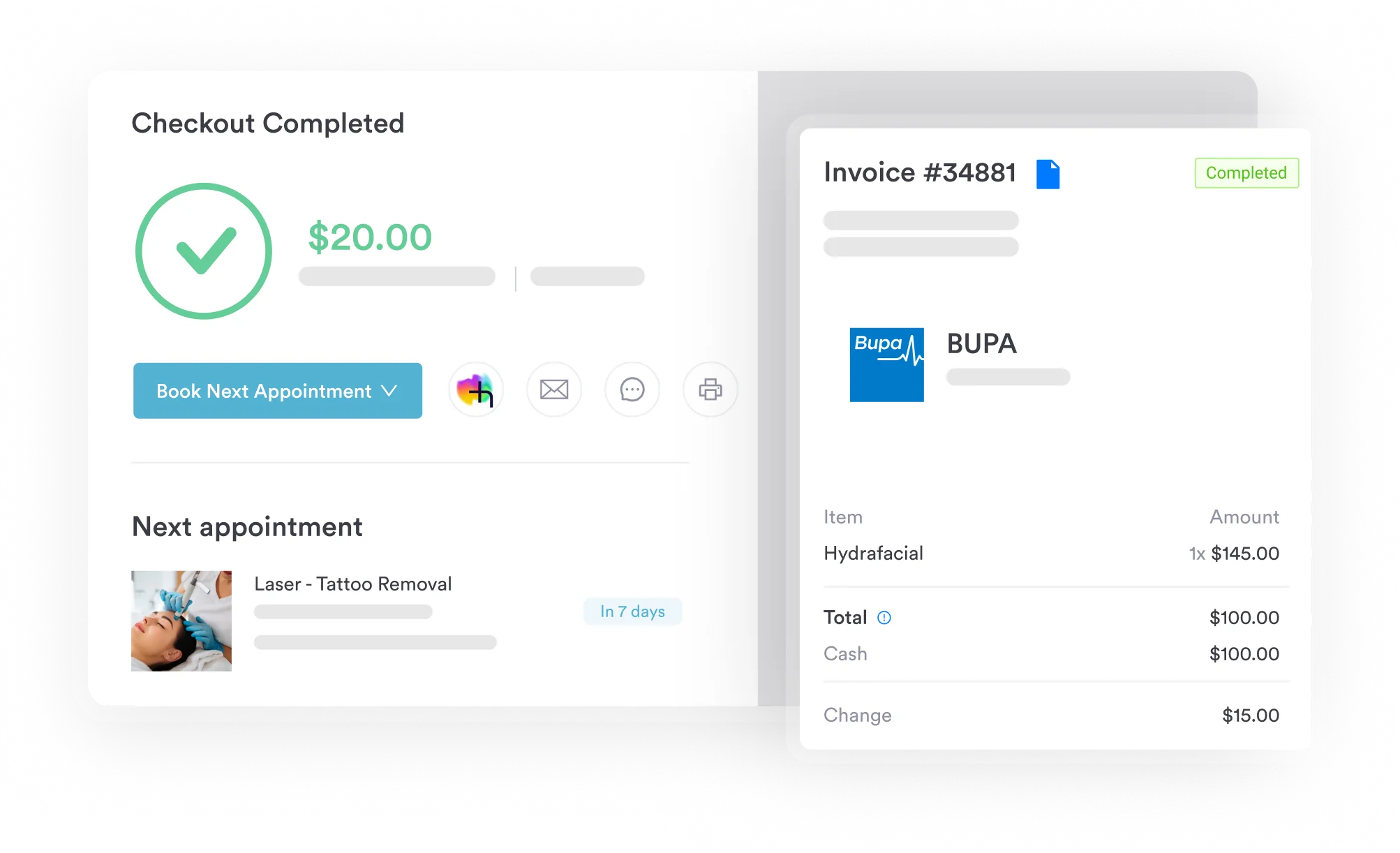

Pabau validates each claim for missing or invalid details before it leaves, submits it through your clearinghouse and tracks it from Pending to Paid. Your billing team only works the claims that need a fix.

Serum IFE is rarely a hard code to choose. The denials come from the paperwork around it. A urine specimen gets billed as serum, a reflex order has no recorded trigger, or a non-covered diagnosis goes out without an ABN.
Fix those three at the requisition, before the test runs, and 86334 becomes one of the more predictable codes in a myeloma workup. Leave them to the denial queue, and each denied claim costs a second round of work.
Book a demo to see how Pabau checks each lab claim before it goes out, so serum IFE claims get paid the first time.

Need guidance on what a clean claim requires for lab codes? Clean claim requirements in medical billing covers every field that must be correct before a lab claim leaves your system.
Want to understand how clearinghouse submission works for CPT codes? Medical claims clearinghouse guide explains the 837P transmission path and how payer responses are handled.
Looking to build a structured denial prevention process? Revenue cycle management for labs and practices outlines the end-to-end workflow from order through remittance.
CPT code 86334 covers immunofixation electrophoresis performed on serum. The test identifies the immunoglobulin class (IgG, IgA, IgM, IgD or IgE) and light-chain type (kappa or lambda) of a monoclonal protein in blood. IFE on urine or other body fluids is billed under CPT 86335.
The specimen source is the sole distinction: 86334 is for serum, and 86335 is for urine, CSF or other body fluids. Billing 86335 for a serum specimen, or the reverse, is one of the most common denial triggers for immunofixation claims.
The ICD-10-CM codes MAC LCDs cover most often are C90.00 (multiple myeloma), D47.2 (MGUS) and C88.0 (Waldenström macroglobulinemia). E85.9 (amyloidosis), R77.9 (abnormal plasma protein) and D47.9 (plasma cell dyscrasia) are also common. Confirm the covered-diagnosis list in your MAC’s current LCD before submitting.
Yes. Medicare covers CPT 86334 under the Clinical Laboratory Fee Schedule (CLFS) when the claim carries a covered ICD-10 code. The MAC’s LCD documentation requirements must also be met. CMS updates the national limitation amount every year, so check the current CLFS rate before quoting it.
Yes, billing SPEP (84165) and serum IFE (86334) on the same date of service is standard practice in a complete M-protein workup. No CCI column I/II edit is expected to prohibit same-day co-billing, but verify against the current quarterly CCI table before assuming payability.
The top causes are a wrong specimen code (86335 submitted for a serum specimen) and a diagnosis code missing from the MAC’s covered-indication list. Missing medical necessity documentation and a missing ABN for a non-covered indication complete the list.
Reflex ordering occurs when a lab automatically adds IFE (86334) after an abnormal SPEP result on the same accession. A lab protocol triggers it, not a separate physician order. Standalone ordering occurs when the physician orders IFE directly at the initial workup. That often happens when clinical suspicion for myeloma or MGUS is high enough to skip SPEP screening. Both scenarios require medical necessity documentation and a covered ICD-10 code on the claim.