CPT code 93503: Swan-Ganz catheter billing and modifiers
CPT code 93503: Official descriptor and procedure overview In the AMA CPT code s...

Last Updated: Oct 23, 2026
84999 is the CPT code for an unlisted chemistry procedure. It covers a chemistry test with no specific code anywhere in the 82009-84999 Chemistry range, such as a novel assay or an emerging biomarker.
The code has no national fee schedule rate, so payers review each claim individually. Every 84999 claim needs a special report describing the test, its methodology, and why no specific code fits.
Let Pabau's smart automation suggest the right codes, reduce claim denials, and keep your practice compliant—effortlessly.
Automate repetitive tasks and focus on what matters most—your patients.
Reduce coding errors and ensure compliance with the latest regulations.
Clean claims, fewer denials, and faster reimbursements.
Powerful insights and reporting to help your practice thrive.
HIPAA compliant SOC 2 certified GDPR-compliant Trusted by 4,000+ clinics worldwide

CPT code 84999 is the catch-all for chemistry procedures that have no specific CPT code in the 82009-84999 range.
Every 84999 claim needs an AMA special report. It covers the procedure, why no specific code fits, clinical necessity, time and equipment, and the closest comparable code.
Medicare has no fixed fee schedule rate for CPT 84999. Each Medicare Administrative Contractor (MAC) sets payment case by case.
Pabau’s claims management software attaches the special report to the claim and tracks prior authorization status, so missing paperwork is caught before submission.
CPT code 84999 is officially described as “Unlisted chemistry procedure” in the AMA CPT manual. It’s the final code in the Chemistry subsection of the Pathology and Laboratory section, which runs from 82009 through 84999.
Every other code in that range covers a named chemistry analyte or method. When a lab performs a chemistry test that no defined code describes, 84999 is the designated placeholder.
The code carries no Relative Value Unit (RVU) assignment and no national fee schedule rate. As a result, most payers send every 84999 claim to manual review and won’t decide on payment until they’ve read the attached documentation.
Good medical billing workflows flag these claims for review before submission instead of treating them like any other lab code.
The AMA’s rule is simple: use a specific CPT code whenever one exists. CPT 84999 is appropriate only when the procedure has no specific code. Billing it for a procedure that already has an assigned code is a compliance violation, and payers treat it as miscoding.
Before billing 84999, search the full 82009-84999 range and check HCPCS Level II for a miscellaneous laboratory code. The AAPC Codify CPT lookup helps with cross-reference results.
If a specific code exists anywhere in CPT or HCPCS, use it. The decision path below puts those checks in order, along with the package an 84999 claim needs.
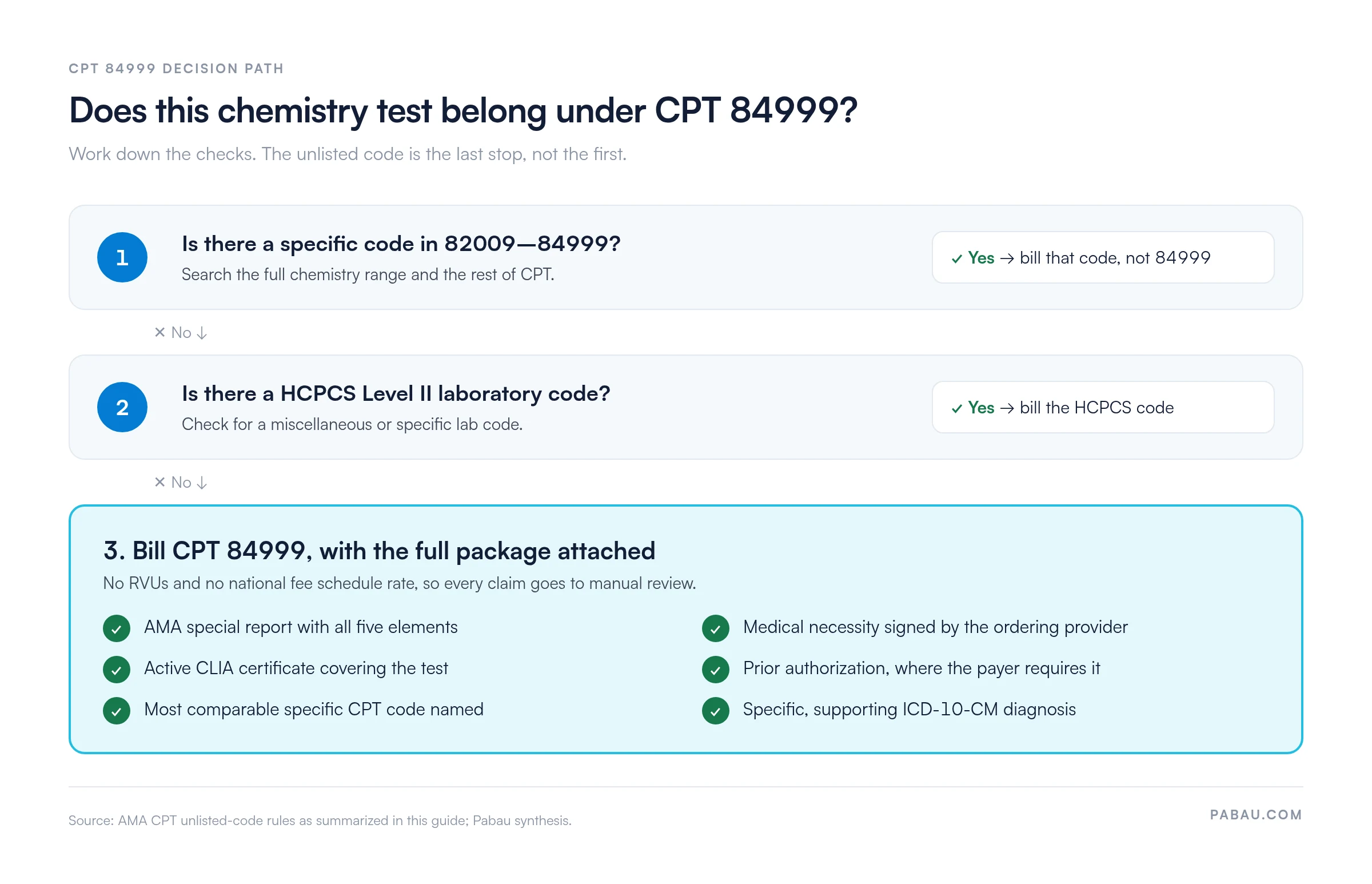
Claims for 84999 without attached documentation are almost certain to be denied. The AMA requires a special report for every unlisted code, and payers layer their own requirements on top. Lab billing compliance means assembling every element before the claim leaves the practice.
A special report is a narrative document submitted with the claim. It explains why the unlisted code was used and what the procedure involved. Every compliant special report contains these five elements:
A clean claim for an unlisted code also depends on two checks outside the report. The ordering provider’s notes in the patient record must support medical necessity, and the lab must hold active CLIA certification. CLIA certification doesn’t guarantee reimbursement, but a lab without it will be denied.
Before finalizing the special report, have the ordering clinician review and co-sign it. Payer reviewers frequently deny 84999 claims when the report reads like a billing department document. A physician-signed clinical narrative carries far more weight in the review process.
Medicare doesn’t have a fixed fee schedule rate for CPT code 84999. Because the code carries no RVU assignment, the CMS Physician Fee Schedule returns no national rate.
Instead, each Medicare Administrative Contractor (MAC) reviews 84999 claims individually. Payment is set from the special report and a comparison to the most analogous specific code.
Commercial payers vary widely. Some follow their MAC’s methodology, while others keep proprietary fee schedules for unlisted codes. A small number have blanket non-coverage policies for unlisted laboratory codes, so verify each payer’s policy before you submit.
Use the FastRVU 2026 RVU lookup to find the RVU values for the most analogous specific CPT code. MACs typically use that comparable code’s payment rate as the benchmark for 84999 reimbursement. Including it in the special report gives the reviewer a starting figure.
Prior authorization (PA) requirements for 84999 vary by payer and plan year. Medicare doesn’t routinely require PA for outpatient lab services, but MACs may require it for high-cost unlisted procedures. Many commercial payers require PA for any unlisted code.
Check each payer’s policy before performing the test when possible, because retroactive authorization is harder to get. When PA is obtained, record the authorization number on the claim.
Denials for 84999 are common, but they’re also predictable, and most stem from the same documentation failures. Checking the denial codes on your explanation of benefits (EOB) against these patterns catches the problem before the appeal deadline passes.
Solid denial management workflows cut the number of claims that reach this stage. When one does, a structured appeal improves your chances.
Tracking denied 84999 claims and their medical billing denial codes across a billing cycle reveals patterns. A run of “specific code exists” denials points back to code selection, so the fix belongs in the coding workflow rather than in the paperwork.
Build an 84999 pre-submission checklist. Confirm the special report is attached and the medical necessity letter is signed by the ordering provider. Then check that the CLIA certificate is current, prior authorization is obtained where required, and the comparable code is documented. Running it before every 84999 claim removes the most avoidable denial categories at the source.
The ICD-10-CM diagnosis code paired with 84999 must support the medical necessity of the specific chemistry test ordered. Payers cross-reference the diagnosis against the procedure to judge whether the test was clinically appropriate. A mismatched or overly vague diagnosis code is a fast path to denial.
Use the most specific ICD-10-CM code the patient’s documented condition supports. Unspecified codes (codes ending in .9 or flagged “unspecified”) are acceptable only when the patient record doesn’t support a more specific code. Payers increasingly flag unspecified diagnosis codes on unlisted procedure claims as insufficient to establish medical necessity.
When the test follows up an earlier abnormal chemistry result, check whether the record supports R79.89 or a more specific code for the finding itself.
Billing CPT 84999 involves more moving parts than any specific chemistry code. Documentation must be assembled, attached and tracked. Prior authorization status must be monitored. Denials must be caught, coded and appealed within tight windows, and a manual workflow loses track of at least one of those steps.
Pabau, the practice management platform we build, offers denial-reducing claims management for unlisted codes. Billing teams can add custom fields to the superbill for labs running novel assays.
The special report and medical necessity documentation attach to the claim before it leaves the system. Prior authorization status is tracked against each pending 84999 claim.
Pabau’s Claim.MD clearinghouse integration validates claims against payer-specific rules in real time. An 84999 claim missing its special report is flagged before it reaches the payer. So is a claim headed to a payer with a blanket unlisted-code exclusion. Without that check, the same claim would come back as a denial 30 days later.

Pabau helps labs attach special reports to claims, track prior authorization status, and submit through Claim.MD for real-time payer validation before billing 84999.

Treat CPT 84999 as the last stop on the coding path. Exhaust the 82009-84999 range and HCPCS Level II first, then bill the unlisted code only with the full package attached.
The trade-off is preparation time. Every 84999 claim takes more work than a specific code, and payment still depends on how a reviewer reads your special report. Standardizing the report and the pre-submission checklist makes each new claim a repeatable task.
To see how Pabau keeps 84999 documentation attached to every claim, book a demo.

Looking for a clearinghouse that validates chemistry claims in real time? Claim.MD clearinghouse overview explains how the integration works with Pabau’s billing platform.
Want to understand the full 837 claim submission process? 837 file billing guide walks through how electronic claims are formatted and transmitted to payers.
CPT code 84999 covers any chemistry procedure that has no specific CPT code in the 82009-84999 range. It’s the designated unlisted code for novel assays, emerging biomarkers, and chemistry tests not yet in the AMA CPT code set.
Use CPT 84999 only when no specific CPT or HCPCS code exists for the chemistry procedure performed. If a specific code exists anywhere in the current CPT manual or HCPCS Level II, that code must be used. Billing 84999 when a specific code applies is a coding compliance violation.
Every 84999 claim requires an AMA-compliant special report covering five elements. It names the procedure and methodology, explains why no specific code exists, and documents clinical necessity. It also lists time and equipment and the closest comparable CPT code. A signed medical necessity letter from the ordering provider and active CLIA certification are also required.
Yes, Medicare can reimburse CPT 84999, but there’s no fixed national fee schedule rate. Each Medicare Administrative Contractor reviews the claim individually. Payment is based on the special report and the rate of the most analogous specific code. It varies by MAC region and is never guaranteed.
The most common reason is a missing or incomplete special report. Other frequent causes are a specific CPT code existing for the procedure, weak medical necessity documentation, CLIA certification issues, and missing prior authorization. Repeated “specific code exists” denials point to a problem in code selection before submission.
It depends on the payer. Medicare doesn’t routinely require prior authorization for outpatient lab services, but many commercial payers require it for any unlisted procedure code. Check the payer’s authorization policy before performing the test when you can, and record the authorization number on the claim.