HCPCS code J7520: Sirolimus oral billing guide
HCPCS code J7520 covers oral sirolimus, one unit per milligram HCPCS code J7520 ...

Last Updated: Nov 12, 2026
83993 is the CPT code for calprotectin, fecal. It reports one quantitative immunoassay that measures calprotectin in a stool specimen to detect intestinal inflammation.
Clinicians order it mainly to tell inflammatory bowel disease from irritable bowel syndrome, and to monitor Crohn's disease or ulcerative colitis. Calprotectin measured in blood or serum does not map to this code.
Let Pabau's smart automation suggest the right codes, reduce claim denials, and keep your practice compliant—effortlessly.
Automate repetitive tasks and focus on what matters most—your patients.
Reduce coding errors and ensure compliance with the latest regulations.
Clean claims, fewer denials, and faster reimbursements.
Powerful insights and reporting to help your practice thrive.
HIPAA compliant SOC 2 certified GDPR-compliant Trusted by 4,000+ clinics worldwide

CPT code 83993 reports one quantitative calprotectin measurement on a stool specimen, run by immunoassay. Blood or serum calprotectin assays do not map to it.
K50.x (Crohn’s disease) and K51.x (ulcerative colitis) are the best-supported diagnosis pairings. IBS codes (K58.x) draw more payer scrutiny and need the rule-out intent documented.
Medicare’s 2024 Clinical Laboratory Fee Schedule set the national rate for 83993 at $19.63. At that price, reworking a denied claim costs a large share of what the test pays.
Many commercial payers require prior authorization for 83993, while Medicare generally does not. Verify the plan’s rule before the specimen is collected.
Pabau, the practice management platform we build, checks eligibility through Claim.MD and warns staff when a case is missing its prior authorization code.
CPT code 83993 is the procedure code for a quantitative fecal calprotectin test. Its official American Medical Association (AMA) descriptor is Calprotectin, fecal. The code sits in the Chemistry subsection of the CPT Pathology and Laboratory section, which spans codes 80047-89398.
Calprotectin is a calcium-binding protein that neutrophils release during gastrointestinal (GI) inflammation. When the gut is inflamed, calprotectin levels in stool rise sharply. The lab measures that concentration with an enzyme-linked immunosorbent assay (ELISA) or an equivalent quantitative immunoassay.
CPT code 83993 covers exactly one quantitative calprotectin measurement from a stool specimen. The descriptor is only two words long, so coders often stretch it to tests it does not cover, or miss what it already includes.
Medicare coverage for CPT 83993 follows Local Coverage Determinations (LCDs) published by Medicare Administrative Contractors (MACs). The ICD-10-CM codes below are the indications payers support most consistently. A diagnosis code the payer does not accept for this test is one of the fastest routes to a denial.
Use the CDC/NCHS ICD-10-CM web tool to find the most specific code for the documented scenario before you pair it with CPT 83993.
CMS pays CPT 83993 under the Clinical Laboratory Fee Schedule (CLFS). The 2024 Q1 file lists a national payment rate of $19.63 for 83993, effective January 1, 2024. CMS updates the schedule each year, so check the current quarter’s file before relying on any figure.
Medicare coverage is decided at the MAC level through LCDs. No National Coverage Determination (NCD) governs CPT 83993 specifically, so coverage rules vary by jurisdiction. Check your regional MAC for the applicable LCD before billing.
Run insurance eligibility verification before the fecal calprotectin sample is collected. Finding a prior authorization requirement after the specimen is processed leaves the lab cost spent and the payment at risk. Build the verification step into the order workflow, not the billing workflow.
Thin documentation is the other common denial trigger for CPT 83993, next to unsupported ICD-10 pairings. The chart note has to show the test is clinically necessary, not ordered as a screening measure.
Use this checklist before submitting a claim. Each item maps to a standard payer audit point and supports medical billing compliance under HIPAA-governed electronic claim standards.
Medicare does not generally require prior authorization for CPT 83993, but many commercial payers do. Payer policies change frequently, so treat the steps below as a framework rather than a definitive payer list.
Confirm insurance eligibility verification status and prior authorization requirements during the clinical encounter, before the specimen is ordered or collected.
Gastroenterology coders meet several stool-based and protein-marker codes that are distinct from CPT 83993. The wrong code either overbills, which draws an audit flag, or underbills and leaves payment unclaimed.
The chart below runs the same comparison as a decision. Start from the stool specimen, then ask what the lab measured and how.
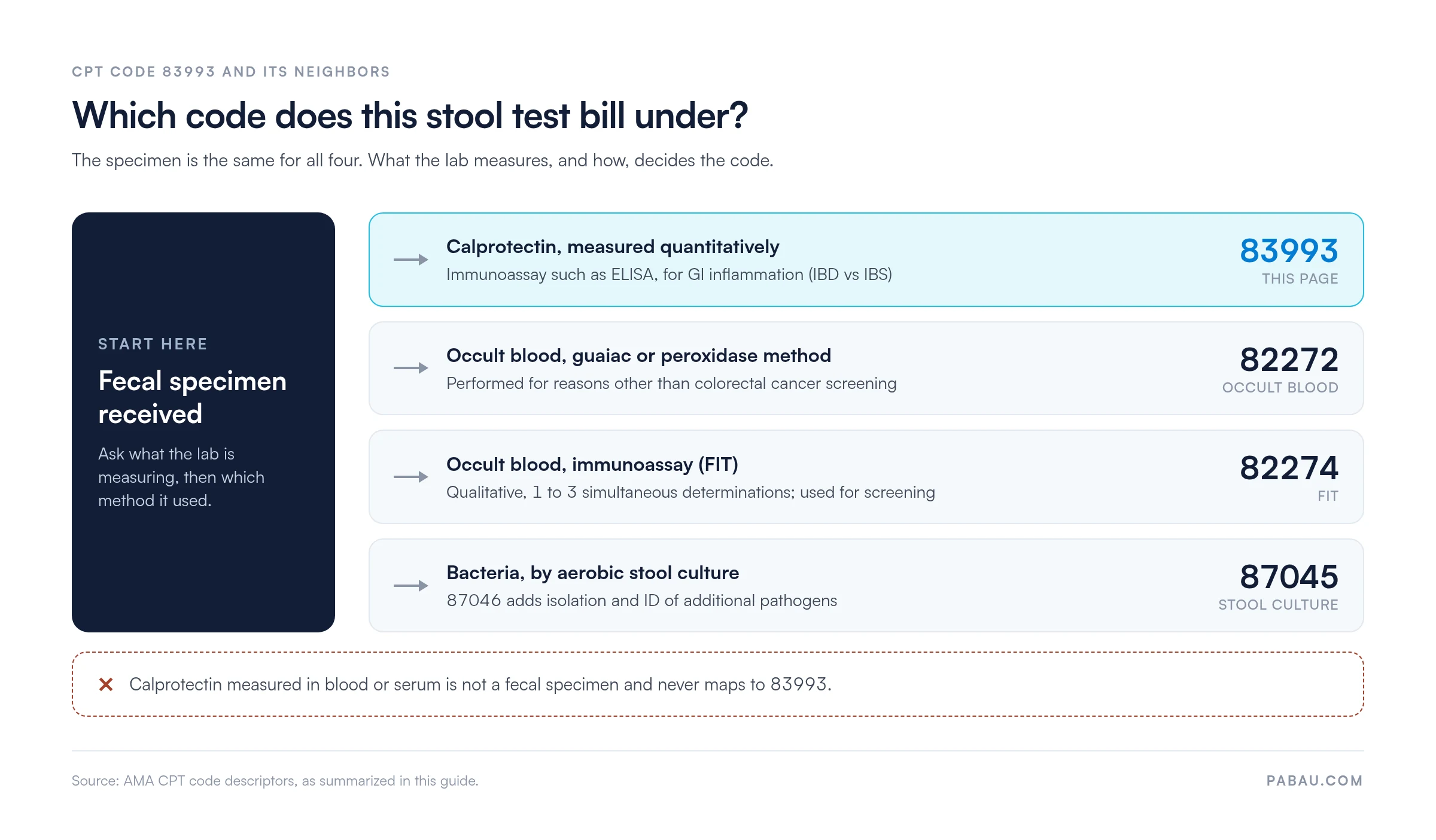
The guaiac test that most often gets swapped with this one is 82272, and its descriptor rules out colorectal cancer screening. Use the AAPC Codify CPT lookup to verify descriptors when unsure whether a neighboring code applies. The AMA’s published guidelines take precedence over third-party references.
Lab tests are often ordered without a same-day E/M visit, so no visit note anchors the medical necessity documentation. For CPT 83993, the same denial categories repeat across practices and payers.
Reviewing denial reason codes against the prevention actions above during claim scrubbing catches most of these issues before they reach the payer.
A denial management workflow for CPT 83993 follows a standard structure. What decides the appeal is the documentation specific to this code.
Most CPT 83993 denials trace back to the order, not the claim. The diagnosis, the prior authorization number and the differential intent are all known when the test is ordered. A workflow that captures them then carries them through to submission.
For medical billing fundamentals applied to lab codes, the key distinction is between in-house and reference laboratory workflows. Each one creates different billing responsibilities.
Submitting a clean claim on the first attempt matters most on low-value lab codes like CPT 83993. At a national rate of $19.63, every resubmission takes a large bite out of a small payment.
Track CPT 83993 denial rates separately from your overall lab denial rate. When 83993 denials cluster around one payer or one ICD-10 code, the cause is usually the order template. Fix the template or the order entry step once, and stop reworking claims one at a time.
In many gastroenterology practices, eligibility is checked by phone after the visit and the PA number lives in a spreadsheet. The claim is then keyed into a separate billing system, so a missing authorization surfaces only when the denial arrives.
Pabau, the practice management platform we build, keeps the order, the case and the claim on one patient record. Its claims management software runs eligibility checks and sends CMS-1500/837P claims through the Claim.MD clearinghouse. The prior authorization code, dates and sessions sit on the case, and staff get a warning when one is missing.
Practices that switch on Labs can order Quest tests from the patient record, and Labcorp results sync back automatically. Electronic remittance advice posts against the same record. A rejected calprotectin claim shows up the day it happens, not at month-end reconciliation.

Pabau checks eligibility through Claim.MD, tracks prior authorization codes on the case, and posts remittances back to the patient record. See how it handles CPT 83993 claims for gastroenterology practices.

At $19.63 a test, CPT 83993 leaves no room for a second submission, so the claim has to be right when the test is ordered. That means a supported diagnosis code, a prior authorization number where the plan needs one, and a note that states the IBD-versus-IBS question. Each of those is known before the specimen leaves the room.
Practices that move those checks to the order step stop paying staff time to rework low-value lab claims. Book a demo to see how Pabau carries the order details through to a clean CPT 83993 claim.

Need to understand how clearinghouse submission works? Medical claims clearinghouse guide explains how claims route from practice to payer and where errors are caught.
Building a denial prevention process from scratch? Revenue cycle management overview covers the end-to-end workflow that keeps lab claims from aging into write-offs.
Looking for the 837P electronic claim format? 837 file guide details the transaction set used for professional claim submissions including CPT 83993.
CPT code 83993 covers quantitative measurement of calprotectin in a fecal (stool) specimen using an immunoassay method such as ELISA. It is used to detect intestinal inflammation and to differentiate IBD (Crohn’s disease, ulcerative colitis) from non-inflammatory conditions like IBS. The code does not cover blood-based calprotectin testing, stool cultures, or occult blood tests.
Medicare pays CPT 83993 under the Clinical Laboratory Fee Schedule (CLFS). The 2024 Q1 file set the national rate at $19.63, effective January 1, 2024. CMS updates the schedule each year, so confirm the current quarter’s rate before quoting a figure.
The strongest pairings are K50.x (Crohn’s disease) and K51.x (ulcerative colitis). K58.x (IBS) is accepted when the clinical purpose is ruling out IBD. Z12.11 (colorectal cancer screening) is generally not covered. Check your MAC’s or payer’s current policy for the full list.
Not always. Medicare does not typically require prior authorization for CPT 83993, but many commercial payers do, and their rules change often. Check the specific plan during eligibility verification, before the specimen is collected, so the practice is not left with an unrecoverable lab cost.
The top denial reasons are an unsupported ICD-10 diagnosis code, missing prior authorization, thin medical necessity documentation, and an exceeded frequency limit. Claims without an explicit differential diagnosis statement in the physician’s note are especially exposed to medical necessity denials.
Yes, when each test is clinically indicated and documented separately. For example, a stool culture (87045) and a calprotectin test (83993) ordered for different clinical reasons may appear on the same claim. Give each code its own medical necessity documentation, and confirm the reference lab is not billing the same test.