HCPCS code V2599: Other type contact lens billing guide
What is HCPCS code V2599? HCPCS code V2599 is the Level II supply code for a con...

Last Updated: Oct 20, 2026
82272 is the CPT code for blood, occult, by peroxidase activity (eg, guaiac), qualitative; feces, 1-3 simultaneous determinations, performed for other than colorectal neoplasm screening. It is the diagnostic guaiac fecal occult blood test (gFOBT), ordered when symptoms or findings suggest bleeding in the gut.
One unit covers all one to three determinations. A guaiac test for routine colorectal cancer screening bills 82270 instead, and a screening FIT bills 82274 or, on Medicare claims, G0328.
Let Pabau's smart automation suggest the right codes, reduce claim denials, and keep your practice compliant—effortlessly.
Automate repetitive tasks and focus on what matters most—your patients.
Reduce coding errors and ensure compliance with the latest regulations.
Clean claims, fewer denials, and faster reimbursements.
Powerful insights and reporting to help your practice thrive.
HIPAA compliant SOC 2 certified GDPR-compliant Trusted by 4,000+ clinics worldwide

CPT code 82272 reports a qualitative guaiac fecal occult blood test on 1-3 specimens, performed for reasons other than colorectal cancer screening.
Pair 82272 with the symptom or condition that prompted the test, such as K92.1 melena or R19.5, never a Z12 screening code.
Routine guaiac screening bills 82270, and screening FIT bills 82274 or, on Medicare claims, HCPCS G0328.
Medicare recognizes 82272 as a waived test without modifier QW, but the performing site still needs a valid CLIA certificate.
Pabau, the practice platform we build, supports CPT charge entry and Claim.MD claim submission, so your coder’s 82272 line goes out as entered.
CPT code 82272 is the guaiac-based fecal occult blood test (gFOBT) performed on 1-3 stool specimens for a diagnostic reason. The AMA descriptor reads: Blood, occult, by peroxidase activity (eg, guaiac), qualitative; feces, 1-3 simultaneous determinations, performed for other than colorectal neoplasm screening.
That closing clause decides the code. 82272 is for patients whose symptoms, findings or conditions suggest bleeding in the gut. Typical reasons are dark stools, unexplained anemia or a known bleeding source. A guaiac test done to screen an asymptomatic patient for colorectal cancer belongs to CPT code 82270 instead.
The test detects heme-mediated peroxidase activity on guaiac-impregnated paper. Stool is applied to a test card, developer solution is added, and the result is read as positive or negative. It gives no quantity.
Three CPT codes and one HCPCS code cover stool occult blood testing, and each answers two questions differently. Which chemistry was used, guaiac or immunoassay? And was the test screening or diagnostic?
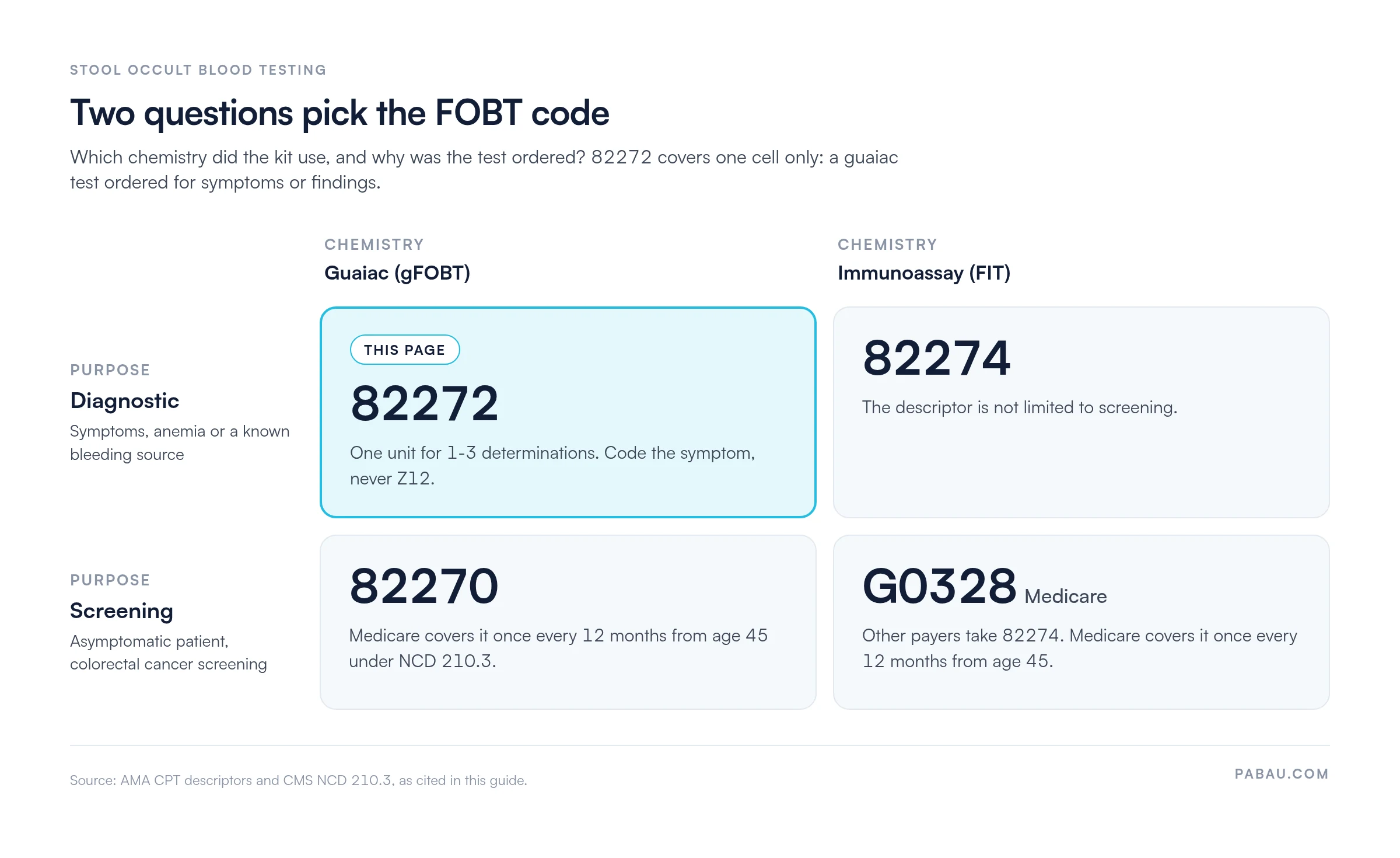
Billing 82272 for a routine screening test, or 82270 for a symptomatic patient, puts the wrong code on the claim. If your coding software auto-suggests a code, check its descriptor against the current CPT code set before you accept it.
Because 82272 excludes colorectal cancer screening by definition, none of the screening benefit rules attach to it. That includes the Medicare screening frequency, the zero cost-share for preventive services, the Z12 screening diagnosis and modifier 33.
If the documentation shows a routine screening test, rebill it under CPT code 82270 or the matching FIT code. If it shows symptoms, keep 82272 and code those symptoms.
The diagnosis on an 82272 claim must name the reason the test was ordered. Medicare checks it against the covered code list that accompanies NCD 190.34. Confirm each code is valid in the ICD-10-CM code set in force on the date of service.
Documentation rule: the visit note must record the symptom or condition you code. Confirm each diagnosis against the current NCD 190.34 covered code list before you bill Medicare. Payers compare the note with the claim during audits.
Anemia workups need the most care. Report D50.0 only when the note ties the anemia to chronic blood loss, and D50.9 while the cause is still unknown.
Medicare Part B covers diagnostic FOBT under NCD 190.34 when the record supports one of its indications:
The NCD also sets two limits. The test is reported once for up to three separate specimens. Some patients take NSAIDs and have a history of GI bleeding but no other signs or symptoms. For them, testing is generally appropriate no more than once every three months.
Medicare pays 82272 under the Clinical Laboratory Fee Schedule, so it has no technical and professional split. Check the current year’s file for the national limit. Medicare Part B usually charges the patient no deductible or coinsurance for covered clinical laboratory tests.
A diagnostic test needs an order from the treating practitioner, and the ordering provider’s NPI goes on the claim. Medicare Advantage plans can apply their own rules, so check the plan before you assume fee-for-service coverage applies.
Guaiac FOBT is a CLIA-waived test, so a practice can run it in the office under a CLIA Certificate of Waiver. Unlike most waived tests, 82272 does not need modifier QW on Medicare claims. CMS lists it among the waived codes that are recognized without QW, in Transmittal 11547 and earlier CLIA updates.
The place of service follows the billing entity. An office running the test reports POS 11, and an independent lab billing it reports POS 81. When a hospital outpatient lab performs the test, the hospital bills it on its own institutional claim.
A clean 82272 claim comes down to seven checks before the claim leaves the practice. Insurance eligibility verification before the encounter confirms the plan is active and shows any plan-specific lab rules.
Medicare applies its frequency and medical-necessity edits at the MAC and the Common Working File, not at the clearinghouse. A clearinghouse can pass an 82272 claim that Medicare later denies. Check the prior test date and the diagnosis against NCD 190.34 before the kit goes out.
Most 82272 denials trace back to six root causes. A solid denial management workflow catches the patterns early and stops them from recurring. The adjustment codes below are the ones payers commonly use, and the exact code varies by payer.
Our denial codes guide breaks down the CARC and RARC codes that accompany these denials.
Commercial payers and Medicaid set their own rules for 82272 on top of the Medicare framework. They differ most on cost-share, modifiers and prior authorization.
Commercial plans: diagnostic 82272 follows the plan’s normal lab benefit, so deductibles and copays can apply. The ACA zero cost-share covers screening tests, which bill under 82270 or 82274, not 82272. Document the symptoms clearly so the plan processes the test as diagnostic.
Medicaid: coverage rules vary by state, and some states set their own modifier or frequency rules for lab tests. Check the state’s managed care organization or fee-for-service policy before billing. Review medical billing compliance requirements for your state’s Medicaid program.
Medicare Advantage: plans follow NCD 190.34 at a minimum but may add prior authorization or network lab rules. Call the plan’s provider line if your practice has not billed 82272 to that plan before.
Many 82272 denials start at charge entry, when the wrong code, diagnosis or unit count reaches the claim. Pabau’s claims software for practices supports CPT charge entry and Claim.MD electronic claim submission. Your coder enters 82272, the diagnosis and any modifiers once, and that line goes to the payer as entered.
Claim status comes back into the same system, so your team can see which 82272 claims were paid, rejected or denied. The coding decisions stay with your coder. Pabau keeps the submitted claim and its status in one place, so you can fix a recurring cause once.

Pabau supports CPT charge entry and Claim.MD electronic claim submission, so your 82272 claims go out as coded. You can then track their status in one place.

Settle one question before choosing the code: was this test ordered because of a symptom or a finding? If yes, bill 82272 with that diagnosis, one unit, and the CLIA number. If no, the claim belongs to CPT code 82270 or a FIT code, and the screening rules apply there.
Getting that choice right stops the most expensive 82272 errors before a claim exists. A clean claim workflow catches most of the rest by checking the diagnosis against NCD 190.34 at ordering. Book a demo to see how Pabau handles CPT charge entry and Claim.MD claim submission for lab codes like 82272.

Testing an asymptomatic patient? CPT code 82270 covers the screening guaiac test, its Z12.11 pairing and the Medicare frequency rule.
Need a complete denial resolution framework? Denial management in healthcare covers the full CARC/RARC lookup process and appeals workflow for lab code claims.
Submitting claims through a clearinghouse? Medical claims clearinghouse explains how 837P electronic claim files work and what payer edits fire before adjudication.
Tracking 835 remittances after payment? Electronic remittance advice walks through ERA reconciliation and how to match payments back to specific lab code line items.
CPT code 82272 covers a qualitative guaiac fecal occult blood test on 1-3 stool specimens, performed for reasons other than colorectal cancer screening. It is a diagnostic code. Routine guaiac screening bills 82270, and immunoassay (FIT) testing bills 82274.
Both are guaiac tests, but 82270 is for colorectal cancer screening and 82272 is for diagnostic use. Bill 82272 when symptoms or findings prompted the test. Bill 82270 when an asymptomatic patient is being screened.
Yes, Medicare Part B covers 82272 as a diagnostic test under NCD 190.34 when a covered indication is documented. The Medicare screening benefit under NCD 210.3 covers 82270 and G0328, not 82272. Payment follows the Clinical Laboratory Fee Schedule.
No, Medicare does not require modifier QW on 82272. CMS lists it among the waived tests recognized without QW. The performing site still needs a valid CLIA certificate, and some non-Medicare payers set their own modifier rules.
Use the symptom or condition that prompted the test. Common choices are K92.1 for melena, K92.0 for hematemesis, R19.5 for other fecal abnormalities and D50.0 for chronic blood loss anemia. Never use Z12.11 or another screening code with 82272.
The most common causes are a screening diagnosis on the claim, a diagnosis outside the NCD 190.34 covered list, or a missing CLIA number. A missing ordering provider NPI and the wrong FOBT code also cause denials. Each has a different fix.