ICD-10 code J44.9: Chronic obstructive pulmonary disease, unspecified
ICD-10 code J44.9: Definition and official descriptor ICD-10 code J44.9 is class...

Last Updated: Nov 10, 2026
Billable Code Specific Code
E55.9 is the billable ICD-10-CM code for vitamin D deficiency, unspecified. It applies when the physician diagnoses vitamin D deficiency, usually from a low serum 25-hydroxyvitamin D result, without naming a manifestation.
The code sits in category E55 (Vitamin D deficiency), which holds only E55.9 and E55.0 for active rickets. Adult osteomalacia is coded to M83.- instead. A claim with E55.9 needs the lab value and the physician's written interpretation on file.
Let Pabau's smart automation suggest the right codes, reduce claim denials, and keep your practice compliant—effortlessly.
Automate repetitive tasks and focus on what matters most—your patients.
Reduce coding errors and ensure compliance with the latest regulations.
Clean claims, fewer denials, and faster reimbursements.
Powerful insights and reporting to help your practice thrive.
HIPAA compliant SOC 2 certified GDPR-compliant Trusted by 4,000+ clinics worldwide

ICD-10 code E55.9 covers vitamin D deficiency, unspecified, when the record names no manifestation such as active rickets (E55.0).
E55 holds two codes only, E55.0 and E55.9, and documented adult osteomalacia is coded to M83.- outside the category.
A serum 25(OH)D result below 20 ng/mL, per Endocrine Society thresholds, is the main lab value supporting E55.9.
Missing lab documentation and using E55.9 when the chart supports E55.0 are the top denial triggers.
Pabau, our practice management platform, links diagnosis codes to CPT procedures and runs eligibility checks and claim edits through Claim.MD.
ICD-10 code E55.9 is the ICD-10-CM code for Vitamin D deficiency, unspecified, confirmed in the CMS ICD-10-CM FY2027 tabular list. It is a valid, billable code that payers accept as a primary or secondary diagnosis depending on the clinical scenario.
The “unspecified” qualifier means the clinical record does not say whether the deficiency has progressed to a named manifestation. When documentation is silent on the specific form, E55.9 is appropriate. When the note names active rickets, E55.0 applies instead. Documented adult osteomalacia moves outside E55 altogether, to a code in M83.-.
The E55 category contains two billable codes (E55.0 and E55.9). Coders must select between them based on what the physician documented, not on assumption. Use the CDC/NCHS ICD-10-CM lookup tool to verify any code’s current validity and hierarchy before billing.
Adult osteomalacia has no code in E55. ICD-10-CM classifies it in the musculoskeletal chapter under M83.-, so an unspecified case is coded M83.9. The E55 Excludes1 note keeps the two categories off the same claim.
E55.0 applies to active rickets, diagnosed when documentation confirms rachitic bony changes in a pediatric patient. E55.9 applies when the physician diagnoses deficiency from lab values without naming a specific clinical manifestation.
The decision turns on the physician’s wording. A note reading “vitamin D deficiency” with a low serum result takes E55.9. A note reading “active rickets” takes E55.0, while documented adult osteomalacia takes a code from M83.-.
Using E55.9 when documentation supports E55.0 is both a specificity error and an audit risk. The diagram below maps each documented condition to its code.
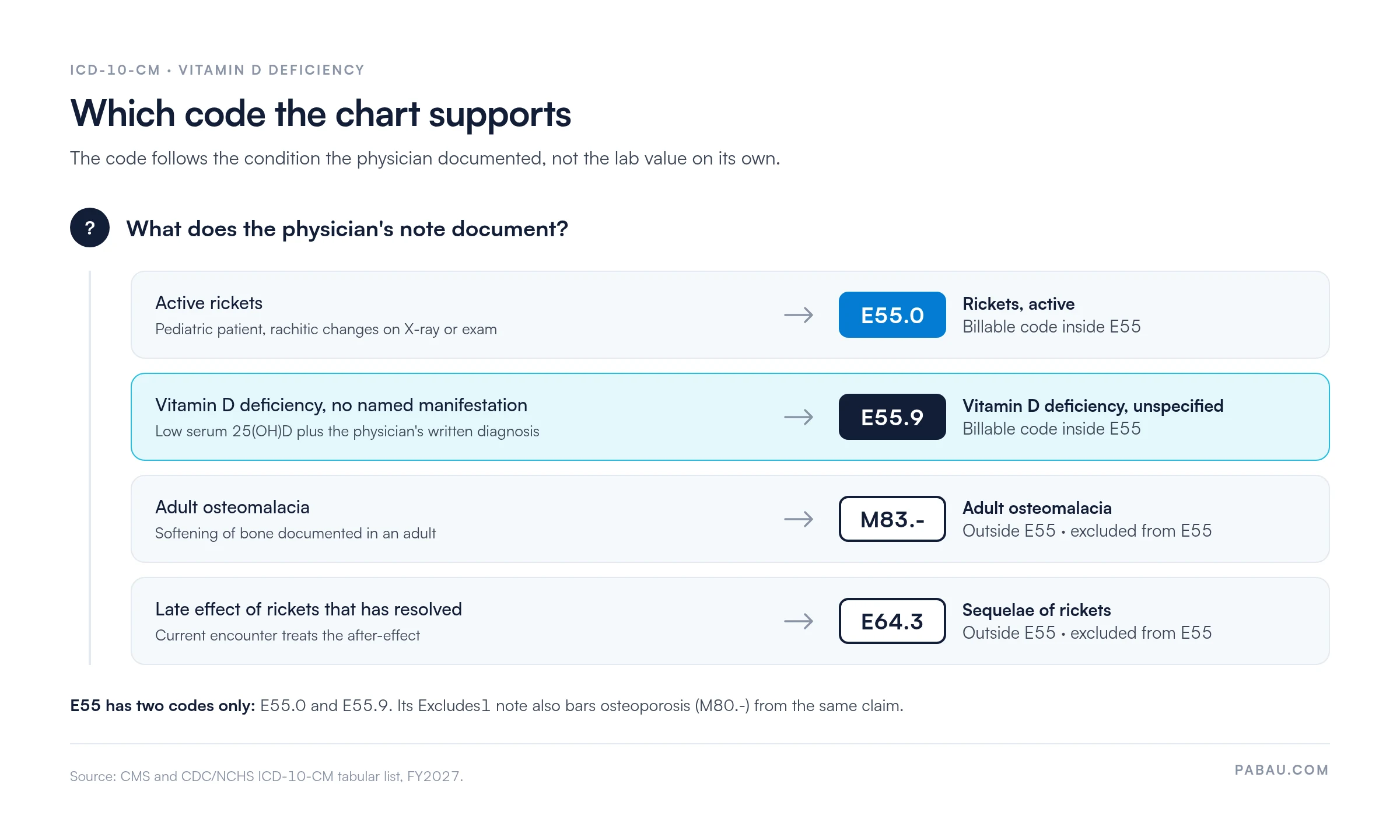
The E55 category carries coding instructions that affect how ICD-10 code E55.9 appears on a claim. Ignoring them is a frequent source of denials and coding audits.
Reviewing the AAPC ICD-10-CM code lookup for E55 surfaces these exclusion and sequela notes:
Before submitting a claim with E55.9, check it against the E55 Excludes1 list in your encoder. That list covers adult osteomalacia (M83.-), osteoporosis (M80.-) and sequelae of rickets (E64.3). A co-listed Excludes1 code generates an edit that most clearinghouses treat as a hard error.
Documentation for ICD-10 code E55.9 must include a serum 25-hydroxyvitamin D (25(OH)D) result with a value that the treating physician has interpreted as deficient. Per Endocrine Society clinical practice guidelines, a serum 25(OH)D below 20 ng/mL is widely accepted as the deficiency threshold.
The Institute of Medicine (now the National Academy of Medicine) uses a lower cut-off. Always cite the guideline the ordering physician followed, because Medicare Administrative Contractors (MACs) apply different Local Coverage Determinations (LCDs) by region.
Beyond the lab value, medical billing compliance requires a clinical interpretation in the physician’s note. The note must state that deficiency is present and clinically significant for this patient.
When vitamin D deficiency drives the encounter, several CPT codes pair regularly with E55.9. The linkage must be medically necessary, so each procedure code should trace back to E55.9 as the supporting diagnosis. The most common pairing is CPT 82306, the assay that confirms the deficiency in the first place.
Practices using claims software built for practices can map diagnosis codes to procedure codes at charge entry. That cuts the mis-linked CPT/ICD-10 pairs that trigger automated edits.
Medicare coverage for E55.9 claims is governed by the LCD each MAC issues. No single national coverage rule applies uniformly. Practices billing vitamin D testing or infusion under E55.9 should identify their MAC and review the applicable LCD before submission.
Pabau sends US claims through Claim.MD, its clearinghouse partner, which runs eligibility checks and claim edits before an E55.9 claim reaches the payer. A medical claims clearinghouse is where a mis-linked diagnosis or a missing modifier gets caught, before it turns into a denial.
Prior authorization is not universally required for E55.9 claims, but payers commonly require it for an IV infusion billed under 96365. Oral supplementation prescribed during an office visit typically does not need pre-auth. Practices should check each payer’s requirements before scheduling infusion therapy, and document the medical necessity justification for IV vs. oral delivery in the chart.
E55.9 denials cluster around five recurring failures. Knowing each one, and the documentation that corrects it, cuts rework and shortens the revenue cycle. For denial patterns across other codes, our guide to denial management in healthcare covers appeal workflows and prevention.
Practices with high volumes of nutritional deficiency claims can use our reference of denial reason codes. It traces each claim adjustment reason code (CARC) back to the missing record behind the rejection.
Vitamin D deficiency rarely appears in isolation on a claim. Coders documenting the full clinical picture should consider these co-diagnosis codes when the physician’s note supports them. Report each code only when documented and relevant to the encounter. Osteoporosis codes are left off this list, because the E55 Excludes1 note covers osteoporosis.
ICD-11, published by the World Health Organization in its ICD-11 browser, classifies vitamin D deficiency under 5B57 in Chapter 5 (Endocrine, nutritional or metabolic diseases). Unlike ICD-10-CM, it keeps osteomalacia inside the vitamin D deficiency code. Rickets is 5B57.0, osteomalacia is 5B57.1, and unspecified deficiency is 5B57.Z.
No mandatory US adoption date for ICD-11 has been announced by CMS as of publication. ICD-10-CM remains the operative system for US insurance claims. Coders should monitor CMS ICD-10 update announcements for transition guidance, but no immediate change to E55.9 billing workflows is expected. Continue using E55.9 on US claims until CMS issues a transition timeline.
Set a calendar reminder each August to review the new ICD-10-CM FY update files from CMS. Vitamin D deficiency codes in the E55 category have been stable. The exclusion notes and the sequela code (E64.3) still receive occasional clarifying updates that change how co-diagnosis codes are sequenced on a claim.
IV vitamin D therapy is the highest-complexity billing scenario involving E55.9. Practices running infusion programs, IV therapy practices included, need a consistent workflow covering diagnosis, prior authorization and claim submission to avoid payment delays.
In many practices the 25(OH)D result sits in a lab portal and the diagnosis sits in the physician’s note. The claim is then built by hand at the billing desk. When those three drift apart, the claim goes out with E55.9 but without the evidence that supports it.
Pabau holds those pieces in one patient record. Practices that switch on Labs order Quest tests from the record, and Quest and Labcorp results sync back automatically with their dates. For infusion patients, the prior authorization code, dates and sessions are tracked on the case, with a warning when one is missing.
At charge entry, claims management links E55.9 to each CPT code. Claims then go out through Claim.MD, which runs eligibility checks and claim edits first. The claim is built from the same record that holds its lab value, so the documentation a payer asks for is already on file.

Pabau links diagnosis codes like E55.9 to CPT procedures at charge entry. It then runs eligibility checks and claim edits through Claim.MD before claims reach the payer.

Vitamin D deficiency claims fail on documentation more often than on code choice. The code selection, E55.0 vs. E55.9 (osteomalacia is coded to M83.-), is straightforward once the physician’s note is complete.
The work worth doing happens before submission. Check that each E55.9 claim carries the serum 25(OH)D value and the physician’s written interpretation. For infusions, confirm the authorization is on file too. That one habit closes off three of the five denial reasons above.
Book a demo to see how Pabau keeps the lab result, the note and the claim for each E55.9 patient in one record.

Need a denial management framework for nutritional deficiency claims? Denial management in healthcare covers CARC code interpretation and appeal workflows.
Looking for clean claim submission best practices? What makes a clean claim explains the documentation and coding elements payers check before processing payment.
Want to understand how remittance advice connects to your E55.9 denials? Electronic remittance advice explained breaks down ERA file structure and denial code mapping.
ICD-10 code E55.9 is the billable ICD-10-CM diagnosis code for vitamin D deficiency, unspecified. It is used when lab values confirm deficiency but the clinical record names no specific manifestation, such as active rickets (E55.0). It is valid for FY2027 claims.
E55.0 is active rickets, assigned only when the physician documents rachitic bony changes in a pediatric patient. E55.9 is unspecified vitamin D deficiency, used when lab values confirm deficiency without a named clinical manifestation. Neither code covers adult osteomalacia, which is coded to M83.-.
A serum 25-hydroxyvitamin D (25(OH)D) result below 20 ng/mL, combined with a physician’s written interpretation of deficiency, is the primary evidentiary standard. Some MAC LCDs set a different threshold, so always verify against the applicable LCD for the patient’s region.
The two most common triggers are missing serum 25(OH)D lab documentation and using E55.9 when the record supports E55.0. Payers also deny for an insufficient medical necessity narrative and missing prior authorization for IV infusion. An Excludes1 conflict at the E55 category level completes the list.
It can, but payer acceptance is not universal. Before accepting E55.9 as the primary diagnosis for IV infusion, some commercial payers and MACs require extra documentation or prior authorization. Others want proof that oral supplementation was tried and failed. Verify payer-specific requirements before billing.
Medicare Part B does not cover oral vitamin D supplementation regardless of E55.9 documentation. Lab testing (CPT 82306) may be covered when medical necessity is demonstrated under the applicable MAC LCD. IV infusion coverage is payer- and LCD-specific and commonly requires prior authorization.