

HCPCS Code Q4175: Billing, coverage, and documentation guide
HCPCS Code Q4175: Code Description and Product Identity HCPCS Code Q4175 is the ...

Last Updated: Nov 20, 2026
92579 is the CPT code for visual reinforcement audiometry (VRA), a behavioral hearing test for infants and toddlers aged about 6 months to 2.5 years. The audiologist pairs each sound with a lit toy or video, so the child learns to turn toward it.
The code itself is simple. Claims stall on the details around it: the child's response method, the order behind the test, and a threshold for every frequency. Get those right and 92579 pays on the first pass.
Let Pabau's smart automation suggest the right codes, reduce claim denials, and keep your practice compliant—effortlessly.
Automate repetitive tasks and focus on what matters most—your patients.
Reduce coding errors and ensure compliance with the latest regulations.
Clean claims, fewer denials, and faster reimbursements.
Powerful insights and reporting to help your practice thrive.
HIPAA compliant SOC 2 certified GDPR-compliant Trusted by 4,000+ clinics worldwide

CPT 92579 bills visual reinforcement audiometry (VRA), a behavioral hearing test for infants and toddlers who can’t yet do play or conventional audiometry.
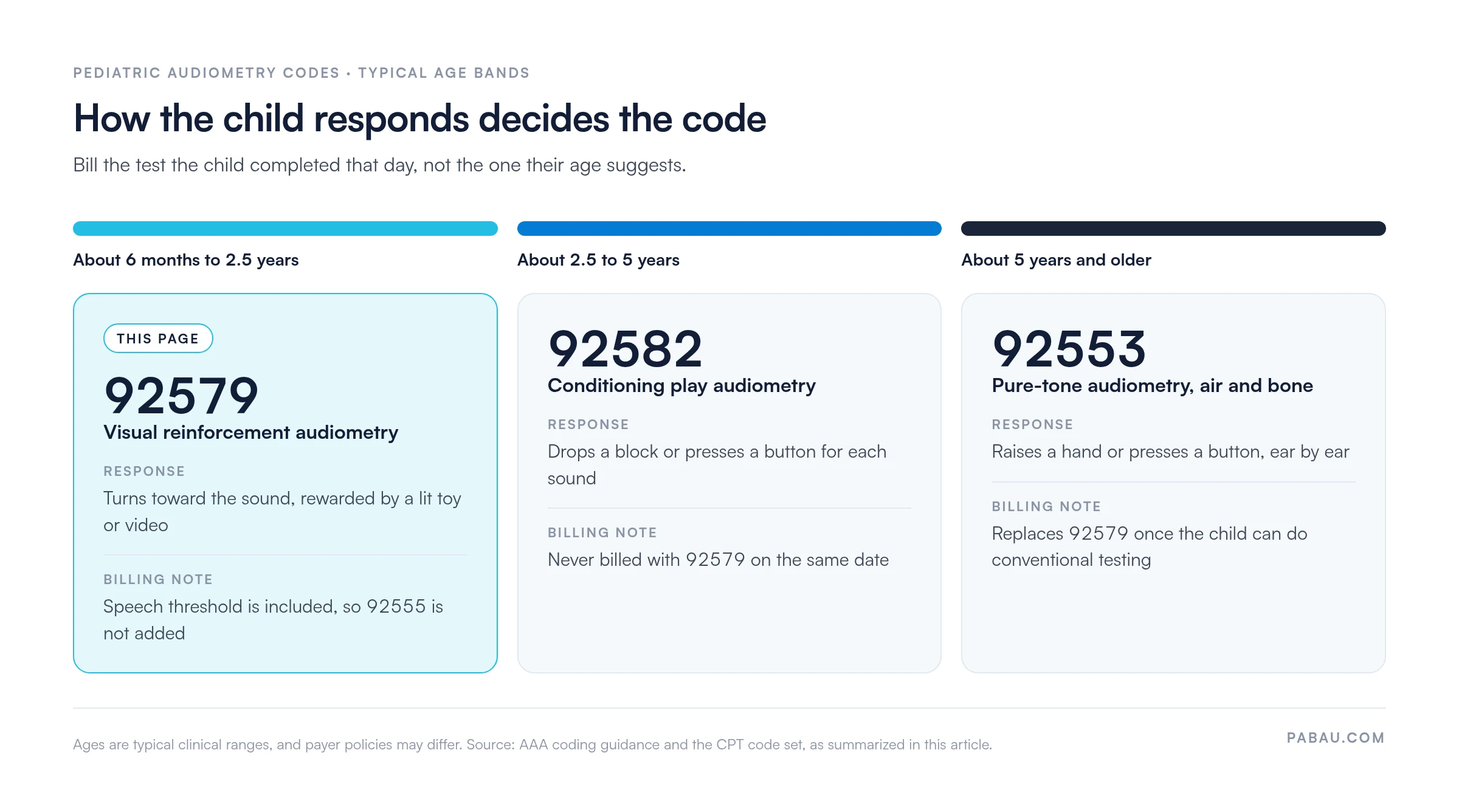
Choose the code by how the child responds: a conditioned head turn is 92579, a play task is 92582, and a raised hand is 92553.
Speech threshold is part of the VRA service, so 92555 isn’t customarily billed on top of 92579.
The 2026 national Medicare rate is about $43.09 non-facility and $29.73 facility, before geographic adjustment.
Most denials trace back to a missing order, thresholds without per-frequency detail, or a diagnosis outside the payer’s covered list.
CPT code 92579 covers visual reinforcement audiometry (VRA), a behavioral hearing test for patients too young or impaired for standard audiometry. The American Academy of Audiology’s coding guidance says VRA estimates the type and severity of hearing loss in infants, children and difficult-to-test patients.
The audiologist pairs each sound with a visual reward, usually a lit toy or a short video. After a few pairings, the child turns toward the reward whenever they hear the sound. VRA tests hearing in the sound field, or ear by ear when insert earphones are used.
The softest level that reliably earns a head turn is recorded in dB HL for each frequency. The test needs a sound-treated booth and calibrated equipment. The quick-reference table below covers the basics a biller checks first.
One 92579 line covers calibration, conditioning, threshold searching and the write-up. The audiologist presents pure tones or narrowband noise at falling intensity levels, and the reinforcer lights up after each correct head turn.
To support the claim, the record should show these elements:
Bill 92579 once per encounter, however many frequencies you test and whether you test one ear or both. It takes no bilateral modifier. Responses can come through sound-field speakers, headphones, insert earphones or a bone oscillator.
Speech threshold is part of the service too. The American Academy of Audiology notes that VRA includes a speech threshold as standard practice, so 92555 is not customarily billed with 92579.
Each of these looks close enough to VRA to end up on the claim. Each one belongs somewhere else.
Age is a guide, not the rule. Bill the test the child completed that day, as the chart below shows, then confirm the code against the table.
Otoacoustic emissions often run in the same visit, because they check the cochlea without needing a response. The limited diagnostic version, 92587, has its own documentation rules.
Every 92579 claim needs a diagnosis that explains the test, backed by findings in the chart. A failed newborn screen or a confirmed loss supports it far better than a vague symptom code.
Code to the highest specificity the visit supports. A child with confirmed loss in both ears belongs under H90.3, not an unspecified code. The CrossCoder crosswalk tool can confirm a CPT-to-ICD-10 pairing, but commercial payers may keep their own lists.
Most VRA patients are infants and toddlers, so Medicaid and commercial plans pay the bulk of 92579 claims. Medicare claims usually involve older patients who are difficult to test, such as adults with developmental disabilities.
Medicare Part B pays for audiology diagnostic tests when a physician or qualified NPP orders them to guide treatment. The order, and the reason for it, belong in the record. Across payers, coverage generally depends on four points:
The CMS Physician Fee Schedule sets the national rates. For 2026, 92579 pays about $43.09 non-facility (1.29 total RVUs) and $29.73 facility (0.89 RVUs). Both use the $33.4009 conversion factor before GPCI adjustment.
Your local rate will differ, so check the PFS lookup for your locality before setting fees. Commercial contracts are often benchmarked against Medicare, while Medicaid rates are set state by state.
Before you bill Medicare, check whether your MAC publishes a local coverage article for audiology tests. Where one lists covered diagnoses, a 92579 claim with an unlisted code denies as CO-167 (diagnosis not covered). That denial is a coding problem, not a documentation one.
A standard, complete VRA session goes out on the CMS-1500 as a bare code. The modifiers below cover the few exceptions.
A thin note is the usual reason a 92579 claim comes back as CO-50, not deemed a medical necessity. An auditor looks for each of these in the chart note itself:
Take a 14-month-old referred after a failed newborn screen. The claim moves through seven checkpoints, and insurance eligibility verification comes first because it stops the most front-end denials.
A clean claim pays on the first pass, so the checklist below is worth a minute before every submission.
92579 denials cluster around a handful of reason codes, and each maps to a fixable error. Our guide to denial codes explains every CARC below in more depth.
The same few mistakes cause most of these. Watch for 92555 billed on top of VRA, 92579 and 92582 on one session, and a screening diagnosis on a diagnostic test. A steady denial management process catches the pattern before it repeats.
Several audiology codes can go on the same date as 92579 when each service is distinct and documented separately. NCCI edits change every quarter, so check the current status before you submit any pairing.
When the workup adds acoustic reflexes to tympanometry, report 92550 in place of 92567. The two middle ear codes are not billed together.
Once a quarter, pull every 92579 remittance with a CO-97 code and note the companion code behind each one. If one payer keeps bundling the same pair, it may apply its own edit policy. Add a modifier check for that payer to your pre-submission routine.
In many audiology practices, the claim is built by hand after the visit. Someone retypes the diagnosis, looks up the code and hopes the order details made it across. A single missing field sends the claim back weeks later.
Pabau, a practice management platform with built-in claims management software, pre-fills the CMS-1500 from the patient record. ICD-10 and CPT lookup libraries help you pick 92579 and its diagnosis, and required fields are checked before the claim leaves.
US claims go out through Claim.MD, with eligibility checks before the visit and ERA remittances posted back against the claim. Your team spends less time rekeying data and more time on the denials that need a person.
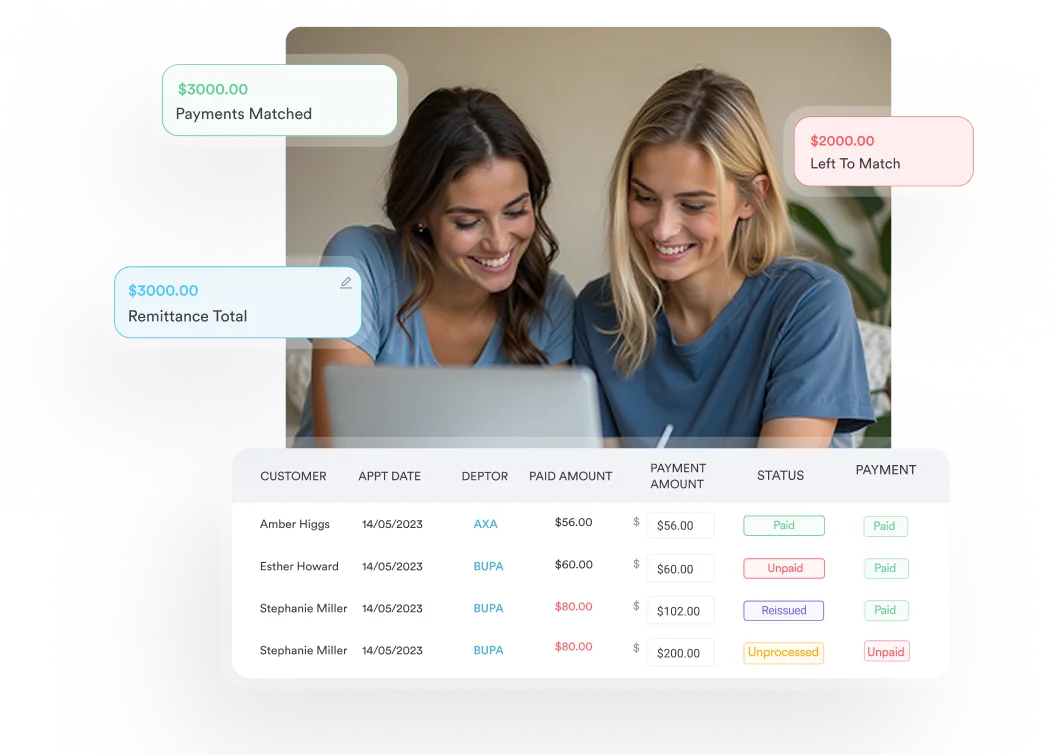

Pabau pre-fills claims from the patient record, checks required fields before sending and submits US claims through Claim.MD. Eligibility checks and ERA posting sit in the same system.

The code on a VRA claim is rarely the problem. What gets 92579 paid is a note that proves the test was needed and shows a threshold for every frequency.
If you fix one habit, make it the response-method check. Code the test the child completed, not the one their age suggests, and the choice between 92579, 92582 and 92553 stops causing rework.
Book a demo to see how Pabau pre-fills and checks each audiology claim before it reaches the payer.

Want to see how a claim reaches the payer? Our Claim.MD clearinghouse guide explains how electronic claims move through a clearinghouse.
Confused about ERA reconciliation? Electronic remittance advice explained walks through how to read and act on ERA files.
Looking for the revenue cycle context? What is revenue cycle management covers the billing lifecycle 92579 sits within, from eligibility to payment posting.
Testing an older child with headphones? CPT code 92557 covers comprehensive audiometry once a patient can respond conventionally.
Billing air-conduction thresholds only? CPT code 92552 explains pure-tone audiometry by air alone.
Yes, once every 12 months, for nonacute hearing loss only. The audiologist adds modifier AB, and 92579 is on the eligible list, as ASHA’s summary of the rule confirms. Acute hearing loss and vestibular conditions still need an order.
Yes. The descriptor sets no age limit, and audiologists use VRA for difficult-to-test patients, such as adults with developmental or cognitive disabilities. Document why conventional audiometry wasn’t possible.
No published minimum exists. The American Academy of Audiology notes that CPT gives no guidance on how many responses are needed. Record every frequency and ear you obtained, and use modifier 52 when testing stopped early.
Yes. Responses can come through sound-field speakers, headphones, insert earphones or a bone oscillator. Report bone-conduction thresholds within the same 92579 service.
92579 uses a visual reward to condition a head turn, typically from 6 months to 2.5 years. 92582 uses a play task, typically from 2.5 to 5 years. Report the one method used in the session.





