HCPCS code E0280: Bed cradle Medicare billing guide
HCPCS code E0280 describes the cradle frame, not the bed HCPCS code E0280 is the...

Last Updated: Oct 15, 2026
81206 is the CPT code for BCR/ABL1 (t(9;22)) (eg, chronic myelogenous leukemia) translocation analysis; major breakpoint, qualitative or quantitative.
It covers the p210 fusion transcript found in nearly all chronic myelogenous leukemia (CML) cases. Labs report it at diagnosis and during quantitative monitoring on tyrosine kinase inhibitor (TKI) therapy. The minor breakpoint (p190) is reported with 81207 and other breakpoints with 81208, so the breakpoint tested decides the code.
Let Pabau's smart automation suggest the right codes, reduce claim denials, and keep your practice compliant—effortlessly.
Automate repetitive tasks and focus on what matters most—your patients.
Reduce coding errors and ensure compliance with the latest regulations.
Clean claims, fewer denials, and faster reimbursements.
Powerful insights and reporting to help your practice thrive.
HIPAA compliant SOC 2 certified GDPR-compliant Trusted by 4,000+ clinics worldwide

CPT Code 81206 reports BCR/ABL1 translocation analysis at the major breakpoint (p210), whether the lab runs it qualitatively or quantitatively.
Codes 81206, 81207 and 81208 differ by breakpoint type (major, minor, other), so the test method never decides between them.
81206 is a Tier 1 molecular pathology code (81200-81383), and Medicare pays it under the Clinical Laboratory Fee Schedule.
Pabau, the practice management platform we build, submits claims electronically through Claim.MD and tracks their status.
CPT Code 81206 is a Tier 1 molecular pathology code in the 81200-81383 range of the AMA CPT code set. The official descriptor reads: BCR/ABL1 (t(9;22)) (eg, chronic myelogenous leukemia) translocation analysis; major breakpoint, qualitative or quantitative.
The phrase that decides the code is “major breakpoint.” Nearly all CML cases carry a fusion at the major breakpoint cluster region (M-bcr), which produces the p210 protein. CPT 81206 covers that transcript whether the lab reports a detected result at diagnosis or a measured level during treatment.
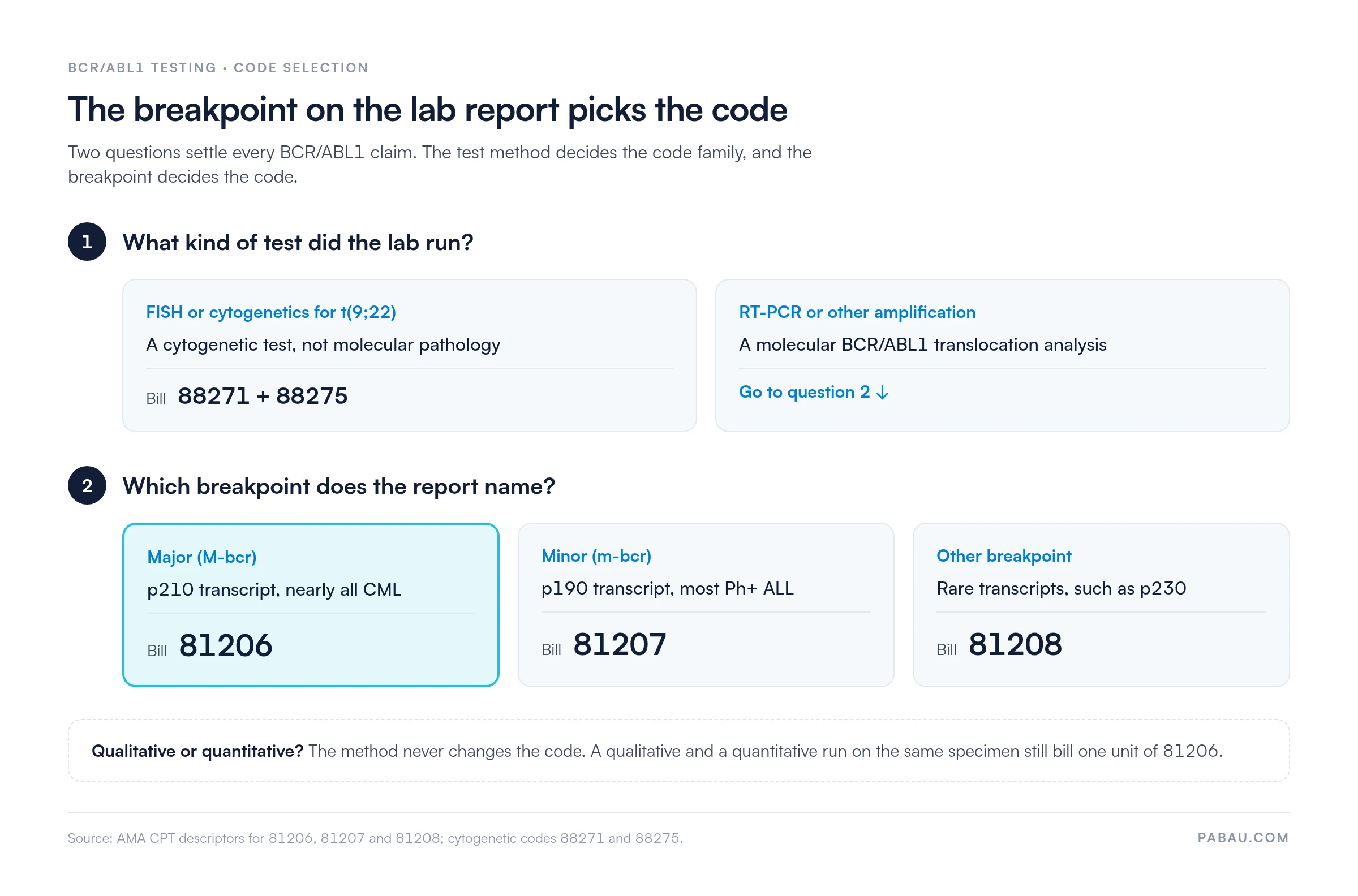
The two neighboring codes cover the other breakpoints. CPT 81207 reports the minor breakpoint (m-bcr, p190), which most Philadelphia chromosome-positive acute lymphoblastic leukemia (Ph+ ALL) cases carry. CPT 81208 reports any other breakpoint, such as the rare p230 transcript.
All three descriptors say “qualitative or quantitative,” so the method never changes the code. The breakpoint named in the lab report does. The chart below walks through both decisions, starting with whether the test was molecular at all.
Physicians order CPT Code 81206 to detect or measure the major-breakpoint BCR/ABL1 transcript. Each indication below must be documented in the medical record to support medical necessity.
National Comprehensive Cancer Network (NCCN) guidelines for CML treat molecular testing at diagnosis and quantitative monitoring during TKI therapy as standard care. That supports medical necessity when the order documents the presentation and the reason for testing.
Every CPT 81206 claim needs an ICD-10-CM code that states the clinical reason for the test. Payers check medical necessity at the diagnosis-code level, so an unspecified or mismatched code is a leading denial trigger.
Verify each code in the CDC/NCHS ICD-10-CM web tool before submission. Pick the C92.1x or C91.0x code that matches the remission status on the date of service, rather than an unspecified leukemia code.
Medicare covers BCR/ABL1 major-breakpoint analysis when the claim meets the medical necessity criteria of the Medicare Administrative Contractor (MAC). Local Coverage Determinations (LCDs) for molecular pathology set those rules, so they vary by MAC jurisdiction. Confirm which LCD applies to the performing lab before billing.
Medicare pays CPT 81206 under the CMS Clinical Laboratory Fee Schedule (CLFS), not the Physician Fee Schedule. Lab codes carry no work RVUs, so look up the payment limit in the CLFS file for the quarter of the date of service.
Pabau submits 81206 claims electronically through Claim.MD, the US clearinghouse it connects to, and tracks their status.
Medicare fee-for-service does not generally require prior authorization (PA) for CPT 81206, but many Medicare Advantage and commercial plans do. Confirm the rules before ordering with an insurance eligibility verification that captures the plan-level PA rules, not just general coverage.
Payers deny 81206 claims when the record does not show which breakpoint was tested or why. Knowing the full medical billing workflow for molecular pathology helps staff collect the right records before the claim goes out.
Required documentation for a defensible 81206 claim:
FISH for t(9;22) is a cytogenetic test, reported with 88271 and 88275 rather than 81206. Keep those codes off a claim for a PCR-based BCR/ABL1 assay.
Keeping documentation aligned with medical billing compliance standards reduces audit exposure, particularly for molecular pathology claims that attract MAC post-payment review.
Run three checks before every CPT 81206 claim. Confirm the lab report names the major breakpoint (p210) and the diagnosis is a C92.1x or C91.0x code matching remission status. Then check the PA number is attached where required. If the report names p190 or another transcript, the claim belongs on 81207 or 81208.
Denial patterns for CPT Code 81206 repeat across payers and MAC jurisdictions. Effective denial management in healthcare starts with finding which of these causes drives your rejections.
Most payers allow at least one level of administrative appeal, and Medicare runs a five-level process. The denial codes on the remittance advice tell you which appeal argument to make.
Getting paid correctly for CPT Code 81206 depends on clean claim construction and a steady order-entry workflow. The tips below address the most common leakage points, and claims software for billers helps your team act on them.
Audit your last 90 days of 81206 claims and group them by denial reason using your clearinghouse ERA data. If more than 15% share the same CARC, the cause usually sits at order entry. Fix the step that produces the missing field instead of correcting each claim after denial.
Many lab and oncology billing teams build 81206 claims by hand from the order and the lab report. A wrong breakpoint code or a missing PA number then shows up weeks later as a denial.
Pabau keeps the patient record and the claim in one system. It submits claims through Claim.MD and tracks their status.
Your coders run the breakpoint, diagnosis and PA checks in this guide before each claim goes out. When a rejection comes back, they see it in Pabau and can correct it while the details are fresh.

See how Pabau submits claims electronically through Claim.MD and tracks their status.

Code 81206 from the breakpoint the lab tested, and the most common error on this code family goes away. The major breakpoint (p210) is 81206 whether the result is qualitative or quantitative. The minor breakpoint (p190) is 81207, and any other transcript is 81208.
The trade-off is documentation. When a lab report omits the breakpoint, a coder cannot choose the right code and a payer cannot verify it. Ask your lab to name the transcript on every report, and build the PA and diagnosis checks into order entry.
Book a demo to see how Pabau submits claims through Claim.MD and tracks their status.

Need to understand how clearinghouse submission works end to end? Medical claims clearinghouse overview explains how electronic claim routing, validation, and ERA processing connect payers to your billing system.
Seeing recurring denials on your 835 remittance files? Electronic remittance advice (ERA) guide breaks down how to read CARC and RARC codes and route denial corrections efficiently.
Want the bigger picture behind each 81206 claim? Revenue cycle management fundamentals covers the end-to-end process from eligibility through collections.
Billing a molecular test with no Tier 1 code? CPT code 81479 billing guide covers the unlisted molecular pathology code and the documentation payers expect with it.
CPT Code 81206 covers BCR/ABL1 (t(9;22)) translocation analysis at the major breakpoint, which produces the p210 fusion protein found in nearly all CML cases. It applies to both qualitative and quantitative testing. It is a Tier 1 molecular pathology code in the 81200-81383 range.
The two codes differ by breakpoint, not by method. CPT 81206 reports the major breakpoint (p210), and CPT 81207 reports the minor breakpoint (p190), which most Ph+ ALL cases carry. Both descriptors cover qualitative or quantitative analysis, so quantitative p210 monitoring still bills 81206.
Yes, Medicare covers CPT 81206 when the claim meets the medical necessity criteria in the MAC’s Local Coverage Determination for molecular pathology. Medicare pays it under the Clinical Laboratory Fee Schedule. The claim needs a documented indication and a specific ICD-10-CM code, typically from C92.1x.
You need a signed physician order with the clinical indication and a lab report naming the method, specimen, breakpoint analyzed and result. Add the clinical note supporting the test, a matching ICD-10-CM code, and the PA number if the plan required one. Keep each element in the medical record for post-payment audits.