CPT Code 88346
CPT code 88346 is the billing code for direct immunofluorescence (DIF) on a tiss...

Last Updated: Nov 26, 2026
80321 is the CPT code for definitive testing of alcohol biomarkers, 1 or 2. Labs bill it when they confirm ethyl glucuronide (EtG), ethyl sulfate (EtS) or both, and sometimes phosphatidylethanol (PEth). Three or more biomarkers move the claim to 80322.
The code sits in the 80320-80377 definitive drug testing range. Ethanol, methanol and isopropanol belong to 80320 instead. Medicare does not accept 80320-80377 and takes HCPCS G0480-G0483, so 80321 goes to commercial and Medicaid plans.
Let Pabau's smart automation suggest the right codes, reduce claim denials, and keep your practice compliant—effortlessly.
Automate repetitive tasks and focus on what matters most—your patients.
Reduce coding errors and ensure compliance with the latest regulations.
Clean claims, fewer denials, and faster reimbursements.
Powerful insights and reporting to help your practice thrive.
HIPAA compliant SOC 2 certified GDPR-compliant Trusted by 4,000+ clinics worldwide

CPT code 80321 reports definitive testing for alcohol biomarkers, 1 or 2, which usually means ethyl glucuronide (EtG), ethyl sulfate (EtS) or both.
The analyte decides the code. One or two alcohol biomarkers is 80321, three or more is 80322, and ethanol or methanol belongs to 80320.
Medicare does not accept CPT 80320-80377, so a Medicare claim for EtG or EtS confirmation reports HCPCS G0480 instead.
Pair 80321 with an alcohol diagnosis such as F10.20 or F10.21, never Z79.891, which describes long-term opiate analgesic use.
Practices using Pabau, a practice management platform, keep the lab order, the imported result and the Claim.MD claim on one patient record.
CPT code 80321 is the definitive drug testing code for alcohol biomarkers, 1 or 2. Payer policies such as Michigan’s Blue Cross Complete drug testing policy list it as “Alcohol biomarkers; 1 or 2” in the 80320-80377 range. Labs use it to confirm ethyl glucuronide (EtG), ethyl sulfate (EtS) or both.
The tier follows the number of biomarkers the lab reports. EtG and EtS reported together stay inside the “1 or 2” tier, so they make one line of 80321. Labcorp’s Medtox test directory, for example, lists its urine EtG and EtS test under 80321, run by LC-MS/MS.
The American Medical Association publishes the full CPT descriptor in its codebook. The wording above is how payer policies and lab directories print it.
Alcohol biomarkers are compounds the body makes when it processes ethanol. They stay detectable longer than ethanol itself, which is why abstinence monitoring programs order them.
Lab directories warn that incidental exposure, such as hand sanitizer or mouthwash, can produce a detectable EtG or EtS result. Record any reported exposure in the chart, because it shapes how the result is read and whether a repeat test is justified.
Choose the code from what the lab measured and how many alcohol biomarkers it reported. Ethanol and the other alcohols sit in 80320, while the biomarker count splits claims between 80321 and 80322.
The rest of the range works the same way. 80323 covers alkaloids not otherwise specified, 80324-80326 tier amphetamines by analyte count, and 80329 covers non-opioid analgesics, 1 or 2. Most drug classes split into tiers by how many analytes the lab reports.
One payer document still prints 80322 as “3 or 4”. Anthem and Molina use “3 or more”, which matches the AMA wording, so a three-biomarker panel is 80322 either way.
CPT 80321 is a definitive code. Definitive testing identifies each analyte, while presumptive testing shows only that a drug class is probably present. Presumptive testing reports with 80305, 80306 or 80307, and the older 80300-80304 were deleted.
The method name alone does not settle the code, because the 80307 descriptor also lists mass spectrometry. The lab report has to show that the test identified each biomarker. An EtG immunoassay run on a chemistry analyzer is presumptive, so it reports with 80307.
Billing a presumptive and a definitive code on the same date is payer-dependent. Blue Cross Complete, for example, does not pay the definitive code separately when the same independent lab reports 80307 that day.
Medicare does not accept CPT 80320-80377, as AAPC’s Pathology/Lab Coding Alert confirms. A Medicare claim for EtG or EtS confirmation reports HCPCS G0480 instead.
The G codes count drug classes per day. A test limited to alcohol biomarkers falls in the lowest tier, G0480.
The “1-7 drug class(es)” wording that circulates for 80321 belongs to G0480. It is not part of the CPT descriptor, so a chargemaster line built on it needs correcting. The CPT codes for drugs with no named class are 80375-80377, and Medicare does not accept those either.
A clean claim submission for 80321 starts with the payer and ends with the lab report agreeing with the code. Work through these steps in order:
Taken together, the payer, the test method and the biomarker count settle the code in four checks.
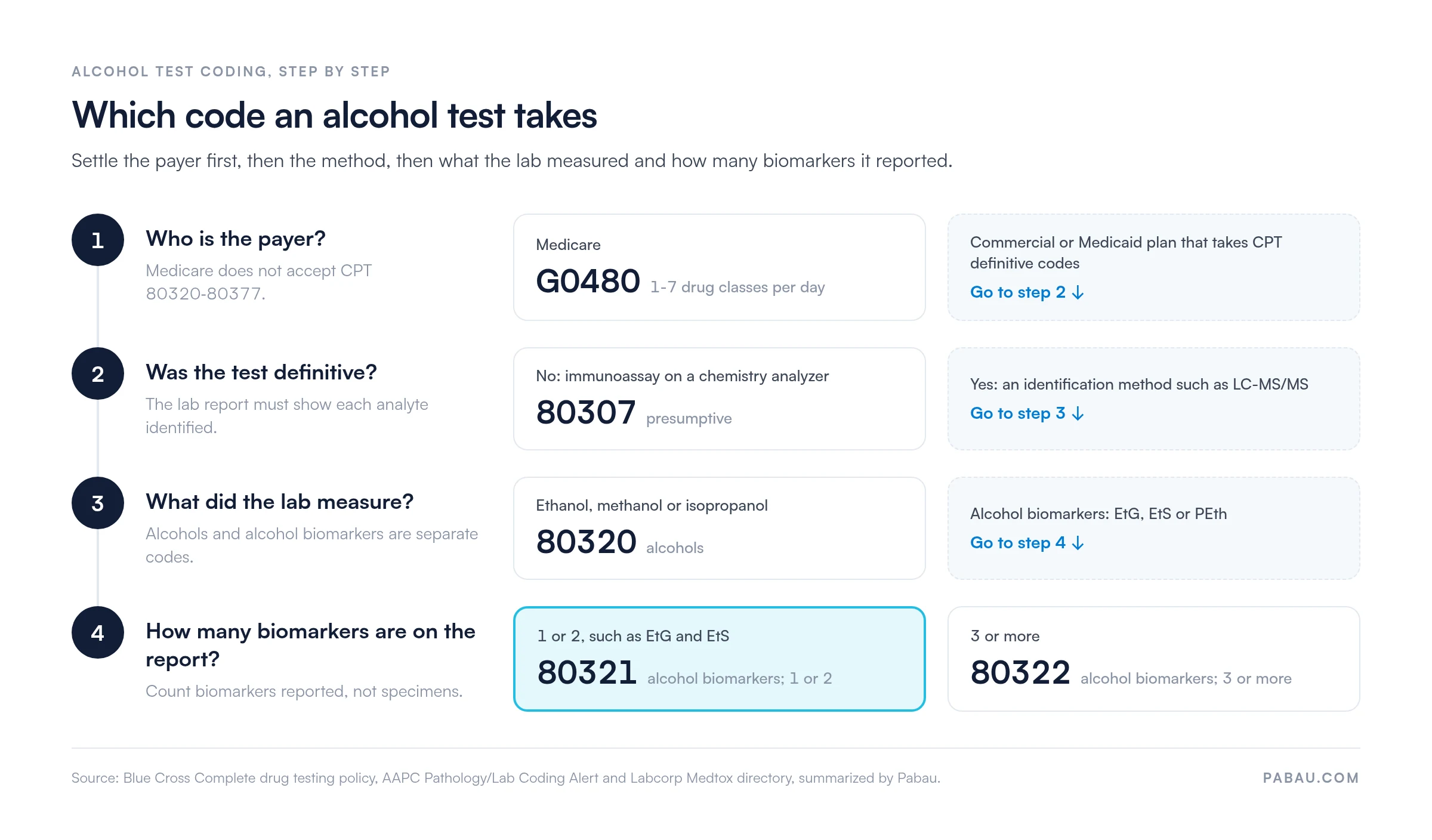
Medical necessity rests on the diagnosis that explains why alcohol use needs monitoring. The descriptors below are the official ICD-10-CM wording, so confirm each pairing against the payer’s own policy.
Z79.891 is “Long term (current) use of opiate analgesic”. It supports opioid monitoring and does not justify alcohol biomarker testing, so keep it off 80321 claims. During active treatment, F10.20 is the usual pairing for abstinence monitoring. When the chart documents dependence in remission, F10.21 tells the payer exactly why abstinence is being checked.
Laboratory codes such as 80321 fall under the CMS Clinical Laboratory Fee Schedule, not the Physician Fee Schedule. Medicare pays the equivalent service through G0480, so look up G0480 on the CLFS file for Medicare patients.
Commercial and Medicaid payers set their own 80321 rates through fee schedules and lab contracts. Check the payer’s fee schedule or your contract before you quote a figure to a patient.
CLFS rates have been set from private-payer data since the Protecting Access to Medicare Act (PAMA). A contract pegged to Medicare rates moves when the annual CLFS file changes, so review it each year.
Two parties document an 80321 claim: The ordering provider and the performing laboratory. An audit pulls both records, and neither one can stand in for the other.
The ordering provider documents:
The performing laboratory documents:
Record who requested the test as well. Policies such as Blue Cross Complete’s exclude testing done only for employment, school activities or a court order. Good medical billing documentation ties the order, the lab report and the claim to the same encounter.
Most 80321 denials trace back to the wrong payer code, the wrong tier or a thin order. For the remark codes behind them, see Pabau’s guide to denial codes in medical billing.
A structured denial management workflow groups remark codes by cause. That shows which of these errors keeps coming back, so you can fix it at the order or the chargemaster.
Audit your chargemaster for 80321. If the line still reads alcohols or 1-7 drug class(es), it was built on the wrong descriptor. Rename it Alcohol biomarkers; 1 or 2, and map ethanol tests to 80320.
In many practices the EtG order, the lab result and the claim live in three places. The biller reads a PDF result, counts biomarkers by hand and picks a code days later. That is where 80321, 80322 and G0480 get swapped.
Pabau keeps those steps on one patient record. Practices that switch on labs order Quest tests from the record, or place Labcorp orders in Labcorp Link. Results sync back automatically, so the biller sees which biomarkers were reported before choosing the code.
Pabau’s claims management software then sends the claim through Claim.MD, with eligibility checks and ERA remittances. Prior authorization codes, dates and sessions sit on the case, with a warning when one is missing. A plan that requires authorization for drug testing is easier to manage. A missing authorization is flagged on the case before the claim goes out.

Pabau keeps the lab order, the imported EtG or EtS result and the Claim.MD claim on one record. The biomarker count on the report and the code on the claim agree before submission.

Code every alcohol test by settling the payer before you count anything. Medicare patients get G0480, so the choice between 80321 and 80322 only arises on commercial and Medicaid claims.
Fix the descriptor in your chargemaster first, then make the order and the lab report agree on the biomarker count. That single check stops most tier and payer errors before the claim leaves the practice.
Book a demo to see how Pabau links lab orders, results and claims for practices that monitor alcohol use.

Need to understand the broader clearinghouse submission workflow? Electronic remittance advice (ERA) explained covers how 835 ERA files map denial reason codes to specific claims. That gives you an audit trail for every 80321 submission.
Seeing repeat claim rejections on drug testing codes? Insurance eligibility verification explains how to confirm active coverage and benefits before the specimen is collected.
Want a complete view of the revenue cycle behind lab billing? What is revenue cycle management? walks through each stage of the revenue cycle, from scheduling to payment posting.
Billing a broad drug panel for a Medicare patient? HCPCS code G0483 covers definitive testing for 22 or more drug classes, the top tier of the Medicare G codes.
Choosing the diagnosis behind an alcohol test order? ICD-10 code F10 for alcohol use disorder breaks down the F10 codes that support alcohol biomarker testing.
CPT code 80321 covers definitive testing for alcohol biomarkers, 1 or 2. Labs use it most often for ethyl glucuronide (EtG) and ethyl sulfate (EtS), and sometimes for phosphatidylethanol (PEth). Three or more biomarkers move the claim to 80322.
CPT 80320 reports alcohols, such as ethanol, methanol and isopropanol. CPT 80321 reports alcohol biomarkers, 1 or 2, such as EtG and EtS. A lab that measures both on one date reports each code on its own line.
CPT 80322 is alcohol biomarkers, 3 or more. Use it when the lab reports three or more alcohol biomarkers on the same date of service. Anthem and Molina print it this way, although one Blue Cross Complete document says 3 or 4.
No. Medicare does not accept CPT 80320-80377. A Medicare claim for alcohol biomarker testing reports HCPCS G0480, the definitive testing code for 1-7 drug classes per day.
Commercial and Medicaid payers set their own rates for 80321, so check the payer fee schedule or your lab contract. For Medicare patients, look up G0480 on the CMS Clinical Laboratory Fee Schedule, which CMS updates every year.
It depends on the payer. 80307 is a presumptive code for instrument chemistry analyzers, and 80321 is definitive. Blue Cross Complete, for example, does not pay the definitive code separately when the same independent lab reports 80307 that day.
Alcohol diagnoses such as F10.10, F10.20, F10.21 and F10.99 are the usual pairings. Z79.891 describes long-term opiate analgesic use, so it does not support alcohol biomarker testing.
The ordering provider records why testing is needed, how the result changes care and a supporting diagnosis. The lab report lists each biomarker tested, its result, the method and the collection date. Both records stay in the chart for audit.