HCPCS code P9058: Red blood cells, leukocytes reduced, CMV-negative, irradiated
HCPCS code P9058: Official descriptor and key attributes HCPCS code P9058 report...

Last Updated: Oct 26, 2026
80320 is the CPT code for definitive drug testing of Drug Class List A, the alcohols class. The code covers methods that identify individual drugs and distinguish between structural isomers, such as GC/MS or HPLC/MS. Immunoassays and enzymatic methods are excluded.
The alcohols class is billed as one unit per date of service, whether the lab confirms ethanol alone or adds methanol and isopropanol. Medicare does not accept 80320 and takes HCPCS G0480-G0483 instead, while commercial payers reimburse it under their own contracts.
Let Pabau's smart automation suggest the right codes, reduce claim denials, and keep your practice compliant—effortlessly.
Automate repetitive tasks and focus on what matters most—your patients.
Reduce coding errors and ensure compliance with the latest regulations.
Clean claims, fewer denials, and faster reimbursements.
Powerful insights and reporting to help your practice thrive.
HIPAA compliant SOC 2 certified GDPR-compliant Trusted by 4,000+ clinics worldwide

CPT code 80320 reports definitive testing for the alcohols drug class only, billed as one unit per date of service.
Medicare does not accept 80320, so bill G0480 for 1-7 drug classes or the G-code tier that matches the class count.
A missing or unsigned physician order is the most common reason an 80320 claim is denied.
Pabau’s claims management software submits 80320 claims through Claim.MD and tracks their status and remittance.
CPT code 80320 covers definitive drug testing of the alcohols class (Drug Class List A) in the AMA’s CPT code set. Definitive testing means definitive testing as a method that identifies specific drugs, qualitative or quantitative, and distinguishes between structural isomers. Because chromatography with mass spectrometry is the usual method, 80320 sits apart from the presumptive immunoassay screens reported under 80305-80307.
Instead of billing per analyte, the code is billed per drug class. Testing ethanol alone and testing ethanol plus methanol on the same specimen both yield one unit of 80320. Both analytes belong to the alcohols drug class.
The alcohols class covers a short list of analytes. Common analytes billed under 80320 include:
Check the AMA Definitive Drug Classes table for the current analyte list before you assign the code. Otherwise, a compound outside the alcohols class is not reported with 80320.
Specimen type is most commonly urine, although serum or blood is acceptable depending on the clinical question. However, the critical distinction is methodology. If the laboratory uses an immunoassay screen without mass spectrometry confirmation, the result qualifies as presumptive, not definitive, and 80320 is not the correct code.
First, definitive drug testing identifies specific drugs and distinguishes between structural isomers. In contrast, presumptive testing indicates probable presence or absence without that analytical specificity. CPT code 80320 sits in the definitive tier alongside codes 80321 through 80377, each covering a distinct drug class.
In most clinical workflows, a presumptive screen (80305 or 80307) precedes definitive testing. When the screen returns a positive, unexpected, or clinically inconsistent result, the ordering provider requests definitive confirmation. That second step is therefore what 80320 documents for the alcohols class. Definitive testing may also be ordered without a prior screen when the clinical question needs a specific drug identified from the outset.
CPT 80307 is a presumptive, multi-class code billed once per date of service, however many drug classes are screened. CPT code 80320 is a definitive, single-class code billed once per drug class confirmed. Because they serve different steps in the testing workflow, they are generally not billable together for the same drug class on the same date.
National Correct Coding Initiative edits govern the bundling relationship between 80307 and 80320. These edits update quarterly, so verify current NCCI tables before assuming a modifier 59 will overcome a denial for same-class, same-date submission.
Each code from 80320 through 80377 maps to a specific drug class. Multiple codes from this family may be billed on the same date of service when the laboratory definitively tests multiple drug classes. Below are selected codes showing where 80320 sits alongside its neighbors.
For example, a pain management panel may definitively test opiates, benzodiazepines, and alcohols on the same DOS. On a commercial claim, codes 80361, 80346 (or 80347), and 80320 may then all be stacked. Each is billed as one unit for its respective class, subject to payer frequency limits.
Bill 80320 as a separate line per drug class tested definitively. Do not combine alcohols with another drug class under a single 80320 unit, and do not substitute 80307 for a panel of definitive tests. Stacking individual definitive codes (80320, 80321, 80346, 80361, etc.) is the correct approach when multiple classes are confirmed on the same date.
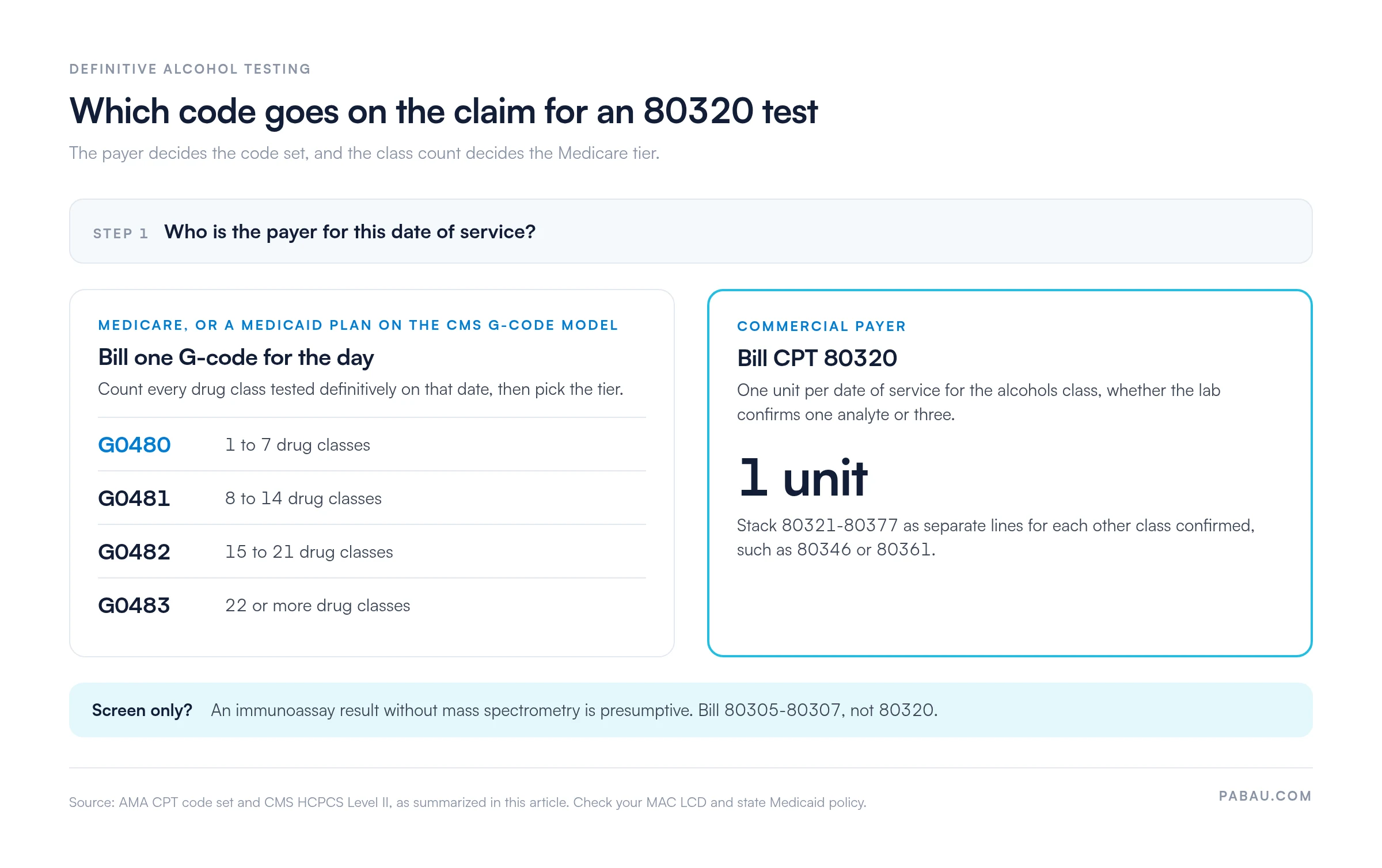
Medicare does not reimburse CPT code 80320 for definitive drug testing. CMS replaced the 80320-80377 CPT family with HCPCS G-codes for Medicare (and Medicaid programs that follow the CMS G-code model; check your state). As a result, submitting 80320 to a Medicare payer produces a denial. Specifically, the correct G-code depends on how many drug classes are tested definitively on the same date of service.
If a Medicare patient’s panel definitively tests alcohols as the only drug class, bill G0480 (1-7 classes). If alcohols are tested alongside six other definitive classes, G0480 still applies because the total falls within the 1-7 range. By contrast, a panel of 22 or more classes moves to G0483, the top tier.
Verify class-count thresholds against the CMS HCPCS Level II guidelines and your applicable MAC LCD, because local policy may update specific boundaries. For commercial payers, however, CPT code 80320 remains the correct submission. The chart below walks through that choice for a single date of service.
Commercial payers reimburse 80320 under their own contracted fee schedules, so rates vary by payer contract. The Clinical Laboratory Fee Schedule applies to Medicare, which pays G0480-G0483 rather than 80320. CMS publishes the CLFS annually, so check CMS.gov for current rates because figures change each calendar year.
Submitting through a Claim.MD clearinghouse adds real-time eligibility checks and ERA processing, which shortens the wait between test completion and payment.
Most commercial payer contracts cover definitive drug testing when medical necessity is documented and a signed physician order is on file. Prior authorization thresholds and frequency limits vary by payer and state, so confirm the annual test allowance in each payer’s policy.
Payer audits on definitive drug testing codes focus heavily on documentation completeness. A technically correct claim for CPT code 80320 fails review when the chart does not contain each of the following elements.
Billing compliance for drug testing means these elements must be present before the claim leaves the practice. Retroactive correction after a denial audit costs far more than a pre-submission checklist. Consistent clean claim submission depends on tying the lab order to the clinical note and the ICD-10 code at ordering, not at billing.
The ICD-10 diagnosis linked to CPT code 80320 must satisfy the medical necessity standard in the applicable MAC LCD. The following codes are commonly accepted across most LCDs, but verify against your specific MAC’s current documentation before treating any list as exhaustive.
Patients in alcohol use disorder programs often carry F10.20. Confirm the record supports active dependence rather than remission (F10.21) before you link it to the claim.
Use the CDC ICD-10-CM search tool to confirm each code is valid for the current year before billing. Annual updates may also retire or revise codes in this group. LCD-required diagnosis lists are MAC-specific and updated periodically, so always verify against your MAC’s current policy.
Most 80320 denials fall into a handful of recurring patterns. A structured denial management workflow catches them early, and our guide to decoding payer denial codes explains the payer reason codes behind each one.
Run a three-point check on every 80320 claim before it goes out. Confirm the signed physician order, an ICD-10 code on the MAC LCD list, and a lab report naming the confirmatory method. Running this check catches the three most common rejection triggers before the claim leaves the queue.
CPT code 80320 follows a per-drug-class billing model: one unit per class per date of service. When an alcohols panel runs twice in one day for the same patient, modifier 91 documents the repeat test for the same analyte. That is uncommon but clinically possible in serial toxicity monitoring, and the repeat must be clinically justified and documented. Units, bundling edits, and frequency restrictions interact on laboratory codes, so check all three before the claim goes out.
Definitive alcohol testing arises in several distinct practice contexts, each with its own documentation emphasis.
Billing 80320 by hand means copying the order, the diagnosis, and the lab result into the claim from three places. A Medicare claim can then go out on 80320 instead of a G-code, or a denial can sit unread in a clearinghouse portal.
Pabau, the practice management platform we build, keeps patient records, clinical notes, and claims in one system. Its claims management software works through Pabau’s Claim.MD integration, which submits claims electronically and tracks status and remittance. That way, the documentation you attach at ordering reaches the payer.
Denials then show up next to the patient record. Your team can fix a missing order or a wrong code tier and resubmit while the documentation is fresh.

Pabau keeps patient records and claims in one system, and its Claim.MD integration submits 80320 claims and tracks their status and remittance.

Settle the payer before anything else. A Medicare claim, or one for a Medicaid plan on the CMS G-code model, takes G0480-G0483. A commercial claim takes 80320 at one unit for the alcohols class.
After that, the order, the diagnosis, and the methodology line on the lab report decide whether the claim survives review. Build those three checks into ordering instead of billing, and the denials covered above become rare. Book a demo to see how Pabau submits and tracks drug testing claims through Claim.MD.

Running the presumptive screen first? CPT code 80305 covers presumptive testing read by direct optical observation and how it pairs with definitive confirmation.
Need a framework for reducing laboratory billing denials? Denial management in healthcare covers root-cause analysis, appeal workflows, and payer-specific denial patterns for clinical labs.
Submitting claims through a clearinghouse for the first time? Electronic remittance advice explained walks through ERA processing, 835 file structure, and how to read payer remittance reports after submission.
Preparing for a lab billing audit? Medical billing compliance explains the documentation and policy controls auditors check first.
Want to understand the full medical billing cycle for lab codes? Revenue cycle management overview explains how lab billing fits into the end-to-end RCM process from order through payment posting.
CPT code 80320 reports definitive drug testing for the alcohols drug class, such as ethanol, methanol, and isopropanol. The method must identify specific drugs, qualitative or quantitative, typically by chromatography with mass spectrometry. It is distinct from presumptive alcohol screening and is billed once per drug class per date of service.
Use G0480 when one to seven drug classes are tested definitively that day for a Medicare patient. The same applies to a Medicaid program that follows the CMS G-code model. Check your state’s Medicaid policy, because coding varies. G0480 is a single per-day code that replaces the individual CPT 80320-80377 codes for those payers. Stacking individual CPT codes on a Medicare claim results in a denial.
Five triggers account for most 80320 denials. The first is submitting 80320 to Medicare instead of a G0480-G0483 tier. The second is a missing or unsigned physician order, and the third is a diagnosis code not on the MAC LCD list. An NCCI bundling edit is the fourth, when 80307 and 80320 are billed for the same class and date. The fifth is a lab report that does not state the confirmatory method, such as LC-MS/MS or GC-MS.
One unit of CPT code 80320 per drug class per date of service is the standard billing model. If only the alcohols class is tested definitively, bill one unit. Payer frequency limits and NCCI edits may restrict additional units. Check the applicable LCD and current NCCI table, because edits update quarterly. Prior authorization may be required when frequency thresholds are exceeded.