HCPCS Code L0472: Hyperextension TLSO billing guide
HCPCS code L0472: Official descriptor and device definition HCPCS code L0472 des...

Last Updated: Nov 5, 2026
77071 is the CPT code for manual application of stress by a physician or other qualified health care professional for joint radiography. The descriptor also includes the contralateral joint, if indicated.
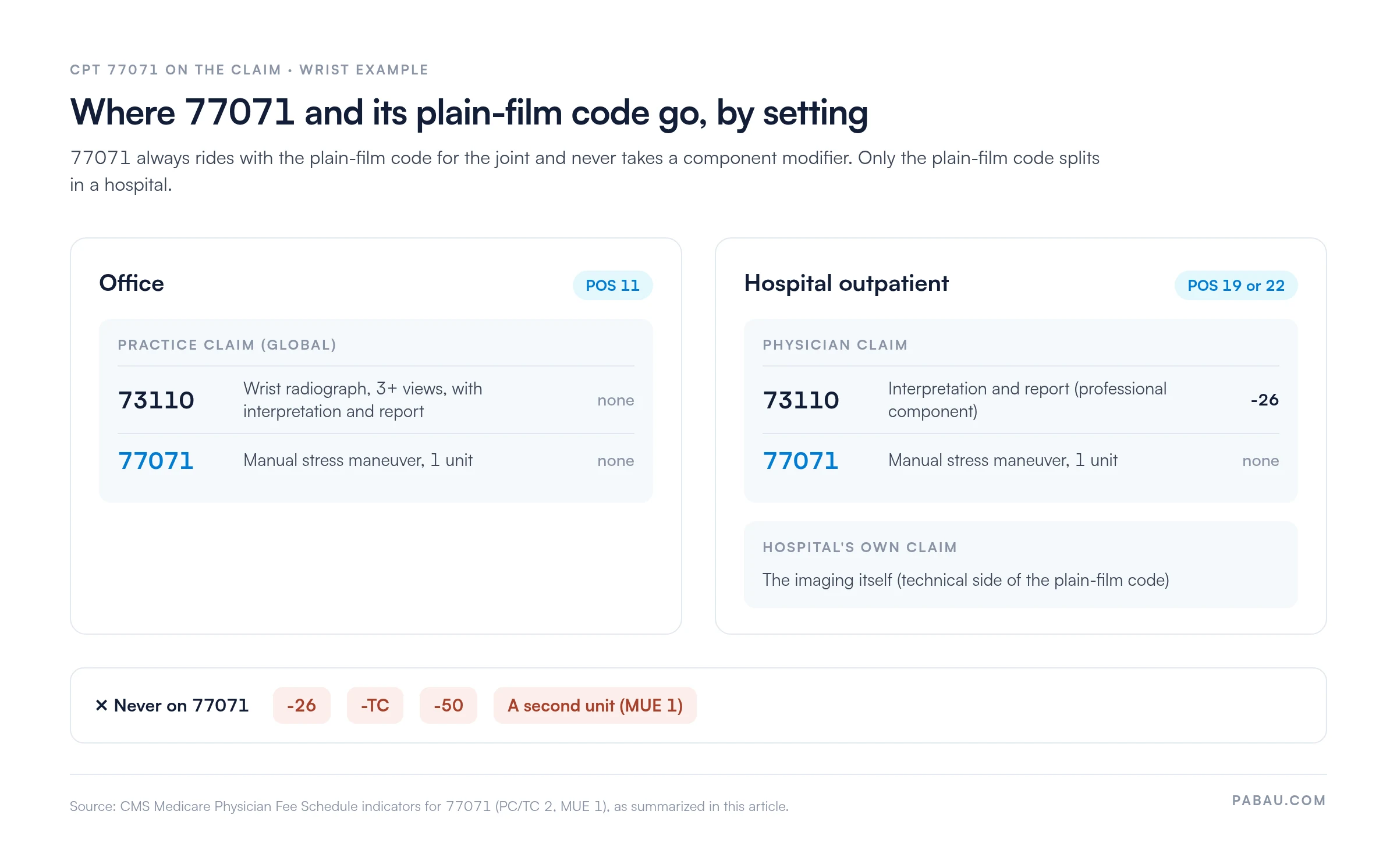
The code reports the stress maneuver only. The plain-film code for the joint is billed alongside it and covers the radiograph, its interpretation and the report. A wrist claim, for example, carries 73110 plus 77071. Bill one unit per date of service, with no -50 and no -26 or -TC.
Let Pabau's smart automation suggest the right codes, reduce claim denials, and keep your practice compliant—effortlessly.
Automate repetitive tasks and focus on what matters most—your patients.
Reduce coding errors and ensure compliance with the latest regulations.
Clean claims, fewer denials, and faster reimbursements.
Powerful insights and reporting to help your practice thrive.
HIPAA compliant SOC 2 certified GDPR-compliant Trusted by 4,000+ clinics worldwide

CPT code 77071 reports only the manual stress a physician or other qualified health care professional applies during joint radiography.
Bill the plain-film code for the joint alongside it, such as 73110 for the wrist, because that code covers the radiograph and its interpretation.
Report one unit with no -50, since the descriptor already includes the contralateral joint and the MUE is 1.
77071 is a professional-only code (PC/TC indicator 2), so modifiers -26 and -TC never apply to it.
Pabau’s claims management software carries the code pair, the diagnosis and the stress documentation through to a clean electronic claim.
CPT code 77071 reports the manual application of stress by a physician or other qualified health care professional during joint radiography. The official descriptor reads: “Manual application of stress performed by physician or other qualified health care professional for joint radiography, including contralateral joint if indicated.” The CMS short descriptor is “Mnl appl strs jt radiography.”
The American Medical Association’s Current Procedural Terminology (CPT) code set places 77071 in the Radiology section. It opens the Bone/Joint Studies range, 77071 to 77086. The code covers the stress maneuver only. A technologist takes the images while the physician holds the joint in a stressed position that routine positioning cannot reach.
The radiograph itself, its interpretation and the report are billed with the plain-film code for that joint. Stress views show how far a joint opens under load, which helps a surgeon grade a ligament injury and plan treatment. Sports medicine practices, orthopedic offices and hospital radiology departments report the code most often.
Read the last clause of the descriptor carefully. “Including contralateral joint if indicated” means the unit count stays the same when the opposite side is stressed for comparison. A session with stress views of both ankles is still one unit of 77071.
77071 is a narrow code. It pays for the professional work of applying and holding the stress, and for none of the imaging work that the plain-film code already covers.
Included in 77071:
Not included (bill separately when applicable):
One frequent miscoding error: Billing 77071 for weight-bearing views, where the patient’s own body weight provides the stress. Nobody applies manual stress there, so those images go on the plain-film code alone. Weighted distraction views of the acromioclavicular joints are part of 73050 and do not support 77071 either.
Every 77071 claim line needs a partner. The plain-film code for the stressed joint carries the radiograph, its interpretation and the report. 77071 adds the stress maneuver on top, so billing it alone describes a stress with no image behind it.
Choose the plain-film code by the total views documented in the report. A three-view wrist series goes on 73110, and a three-view ankle series on 73610. The claim then carries that code once and one unit of 77071, however many stress views were taken.
The plain-film code keeps its own component split. In a hospital, the physician bills that code with -26 and the facility bills the technical side. 77071 goes on the professional claim with no component modifier, as the two claim layouts below show.
Payers expect the diagnosis on a 77071 claim to explain why a stress view was needed. Routine radiographs show the bones at rest. Stress views show how much a ligament allows the joint to open under load. Common indications include:
Code to the highest specificity the record supports, including laterality and the seventh character. A generic sprain code with no documented instability often fails medical-necessity review against the payer’s Local Coverage Determination (LCD).
77071, 77072 and 77073 sit next to each other in the Bone/Joint Studies range, but they describe unrelated services. 77071 is the only one of the three that involves applied stress.
Two features separate 77071 from its neighbors. A physician or other qualified health care professional must apply the force, and the code never stands alone on the claim. If the procedure note describes no manual stress maneuver, 77071 is the wrong code.
Read the ordering indication before you code. ‘Assess ligament laxity’ or ‘evaluate joint instability’ points to 77071 plus the plain-film code for the joint. ‘Bone age’, ‘leg length’ or ‘survey for metastases’ points to 77072, 77073 or the 77074-77077 surveys.
Modifier choice for 77071 is simpler than for most radiology codes, because its professional-only status removes the component split. Three points decide the claim line: Units, laterality and NCCI edits.
Bill one unit of 77071 per date of service, with no -50, whether the physician stresses one joint or both sides for comparison. The descriptor’s contralateral clause covers the second side, and the MUE of 1 blocks a second unit.
Payers review 77071 claims at two levels: The ordering provider’s record, which establishes medical necessity, and the procedure report, which proves the stress was applied. A weakness in either one is enough to trigger a denial.
Required in the physician order:
Required in the report:
Payers that apply LCDs for musculoskeletal imaging cross-reference the ICD-10-CM code on the claim against their covered indications. The diagnosis must reflect the documented instability finding, not only the original injury.
Medicare pays CPT code 77071 under the MPFS, using relative value units (RVUs) multiplied by the annual conversion factor. Each locality then adjusts the result with a geographic practice cost index (GPCI). Confirm current figures in the FastRVU 2026 RVU lookup tool or the CMS fee schedule search before quoting a rate.
Because no visits are bundled into 77071, a physician who applies the stress and then sees the patient the same day may bill both. The E/M must be separately documented and carry modifier -25.
Medicare fee-for-service does not generally require prior authorization for 77071. Medicare Advantage, managed Medicaid and commercial plans set their own rules, so check each plan before the appointment.
Most 77071 denials trace back to the handful of root causes in the table below. A pre-submission check catches most of them before the claim leaves the practice. Practices with a structured denial management workflow fix each pattern at its source instead of appealing the same error every month.
The National Correct Coding Initiative (NCCI) publishes quarterly column 1/column 2 edit tables. They govern which code pairs cannot be billed together without a modifier. Confirm the current pairs for 77071 via the AAPC’s CPT code lookup or the CMS NCCI Policy Manual before billing.
77071 and the plain-film code for the same joint are the expected pairing, so never append -59 just to push that pair through. Use -59 or an X modifier only when a documented, distinct service sits behind it. Blanket use of -59 is an audit trigger.
The guide to medical billing denial codes shows how NCCI-related CARC codes appear on remittances. Your billing team can then identify and appeal them correctly.
Run every 77071 claim through an NCCI scrubber before submission. Any time you use modifier -59, document the distinct service in the record. Payers that audit -59 usage will request that documentation.
Pabau’s claims management software gives orthopedic, sports medicine and radiology practices one path from the visit record to the electronic claim. For 77071, denial risk sits in the code pair, the unit count and the stress documentation, which a structured workflow keeps in check.
Pre-submission checks flag coding errors before a claim leaves the practice, which supports clean claim submission. Providers can generate a superbill from the visit record. It carries both CPT codes, the ICD-10-CM diagnosis and the place-of-service code to the claim form without re-entry.
Claims leave Pabau electronically through Claim.MD, our integrated US clearinghouse partner, which connects to more than 4,000 US payers. It runs eligibility checks before the appointment and matches ERA/835 remittances after payment posts.
Every subscription includes full billing and claims functionality. A small orthopedic office gets the same claim scrubbing and ERA matching as a large radiology group.

Pabau connects your documentation, coding workflow and clearinghouse submission, so 77071 claims go out with the right code pair and come back paid.

CPT code 77071 pays for one piece of work: The manual stress a physician or other qualified professional applies to a joint during radiography. It never carries the image, so every claim needs the plain-film code for the joint beside it.
Three decisions prevent most denials. Pair the code, bill one unit even when both sides are stressed, and keep -26 and -TC off a code with no component split. Then make sure the report names who applied the stress and how.
Pabau keeps the order, the stress report and the claim in one connected workflow, so the code pair reaches the payer intact. Book a demo to see how Pabau handles radiology and musculoskeletal billing for your practice.

Need to understand how clearinghouse submission works end-to-end? Medical claims clearinghouse guide explains how claims move from practice to payer and what happens when they are rejected.
Billing denial codes appearing on your 77071 remittances? Electronic remittance advice (ERA) guide covers how to read 835 remittance files and act on CARC denial reason codes.
Starting to credential with new payers for your radiology practice? How to get credentialed with insurance companies walks through the enrollment steps and timelines that affect when you can bill codes like 77071.
CPT code 77071 covers the manual application of stress by a physician or other qualified health care professional during joint radiography. It includes the contralateral joint if indicated. It does not include the radiograph, its interpretation or the report, which are billed with the plain-film code for the joint.
CPT 77071 reports a manual stress maneuver during joint radiography, used to assess ligament injury and instability. CPT 77072 reports bone age studies. CPT 77073 reports bone length studies (orthoroentgenogram, scanogram). Neither 77072 nor 77073 involves applied stress, and skeletal surveys are a separate group, 77074 to 77077.
No, not as a bilateral procedure. The descriptor already includes the contralateral joint if indicated, and the MUE is 1. Report one unit with no -50 modifier, even when the physician stresses both sides for comparison.
Medicare pays 77071 from the MPFS, using RVUs multiplied by the annual conversion factor and adjusted by locality. It is a professional-only code, so there is one global rate and no -26 or -TC rate. Rates change each January, so confirm current figures in the CMS MPFS Look-Up Tool before quoting one.
Two records support the claim. The order names the joint, the instability indication and the ordering provider. The report states that manual stress was applied, by whom and with which technique, and records the findings under stress. A missing stress statement is one of the most common documentation reasons for denial.
The most common reasons are a diagnosis that does not support instability, and 77071 billed without the plain-film code for the joint. Others are extra units or -50 for the contralateral joint, and -26 or -TC on a professional-only code. Missing stress documentation and missing prior authorization complete the list.