CCSD code A2720: Proximal gastric vagotomy billing guide
What is CCSD code A2720? CCSD code A2720 is the procedure billing code assigned ...

Last Updated: Oct 8, 2026
77073 is the CPT code for bone length studies (orthoroentgenogram, scanogram).
It covers a calibrated radiographic or CT scout series that measures limb length discrepancy, reported once per study. Common billing errors involve bilateral reporting, the -26/-TC split between hospital outpatient and office settings, and confusion with neighboring codes 77072 and 77074.
Let Pabau's smart automation suggest the right codes, reduce claim denials, and keep your practice compliant—effortlessly.
Automate repetitive tasks and focus on what matters most—your patients.
Reduce coding errors and ensure compliance with the latest regulations.
Clean claims, fewer denials, and faster reimbursements.
Powerful insights and reporting to help your practice thrive.
HIPAA compliant SOC 2 certified GDPR-compliant Trusted by 4,000+ clinics worldwide

CPT code 77073 covers bone length studies by orthoroentgenogram or CT scanogram, reported once per study rather than once per limb.
Modifier -50 does not apply, because Medicare’s bilateral indicator for 77073 is 0.
Medicare Advantage and many commercial plans can require prior authorization through radiology benefit managers such as eviCore.
Pabau’s claims management software links imaging orders to coded encounters and tracks each claim from submission to payment.
CPT code 77073 is defined by the American Medical Association’s CPT code set as: Bone length studies (orthoroentgenogram, scanogram). It sits in the Radiology section, Bone/Joint Studies subsection (77071-77086). The code measures limb length discrepancy and is reported once per study.
Bone length studies measure limb length discrepancy by capturing a calibrated radiographic series across the full extremity. CPT code 77073 covers two techniques, the orthoroentgenogram and the CT scanogram. The choice between them depends on patient size, radiation dose, and the equipment available.
The orthoroentgenogram uses three separate plain-film exposures on a single long cassette: Hip, knee, and ankle. A calibrated ruler is placed alongside the limb. The technologist measures segment lengths from the exposures. Orthopedic surgeons and musculoskeletal imaging departments order this study for scoliosis follow-up, leg length inequality workup, and post-surgical alignment assessment.
The CT scanogram uses scout images from a CT acquisition rather than plain film. Both techniques produce the same clinical output: Segment-by-segment length measurements with a calculated discrepancy. Documentation must specify which technique was used, as payers audit this detail.
CPT code 77073 is reported once per study, regardless of how many limbs are measured. The study captures a comparative measurement across both legs to quantify the discrepancy. Medicare’s bilateral indicator for 77073 is 0 (no bilateral adjustment), so do not append -50 or report two units.
Bilateral reporting errors commonly cause denials and overpayment findings on 77073 claims. Train billing staff that the code already describes a study capturing both limbs.
Run a monthly denial report filtered to CPT 77073. If bilateral-billing errors appear more than twice in 90 days, schedule a focused coder training session on the single-study reporting rule. Repeat denials on one code carry compliance risk as well as lost revenue.
The 770xx bone study family covers four distinct clinical scenarios, and picking the wrong one commonly causes denials. An order that asks for skeletal maturity rather than limb length belongs under 77072, not 77073.
Billing 77073 with a same-session knee series: This is a contested coding question. The AMA CPT Knowledge Base has addressed whether 77073 can be co-billed with a same-session 73562. That answer is subscription-gated. Before submitting both codes on one claim, consult the Knowledge Base directly or contact your MAC for policy guidance. Do not assume bundling is permissible or prohibited until you confirm the answer for your payer.
CPT code 77073 has a PC/TC split, so the professional and technical components can be billed separately. That happens in split-billing arrangements, such as a radiologist employed by a group reading on hospital-owned equipment.
Medical necessity for CPT code 77073 must be established through a linked ICD-10-CM diagnosis code. Payers audit the diagnosis-to-procedure pairing, and a missing or unsupported diagnosis code commonly causes denials.
Always use the most specific ICD-10 code available. Submitting M21.70 (unequal limb lengths, unspecified site) can trigger a medical necessity review when the referral clearly documents the femur or tibia.
Medicare covers CPT code 77073 when medical necessity is established. Coverage is governed by the Medicare Physician Fee Schedule (MPFS). Payment varies by place of service and by whether the global, professional, or technical component is billed. Use the CMS Physician Fee Schedule lookup for current national rates, as figures change annually. The 2026 non-facility rate (POS 11 – office) is higher than the facility rate (POS 19/22 – outpatient hospital). That’s because the practice expense component is paid separately in a non-facility setting.
No national coverage determination (NCD) exclusively governs bone length studies. MAC-specific local coverage determinations (LCDs) may apply, so check your MAC’s LCD database before submitting. Some LCDs restrict 77073 to specific diagnoses or clinical thresholds.
Pabau, the practice management platform we build, submits claims electronically through Claim.MD, which connects to thousands of US payers. Eligibility checks run before the claim is submitted.
Before submitting 77073 to Medicare Advantage plans, verify coverage in the specific plan’s benefit document. Medicare Advantage payers can impose prior authorization requirements that traditional Medicare does not, and failure to obtain auth is an automatic denial.
Traditional Medicare (Parts A and B) does not require prior authorization for CPT code 77073 at the national level. Medicare Advantage plans are a different matter. eviCore by Evernorth manages radiology benefits for many Medicare Advantage plans, including HCSC Medicare Advantage. CPT code 77073 appears on the HCSC Medicare Advantage radiology prior authorization code list effective January 1, 2026.
Confirming insurance eligibility verification at scheduling is the first step. The authorization process then typically requires:
Commercial payers not using eviCore may have their own radiology management programs. Always check the specific plan before scheduling the study.
Insufficient documentation commonly causes 77073 claims to fail post-submission audits. The referral and the radiology report together must establish medical necessity and technique. Submitting a clean claim starts with verifying these elements before the claim leaves the practice.
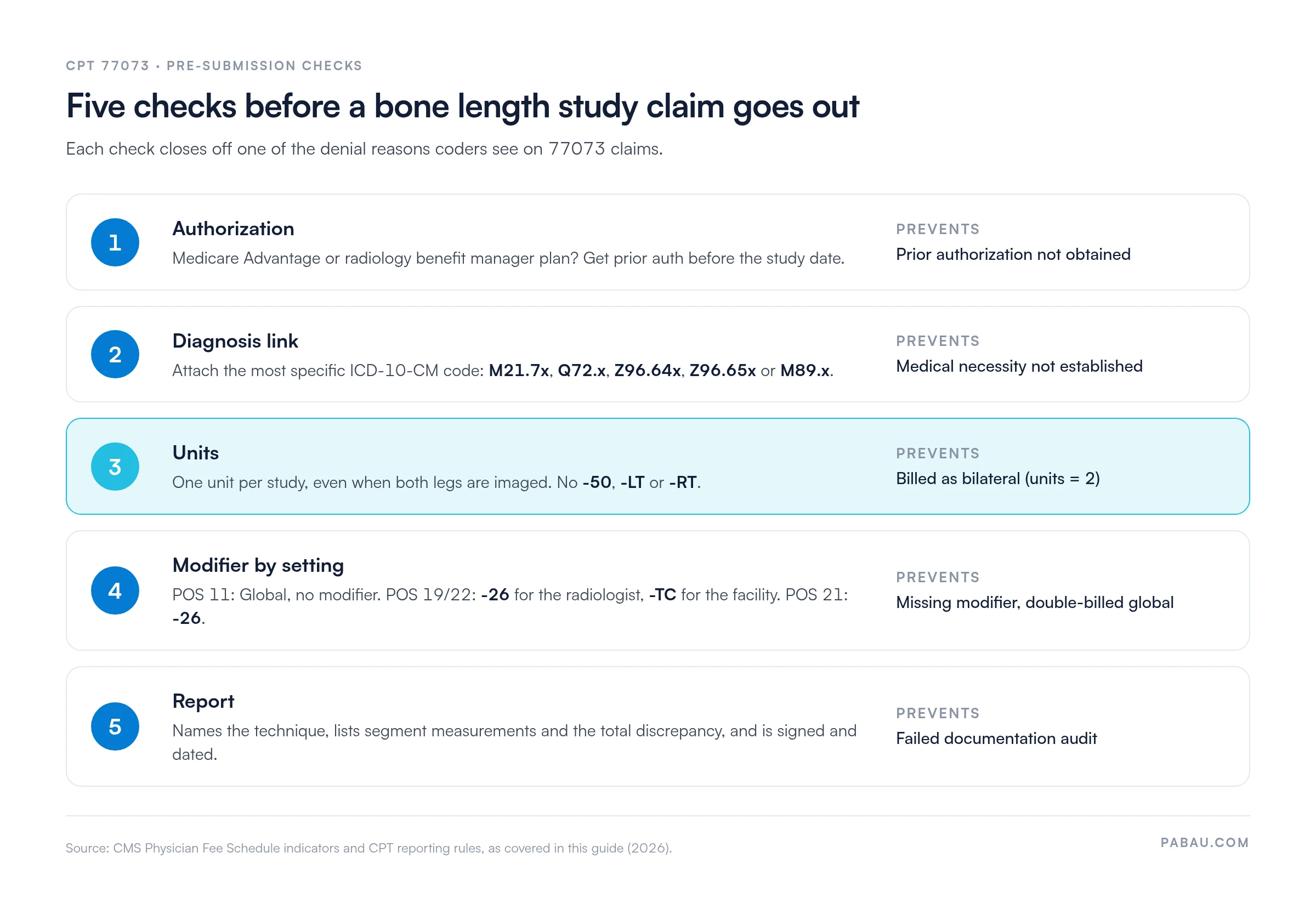
CPT code 77073 denials cluster around five root causes. Structured denial management workflows should track each reason code separately so patterns surface quickly. Review medical billing denial codes alongside the specific reason your MAC or payer uses to categorize each rejection.
Each of those denials has a matching check you can run before submission. The sequence below follows the order a 77073 claim passes them, from authorization to the signed report.
Where 77073 is performed directly affects Medicare payment. The MPFS pays a higher allowed amount in non-facility settings (POS 11 – physician office). There, the practice expense component of the RVU is not shared with a facility. In hospital outpatient departments (POS 19 off-campus, POS 22 on-campus), the facility receives a separate payment under the OPPS. The physician fee schedule then pays only the reduced professional component, even without modifier -26.
Use the FastRVU 2026 RVU lookup to retrieve current Work, Practice Expense, and Malpractice RVU values for 77073 by facility status. Current rates are not reproduced here, because the MPFS is updated annually and a stated figure would soon go stale.
Billing 77073 slows down when the imaging order, the diagnosis, and the claim sit in separate systems. Coders re-key ICD-10 codes, call payers to confirm coverage, and track claim progress in spreadsheets.
Pabau’s claims management software keeps the clinical record and the claim in one place. The diagnosis on the encounter carries through to the claim, and every claim shows its current status.


Pabau links imaging orders to coded encounters, checks eligibility before the study, and tracks every claim from submission to payment. See each claim’s status and remittance on one dashboard.

Most of the rules for CPT code 77073 follow from one fact: The study already covers both legs. Bill one unit, choose the modifier by place of service, and link the most specific diagnosis the referral supports.
Prior authorization is the check to move earliest. Confirm it with Medicare Advantage and commercial plans when the order arrives, rather than after a denial comes back.
Want the order, the diagnosis, and the claim status in one record for your radiology or orthopedic billing? Book a demo to see how Pabau handles it.

Need to understand how clearinghouse claim routing works? Medical claims clearinghouse explains how claims move from practice to payer and where errors are caught.
Want your billing process to hold up in an audit? Medical billing compliance covers the documentation and process standards that support successful appeals.
Billing for a practice that handles multiple radiology codes? Superbill guide walks through how to structure encounter-level billing documents that hold up to payer review.
CPT code 77073 is the AMA billing code for bone length studies using orthoroentgenogram or scanogram techniques. It measures limb length discrepancy across the hip, knee, and ankle segments in a single calibrated radiographic series. It is reported once per study regardless of how many limbs are imaged.
CPT code 77073 is a single-study code reported once per encounter, not once per limb. Modifier -50 (bilateral) does not apply, and laterality modifiers -LT and -RT are also inappropriate. The procedure inherently captures a comparative measurement of both extremities to quantify discrepancy.
CPT 77072 covers bone age studies, which assess skeletal maturity from a single hand and wrist radiograph – typically ordered for pediatric patients. CPT 77073 covers bone length studies that measure limb length discrepancy using a multi-exposure series or CT scanogram. It is ordered for any age when limb inequality or post-arthroplasty alignment is the clinical question.
A scanogram uses CT scout images to measure limb segment lengths. An orthoroentgenogram uses three sequential plain-film exposures on a single long cassette with a calibrated ruler. Both techniques fall under CPT code 77073. The radiology report must name the specific technique used; payers audit this detail during medical necessity reviews.
Whether 77073 and a same-session diagnostic knee series (73562) can be co-billed is a contested question addressed in the AMA CPT Knowledge Base. The AMA’s answer is subscription-gated. Don’t assume the codes are separately billable or bundled until you’ve checked the AMA CPT Knowledge Base or asked your MAC.
Yes, Medicare covers CPT code 77073 when medical necessity is documented through a supported ICD-10-CM diagnosis code. There is no national coverage determination (NCD) governing bone length studies, but MAC-specific local coverage determinations may apply. Medicare Advantage plans commonly require prior authorization through radiology benefit managers such as eviCore.
Common denial reasons include a missing or unsupported ICD-10 code and prior authorization not obtained from a Medicare Advantage or commercial payer. Others are bilateral billing (modifier -50 or two units), a missing -26 or -TC in split billing, and bundling edits with a same-session knee series. Each denial reason requires a distinct corrective action before resubmission.
Commonly accepted pairings include M21.7x (acquired unequal limb lengths), Q72.x (congenital limb reduction defects), and M89.x (other bone disorders). Z96.641-Z96.659 (presence of a hip or knee joint implant) covers post-arthroplasty imaging. Always use the most specific code available; submitting an unspecified code when the referral documents a specific segment can trigger a medical necessity review.