



CCSD code G5100: Bypass of duodenum billing guide
CCSD code G5100 bills a bypass that leaves the duodenum in place CCSD code G5100...

Last Updated: Oct 16, 2026

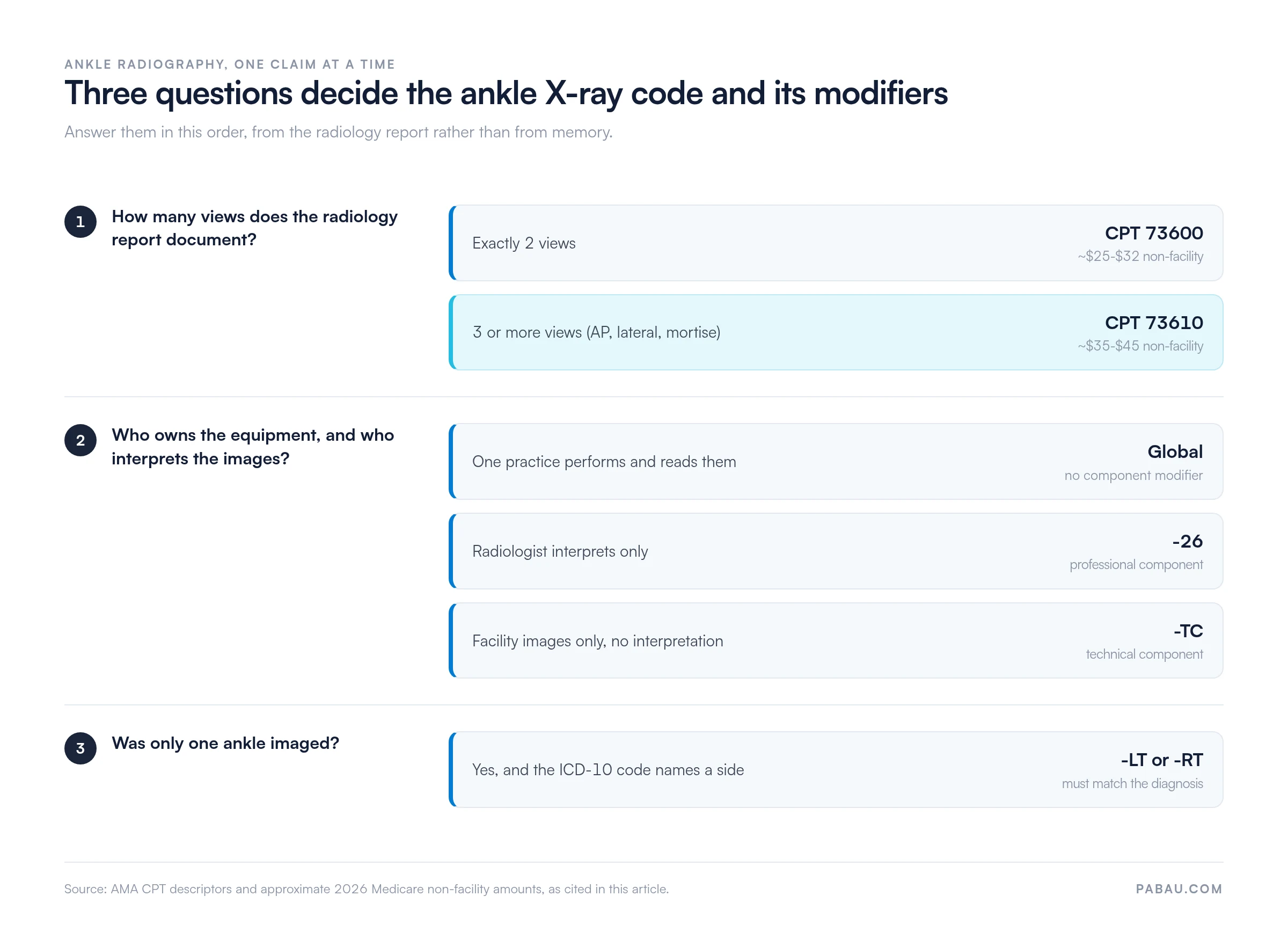
CPT Code 73610 covers a complete radiologic examination of the ankle, with a minimum of 3 views.
Two views means CPT 73600 instead, so count the views in the radiology report before you select a code.
Modifiers -26 and -TC split the professional and technical components when the radiologist and the facility are separate entities.
The 2026 Medicare non-facility rate runs roughly $35 to $45 before geographic adjustment, so check your own locality in the CMS Look-Up Tool.
Practice management software like Pabau links the code, the ICD-10 diagnosis, and the modifier at the point of documentation, which cuts 73610 denials.
CPT Code 73610 is the billable code for a complete radiologic examination of the ankle, meaning a minimum of 3 views. The standard series is anteroposterior, lateral, and mortise. Capture only 2 views and the correct code is 73600. That one number decides the code, the payment, and whether the claim matches the radiology report.
This reference covers the official AMA descriptor, the modifier rules, 2026 Medicare fee schedule data, and the ICD-10 crosswalk. It also maps the denial patterns that cost ankle imaging practices the most revenue.
The American Medical Association (AMA) maintains the CPT code set. Its official descriptor for 73610 is: Radiologic examination, ankle; complete, minimum of 3 views. The code sits in the Radiology section of the CPT code book, under Diagnostic Radiology for the musculoskeletal system.
Some clinical scenarios call for additional oblique or stress views. Any number of views at or above 3 still qualifies for 73610, because the descriptor sets a floor rather than a ceiling. Count the views in the radiology report before you select between 73610 and 73600.
The distinction between 73610 and 73600 is purely numeric. The official AMA descriptor for 73600 is a radiologic examination of the ankle at 2 views. CPT Code 73610 covers the complete series at 3 or more views.
Billing 73610 when only 2 views appear in the radiology report is upcoding. Billing 73600 when 3 views were taken leaves revenue on the table.
Podiatrists running in-office imaging equipment are the most common source of 73610/73600 mix-ups. The standard ankle series in podiatry almost always captures 3+ views, so 73600 should be the exception, not the default. Always confirm the view count in the radiology report before code selection.
Medical necessity for CPT Code 73610 depends on a supported ICD-10 diagnosis. The CDC/NCHS ICD-10-CM tool is the authoritative lookup for current diagnosis codes. Our ICD-10-CM code reference groups the ones musculoskeletal imaging claims lean on most.
Payers may also apply Local Coverage Determinations (LCDs) from Medicare Administrative Contractors that restrict which ICD-10 codes support imaging. Confirm your MAC’s LCD before submitting if the clinical picture is borderline.
Podiatry and sports medicine practices order a complete ankle series for a predictable set of indications:
Laterality matters. When imaging only one ankle, the ICD-10 code must specify right or left, and a corresponding modifier (-LT or -RT) must appear on the claim. Claims submitted without laterality matching between the diagnosis and procedure codes are a common denial trigger.
Payers apply the same check to one-sided rib films. Claims under CPT code 71100 are denied most often when the radiology report never names the side imaged.
Modifier selection for CPT Code 73610 depends on the billing entity and the clinical setting. It also depends on whether the procedure is repeated, or needs distinguishing from another service. Incorrect modifier use generates denials as reliably as the wrong code does.
A podiatrist or orthopedic surgeon may own the X-ray equipment, perform the imaging, and interpret it. No modifier is needed there. That is global billing, and the single CPT Code 73610 claim covers both components.
Contrast-enhanced CT follows the same ownership test. A cardiac CT billed under CPT code 75572 goes out globally when one entity owns the scanner and reads it.
Split billing applies when the professional and technical functions are separated. A radiology group reading images on behalf of an outpatient facility bills 73610-26. The hospital or imaging center bills 73610-TC.
The split works identically in contrast fluoroscopy. An upper GI series under CPT code 74240 is billed 74240-26 by the radiologist and 74240-TC by the facility that owns the equipment.
Billing 73610 without a modifier in a split setting is a claim accuracy error. So is billing globally when the practice does not own the equipment.
The whole selection, from view count to laterality, comes down to three questions asked in order.
The CMS Physician Fee Schedule Look-Up Tool is the authoritative source for current payment amounts. Geographic practice cost index (GPCI) adjustments mean the same code pays differently by locality.
The figures below are approximate 2026 national amounts. Verify your own locality before you quote a patient or post an expected payment.
Private payer rates are negotiated separately and usually sit above Medicare. Contact each commercial payer, or review your contract fee schedules for the non-Medicare amounts.
Use FastRVU’s 2026 RVU lookup tool to check the work, practice expense, and malpractice components behind the fee. Listing 73610 on your encounter form beside its common ICD-10 companions also saves the front desk a separate lookup.
Relative Value Units (RVUs) drive Medicare’s fee schedule calculation. These are the three components for CPT Code 73610, as listed in the FastRVU 2026 lookup:
CMS updates RVU values every year. Pull the current year’s PFS file before you rely on these components for a billing submission.
CPT Code 73610 carries a global period designation of XXX, which means the global surgery concept does not apply. Diagnostic radiology codes are not subject to the pre-operative and post-operative periods that surgical CPT codes carry. That distinction matters for physical therapy and sports medicine practices that sometimes bundle imaging with treatment codes.
Because there is no global period, 73610 can be billed on the same date of service as E/M codes and most procedural codes. NCCI edits still apply. Check the current edit pairs if you routinely bill 73610 alongside procedure codes for the same encounter.
Podiatrists (DPMs) are among the most frequent billers of CPT Code 73610. Most podiatry practices own in-office X-ray equipment and perform global billing (no -26 or -TC modifier). That is correct when the supervising physician both performs and interprets the imaging.
Problems arise in multi-provider practices where a technician captures the images but the interpreting physician is a different credentialed provider.
Payer-specific rules for in-office imaging in podiatry can vary. Some commercial payers require prior authorization for bilateral ankle imaging or for imaging performed on the same date as an E/M visit.
Check your payer contract addenda and any applicable LCDs before assuming global billing applies universally. The AAPC CPT code lookup resource includes payer-specific crosswalk data useful for podiatry billing teams navigating these variations.
Review your MAC’s Local Coverage Determination for musculoskeletal imaging before billing 73610 alongside same-day E/M codes. Some MACs require a 25 modifier on the E/M to signal a separate, significant evaluation. Confirming this rule upfront prevents the most common same-day denial for podiatry imaging claims.
Ankle imaging claims for CPT Code 73610 are denied for a predictable set of reasons. Most of them are preventable at the point of documentation. The table below maps each denial pattern to its root cause and its fix. The same denial management workflows cut rework across musculoskeletal billing.
A complete claim requires more than the CPT code. The radiology report must explicitly state the number of views taken. The ordering physician’s name and NPI must appear on the claim. For hospital outpatient settings, the facility must document that the imaging was ordered by a credentialed provider with appropriate staff supervision.
An integrated billing platform catches laterality and modifier mismatches before the claim leaves the practice. That is a month earlier than a payer denial letter.
Coders in podiatry, orthopedics, and sports medicine bill the whole lower-extremity radiology family alongside CPT Code 73610. The table below covers the codes that most often appear on the same claim or in the same encounter.
Podiatry claims often carry 73610 and 73630 together, when the encounter warrants imaging of both the ankle and the foot. NCCI edits do not bundle the two codes. Billing both on one claim is correct when both sites were imaged and each carries its laterality modifier.
When a 73562 knee series leads to a prefabricated adjustable knee brace, the brace is billed on its own claim line under HCPCS code L1832.
View count mismatches, laterality omissions, and modifier errors share one cause. The radiology report says one thing and the claim says another, because a person re-keyed it in between. Practice management software like Pabau closes that hand-off.
Pabau’s error-checking claims management software captures the CPT code, links the ICD-10 diagnosis, and records the modifier inside the clinical record. Billing staff then work from the data the clinician entered, so nobody reads a view count off a printed report.

The built-in Claim.MD clearinghouse integration submits those claims electronically to thousands of US payers. Built-in CPT and ICD-10 catalogs validate the code-to-diagnosis pairing before the claim leaves. Real-time eligibility checks and electronic remittance advice (ERA) processing mean a 73610 problem surfaces in days rather than weeks.

Pabau’s claims management software links CPT codes to ICD-10 diagnoses and modifier selections at the point of documentation. See how practices billing ankle imaging codes reduce claim rework by catching errors before submission.

Three things decide whether an ankle X-ray claim gets paid: the view count in the report, the laterality modifier, and the component split. Get those right and 73610 stops being a denial risk. Get one wrong and no amount of appeal work makes the claim clean.
A tighter month-end billing review will not catch these. The repair belongs upstream, in documentation that already states the view count, the side, and the ownership arrangement. Then the coder has nothing left to infer, and the audit trail is already there if a payer asks.
Ankle imaging claims should not need a monthly clean-up. Book a demo to see the view count, the diagnosis, and the modifier travel together from the clinical note to the clearinghouse.

Want to understand how clearinghouse claim submission works? Medical claims clearinghouse guide explains the end-to-end path from claim creation to payer adjudication.
Need to reduce claim denial rates across your billing team? Denial codes in medical billing maps the most common CARC denial reason codes to root causes and appeals strategies.
Looking for guidance on electronic remittance processing? Electronic remittance advice (ERA) covers how 835 transaction files reduce manual payment posting for radiology and podiatry billing teams.
CPT Code 73610 is a radiologic examination of the ankle requiring a complete series with a minimum of 3 views. It covers the professional interpretation, technical capture, or both depending on the billing arrangement. The three standard views are anteroposterior, lateral, and mortise. Additional oblique or stress views can be included without changing the code.
CPT 73600 covers an ankle X-ray series of 2 views. CPT 73610 covers a complete series of 3 or more views. The distinction is purely view count: if the radiology report documents 2 views, 73600 is correct. If it documents 3 or more, 73610 is correct. Billing 73610 with a 2-view report is upcoding.
Five modifiers cover almost every 73610 claim. Use -26 for the professional component and -TC for the technical component. Use -LT or -RT to state which ankle was imaged. Use -76 or -77 when the same or a different physician repeats the procedure. Use -59 when 73610 is billed alongside another code subject to NCCI edits.
The approximate 2026 Medicare non-facility rate is $35-$45. The facility rate is roughly $15-$25. Rates vary by geographic locality. Always verify current amounts using the CMS Physician Fee Schedule Look-Up Tool before submitting claims, as amounts are updated annually.
CPT 73610 has an XXX global period designation, meaning the global surgery concept does not apply. Diagnostic radiology codes are not subject to pre-operative or post-operative periods. This means 73610 can be billed on the same date of service as evaluation and management codes, subject to NCCI bundling edits and modifier requirements.
Yes. CPT 73610 (ankle, complete, 3+ views) and CPT 73630 (foot, complete, 3+ views) are not bundled by NCCI edits. You can bill both on one claim when both sites were imaged in the same encounter. Apply a laterality modifier to each code so it matches the ICD-10 diagnosis submitted.



