



CCSD code G5100: Bypass of duodenum billing guide
CCSD code G5100 bills a bypass that leaves the duodenum in place CCSD code G5100...

Last Updated: Oct 16, 2026

CPT code 73110 reports a complete wrist X-ray with a minimum of three views, usually PA, lateral, and oblique.
The radiology report has to name the number of views taken. A note saying only “wrist X-ray” is the most common reason these claims come back.
Modifier 26 and modifier TC split the payment when the reading physician and the imaging facility bill separately.
Medicare pays roughly $42.75 nationally in 2026, and the amount is the same in an office and in a facility.
Practice management software like Pabau pre-fills a claim from the codes already attached to the visit and checks the required fields before it goes out.
CPT code 73110 bills a complete radiologic examination of the wrist, and it needs a minimum of three views. That view count is what the code turns on. Two views is 73100, three or more is 73110, and the radiology report is what proves which study you performed.
Payers read that line, so a report saying only “wrist X-ray” hands them a reason to downcode or deny. Medicare’s 2026 national payment sits at roughly $42.75, the same in an office and in a facility.
This article covers the modifiers, the RVUs, the diagnosis codes that support medical necessity, and the checks worth running before the claim goes out.
The code is maintained by the American Medical Association (AMA) and sits in the Radiology section of the CPT code set. Its official descriptor reads: Radiologic examination, wrist; complete, minimum of 3 views.
Radiologists, orthopedic surgeons, emergency physicians, and hand surgeons all report it. The setting does not change the choice, so an office, a hospital outpatient department, and an emergency room all bill the same code.
A standard series runs posteroanterior (PA), lateral, and oblique. Some protocols add a scaphoid view when a fracture is suspected, or a carpal tunnel view, which pushes the series to four or five images.
Extra views do not change the code. 73110 covers any series that meets or passes the three-view minimum, so a three-image study and a six-image study bill identically.
A complete series is justified whenever the clinical question needs the oblique view to answer it. In practice, that covers six scenarios, and each one has to arrive on the claim with a matching ICD-10-CM diagnosis code:
Payers audit wrist radiology claims for medical necessity, and repeat imaging draws the most scrutiny. If the same study was performed three weeks ago, the note has to record what changed clinically since then.
Both codes describe a wrist X-ray, so the anatomy will not tell you which one to bill. The number of views does.
Billing 73110 on a two-view study is upcoding, and billing 73100 on a three-view study is revenue you simply gave away. The rest of the comparison below follows from that one line in the report.
When the report says “two views obtained”, bill 73100. Three views or more means 73110. That sentence is the audit trail, so technologists and radiologists should write the view count into every study rather than leaving it to the coder.
The view-count floor changes with the body region, so coders check it code by code. A unilateral rib series billed as 71100 needs two documented views of one side.
Modifier 26 and modifier TC split 73110 between the physician who reads the images and the facility that produced them. Choose the wrong one and the claim is either underpaid or rejected as duplicate billing.
The table below covers the five modifiers that appear on wrist radiology claims.
Ask who owns the equipment. If a single entity owns the X-ray unit, employs the technologist, and employs the physician who reads the images, bill globally with no modifier. If the facility and the reading physician sit in different billing entities, split the claim.
A hospital outpatient department bills TC while the radiology group bills 26. A private orthopedic office with its own unit and an employed radiologist bills the global code. Splitting in a global setting creates duplicate billing, and failing to split in a hospital setting creates a bundling denial.
Write the number of views into the radiology report every time, rather than “wrist X-ray obtained”. A report that says “3-view wrist series” protects the 73110 claim. One that says “wrist X-ray” gives an auditor grounds to ask which code applies.
CPT 73110 pays roughly $42.75 nationally in 2026, and that figure does not move with the place of service.
Plenty of office-based codes pay less inside a facility, because the hospital absorbs the practice expense. 73110 is not one of them, so CMS lists a single payment amount for both settings.
Figures come from the 2026 Medicare Physician Fee Schedule, before geographic adjustment. Geographic practice cost indices move the number locally. Confirm your own locality in the CMS MPFS Look-Up Tool before quoting a payer or a patient. Commercial rates diverge further still.
Some regional plans pay above Medicare, while several Medicaid managed care plans pay well below it. Bill from your contracted schedule rather than the national number.
CPT 73110 carries 1.28 total relative value units (RVUs) in 2026. The split is 0.17 work, 1.09 practice expense, and 0.02 malpractice. Those values are identical in both settings, which is exactly why the payment is too.
Practice expense is about 85% of the total, and that ratio quietly settles the modifier question. Nearly all of the money sits in the technical component, so whoever owns the X-ray unit collects the larger share of the claim.
A radiology group reading images it did not produce should expect the smaller one. Locality-adjusted figures live in the CMS relative value files.
Every 73110 claim needs at least one ICD-10-CM code explaining why the wrist was imaged. Pick the most specific code the documentation supports.
The pairings below are the ones that show up most often on wrist radiology claims, and our ICD-10-CM code index covers the rest.
Swap the laterality digit for a left wrist, which gives you S62.002A, S63.012A, M19.032, M05.432, and M25.532. Specificity matters most on repeat claims.
M25.531 is fine for a first imaging visit, but a second study on the same diagnosis invites review unless the note records a change. For a carpal tunnel workup, pair the study with G56.01 (carpal tunnel syndrome, right upper limb).
Start with the anatomy, then apply the view count. Carpal bones and the wrist joint are 73100 or 73110, while metacarpals and phalanges are 73120 or 73130. Fingers and the forearm have codes of their own.
The grid below shows how those four wrist and hand codes fall into place.
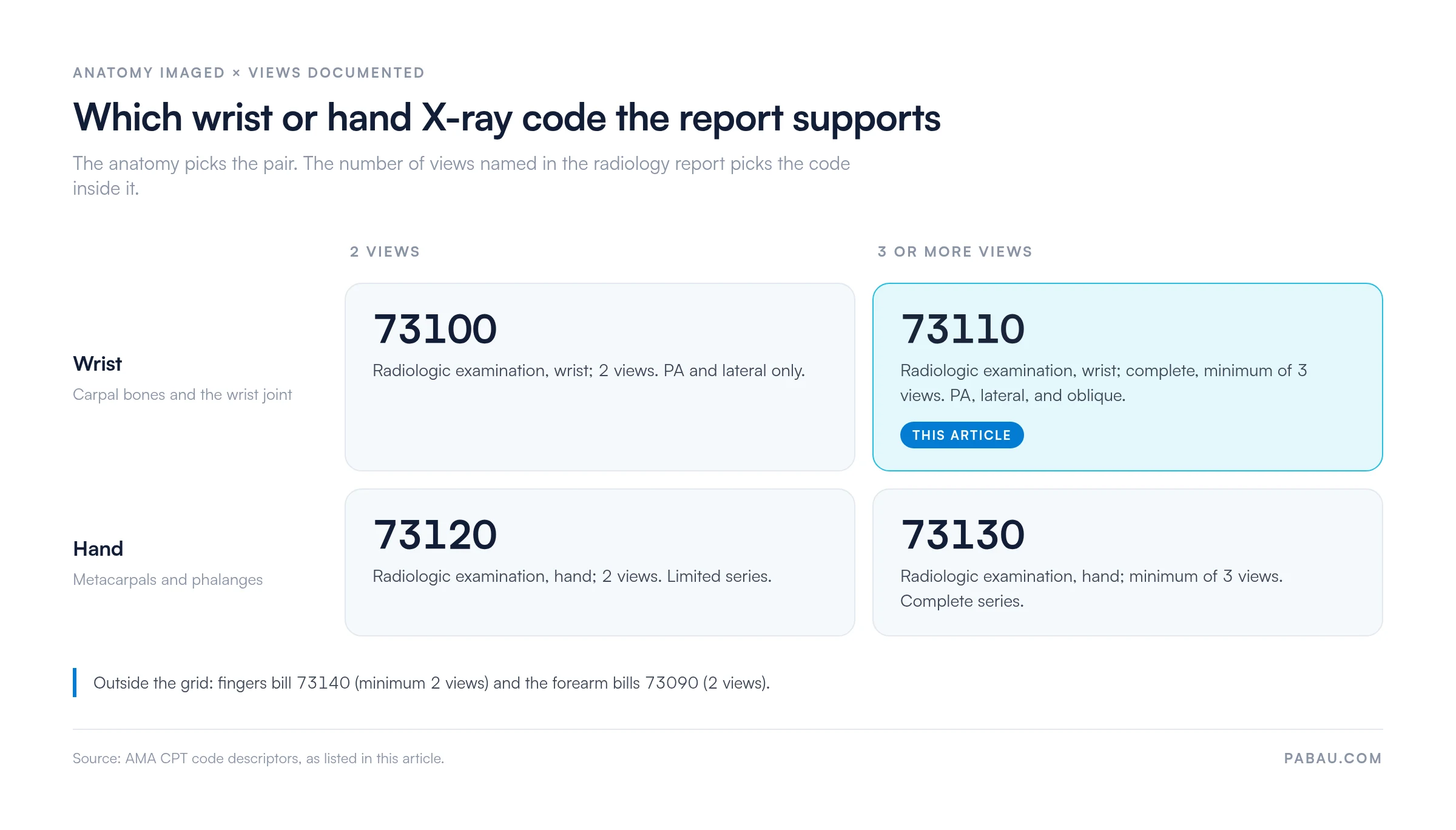
Bill 73130 when the images cover the metacarpals and phalanges, and 73110 when the focus is the wrist joint and carpal region. Both are sometimes ordered at the same visit.
NCCI edits allow that pairing when the two studies are clinically distinct and separately documented. Check the AAPC CPT code lookup before putting them on one claim.
Wrist radiology denials cluster in three places: the documentation, the modifier, and the NCCI edits. Run these six checks before the claim leaves the practice.
The order is placed at the visit and the technologist captures the series. A report comes back naming the number of views. A coder reads that line, picks 73110 or 73100, and attaches the diagnosis code. Ownership of the equipment decides the modifier, so it is 26, TC, or none at all.
The claim goes to the clearinghouse, which checks the format and the payer’s basic requirements. From there the payer adjudicates it and returns an electronic remittance advice.
Two mistakes cause most of the rework along that path. The first is a report with no view count, which forces the coder to query the radiologist or guess. The second is a modifier applied out of habit rather than from the billing entity, which is what produces duplicate-billing rejections in hospital settings.
Orthopedic groups, urgent care chains, and emergency departments produce these claims in volume. They gain the most from auto-populating the modifier from the rendering provider’s billing entity. That takes the decision away from the front desk entirely.
When rejections do come back, work them by pattern rather than one at a time. That is what moves the first-pass rate, and our guide to denial management in healthcare walks through the process.
Check your NCCI edits before billing CPT 73110 alongside any same-day procedure code. The National Correct Coding Initiative publishes new edit tables each quarter. A coder who reviews them that often catches bundling denials early, rather than appealing them later.
Coding references give you the number. Getting that number onto a clean claim is a separate job. Practice management software like Pabau keeps the imaging order, the report, the diagnosis codes, and the claim inside one patient record.
Its claims management software pre-fills the claim from the codes already attached to the visit. Coders get code lookup libraries when they need to search. The system also checks that required claim fields are complete before submission.
It does not pick your modifier or crosswalk your codes, so the coding judgment stays with your team. What it removes is the retyping. US practices route claims onward through the Claim.MD integration.
It reaches a clearinghouse network covering thousands of US payers and runs real-time eligibility checks. Electronic remittance advice (ERA) comes back into the same platform.
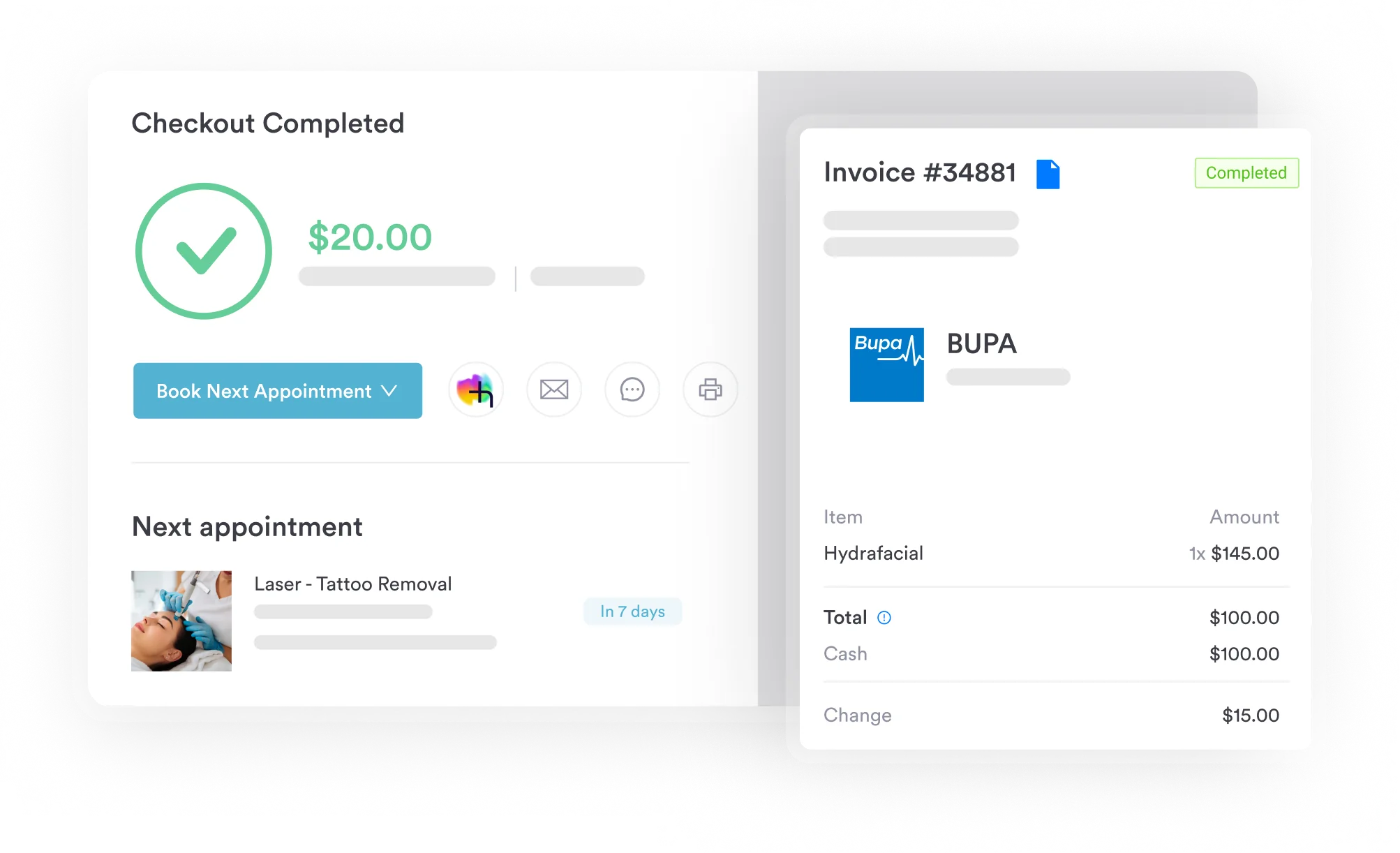
The claim, the appointment, and the clinical note sit in the same record. A coder checking a wrist study can read the report without opening a second system. For a practice billing radiology alongside other code families, that is where the time goes back.

Pabau’s claims management pre-fills each claim from the codes already attached to the visit. Your coders get searchable code libraries, and required fields are checked before the claim is submitted.

Two lines decide whether a 73110 claim gets paid. The report has to name the view count, and the modifier has to match whoever owns the equipment. Get those right and the rest of the claim is routine work.
The rate itself leaves little to optimize, since Medicare pays roughly $42.75 either way. Rework is the part you control, and it starts with the radiology report rather than the billing screen.
Pabau’s claims management, together with the Claim.MD integration, carries the cycle from claim submission to ERA receipt in one place. Book a demo to see how your wrist and hand radiology claims would move through it.

Need the billing workflow end to end? What is medical billing follows a claim from patient intake through submission, payment, and follow-up.
Want fewer rejections across every code? Denial management in healthcare covers the payer rejection patterns worth working systematically rather than one claim at a time.
Chasing a better first-pass rate? What makes a clean claim sets out the fields and checks that keep a claim from bouncing on its first submission.
Billing another complete radiology series? CPT code 73610 applies the same view-count logic to ankle imaging.
Coding knee radiographs too? CPT code 73560 covers the knee series, its modifiers, and its reimbursement.
Yes. The record needs an order naming the study and the reason for it. A treatment note mentioning wrist pain does not stand in for that order, and payers ask to see it on review.
Modifier 76 when the same physician repeats the study, and modifier 77 when a different physician does. Record why the repeat was needed, because a same-day duplicate without a reason reads as a billing error.
One calendar year from the date of service. Commercial payers set their own windows and many are far shorter, so work from each contract rather than assuming the Medicare limit applies.
Medicare does not require prior authorization for plain radiography. Some commercial plans and Medicare Advantage plans run their own imaging review, so confirm the policy before a high-volume site starts billing it.
The order, the number of views named in the report, the signed interpretation, and a diagnosis code matching the reason for imaging. Missing any one of those is enough to support a takeback.
The provider or entity that performed or ordered the study and holds the signed interpretation. That includes radiologists, orthopedic surgeons, emergency physicians, and hand surgeons working within their privileges.



