

HCPCS Code L0472: Hyperextension TLSO billing guide
HCPCS code L0472: Official descriptor and device definition HCPCS code L0472 des...

Last Updated: Nov 5, 2026
76800 is the CPT code for ultrasound, spinal canal and contents. It reports a diagnostic ultrasound of the spinal cord, conus medullaris and cauda equina. Most exams are on newborns and young infants, whose spines haven't ossified yet.
A 76800 claim gets paid when three things line up. You need a spine-specific indication, a diagnosis your MAC's LCD accepts, and the right global, TC or 26 split. Rates change every year, so this guide shows how to look up current Medicare reimbursement and how to prevent the seven most common denials.
Let Pabau's smart automation suggest the right codes, reduce claim denials, and keep your practice compliant—effortlessly.
Automate repetitive tasks and focus on what matters most—your patients.
Reduce coding errors and ensure compliance with the latest regulations.
Clean claims, fewer denials, and faster reimbursements.
Powerful insights and reporting to help your practice thrive.
HIPAA compliant SOC 2 certified GDPR-compliant Trusted by 4,000+ clinics worldwide

CPT code 76800 reports a diagnostic ultrasound of the spinal canal and contents, most often in newborns and young infants.
Coverage turns on the diagnosis, and your MAC’s LCD or the payer’s own policy decides which ICD-10-CM codes qualify.
Bill globally when one entity owns the equipment and reads the study, otherwise split it into a TC claim and a modifier 26 claim.
Intraoperative ultrasound guidance is reported with 76998, so keep 76800 for the diagnostic spinal canal exam.
Pabau pre-fills the claim from the record, offers CPT and ICD-10-CM lookup libraries, and checks required claim fields before sending.
CPT code 76800 is the procedure code for “Ultrasound, spinal canal and contents,” as defined by the American Medical Association’s CPT code set. It sits within the Radiology section (70010-79999), Diagnostic Ultrasound subsection, and it’s the only code in its spinal canal range.
The exam uses real-time B-mode ultrasound to image the spinal canal, the cord and the soft tissue around it. You’ll see it most in neonates and young infants. Their posterior elements haven’t ossified yet, so the sonographer can see the spinal cord, conus medullaris and cauda equina directly.
Medical necessity for 76800 rests on a clinical reason to image the spinal canal itself. Payers routinely deny the code when the record supports an abdominal or retroperitoneal question instead.
These are the scenarios that usually support it. Each one needs a matching ICD-10-CM code that your Medicare Administrative Contractor (MAC) accepts under its Local Coverage Determination (LCD).
The ordering note should state the indication, the relevant history, and why ultrasound was chosen over MRI or CT. Payers that follow AMA coding guidance expect the report to show that decision, not just describe the procedure.
MAC LCDs decide which ICD-10-CM codes trigger coverage for 76800. The table lists diagnoses often used with the code. Check each one against your own MAC’s LCD, because LCDs differ by region and change over time.
The classic miscode is reaching for 76700 or 76705 because the abdomen was scanned in the same session. Each code describes a different anatomical target, and patient position or nearby structures don’t change that.
When a spinal canal exam and an abdominal exam happen on the same date, each needs its own documented medical necessity. One note that blends both sets of findings won’t survive an audit. The AAPC Codify CPT lookup helps you review bundling edits before you put two codes on one claim.
A 76800 claim needs a final written report, an archived image set, and a signed interpretation. Missing any one of the three is enough for Medicare or a commercial payer to deny it.
Before the report is signed, check it carries each of these:
Image storage has to meet your state’s record retention law and each payer’s rules. Most MACs expect images to be retrievable on audit request. Keeping them only on portable media, with no backup archive, is a common audit failure.
The modifier on a 76800 claim depends on who performs the exam and who interprets it. Get it wrong on a split-bill claim, and you’re looking at a duplicate-billing denial or a take-back request.
Here’s the same decision as a picture, with the one rule that catches most split-bill errors:
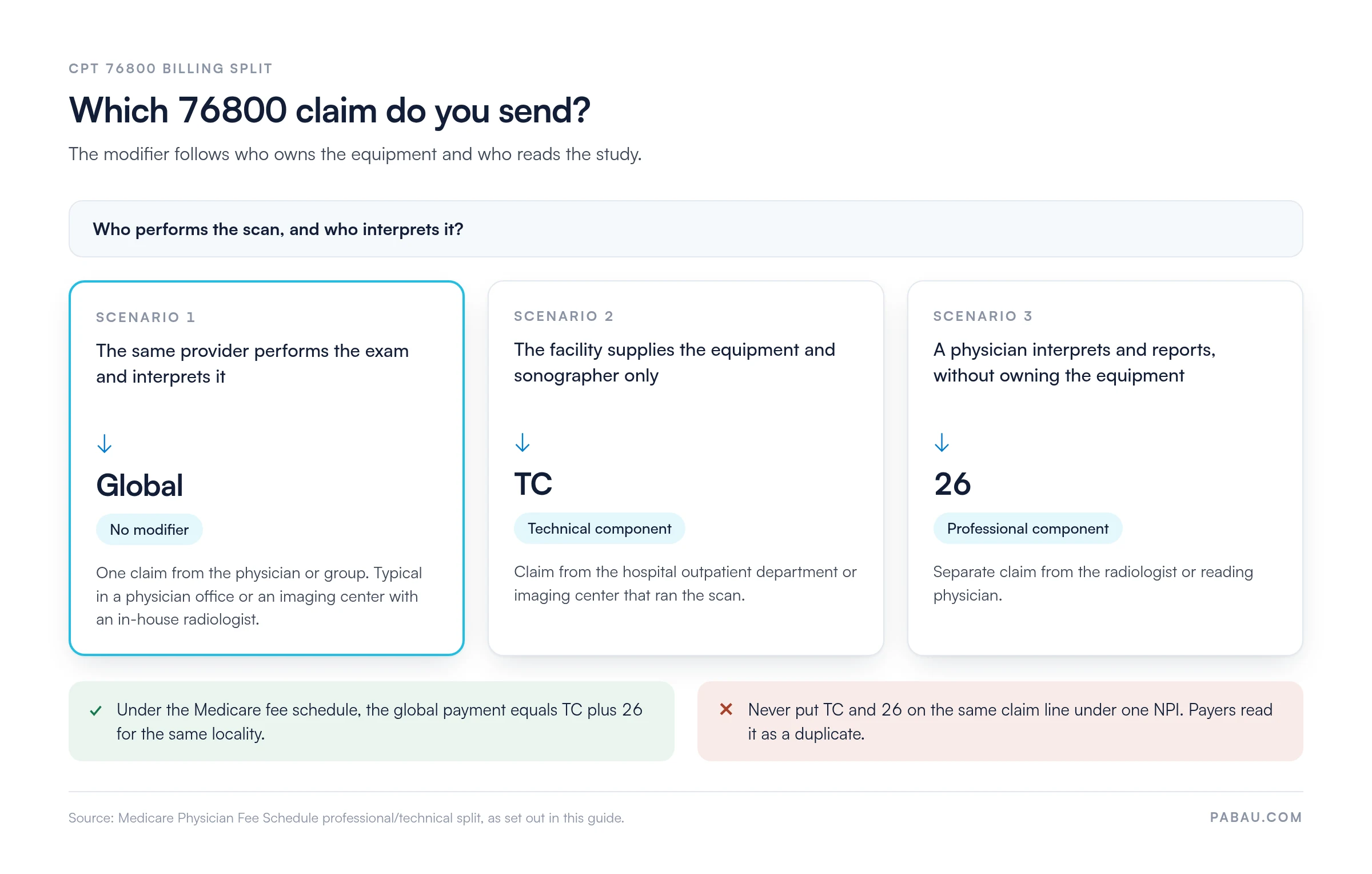
Never bill TC and modifier 26 on the same claim line under the same NPI, because CMS reads it as a duplicate. When the components are split, each entity submits its own claim for the part it performed.
Medicare pays 76800 under the Medicare Physician Fee Schedule (MPFS), adjusted by the Geographic Practice Cost Index (GPCI) for your locality. Rates change with each annual CMS update, so pull current figures from the CMS Physician Fee Schedule lookup tool before you set prices.
The practice expense RVU is usually the largest part of 76800, reflecting transducer and facility costs. The work RVU is modest next to more invasive spinal imaging. The FastRVU 2026 RVU lookup shows current work, practice expense and malpractice RVUs by modifier and locality.
Keep these points in mind when you check a payment:
837P claims go electronically to US payers through Claim.MD. After the payer adjudicates, the electronic remittance advice comes back as an 835 file, and each payment adjustment maps to the original claim.
Traditional Medicare (fee-for-service) doesn’t require prior authorization (PA) for 76800. Your MAC’s LCD still decides whether the diagnosis on the claim triggers coverage. A non-covered ICD-10 code ends in a denial just as surely as a missing PA.
Medicare Advantage and commercial managed-care plans work differently, and many require PA for non-emergency diagnostic imaging. Run insurance eligibility verification before scheduling, then do a payer-specific PA check.
A PA request for 76800 usually asks for:
Medical billing compliance means the PA approval number is on the claim before it goes out. A claim sent without a required approval number is denied, and it often needs a fresh authorization rather than an appeal.
Run the eligibility check when the 76800 exam is booked, not on the morning of the scan. Payer PA thresholds vary by plan, so confirm the specific plan’s imaging authorization rules at scheduling.
Most 76800 problems are baked in long before the claim is built. Following one claim through the process shows where each one starts:
The same seven denial patterns come up again and again on 76800 claims. Each one traces back to a step in the process above.
A clean claim for 76800 depends on the diagnosis, the modifier and the authorization being right before it leaves your system. Pabau, the practice management platform we build, includes cleaner claims management software that pre-fills the claim from the record.
A denial management workflow catches what still slips through. It tracks CARC denial codes from ERA files and routes appeals before the filing deadline.
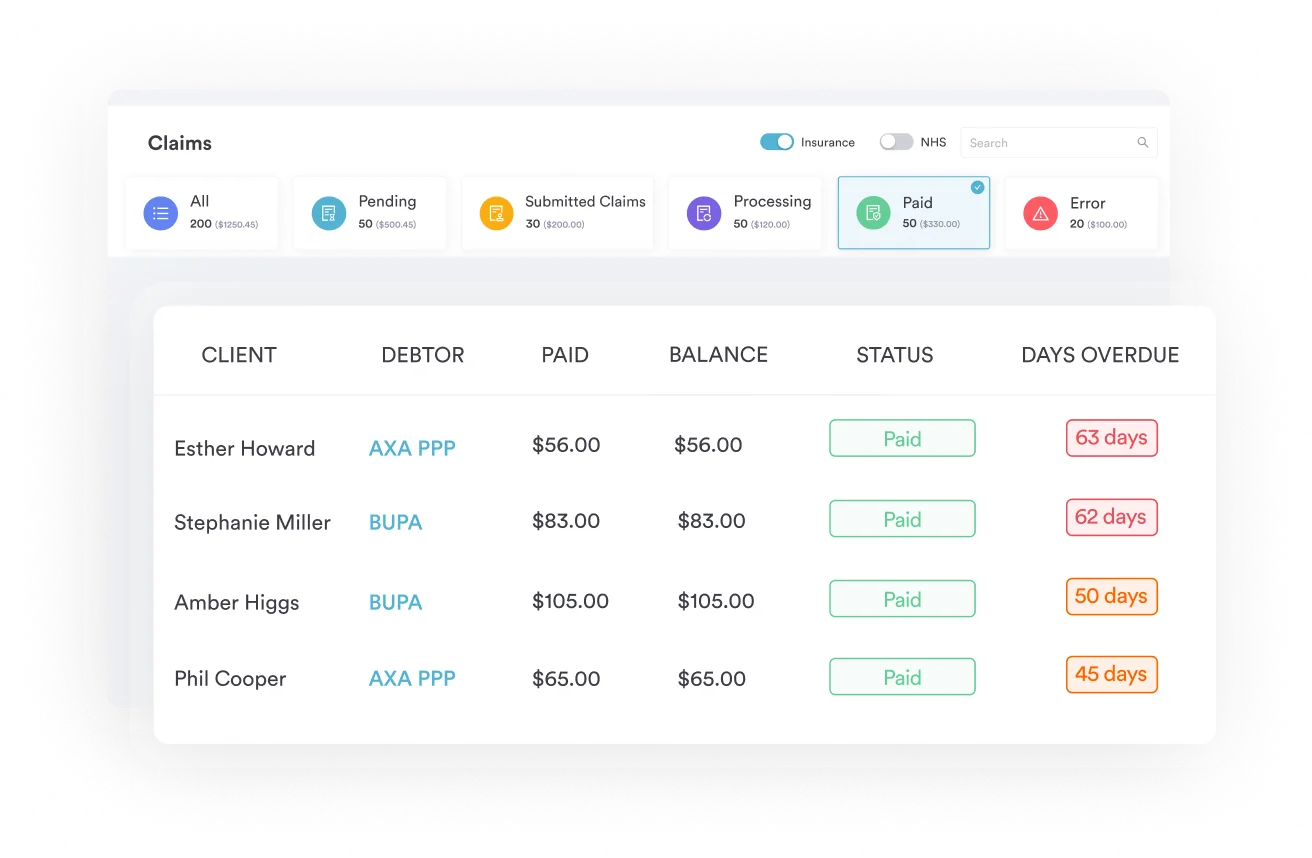
Billing 76800 by hand means copying codes from a scan report, a referral and an authorization letter into the claim. Each copy is a chance for a wrong digit, a missing PA number or a dropped modifier.
Pabau pre-fills the claim from the record, offers CPT and ICD-10-CM lookup libraries, and checks required claim fields before sending. 837P claims go electronically to US payers through Claim.MD, and 835 ERA files post back automatically.

Pabau pre-fills the claim from the patient record, offers CPT and ICD-10-CM lookup libraries, and checks required claim fields before sending. ERA files post back, so your team works denials in one place.

Most 76800 denials are decided before the claim is built. They start at scheduling, when nobody checked the plan’s PA rules, or at the report, when the indication didn’t name the spine.
So fix the front end first. Make the ordering note state a spinal question, and confirm the diagnosis against your MAC’s LCD. Then settle who owns the equipment before anyone picks a modifier.
Get those three right and the claim itself becomes routine. Book a demo to see how Pabau pre-fills 76800 claims and stops them sending with a blank authorization field.

Comparing 76800 with abdominal ultrasound codes? CPT code 76705 explains the limited abdominal ultrasound and when it can sit on the same date as a spinal exam.
Need a guide to how medical claims clearinghouses work? Medical claims clearinghouses explained covers how 837 files route to payers, ERA return paths, and what to look for in a clearinghouse integration.
Researching the 837 file format for electronic claim submission? 837 file: What it is and how it works explains the transaction set, required loops, and how errors in the 837 structure trigger front-end rejections.
Looking for a reference on superbill structure for radiology visits? What is a superbill? walks through the required fields, how CPT and ICD-10 codes appear on it, and how its data flows into the claim.
Usually not. Aetna’s spinal ultrasound policy, for example, treats diagnostic spinal ultrasound for neuromusculoskeletal conditions as unproven outside infancy. Adult coverage mostly comes from intraoperative use, so check the plan’s policy before booking.
It works best in newborns and in early infancy, before the posterior spinal elements ossify. Past about 6 months the acoustic window narrows, and the exam can be very limited.
Q82.6, congenital sacral dimple, is the usual diagnosis for a screening exam. Lumbosacral skin markers are a covered indication in many infant policies, but confirm the code against your MAC’s LCD.
No. Unlike abdominal ultrasound, which splits into 76700 and 76705, the spinal canal has one code. If a study is cut short, ask your payer whether it wants modifier 52 for reduced services.
The physician who interprets the images and signs the final report bills modifier 26. A countersignature without that physician’s own interpretation doesn’t support the professional claim.



