CCSD code F5010: Parotid duct transposition billing guide
CCSD code F5010 covers parotid duct transposition, one side or both CCSD code F5...

Last Updated: Oct 9, 2026

CPT code 76705 describes a limited abdominal ultrasound performed in real time with image documentation, covering a single organ, single quadrant, or follow-up study.
Billing 76700 without documenting every required abdominal organ is a common cause of downcoding and denial.
2026 Medicare reimbursement for CPT 76705 is approximately $55-$65 for the global service in a non-facility setting. Rates vary by locality and by whether TC or modifier 26 is appended.
Pabau’s claims management software automates ICD-10 pairing, flags missing documentation, and routes CPT 76705 claims through the Claim.MD clearinghouse to thousands of US payers.
CPT code 76705 bills a limited abdominal ultrasound performed in real time with image documentation. It covers a single organ, a single quadrant, or a follow-up look at a known finding. Its complete counterpart, CPT 76700, covers the full abdominal survey.
Choosing between the two decides whether the claim pays at the rate you expect. This guide covers the 76705 vs 76700 boundary and the 2026 Medicare rates for each billing component. It also covers the ICD-10 codes that support medical necessity, the modifiers that apply, and the documentation payers ask for.
The American Medical Association (AMA) defines the code as: Ultrasound, abdominal, real time with image documentation; limited (e.g., single organ, quadrant, follow-up). That parenthetical carries the weight of the code. It pays for a focused examination of the organs named in the order, not a survey of the whole abdomen.
When a sonographer images only the liver to work up an abnormal LFT, CPT 76705 is the correct code. The same applies to a follow-up of a known gallbladder polyp. Billing the complete code in either scenario overstates the service and creates compliance exposure under OIG audit criteria.
The boundary between CPT code 76705 and CPT 76700 is the most consequential coding decision in abdominal ultrasound billing. 76705 covers the limited study and 76700 covers the complete one. A complete study requires real-time imaging of seven structures. Those are the liver, gallbladder, common bile duct, pancreas, spleen, kidneys, and the upper abdominal aorta or inferior vena cava.
If an organ cannot be visualized for a clinical or technical reason, the report must note why. The study still qualifies as complete. Without that note, the coder has to downcode to 76705.
CPT 76705 and CPT 76700 cannot be billed together on the same day for the same patient by the same provider. NCCI (National Correct Coding Initiative) edits bundle these codes. If a limited study expands into a complete one during the same session, submit 76700 alone, with documentation supporting the wider scope.
Five situations account for almost every choice between the two codes, and the deciding factor in each one is what the report documents.
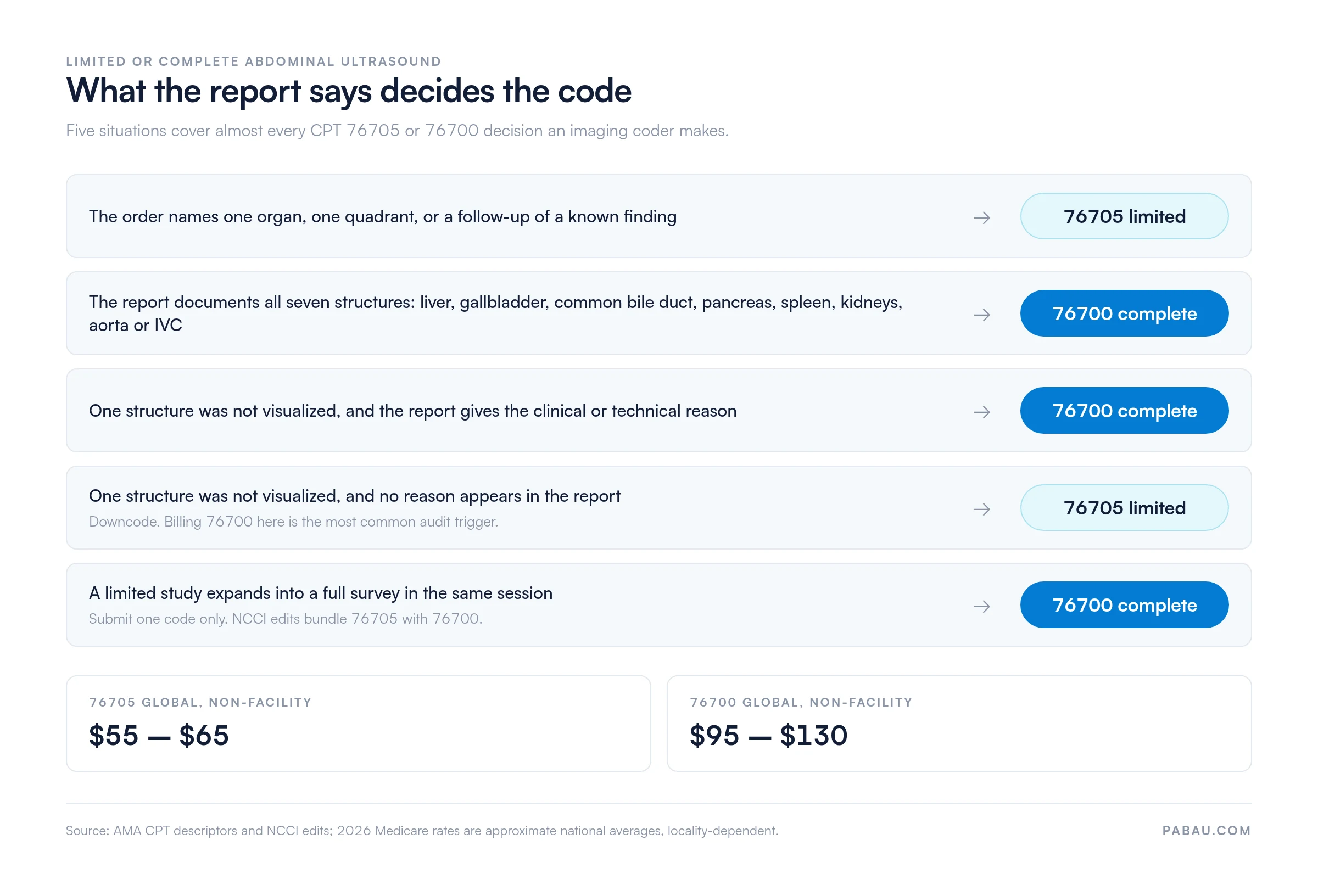
CPT 76705 is used when the order asks for a focused look at one organ or quadrant, or a follow-up of a known finding. The ordering provider’s documentation has to name that clinical indication. Payers look for a clear link between the ICD-10 diagnosis, the organs examined, and the reason a limited study was appropriate.
When the order covers multiple organ systems and no prior complete study exists, check whether CPT 76700 is the more accurate code. The AMA’s guidance, and most MAC LCD policies, tie the limited designation to the focused scope of the imaging order. Time spent and the number of images acquired do not decide it.
Aortic surveillance under 76705 tracks a known aneurysm over time. When the workup moves to a catheter contrast study of the abdominal aorta, the radiologist’s supervision and interpretation is reported under CPT code 75625.
ICD-10 code selection has to reflect the documented diagnosis or presenting symptom, not the procedure performed. For CPT code 76705, the pairing must support medical necessity for a limited abdominal study. The CDC/NCHS ICD-10-CM coding tool is the authoritative source for validating a code’s current status and description.
Always code to the highest level of specificity the medical record supports. R10.9 is a valid placeholder only when the record does not support a more specific code. R10.11 through R10.32 specify the quadrant and the type of pain, so reach for those first when the note localizes the symptom.
Payers cross-reference the diagnosis code against LCD medical necessity criteria. A vague code raises the odds of an additional documentation request or a denial. When the presenting symptom does not appear in the table above, the ICD-10-CM code reference lists the current billable codes by chapter.
Medicare pays roughly $55 to $65 for a global CPT 76705 in a non-facility setting in 2026. The rate is built from the Medicare Physician Fee Schedule (MPFS) on a relative value unit (RVU) structure. Verify the final figure against the official CMS Physician Fee Schedule lookup tool, because rates move with geographic locality and setting.
The FastRVU 2026 RVU lookup breaks the code into its work, practice expense, and malpractice components. Practices that submit 76705 electronically can check payer-specific allowables at the point of submission. A clearinghouse reaches thousands of commercial and government payers.
These figures are approximate national averages for 2026 and need confirming against the current MPFS final rule and your locality adjustment. Commercial payers often reimburse at a multiple of the Medicare rate, though some Medicaid managed care plans pay below it.
Run a payer-mix analysis on your CPT 76705 claims quarterly. Compare what each commercial payer actually pays against your contracted rate and the Medicare benchmark. A shortfall above 10% on any single payer usually points to a contract worth renegotiating or a systematic billing error.
Insufficient documentation is the primary driver of CPT 76705 claim denials. Noridian Healthcare Solutions, the Medicare Administrative Contractor for Jurisdiction E, requires all of the following elements in the medical record. A billable limited abdominal ultrasound needs each one.
Confirming these elements before the claim is transmitted is far cheaper than proving them during an appeal. Pre-mapping the fields to CPT 76705 inside the billing system cuts missing-information denials. It also removes the need for a manual chart review on every claim.
Modifier selection for CPT code 76705 affects both the payment amount and the compliance risk of the claim. Using the wrong modifier in a split-billing scenario is one of the fastest ways to trigger a Medicare audit flag on imaging claims.
TC/PC split billing is most common in hospital outpatient and free-standing imaging center settings. In a physician office that owns the ultrasound equipment, no modifier is appended and the global fee is billed. Appending modifier -26 there underpays the practice and can be flagged as a billing irregularity.
Most CPT 76705 claim denials trace back to four recurring errors. Each one is preventable with a pre-submission documentation checklist.
Tracking denial reason codes for 76705 month by month tells you which of the four is actually costing you money. A payer that denies on the same remark code every month points to a workflow problem, not bad luck.
Billers sometimes reach for the unlisted ultrasound code when no code names a liver study outright. A limited hepatic scan is already described by 76705, so 76999 does not apply.
Manual ICD-10 selection and paper-based documentation create the conditions for CPT 76705 errors. A biller who has to recall the right diagnosis pairing, check a modifier rule, and remember the image attestation will eventually miss one.
Practice management software like Pabau closes that route to error. Our automated claims management software prompts for the organ examined at the point of documentation. It then checks that the coded diagnosis supports a limited study, and flags incomplete fields before the claim is generated.
For a radiology or imaging practice, that means fewer supplemental documentation requests and fewer appeals eating into staff time. Claims route electronically to the clearinghouse with current CPT and ICD-10 catalogues behind them. Remittance data lands back in the billing dashboard instead of arriving weeks later on a paper EOB.
The Claim.MD integration handles eligibility checks, ERA remittance processing, and secondary claim submission across thousands of payers. CARC denial codes tied to 76705 rejection patterns surface in the same dashboard, so a repeat pattern gets caught in days rather than quarters.
Before submitting any CPT 76705 claim, verify three things in your billing system. First, the ICD-10 code matches the organ documented in the report. Second, the modifier reflects the actual billing scenario, whether global, TC, or -26. Third, the radiology report includes a statement confirming image storage.

Pabau brings scheduling, documentation, and claims submission into one platform. See how practice management software reduces claim denials and automates ICD-10 pairing for imaging codes like CPT 76705.

The 76705 decision is made at the point of documentation, not at the point of billing. By the time a coder reads the report, the choice between limited and complete has already been fixed by what the sonographer recorded.
So the practices that hold a low denial rate on imaging claims are the ones that push the check upstream. Prompt for the organ at the time of the exam and tie the ICD-10 code to it. Then require the storage attestation before the report can be signed.
That leaves the coder confirming a decision rather than reconstructing one. Book a demo to see how Pabau builds those checks into your imaging claims before they leave the practice.

Need to understand how clearinghouse claims flow for imaging codes? Our Claim.MD clearinghouse guide explains how electronic claims move from EHR to payer and where 76705 claims commonly stall.
Tracking denial patterns across your imaging codes? Medical billing compliance practices covers how to set up a denial tracking workflow that surfaces code-specific patterns before they compound.
Credentialing with imaging payers? Getting credentialed with insurance companies outlines the steps for enrolling with Medicare and commercial payers for radiology and diagnostic imaging services.
Want the imaging claim to pay first time? What makes a clean claim lists the fields a payer checks before it accepts a submission.
Denials piling up on one payer? Denial management in healthcare shows how to turn a rejection into a workflow fix instead of a rebill.
CPT code 76705 bills a limited abdominal ultrasound performed in real time with image documentation. It covers a single organ, a single quadrant, or a follow-up examination. It applies when the clinical indication calls for a focused study rather than a comprehensive evaluation of all abdominal organs. Common uses include monitoring a hepatic cyst or evaluating right upper quadrant pain for gallstones. Following up a renal lesion found on a prior complete study is another.
CPT 76700 represents a complete abdominal ultrasound. It requires documentation of the liver, gallbladder, common bile duct, pancreas, spleen, kidneys, and aorta or IVC. CPT 76705 is the limited version, covering only the organ, quadrant, or finding specified in the clinical order. The two codes cannot be billed together on the same date by the same provider for the same patient. NCCI edits bundle them.
The 2026 Medicare national average for the global service with no modifier is approximately $55-$65 in a non-facility setting. Rates vary by geographic locality and practice setting. The technical component (modifier TC) reimburses approximately $35-$45, and the professional component (modifier -26) reimburses approximately $20-$25. Confirm current rates using the CMS Physician Fee Schedule lookup tool, as the MPFS is updated annually.
Commonly paired codes include R10.9 (unspecified abdominal pain), K76.0 (fatty liver), R16.0 (hepatomegaly), and R93.5 (abnormal abdominal imaging findings). Others include K80.20 (gallbladder calculus without cholecystitis), I71.4 (abdominal aortic aneurysm without rupture), and N13.30 (hydronephrosis). Always code to the highest specificity the medical record supports, as non-specific codes increase the likelihood of a medical necessity denial.
Medicare generally does not require prior authorization for CPT 76705, but commercial payers vary significantly. Some managed care plans require prior authorization for any outpatient imaging, while others apply criteria only to repeat or high-cost studies. Always verify authorization requirements with the specific payer before the study is performed. Retroactive authorization is rarely granted for imaging codes.
Modifier -26 applies when a radiologist interprets a study performed at a separate facility. TC applies when the facility or imaging center bills for the equipment and technologist. Modifier -59 applies when the study is separately identifiable from another same-day procedure under NCCI edits. LT or RT applies when laterality is clinically significant. Never append both TC and -26 from the same provider on the same claim.
There is no single CPT code designated solely for a liver ultrasound. When the liver is the only organ evaluated, CPT 76705 is the appropriate code. The examination still has to be real time with image documentation. If additional abdominal organs are evaluated in the same session and meet the complete study criteria, CPT 76700 applies instead.