CCSD code F3070: Suture of palate billing guide
CCSD code F3070 covers stitching a wound in the palate CCSD code F3070 is the co...

Last Updated: Oct 12, 2026
76380 is the CPT code for computed tomography, limited or localized follow-up study. It covers a focused CT that answers one clinical question, most often a sinus recheck after treatment, though the code applies to any anatomic site.
What separates 76380 from a complete CT of the same region is scope and documentation. A complete study, such as 70486 for the maxillofacial area, surveys the whole region and needs a full report. Payers check the order and the radiology report for that difference.
Let Pabau's smart automation suggest the right codes, reduce claim denials, and keep your practice compliant—effortlessly.
Automate repetitive tasks and focus on what matters most—your patients.
Reduce coding errors and ensure compliance with the latest regulations.
Clean claims, fewer denials, and faster reimbursements.
Powerful insights and reporting to help your practice thrive.
HIPAA compliant SOC 2 certified GDPR-compliant Trusted by 4,000+ clinics worldwide

CPT Code 76380 covers a limited or localized follow-up CT study, not a complete diagnostic scan.
The paranasal sinuses are the most common site, but the code is not sinus-specific.
A first-time limited study with no prior imaging should be checked against payer policy before you assign 76380.
In 2026, 76380 carries 0.96 work RVUs against 0.83 for 70486, so code choice turns on scope and documentation.
Pabau’s claims management software submits 76380 claims through Claim.MD and tracks claim status and denials.
CPT Code 76380 is defined by the American Medical Association (AMA) as: Computed tomography, limited or localized follow-up study. The word “limited” carries specific clinical and billing meaning. A limited CT study evaluates fewer anatomic areas, uses fewer image acquisitions, and answers a focused clinical question rather than providing a complete diagnostic survey.
The code applies across multiple anatomic sites. The paranasal sinuses dominate clinical use because post-treatment sinus surveillance is frequently ordered as a targeted follow-up rather than a full maxillofacial CT. Other uses include limited CT of the orbits and of the temporal bones after surgery. Localized follow-up studies of other head and neck structures qualify too. The AMA descriptor does not restrict 76380 to sinuses. What defines the code is a limited or localized scope, whatever the anatomic site.
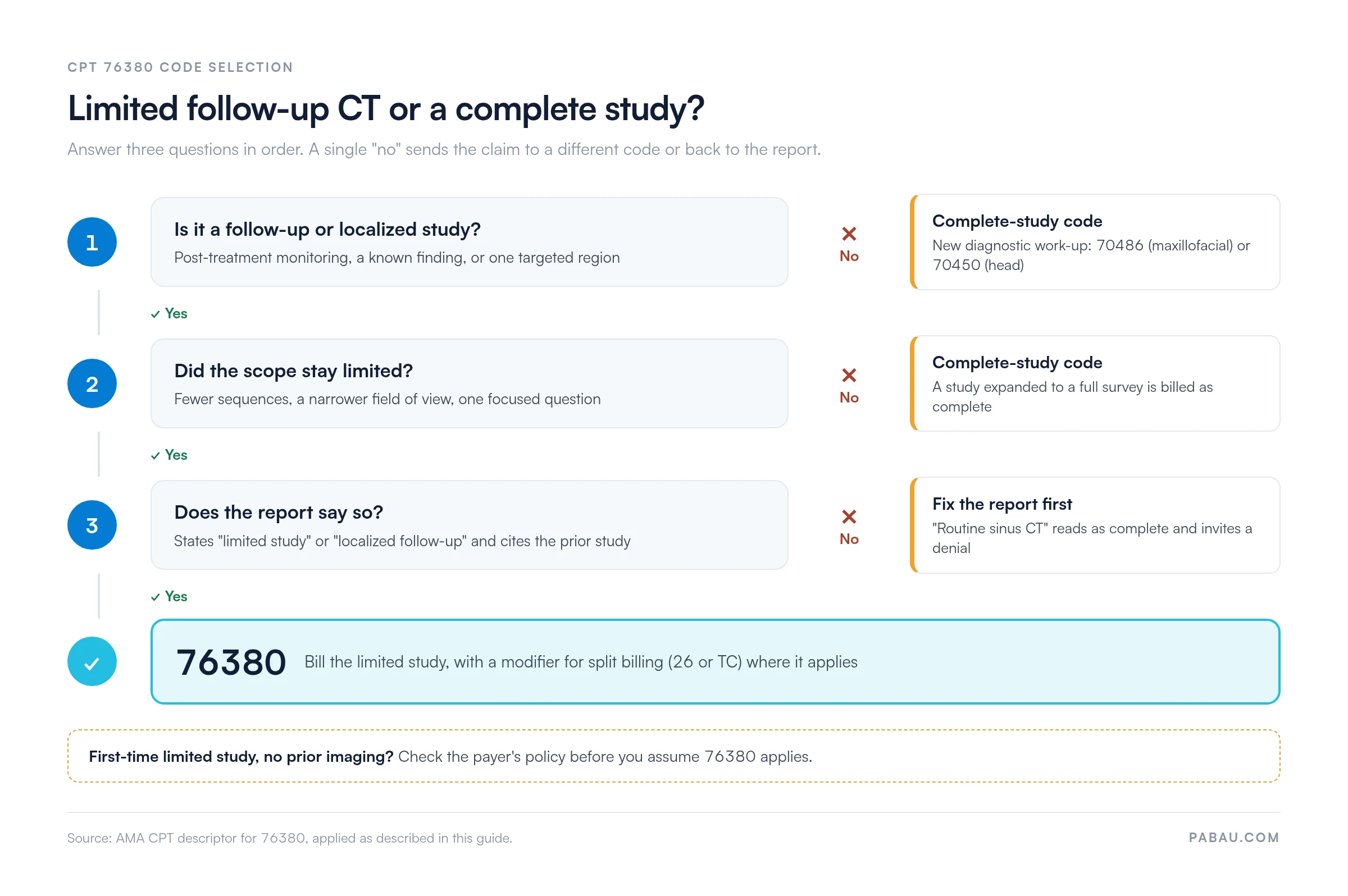
Payers separate a limited study from a complete CT in three ways. It uses fewer image sequences and a narrower field of view, and the ordering note documents a focused indication. A study that acquires multiple reconstruction planes across the full sinus anatomy, with a comprehensive report, is not a limited study. That holds however the order labels it.
Correct code selection for a limited CT study depends on understanding the boundary between 76380 and the complete CT codes in adjacent ranges. Because the descriptor names a follow-up or localized study, a first-time limited CT does not automatically qualify. Check a first-time limited study against the payer’s policy rather than assuming it is 76380.
A study that begins as a limited follow-up and is expanded during the scan to a complete survey must be reported with the complete-study code. Billing 76380 for a study that meets the definition of 70486 is miscoding, however the order was written. The three checks below settle most cases.
Solid documentation is the single most effective defense against denial for a 76380 claim. CMS requires each CT study to be performed at the supervision level assigned to its code, and a qualified physician must interpret it. Strong medical billing compliance starts at the point of ordering, not at the point of billing.
One documentation mistake recurs often. The radiologist’s report describes the study as “routine sinus CT” without noting the limited scope. Payers read “routine” as equivalent to “complete” and deny 76380 as underdocumented. The report must say “limited study” or “localized follow-up.”
Medical necessity for a limited CT study requires a documented clinical indication that justifies the follow-up or localized approach rather than ordering a complete CT. Payers evaluate the ordering note and the clinical scenario when adjudicating 76380 claims.
Common accepted indications include:
Some indications typically do not meet medical necessity for 76380. They include new-onset symptoms without prior imaging and complex multisystem disease that needs a complete survey. Pre-operative planning, where a complete CT is standard of care, is another. Billing 76380 in those scenarios draws medical necessity denials and, if systematic, audit scrutiny.
The ICD-10-CM codes on the claim must support the limited-study rationale. Commonly paired codes include J32.x (chronic sinusitis by site), J33.x (nasal polyp), H05.x (orbital disorders), and Z09 (encounter for follow-up examination after completed treatment). Submitting J01.x (acute sinusitis) with 76380 may trigger a medical necessity denial because acute sinusitis is typically a clinical diagnosis. A limited CT during the acute episode is rarely covered unless conservative management has failed.
The most frequent coding errors with CPT Code 76380 involve the adjacent complete-CT codes for the same anatomic regions. The table below maps the most commonly confused codes, per AAPC’s CPT code reference.
76380 vs. 70486 is the most frequently confused comparison. The scope of the study decides it, whatever the anatomic site. A coronal-only sinus CT performed for post-FESS follow-up is 76380. A multiplanar complete survey of the maxillofacial skeleton ordered for new facial pain is 70486.
Modifier selection for 76380 follows standard radiology billing rules. The applicable modifier depends on how the technical and professional components of the study are billed.
Modifier 52 requires careful use. Appending it signals that the study was reduced from what was planned. If the study was always intended to be limited, 76380 already reflects that scope and modifier 52 is unnecessary. Only append 52 when an unexpected event truncated an otherwise standard limited study.
Medicare reimburses 76380 through the Medicare Physician Fee Schedule (MPFS). The CMS Physician Fee Schedule lookup tool provides current locality-specific payment amounts. National averages change every year as RVUs are recalibrated. Verify the current year’s rates before quoting reimbursement estimates.
The FastRVU 2026 RVU lookup tool provides the current work, practice expense, and malpractice RVU values for 76380 alongside the conversion factor. For 2026, 76380 carries 0.96 work RVUs and 3.96 total RVUs. The complete maxillofacial CT without contrast, 70486, carries 0.83 and 3.84. The two codes pay within a few cents of each other, so they differ in scope and documentation rather than in payment.
Pabau’s claims management software, through the Claim.MD integration, submits claims electronically and tracks their status. Your team sees each 76380 claim’s payer response in one place instead of checking a separate portal.

Run a quarterly pull of your 76380 claim data against the current MPFS conversion factor. Is your average allowed amount per claim well below the MPFS national rate? Look for modifier errors, such as global billing where split billing applies, or place-of-service errors. Most practice management systems can flag this in a denial aging report.
Prior authorization requirements for CPT Code 76380 vary by payer and plan year. Practices that manage insurance eligibility verification and authorization workflows together reduce the lag between order and authorization. Treat prior auth as a scheduling task that starts when the study is ordered.
When prior authorization is required, the submitted clinical criteria must match the documentation that will accompany the claim. Submitting different clinical information at authorization and at billing is a compliance risk, even when the authorization was granted.
Denials on 76380 cluster around a predictable set of errors. Systematic denial management workflows track each denial code in medical billing back to its root cause so the same mistake does not recur. The most common denial patterns are:
A clean claim submission for 76380 pairs the correct code with a matching ICD-10 code and the right modifier for the billing arrangement. It also carries the correct POS and any required authorization number. All five elements must be present before the claim leaves the practice.
Sometimes. The limited CT must answer a separate clinical question, and the current NCCI edits must allow the pair.
CT guidance for biopsy is separately billable using 77012 (CT guidance for needle placement), not 76380. A radiologist may perform a limited CT to locate a lesion, then guide the biopsy with ultrasound. Those are separate imaging modalities serving different procedural roles. However, NCCI edits may bundle the imaging code with the biopsy code. That depends on the specific biopsy CPT and the edit table in effect on the date of service.
Key principles for this scenario:
Many radiology billing teams follow 76380 claims across a clearinghouse portal, payer websites and a denial spreadsheet. A rejected limited-CT claim can sit unnoticed for weeks.
Pabau submits claims electronically through its Claim.MD integration and tracks each claim’s status. When a payer denies a 76380 claim, the denial shows next to it. Your team can correct the report or modifier and send it again.
Code selection stays with your coders and radiologists. What changes is how quickly a denied claim gets noticed and worked, which shortens the time to payment.

Submit 76380 and other radiology claims electronically through Pabau’s Claim.MD integration. Then track each claim’s status and denials in one place.

Bill 76380 when the order, the scan and the report all describe a limited or localized follow-up study. If any one of them reads like a complete survey, bill the complete code or fix the report before the claim goes out.
The 2026 RVUs for 76380 and 70486 sit within a few hundredths of each other. The fee gives no reason to pick one over the other. Documentation decides whether a 76380 claim holds up, and a report that says “limited study” is the cheapest protection you have.
Want submitted claims and denials tracked in one place? Book a demo to see Pabau’s claim submission and status tracking through Claim.MD.

Need help understanding how clearinghouses validate radiology claims? Medical claims clearinghouse guide explains how 837P files route claims to payers and where validation errors occur.
Struggling with claim denials across your radiology billing? What is medical billing covers the end-to-end revenue cycle from encounter to remittance and where 76380-type codes fit.
Want to understand ERA remittance data for denied radiology claims? Electronic remittance advice (ERA) guide explains how to read 835 remittance files and identify CARC denial reason codes.
Adding 3D rendering to a limited CT? CPT code 76376 explains how 3D rendering without an independent workstation is billed as an add-on.
Billing a full head CT instead? CPT code 70450 covers the complete non-contrast head CT and what its report needs.
CPT Code 76380 is the billing code for a limited or localized follow-up computed tomography (CT) study. It covers a focused evaluation of one or more areas rather than a complete diagnostic CT. It is most commonly applied to post-operative or surveillance CT of the paranasal sinuses, though the AMA descriptor does not restrict it to that site. Check a first-time limited study with no prior imaging against payer policy rather than assuming it is 76380.
Yes, Medicare covers CPT Code 76380 when medical necessity is documented in the ordering note and the study is performed under the appropriate supervision level. Medicare does not generally require prior authorization for 76380. Medicare Advantage plans and commercial payers may require it, so verify with the specific plan before scheduling.
Append modifier 26 when billing only the professional component, the radiologist’s interpretation. Use modifier TC for the technical component alone, meaning the equipment and staff. Bill with no modifier when one practice bills both components. Modifier 52 applies when a patient or equipment problem cut the study short. Modifier 59 applies when 76380 is a distinct service on the same date as a bundled procedure.
Prior authorization requirements depend on the payer and plan. Traditional Medicare does not require prior auth for 76380. Some Medicare Advantage and commercial plans use radiology benefit managers, such as EviCore, and may require it. Check the specific payer’s radiology benefit management policy for each plan before scheduling the study.