CPT code 23474: Revision total shoulder arthroplasty billing guide
CPT code 23474: Definition and clinical description CPT code 23474 is the Americ...

Last Updated: Nov 5, 2026
75822 is the CPT code for venography of both extremities, radiological supervision and interpretation. It covers overseeing a contrast study of both arms or both legs in one session, the fluoroscopic imaging, and the signed report.
The code is S&I only. The injection and venous access are reported separately with CPT 36005. In a split-billing setting, the radiologist adds modifier 26 and the facility adds TC. 75822 sits in the Veins and Lymphatics group (75801-75893) of the Vascular Procedures subsection.
Let Pabau's smart automation suggest the right codes, reduce claim denials, and keep your practice compliant—effortlessly.
Automate repetitive tasks and focus on what matters most—your patients.
Reduce coding errors and ensure compliance with the latest regulations.
Clean claims, fewer denials, and faster reimbursements.
Powerful insights and reporting to help your practice thrive.
HIPAA compliant SOC 2 certified GDPR-compliant Trusted by 4,000+ clinics worldwide

CPT Code 75822 reports radiological supervision and interpretation for venography of both arms or both legs in one session, billed as one unit.
The contrast injection and venous access are reported separately with CPT 36005, so check current NCCI edits before you pair the two codes.
Fluoroscopic imaging is part of the 75822 study and is not billed with a separate fluoroscopy code for the same session.
Use modifier 26 for the radiologist and TC for the facility in a split-billing setting, and never report 75820 twice for a bilateral study.
The signed report must document imaging of both limbs in the body of findings, because the procedure title alone does not support 75822.
CPT Code 75822 reports radiological supervision and interpretation (S&I) for a contrast venogram of both arms or both legs in one session. The official descriptor reads: Venography, extremity, bilateral, radiological supervision and interpretation. The code pays for overseeing the study and writing the signed report. The contrast injection and venous access are reported separately with 36005.
Fluoroscopy is part of the imaging study, so it is not billed separately on the same date. The contrast injection and venous access are a separate service, reported with 36005. The bundling section below covers how NCCI edits treat that pair.
75822 is appropriate when a physician needs fluoroscopic imaging of the venous anatomy in both extremities in the same session. The physician’s order must document the indication. It must also match an ICD-10 code that payers recognize as medically necessary for bilateral venous imaging.
Common clinical indications for CPT Code 75822:
The radiology report must show that both extremities were imaged. A report that documents unilateral findings only does not support 75822, whatever the physician order says. Confirm the bilateral scope in the body of the interpreting report before assigning this code.
75820 is the unilateral counterpart to 75822, covering venography of a single extremity. The two codes are not interchangeable. When both limbs are imaged, coders cannot report two units of 75820 in place of 75822.
The decision rule is short. If the radiology report confirms imaging of both limbs, bill 75822 as a single unit. If only one limb was imaged, bill 75820, adding LT or RT when the payer requires laterality. Never upcode 75820 to 75822 without documented bilateral imaging.
75825 and 75827 cover central venous structures, not extremities. Using one of these codes when the clinical record describes extremity imaging is a systematic coding error that triggers audits.
75822 can sometimes be reported alongside 75825 or 75827 on the same date of service. The report must then document the extremity study and the caval study as separate, distinct studies. Payers scrutinize same-day venography combinations closely, so both studies must be medically necessary and documented on their own.
Put together, the scope the report documents picks the code, while the injection follows a code of its own.
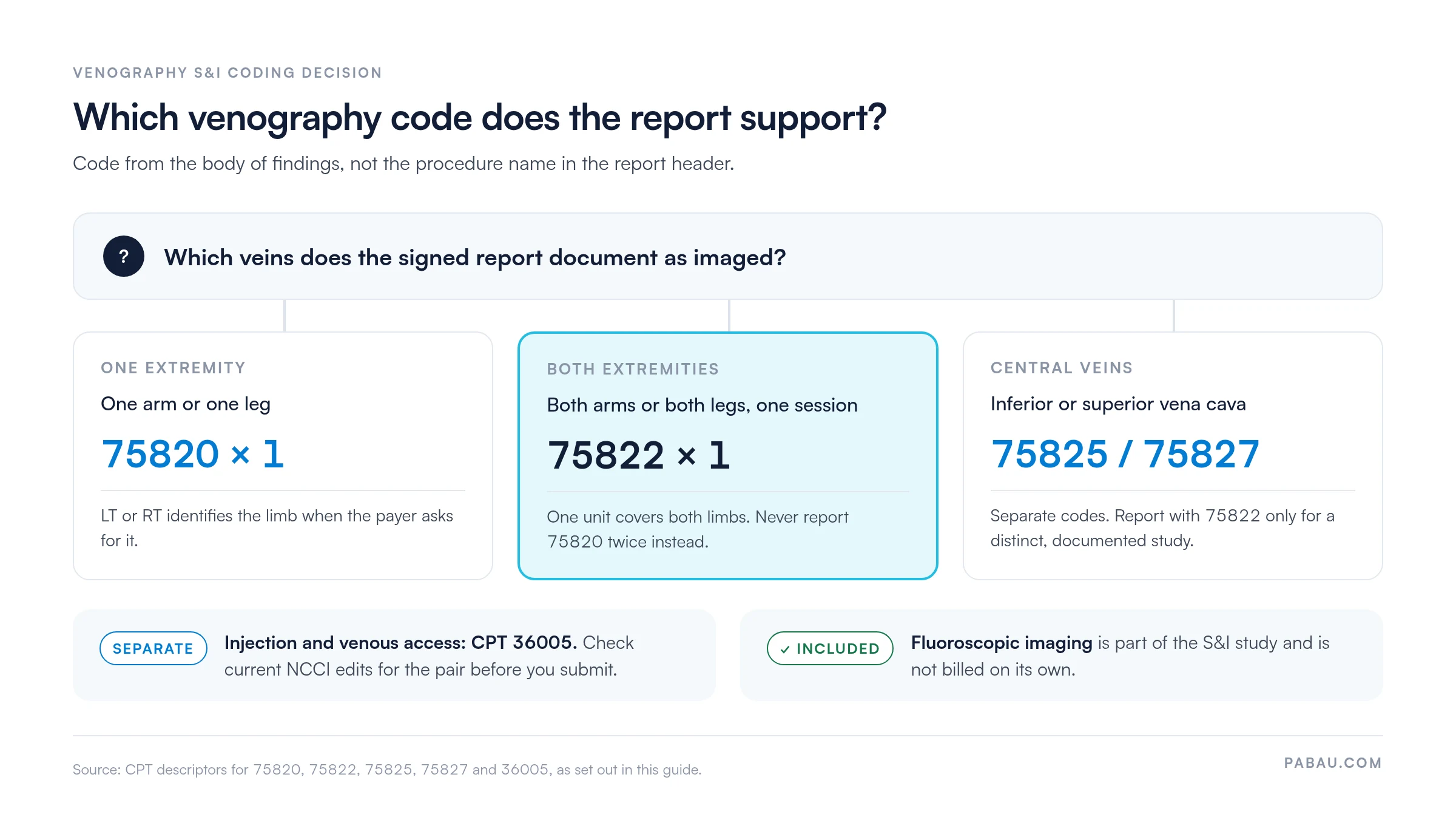
Before assigning any venography code, read the radiology report’s body of findings first, not just the procedure name in the header. Reports titled ‘bilateral lower extremity venography’ sometimes document only unilateral findings if one limb had poor contrast fill. The code must match the documented findings, not the intended procedure.
CPT Code 75822 carries a PC/TC indicator of 1 on the Medicare Physician Fee Schedule, so it supports a professional and technical component split. The modifiers you need depend on the billing setting and who owns the imaging equipment.
Modifier 59 warrants particular caution. The Centers for Medicare & Medicaid Services (CMS) treats modifier 59 misuse as an audit priority. Append it only when documentation shows a separate service, never just to bypass a National Correct Coding Initiative (NCCI) edit. Payers that follow CMS guidance prefer the more specific X modifiers (XE, XS, XP, XU) where they apply.
The diagnosis code on a 75822 claim must reflect the clinical indication the ordering physician documented. A code that is technically accurate but does not match that documented reason triggers medical necessity denials. Per CMS ICD-10-CM coding guidelines, the principal diagnosis must be the condition chiefly responsible for the study.
Never select an ICD-10 code to satisfy a payer’s coverage policy if it does not reflect the physician’s documented clinical impression. That practice can constitute false claims or fraudulent billing.
Medicare payment for CPT Code 75822 is set each year under the Medicare Physician Fee Schedule (MPFS). Rates vary by Medicare Administrative Contractor (MAC) locality, so the national average is a reference point rather than an exact payment figure.
Use the CMS Physician Fee Schedule lookup tool to find the current-year payment for 75822 in your locality. The tool returns the professional component (modifier 26) and technical component (TC) amounts, which matter when the radiologist and facility bill separately.
Key payment rules: Medicare pays the global amount when the physician owns the equipment and employs the technologist. In a hospital outpatient department, the facility receives the technical payment under the Outpatient Prospective Payment System (OPPS). The radiologist then bills separately with modifier 26. Private payer rates can differ from MPFS amounts, so check each payer contract before you estimate reimbursement.
Prior authorization requirements for CPT 75822 vary by payer and plan type. Medicare fee-for-service does not currently require prior authorization for 75822, but many Medicare Advantage plans and commercial payers do. Check the payer’s policy before scheduling the procedure.
Meeting medical billing compliance standards for prior authorization typically takes the following documentation:
Once authorization is granted, record the authorization number on the claim and keep the authorization documentation for the payer’s retention period. Claims for services after the authorization expiration date are not payable, even if the service was clinically appropriate.
The radiology report is the primary documentation source for submitting a clean claim for CPT 75822. Every element below must appear in the report to support medical necessity and correct code assignment.
Missing any of these elements is a common cause of medical necessity denials on 75822 claims. Checking each one before submission prevents denials that the report could have avoided.
Effective denial management workflows for 75822 start with knowing which denial types recur. The table below maps the top denial reasons to their root cause and the correction action.
Review the medical billing denial codes behind any 75822 denial to identify the specific Claim Adjustment Reason Code (CARC). The CARC tells you why the payer denied the claim, which is more actionable than the denial description alone.
Yes, the injection and venous access for extremity venography are reported with 36005 alongside 75822. 36000, the general code for introducing a needle or intracatheter into a vein, is not the venography injection code. CMS updates NCCI edits quarterly, so verify the current edit tables rather than a static list.
General bundling principles for 75822:
Coders who routinely append modifier 59 to catheter codes without reviewing the documentation are exposed to False Claims Act liability. Catching bundling conflicts before submission, rather than after a denial, is part of sound revenue cycle management.
Verify NCCI edits for 75822 and its companion codes each quarter, when CMS publishes its update. The CMS NCCI Policy Manual and the CMS NCCI edit tables (available free from the CMS NCCI edits page) are the authoritative sources. A coding reference that has not been updated since the last quarterly release may contain outdated bundling guidance.
Many 75822 denials trace back to the record behind the claim. The report never confirms both limbs, the authorization number is missing, or the modifier does not match the billing setting.
Pabau, the practice management platform we build, keeps the physician order, the authorization details, and the signed report on the same patient record. Your billing team works from that record instead of chasing documents across systems.
Pabau’s claims management software pulls existing record data into the claim, then submits it through Claim.MD and tracks its status. Your coders still assign the codes. Pabau keeps the documents they check in one place, so a bilateral study is easier to confirm before the claim goes out.

Pabau keeps the order, the authorization and the signed report on one patient record, then submits and tracks claims through Claim.MD. Your team can confirm a bilateral study before the claim goes out.

Code 75822 from what the signed report proves, not from what was ordered. If the findings describe both limbs, bill one unit of 75822 and report the injection with 36005. If they describe one limb, bill 75820 instead.
The cost of getting this right sits at the front of the workflow. A quick check of the report body, the authorization and the setting modifier takes less time than reworking a denied claim.
Book a demo to see how Pabau supports claim submission and tracking while the order and signed report stay on one patient record.

Imaged only one limb? CPT 75820 covers single-extremity venography S&I and the documentation it needs.
Reporting the injection for this study? CPT 36005 explains how the extremity venography injection is coded and paired.
Need a framework for reducing claim denials across your practice? Denial management in healthcare covers the end-to-end workflow for identifying, correcting, and preventing claim denials.
Want to understand how clearinghouse submission works? The Claim.MD clearinghouse guide explains how electronic claims reach payers and return remittance data.
Want the full workflow behind a radiology claim? What is medical billing walks through each step from code assignment to payment posting.
CPT Code 75822 covers radiological supervision and interpretation for contrast venography of both arms or both legs in one session. Use it when the signed report confirms both limbs were imaged. The indication must support bilateral assessment, such as suspected bilateral DVT, chronic venous insufficiency, or pre-operative venous mapping.
75820 covers venography S&I for one limb, and LT or RT identifies the limb when the payer requires it. 75822 covers both limbs in one session and is reported as one unit without laterality modifiers. Never bill two units of 75820 in place of 75822, because the code must match what the report documents.
Medicare fee-for-service does not currently require prior authorization for 75822, but many Medicare Advantage and commercial plans do. They often require it for non-emergent diagnostic imaging, so verify with the specific payer before scheduling the procedure.
75822 covers peripheral veins in both arms or both legs, while 75825 covers venography of the inferior vena cava, a central vein. The two codes are not interchangeable. They may be reported on the same date only when both studies were medically necessary and documented separately.
No. The S&I code includes the fluoroscopic imaging that is part of the study. Billing a separate fluoroscopy code for the same session is unbundling and can trigger an NCCI denial. The contrast injection is different, because it is reported separately with 36005.
Common pairings include the I82 series for acute and chronic venous thrombosis, I87.001-I87.009 for postthrombotic syndrome, and I87.2 for chronic venous insufficiency. The ICD-10 code must reflect the indication the ordering physician documented, not a code chosen to satisfy coverage criteria.