

CCSD code G5100: Bypass of duodenum billing guide
CCSD code G5100 bills a bypass that leaves the duodenum in place CCSD code G5100...

Last Updated: Oct 16, 2026
36005 is the CPT code for injection procedure for extremity venography (including introduction of needle or intracatheter). It covers the contrast injection only, so the radiology supervision and interpretation is reported with a separate S&I code.
Claim denials tied to CPT Code 36005 commonly come from billing the injection without the radiology S&I code. A bundling conflict with an adjacent vascular access code is another common cause, as is an ICD-10 pairing that does not support medical necessity.
Let Pabau's smart automation suggest the right codes, reduce claim denials, and keep your practice compliant—effortlessly.
Automate repetitive tasks and focus on what matters most—your patients.
Reduce coding errors and ensure compliance with the latest regulations.
Clean claims, fewer denials, and faster reimbursements.
Powerful insights and reporting to help your practice thrive.
HIPAA compliant SOC 2 certified GDPR-compliant Trusted by 4,000+ clinics worldwide

CPT Code 36005 covers the injection for extremity venography, including needle or intracatheter introduction. Imaging is billed separately.
Always pair 36005 with the correct radiology S&I code (75820, 75822, 75825, or 75827), billed by the interpreting physician.
NCCI edits bundle 36005 with several vascular access codes, and Modifier 59 may apply when procedures are clinically distinct.
Pabau’s claims management software supports CPT and ICD-10 claim submission through the Claim.MD clearinghouse integration.
The AMA CPT codebook describes CPT Code 36005 as: Injection procedure for extremity venography (including introduction of needle or intracatheter). The code covers only the injection component of the venography study. However, it does not include image acquisition, supervision, or interpretation. Instead, report those separately with the appropriate radiology supervision and interpretation (S&I) code.
According to the American Medical Association’s CPT code set overview, codes in the 36000 series cover introduction and injection procedures for vascular access. CPT Code 36005 sits within that series as the injection-only code for venography of the extremities, including the upper or lower limbs.
Understanding the scope of 36005 also means knowing what it is not. It also does not cover catheter advancement into the vena cava, and it does not replace codes for therapeutic interventions such as venous stenting or angioplasty. Clean billing for vascular procedures depends on recognizing exactly where each injection code begins and ends.
A contrast injection for venography involves injecting a radiopaque contrast agent into a peripheral vein, typically in the dorsum of the foot or hand. Fluoroscopy or X-ray imaging then shows the venous system. The physician inserts a needle or intracatheter, injects the contrast, and the radiologist captures and interprets the images.
For coders, the clinical sequence matters because it determines which codes apply. As a result, CPT Code 36005 captures the injection step only. Three additional facts are important:
When DVT is suspected, clinicians usually perform duplex ultrasound of the extremity veins first and report it with 93971 for a unilateral or limited study. Clinicians typically reserve venography for inconclusive ultrasound results or detailed venous mapping.
CPT 36010 describes introduction of a catheter into the superior or inferior vena cava. As a result, it is a distinctly different procedure from the peripheral extremity injection covered by CPT Code 36005. Confusing the two is a recognized miscoding risk in venous access billing.
The key distinction is that 36005 uses a needle or short intracatheter and stays in the peripheral extremity venous system. In contrast, code 36010 requires formal catheter advancement into the vena cava. Billing 36010 when you only injected a peripheral vein inflates the claim and triggers medical review.
CPT Code 36005 is a surgical component code only. Every venography study requires a matching radiology supervision and interpretation (S&I) code, billed separately by the physician who supervises image acquisition and performs the interpretation.
When the same physician performs the injection and interprets the images, that provider bills both codes. When the procedure is split between a surgeon and a radiologist, each bills their component separately. Missing the S&I code is a frequent denial reason for CPT Code 36005 claims.
Always confirm that 36005 and its matching S&I code appear on the same date of service in the patient record. For a unilateral extremity study, that S&I code is 75820. A claim for 36005 without its S&I counterpart will typically deny as an incomplete service. Document the vessel imaged and the interpreting physician’s name to support the paired claim.
An ICD-10-CM diagnosis code that logically links to the need for a venography study must support medical necessity for CPT Code 36005. Payers audit this pairing closely, so an unsupported diagnosis is a common denial trigger.
Therefore, always select the most specific ICD-10-CM code available. Unspecified laterality codes (e.g. I82.409) are acceptable when laterality is not documented, but payers may request additional records to confirm medical necessity. Verify ICD-10-CM codes against the current fiscal year edition, because the code set changes every year.
Modifier selection for CPT Code 36005 depends on the clinical scenario and payer rules. The table below describes the three most commonly applied modifiers.
For Medicare claims, check the bilateral surgery indicator value assigned to 36005 in the current CMS Physician Fee Schedule data file. The indicator determines whether Medicare applies a 150% payment adjustment or a different rule for bilateral services. Commercial payers may follow different bilateral policies, so reviewing the payer contract or policy manual before billing Modifier 50 is advisable.
The National Correct Coding Initiative (NCCI) bundles CPT Code 36005 with several other vascular access and injection codes. The bundling applies when both are reported for the same patient on the same date. CMS updates NCCI edit tables quarterly, so verifying the current edit table is essential before assuming any pair can be unbundled.
Key bundling principles for CPT Code 36005:
Because NCCI edits change quarterly, practices with high venography volumes should check current 36005 edit pairs before billing. Use the published NCCI Practitioner PTP edit tables on the CMS website, alongside the CMS Physician Fee Schedule lookup tool.
A billable claim for CPT Code 36005 requires a procedure note that supports every element of the code descriptor. Missing documentation is another frequent denial trigger. The procedure note should address each of the following:
Structured medical billing compliance workflows, including procedure note checklists, catch these omissions before the claim goes out. A note that satisfies every item on this list supports both the claim and any subsequent audit.
Medicare calculates reimbursement for CPT Code 36005 from the Relative Value Unit (RVU) components in the Medicare Physician Fee Schedule (MPFS). The total is then adjusted by the Geographic Practice Cost Index (GPCI) for the practice’s locality. Because rates change annually and vary by location, a specific national average dollar figure in this reference would be stale within months.
To find the current payment rate for your practice’s locality, use the CMS Physician Fee Schedule Look-Up Tool at cms.gov. Enter code 36005, then select your MAC jurisdiction and place of service. The tool shows the non-facility (office) rate and the facility (hospital/ASC) rate separately, which differ because the facility’s own claim covers facility overhead.
For a quick RVU breakdown, the FastRVU 2026 RVU lookup tool lists work, practice expense, and malpractice RVU values for 36005. It also shows the current conversion factor. Overall, these components drive the payment difference between facility and non-facility settings.
Claims for CPT Code 36005 deny for predictable reasons, and each has a clear fix when caught before submission. The checklist maps each claim element to the denial it prevents.
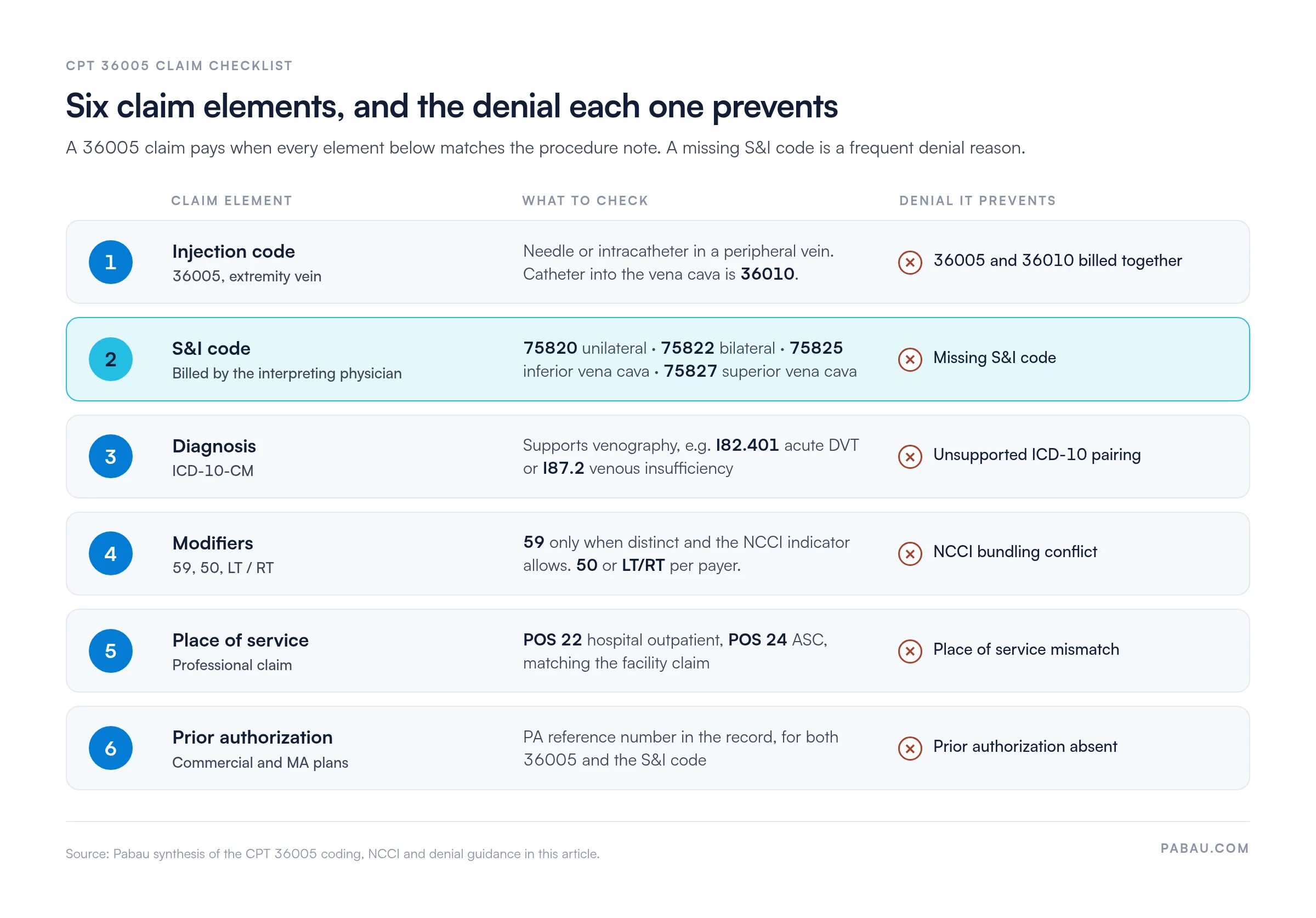
Structured denial management workflows categorize denials by root cause, so billing teams can track recurring issues. When one denial reason repeats across 36005 claims, fix the workflow before reworking individual claims.
For help interpreting remittance advice, our denial codes guide maps common CARC and RARC codes to their resolution paths.
CPT Code 36005 carries a 0-day (000) global period in the Medicare Physician Fee Schedule, meaning the code’s payment includes no post-procedure services. This is also consistent with most vascular injection codes, which are diagnostic in nature rather than surgical. Verify the global period from the CMS MPFS data file field “GLOB_DAYS” for 36005 at the time of billing, as CMS can update this designation.
The 0-day global period has two practical implications:
Medicare generally does not require prior authorization for diagnostic venography billed under CPT Code 36005, though Medicare Advantage plans may impose additional PA requirements. Meanwhile, commercial payers vary widely: many require prior authorization for any elective diagnostic venography, particularly in outpatient or ASC settings.
Therefore, practices should build PA verification into the scheduling workflow for every CPT Code 36005 case involving a commercial insurer. The steps that reduce PA-related denials:
High-volume vascular billing teams should build a payer-specific PA matrix. List which commercial plans require prior authorization for 36005 and which S&I codes they cover. Review the matrix quarterly as plan policies change. Before every procedure, check real-time eligibility through your clearinghouse to catch PA requirements the matrix may not yet reflect.
The billing component for CPT Code 36005 depends on where the practice performs the procedure and who bears the overhead for supplies and staff.
In addition, coders must confirm the correct Place of Service (POS) code on every professional claim for CPT Code 36005. A POS mismatch between what the physician reports and what the facility reports triggers a payment discrepancy that both payers and Medicare auditors flag routinely.
Our guide to revenue cycle management covers how the facility and professional components are split. For practices managing both the professional and facility billing in-house, keeping documentation for both components aligned is critical to avoiding post-payment audits.
A complete 36005 claim draws on the procedure note, the radiology report, the diagnosis, and the place of service. When those sit in separate systems, staff rekey them by hand. As a result, each rekeyed field is another chance to drop the S&I code or mismatch the POS.
Pabau, the practice management platform we build, routes CPT Code 36005 claims through its Claim.MD clearinghouse integration. That integration also connects to thousands of US payers and supports CMS-1500 claims, real-time eligibility checks, and ERA retrieval. Using Pabau’s claims management software also keeps billing in the same system as scheduling and clinical records. Your team never has to retype the procedure note into a separate billing tool.
A clean claim submission process requires matching patient data, POS codes, and diagnosis codes across the professional and facility claims before either is sent. Claim status updates then flow back through the Claim.MD clearinghouse, so your billing team sees which 36005 claims are paid, pending, or denied.


Pabau connects your clinical records, CPT code claims, and payment reconciliation in one platform. Submit 36005 and paired radiology claims through the Claim.MD clearinghouse integration and track reimbursement without switching systems.

CPT Code 36005 is a narrow code, and most of its billing trouble comes from stretching it past its scope. Treat the injection as half a claim. Before submission, confirm the S&I code, the diagnosis, the modifiers, and the place of service against the procedure note.
That check is cheaper than reworking a denied claim, and tracking 36005 denials by root cause shows which step keeps slipping. Fix that step once, in the workflow, and the same denial stops coming back.
Pabau builds the 36005 claim from the same record where the procedure was documented, so the injection, the S&I code, and the diagnosis travel together. Book a demo to see how it works for vascular and interventional radiology billing.

Need to understand how medical billing works end to end? What is medical billing explains the full revenue cycle from claim creation through payment posting.
Looking for guidance on 837P electronic claim submission? 837 file submission guide covers the electronic transaction standard used to submit CPT claims to payers.
Want to understand how to read remittance advice after claim adjudication? Electronic remittance advice guide explains ERA/835 files and how to reconcile payment against the submitted claim.
CPT Code 36005 covers the injection procedure for extremity venography. That includes introducing a needle or intracatheter and injecting contrast material into a peripheral extremity vein. It does not include image acquisition, radiology supervision, or interpretation, which must be billed separately using the appropriate S&I code such as 75820.
The most common pairing is CPT 75820 for unilateral extremity venography or CPT 75822 for bilateral extremity venography. If the study extends to the vena cava, 75825 (inferior) or 75827 (superior) applies. The S&I code is billed by the interpreting physician and must appear on the same date of service.
A frequent denial reason is submitting 36005 without the required radiology S&I code. Other frequent causes include NCCI bundling conflicts with adjacent vascular access codes and ICD-10 pairings that do not support medical necessity. Missing prior authorization from commercial payers and place of service mismatches between the professional and facility claims also trigger denials.
Traditional Medicare generally does not require prior authorization for CPT Code 36005, but Medicare Advantage plans may. Many commercial payers require prior authorization for elective diagnostic venography. Always verify PA requirements with the specific payer before scheduling the procedure, and confirm authorization for the paired S&I code at the same time.



