

HCPCS Code Q4185: Cellesta flowable amnion billing guide
HCPCS Code Q4185: definition and official descriptor HCPCS Code Q4185 is the Lev...

Last Updated: Nov 20, 2026
75825 is the CPT code for venography, caval, inferior, with serialography, radiological supervision and interpretation. It covers contrast imaging of the inferior vena cava, captured as a series of images and read by a physician in a formal report.
Because the descriptor includes radiological supervision and interpretation, no separate supervision code is billed with it. Its closest neighbor is 75827, which covers the superior vena cava instead.
Let Pabau's smart automation suggest the right codes, reduce claim denials, and keep your practice compliant—effortlessly.
Automate repetitive tasks and focus on what matters most—your patients.
Reduce coding errors and ensure compliance with the latest regulations.
Clean claims, fewer denials, and faster reimbursements.
Powerful insights and reporting to help your practice thrive.
HIPAA compliant SOC 2 certified GDPR-compliant Trusted by 4,000+ clinics worldwide

CPT code 75825 reports inferior vena cava venography with serial imaging, and its RS&I is built in, so no separate supervision code goes with it.
Venography used only to guide an IVC filter is bundled into 37191, so 75825 stands beside it only for a separately indicated, separately documented study.
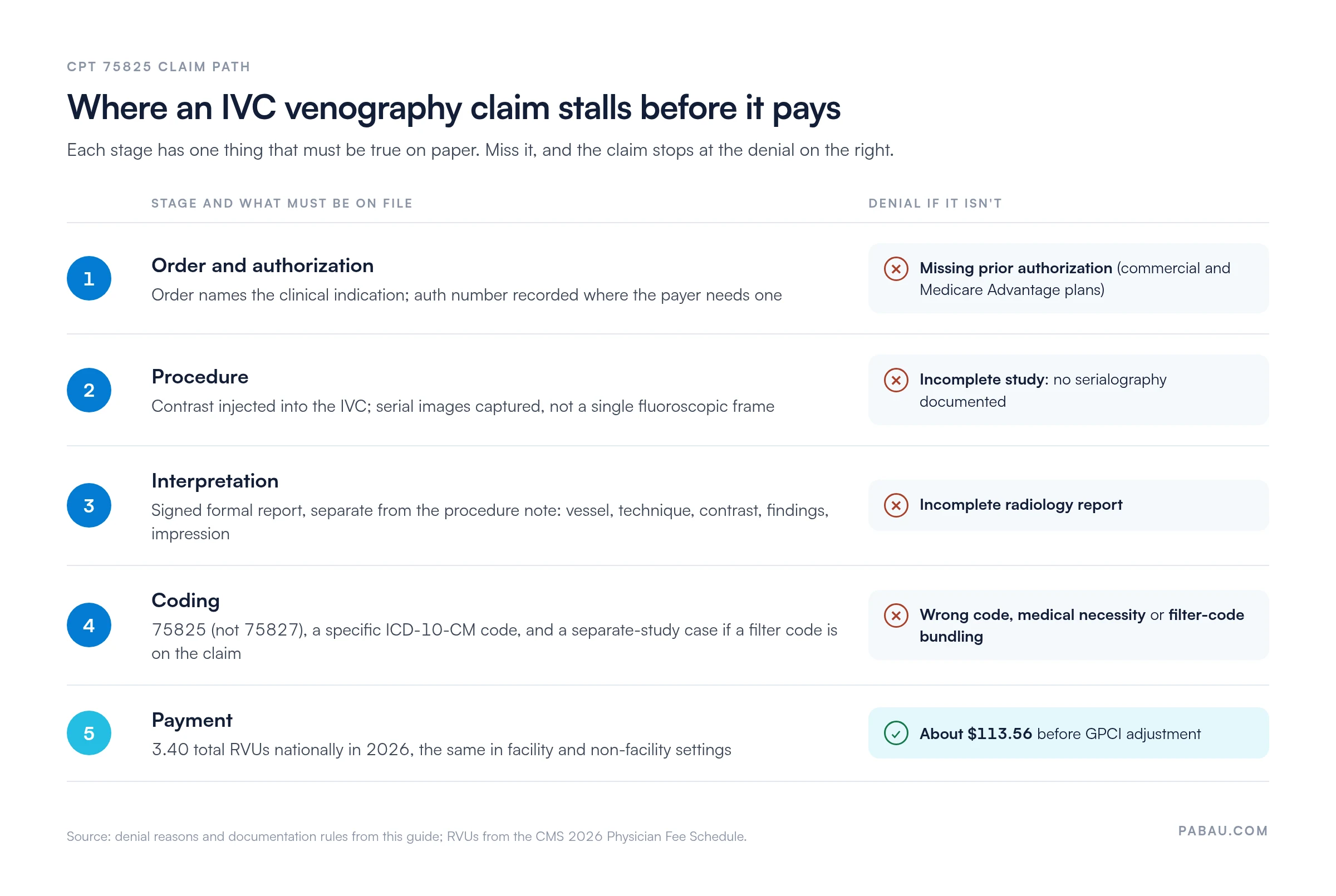
Most 75825 denials trace back to a vague indication, an incomplete report, a missing authorization or 75827 picked by mistake.
Medicare’s 2026 national rate is 3.40 total RVUs, about $113.56 before GPCI, and it’s the same in facility and non-facility settings.
Pabau’s claims management covers claim submission, eligibility checks, ERA remittances and denial and appeal tracking for these claims.
CPT code 75825 reports contrast venography of the inferior vena cava, imaged as a series and interpreted by a physician in a formal report.
It belongs to the AMA’s CPT code set, the five-digit codes maintained by the CPT Editorial Panel to report procedures and tests. The official descriptor reads: Venography, caval, inferior, with serialography, radiological supervision and interpretation.
In plain terms, the code pays for the imaging and the read. The physician injects contrast into the IVC, captures serial fluoroscopic runs and dictates a signed interpretation. Radiological supervision and interpretation (RS&I) is part of the descriptor, so you never add a separate supervision code.
Payers want to see why a catheter study was needed when duplex ultrasound or CT usually comes first. The order and the report should name one of these reasons in words a reviewer can match to the diagnosis code.
An order that just says “IVC study” is where a lot of these claims start to go wrong. Ask the ordering physician for the clinical question before the patient is on the table, not after the denial.
Coders rarely see the procedure, so the report is the claim. Walk through it in the order the study happened and check that each step left a trace.
If serialography or the signed interpretation is missing, expect a denial. A two-line note buried in the operative record won’t carry the claim on its own.
The descriptor draws the line for you. Everything in the left column is paid inside 75825, while the right column lists services that may be reported separately when they’re documented.
Catheter placement is the one that catches people out. 36010 goes on the claim when the venogram is the whole procedure, but filter insertion already includes vascular access. And because RS&I sits inside 75825, adding a separate RS&I code is unbundling that NCCI edits will catch.
The most common question about 75825 is whether it can ride along with a filter code. Usually it can’t. The descriptor for 37191 already covers vascular access, vessel selection, RS&I, roadmapping and imaging guidance.
A complete study means the report covers the IVC from the renal veins to the right atrium, not just the access segment. Partial imaging for catheter positioning never qualifies. Modifier 59 used to unbundle a guidance cavogram is a known audit target, so document the separate decision the study informed.
Picking the wrong venography code is the second most common reason a 75825 claim fails. Usually 75827, the superior vena cava code, gets chosen when the inferior cava was imaged. The table lines up the family members coders confuse most, and AAPC keeps a fuller list of venography CPT codes.
Extremity studies split by side. Bill 75820 for one limb and 75822 for both, each only with its own indication documented.
Every 75825 claim needs at least one ICD-10-CM code that explains why the cava was imaged. Payers can limit covered diagnoses in a local coverage determination (LCD), so check your MAC’s policy before you submit.
Pulmonary embolism codes sit in category I26, split by whether acute cor pulmonale is present. When several diagnoses apply, such as IVC thrombosis and PE, list the main reason for the venogram first.
Medicare pays 75825 under the Physician Fee Schedule, adjusted by your locality’s geographic practice cost index (GPCI). The national 2026 figures below come from FastRVU’s 2026 data for 75825. Confirm your own rate with the CMS Physician Fee Schedule lookup tool, because rates change every January 1.
Unlike many procedures, 75825 pays the same in both settings, so place of service doesn’t move the national rate. Still report the place of service that matches where the study happened, because a mismatch is a claim error in its own right. The FastRVU lookup tool applies your MAC locality’s GPCI if you need a local estimate.
Before you quote expected reimbursement to your practice administrator, run 75825 through the CMS lookup for your MAC locality. National figures are a starting point, and the GPCI in your area can push the allowed amount up or down. Always use the current-year file, not last year’s rate.
Traditional Medicare doesn’t require prior authorization for 75825. Its hospital outpatient program covers services such as blepharoplasty, vein ablation, cervical fusion and facet joint interventions, and venography isn’t among them. You can confirm the current scope on CMS’s OPD prior authorization page.
Commercial payers and Medicare Advantage plans are a different story. Many want authorization for vascular imaging, 75825 included. A request that gets approved the first time usually includes these:
If authorization is denied and the study goes ahead anyway, the claim will almost always follow it. Record the authorization number in the billing workflow and attach it to the claim.
75825 denials are predictable, which makes them fixable. Start by matching the remittance reason against our list of common denial codes, then use the row below that fits. The claim path shows where each one enters.
Here’s an illustrative case. A practice billed 75825 with I82.220 after a venogram for suspected caval thrombus. The report read “IVC imaged, no filling defect” and carried no signature, so the payer denied it as unsupported.
The coder asked the radiologist to complete a signed interpretation recording the serial runs that were acquired and the impression. The corrected claim went back with that report and paid. The fix took one conversation, but it cost a full payment cycle.
Review each item before you click submit. A clean claim the first time is faster than any appeal, which can add 30 to 90 days to payment.
Run the list when the report arrives, not when the claim is queued. That way the missing signature gets fixed while the physician still remembers the case.
Build the checklist into charge entry for 75825. When the interpreting physician’s report comes in, have a coder check the serial imaging and the diagnosis match before the claim is queued. Catching an incomplete report at intake saves a full appeal cycle later.
Once the report is right, most of the work is follow-through. Someone has to check eligibility, send the claim, post the remittance and chase anything that comes back denied. In many interventional radiology practices, that still means a clearinghouse portal, a spreadsheet and a shared inbox.
Pabau, the practice management platform we build, handles that follow-through with denial-tracking claims management. US practices submit claims and run eligibility checks through our Claim.MD integration, and ERA remittances post back automatically. Denials and appeals are tracked against each claim, alongside the patient’s appointments and records.
The result is fewer claims lost between systems. Your billers see which 75825 claims are paid, pending or denied, and they can start an appeal without rebuilding the case from email.

Pabau handles claim submission, eligibility checks, ERA remittances and denial tracking in one place. Your team spends less time chasing claims and more time on patients.

75825 is rarely denied for being hard to code. It’s denied because the paperwork behind it wasn’t finished when the claim went out. Put the effort upstream, at the order and the signed report, and the coding becomes routine.
The one judgment call is the filter case. Treat a venogram done alongside 37191 as bundled unless the report shows a separate diagnostic question. Billing 75825 there is the claim most likely to come back.
Book a demo to see how Pabau follows each IVC venography claim to payment and flags denials while they’re still easy to fix.

Billing an IVC filter on the same day? CPT code 37191 explains what filter insertion includes and when it’s billed alone.
Looking to understand denial patterns across your claims? Denial management in healthcare covers root-cause analysis and appeal frameworks for common payer rejections.
Want to keep modifier use audit-proof? Medical billing compliance walks through the rules and audits that shape how practices bill.
Want context on where venography billing fits in the revenue cycle? What is revenue cycle management explains the end-to-end process from eligibility through final payment posting.
Yes, when the physician only reads the study and a hospital owns the equipment. The physician reports 75825-26, and the hospital bills its share on its own claim. In an office-based lab that owns the equipment, 75825 is billed globally with no modifier.
No. 75825 is catheter-based contrast venography. A CT venogram is reported with CT angiography codes, such as 74175 for the abdomen or 74174 for the abdomen and pelvis.
Usually not. Retrieval code 37193 includes radiological supervision and interpretation, venography included, when performed. Report 75825 only for a separately indicated diagnostic study with its own report.
No. Medicare lists it with global indicator XXX, so no postoperative days attach to it. A later study is billed as its own service when it’s medically necessary.
75825 covers the inferior vena cava and 75827 the superior vena cava. Both include serial imaging and RS&I, so the code depends only on which cava the report says was imaged.





