HCPCS Code V2208: Spherocylinder bifocal lens billing guide
HCPCS Code V2208: Definition and code attributes HCPCS Code V2208 is a Level II ...

Last Updated: Oct 7, 2026
74270 is the CPT code for radiologic examination, colon; contrast (eg, barium) enema, with or without KUB. It reports a single-contrast barium enema, where barium fills the colon and the radiologist images it under fluoroscopy.
Coders often confuse it with 74280, its air-contrast counterpart, and that mix-up is a common cause of denials. Barium enema has declined as a frontline colorectal screening tool since colonoscopy became the preferred option. 74270 remains active and payable for diagnostic indications, often in patients who cannot tolerate optical colonoscopy.
Let Pabau's smart automation suggest the right codes, reduce claim denials, and keep your practice compliant—effortlessly.
Automate repetitive tasks and focus on what matters most—your patients.
Reduce coding errors and ensure compliance with the latest regulations.
Clean claims, fewer denials, and faster reimbursements.
Powerful insights and reporting to help your practice thrive.
HIPAA compliant SOC 2 certified GDPR-compliant Trusted by 4,000+ clinics worldwide

CPT code 74270 describes a single-contrast barium enema of the colon, distinct from 74280 which covers the air-contrast (double-contrast) technique
The KUB is optional: 74270 covers the exam with or without it, so documentation must state whether one was performed
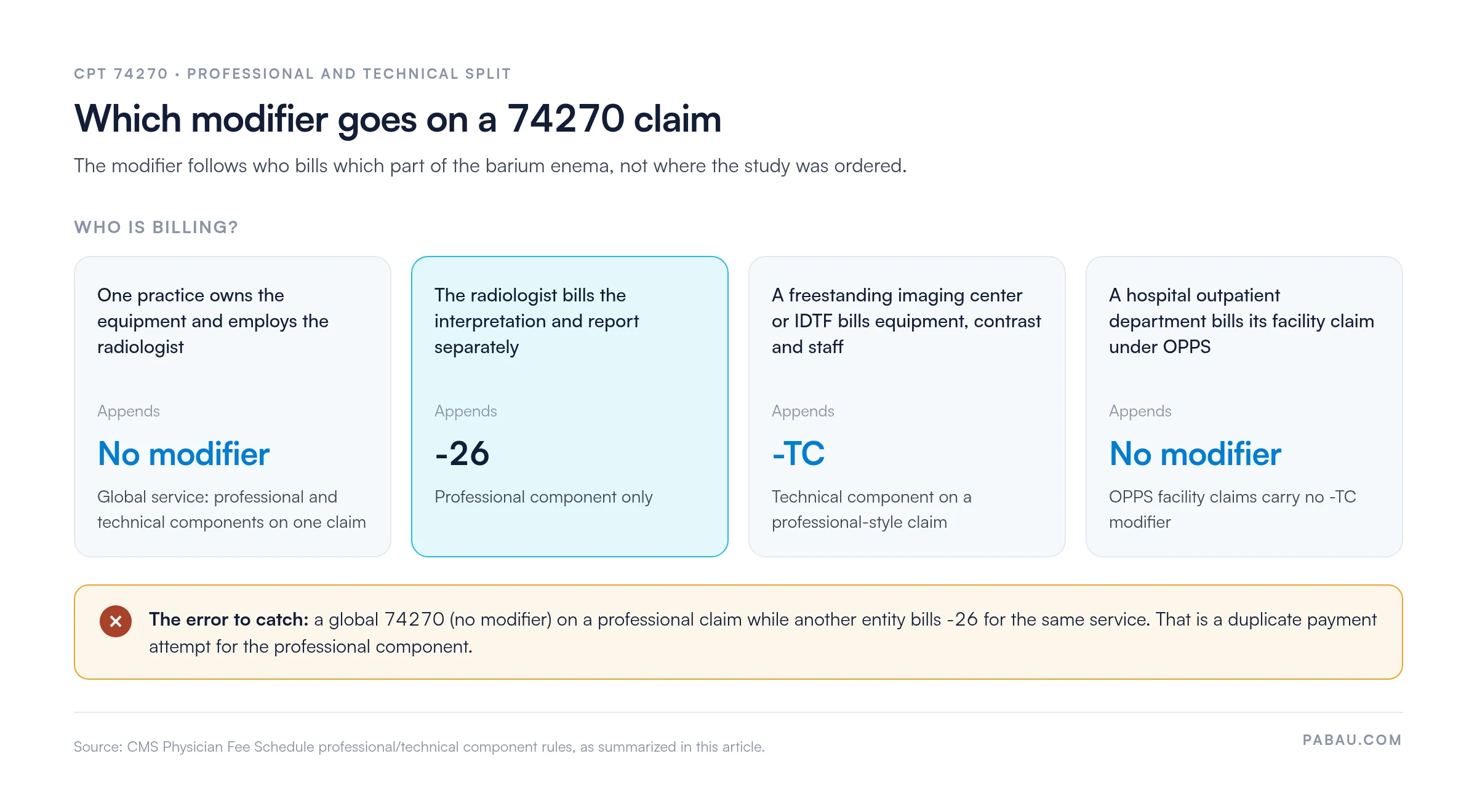
Modifier 26 (professional component) or TC (technical component) applies when the radiologist and facility bill separately, and global billing uses no modifier
Pabau’s claims management software streamlines 74270 claim submission and denial tracking in one workflow
CPT code 74270 is officially described by the AMA as: Radiologic examination, colon; contrast (eg, barium) enema, with or without KUB. It falls under the Radiology section of the CPT codebook, specifically the Diagnostic Radiology subsection for the gastrointestinal tract.
The phrase “with or without KUB” means the code encompasses both scenarios. What it does NOT mean is that you can skip documenting whether a KUB was taken. The radiology report must state whether an abdominal plain film was obtained before the contrast study. A report that is silent on the KUB is a recurring denial trigger on audit.
A single-contrast barium enema introduces liquid barium sulfate (or a water-soluble contrast agent in select patients) into the colon via a rectal catheter. The radiologist uses real-time fluoroscopic imaging to visualize the colonic mucosa as contrast fills and outlines the bowel lumen.
This procedure is used to evaluate a specific set of clinical indications where optical colonoscopy is contraindicated, incomplete, or not feasible:
The “with or without KUB” component refers to a preliminary abdominal plain film taken before contrast is administered. Some radiologists obtain it routinely to assess bowel prep adequacy; others skip it based on clinical context. Either approach is billable under 74270, but the radiology report must document the decision.
74270 covers single-contrast technique; 74280 covers air-contrast (double-contrast) technique. The distinction matters because the two codes are mutually exclusive on the same date of service for the same patient.
The governing rule: select the code based on the technique documented in the radiologist’s procedure note, not on what was ordered. Say the referring clinician ordered an “air-contrast barium enema” and the radiologist switched to single-contrast because of patient tolerance. 74270 is then correct, and the report must explain why.
Coders billing colorectal and upper GI radiology often need to tell 74270 apart from adjacent codes. The table below covers the most common crossover points. Colonoscopy is the pairing payers question most, so check the documentation rules for 45378 before you bill both on one date.
Modifier selection is where compliance risk concentrates on 74270 claims. The code is a “global” radiology service covering both the professional work (radiologist interpretation) and the technical work (equipment, staff, contrast). When two billing entities split those components, each must append the correct modifier. Otherwise the claim overpays one party and underpays the other.
Most common error: a 74270 billed globally, with no modifier, on a professional claim while another entity bills -26 for the same service. That creates a duplicate payment attempt for the professional component. Most payers will reject the second claim or recoup the payment on audit.
Hospital outpatient facility claims under OPPS are a separate case, because they carry no -TC modifier at all. The chart below maps each billing arrangement to its modifier.
Medicare reimburses 74270 based on the CMS Physician Fee Schedule. Rates vary by MAC locality and are updated annually. The values below are national averages; use the CMS Physician Fee Schedule lookup tool for your specific locality and current year. You can also run the numbers through FastRVU’s 2026 RVU lookup for a real-time reimbursement estimate.
Once a 74270 claim pays, pull back the electronic remittance advice and reconcile the payment against the expected RVU-based allowable. That reconciliation step is where underpayments on this code get caught.
No national coverage determination (NCD) governs diagnostic barium enema, so coverage is set by each Medicare Administrative Contractor’s Local Coverage Determination (LCD). Screening barium enema was handled separately under NCD 210.3 and its own G-codes, not 74270. Most MACs cover 74270 when medical necessity is established through an appropriate ICD-10 diagnosis code and documented clinical indication.
Colonoscopy has largely superseded barium enema for colorectal cancer screening, so Medicare will not cover 74270 as a routine screening service. Barium enema is no longer a recommended screening modality, and screening barium enema is not reported with 74270.
The code is payable for diagnostic indications only. The referring clinician’s order and the ICD-10 linkage must reflect a specific clinical question rather than a preventive examination.
Checking your MAC’s LCD before you submit is part of medical billing compliance on 74270. Commercial payers add their own layer, and some require prior authorization. Their rules vary widely:
A complete radiology report supporting a 74270 claim must include every element below. Auditors reviewing denied or queried claims look for these fields specifically.
A superbill that captures the procedure code, modifier, and linked ICD-10 diagnosis at the point of service reduces the documentation errors that surface at billing. The radiology report itself is the primary audit target, but the superbill is what the coder works from, so both must align.
A clean claim for 74270 needs a complete documentation chain before it leaves the practice. The order, the radiology report, the ICD-10 linkage, the modifier and the billing entity details must all agree.
Run a monthly audit of 74270 claims by pulling all claims with this code and checking the modifier column. Modifier -26 and no modifier should never appear on the same date from the same NPI for the same patient. That pairing is one of the most common billing errors on split-component radiology claims.
Most 74270 denials fall into a predictable set of categories. The table below covers each denial type, the most common root cause, and the corrective action. The remittance names each one with an adjustment reason code, which our guide to medical billing denial codes decodes.
A denial management routine catches most of these at the source. Flag every 74270 claim for a modifier check and an ICD-10 linkage review before submission. Then use claims management software that groups denials by code, so you can see whether one payer rejects 74270 more often than the rest.
The ICD-10 diagnosis code on a 74270 claim must reflect a clinical indication that MAC LCDs recognize as medically necessary for a fluoroscopic colon study. The following codes are among the most frequently linked, according to AAPC’s radiology coding resources and CMS coverage guidance.
None of these codes are “guaranteed payable.” Each must be supported by the clinical documentation in the patient’s chart. Use the CrossCoder crosswalk tool to verify that your selected ICD-10 code is an accepted diagnosis pairing for 74270 under your MAC’s LCD before submitting.
A diagnosis code missing from the LCD’s supported list triggers a medical necessity denial, however accurate the procedure code is.
Check whether your MAC has published a coverage article (CA) alongside its LCD for barium enema. Coverage articles often list specific ICD-10 codes that are covered versus those that require additional documentation. They are published separately from the LCD and are easy to miss.
Most 74270 denials start with a claim that left the practice carrying the wrong code, the wrong modifier, or a diagnosis the LCD doesn’t list. Without a shared system, someone checks each claim by hand and then chases short payments one remittance at a time.
Pabau, the practice management and billing platform we build, sends claims to thousands of US payers through its Claim.MD clearinghouse integration. Your team submits the 74270 claim and follows its status in one place. When the remittance comes back, the payment can be checked against what the claim should have paid.
The result is a shorter loop from denial to resubmission. A rejected claim shows up where your biller already works, so the modifier or diagnosis fix goes back out before the claim ages.

Pabau’s claims management tools help radiology and GI practices submit accurate claims, track claim status, and reduce denials for codes like 74270.

The radiology report decides a 74270 claim. Code from the technique the radiologist documented rather than from the order, and the most avoidable denial on this code disappears.
The other fixes are cheap only if they happen before submission. A quick check of the modifier against the billing arrangement, and of the diagnosis against your MAC’s LCD, costs far less than an appeal. The trade-off is discipline, because the check only works if it runs on routine claims too.
Treat barium enema as a diagnostic study with a specific clinical question, and record why colonoscopy wasn’t the choice where that applies. Book a demo to see how Pabau tracks your radiology claims from submission to payment.

Need a framework for tracking clearinghouse denials? Denial codes in medical billing covers CARC and RARC codes used in remittance advice to explain 74270 and other claim rejections.
Want to understand how claims move through the payer ecosystem? Medical claims clearinghouse explains how EDI claim files are validated and forwarded to payers before payment.
Checking your eligibility before the procedure date? Insurance eligibility verification outlines how to confirm payer coverage and any authorization requirements before fluoroscopic studies are performed.
Billing an upper GI study instead? CPT code 74240 covers the single-contrast upper GI tract exam and its own billing rules.
Working with a swallowing study? CPT code 74230 explains how the pharynx and esophagus function study is coded and documented.
CPT code 74270 covers a radiologic examination of the colon using a single-contrast (barium or other positive contrast) enema technique. A preliminary KUB radiograph may or may not be part of it. The code includes fluoroscopic imaging of the colon performed and interpreted by a radiologist. It does not cover air-contrast or double-contrast barium enema, which is reported under 74280.
Medicare rates for CPT 74270 vary by MAC locality and are updated annually in the CMS Physician Fee Schedule. The work RVU for the professional component is approximately 1.01. Use the CMS PFS lookup tool at cms.gov for current national and locality-specific rates. Published rates in any article may be a year or more behind.
No. The descriptor “with or without KUB” means the KUB is optional, not bundled. The radiology report must explicitly state whether a preliminary abdominal plain film was obtained before the contrast study. Omitting that documentation is a common audit finding that can support a medical necessity query or documentation denial on review.
The most frequent denial is the wrong code, with 74270 billed when the report documents air-contrast technique (74280). Close behind are an ICD-10 code that fails medical necessity and modifier errors in split billing. Same-date colonoscopy claims without documented medical necessity and missing commercial prior authorization round out the list. Each has a specific corrective path detailed in the denial table above.