



CCSD code G5100: Bypass of duodenum billing guide
CCSD code G5100 bills a bypass that leaves the duodenum in place CCSD code G5100...

Last Updated: Oct 16, 2026

CPT Code 74230 covers swallowing function studies using cineradiography or videorecording, most commonly billed for the modified barium swallow (MBS) study.
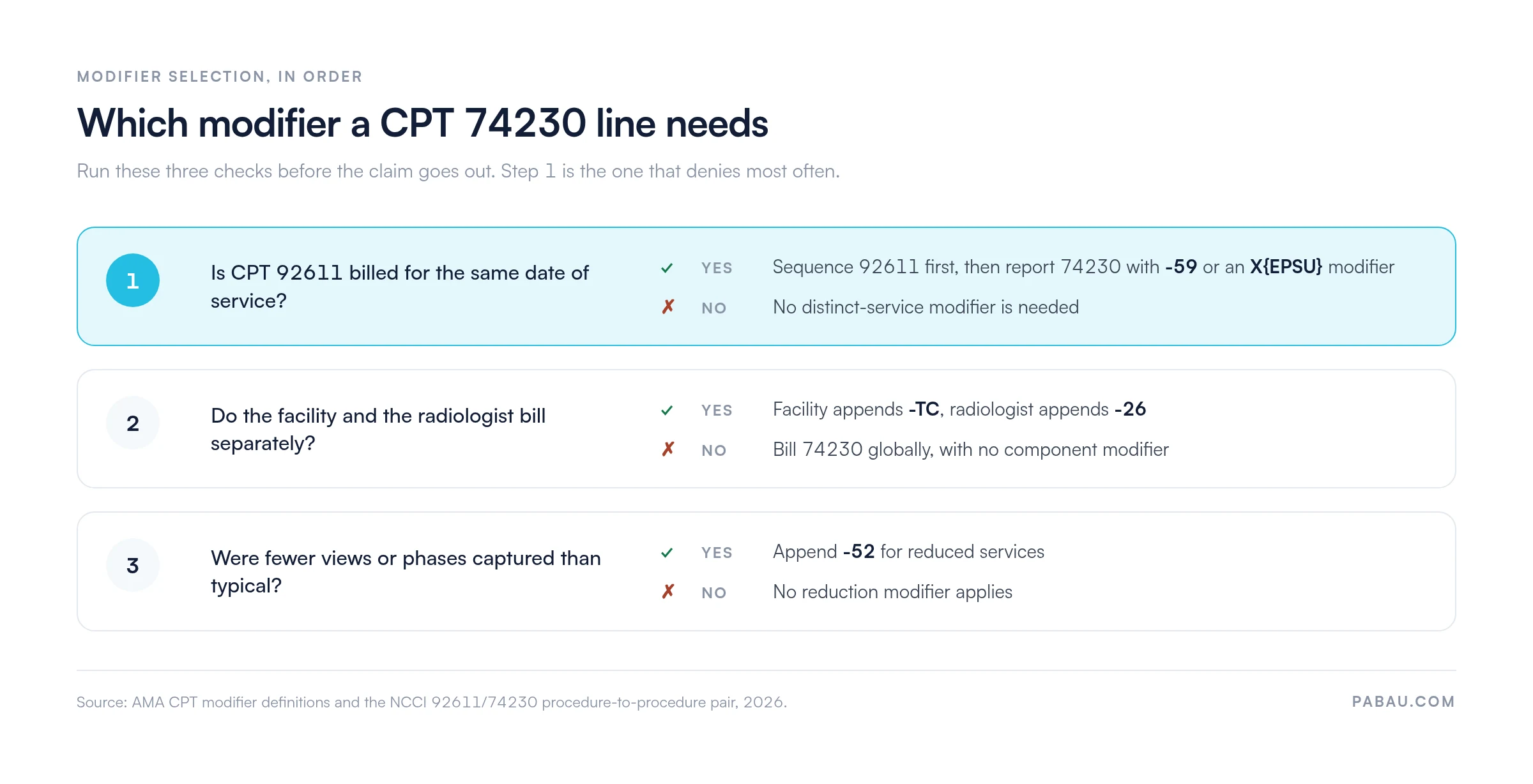
CPT 74230 and CPT 92611 can be billed for the same date of service. Sequence 92611 as the column 1 code and append modifier -59 to 74230.
The global code includes both technical and professional components; split billing requires modifier -TC (technical) or -26 (professional component).
Practice management software like Pabau ties the radiology report, the diagnosis, and the claim together, so 74230 goes out clean.
CPT Code 74230 is billed when a provider performs a swallowing function study using cineradiography or videorecording. The most common use is the modified barium swallow (MBS) study, also called the videofluoroscopic swallowing study (VFSS). Dysphagia evaluation is the primary clinical indication.
The official AMA descriptor reads: “Swallowing function, with cineradiography/videorecording.”
Practices that treat patients with neurological conditions, head and neck cancers, or post-surgical swallowing deficits bill this code most often. The referring physician, the radiologist, and the speech-language pathologist each hold part of the record. The claim depends on all three parts arriving in the same place.
The code falls in the 74210 to 74363 range of the AMA’s CPT code set. That range covers diagnostic radiology, or diagnostic imaging, procedures of the gastrointestinal tract.
Coders frequently confuse CPT 74230 with CPT 74220, the single-contrast esophagram. The distinction matters for medical necessity and for payer acceptance.
Unlike CPT 74220, a single-contrast esophagram, 74230 requires dynamic imaging that captures the pharyngeal and esophageal phases of swallowing as they happen. It is the radiological counterpart to the speech-language pathology evaluation codes, and it requires physician oversight for the technical component.
The AAPC coding guidelines make the boundary explicit. CPT 74220 does not include dynamic evaluation of the swallowing mechanism. Billing 74220 for a videofluoroscopic study is a coding error that invites payer audits.
A double-contrast upper GI series sits one step further down the tract. When the radiologist images the esophagus, stomach, and duodenum with high-density barium and an effervescent agent, the correct code is CPT 74246.
CPT 92611, motion fluoroscopic evaluation of swallowing, and CPT 74230 both cover fluoroscopic swallowing evaluation. The two codes come from different sections of the code set and are billed by different provider types.
Both codes can be billed for the same date of service. CMS did add a CCI edit blocking the pair effective January 1, 2020, then reversed it within weeks.
The American Speech-Language-Hearing Association (ASHA) reported the reversal as retroactive, so the edit never applied to paid claims. It has not returned in any edit set through 2026 Q4, though a lot of billing advice still quotes the original edit.
What remains in the NCCI tables is a procedure-to-procedure pair. CPT 92611 is the column 1 code and 74230 is the column 2 code.
Its modifier indicator is 1, which means an appropriate modifier releases the edit. Sequence 92611 first, then report 74230 with modifier -59 or an X{EPSU} subcategory modifier.
Do not write off a 74230 line just because 92611 was billed for the same date. Sequence 92611 as the column 1 code, then report 74230 with modifier -59 or an X{EPSU} modifier. Document the radiologist and the SLP contributions separately, so the distinct-service claim holds up if a payer asks.
CPT Code 74230 is a global code. It covers both the technical component (equipment, staff, imaging) and the professional component (the radiologist’s interpretation and report). Billing those services separately requires the correct modifier on each line.
When the radiologist and the facility belong to the same group practice, neither component modifier applies. The claim goes out as a global service. When the facility and the radiologist bill separately, the facility appends -TC and the radiologist appends -26. Missing either modifier on a split-billed claim is one of the most common denial triggers for this code.
Three questions settle which modifier a 74230 line carries, and they are worth running in that order before submission.
Medicare reimburses CPT 74230 under the Medicare Physician Fee Schedule (MPFS). Rates vary by geographic area and by billing setting. Pabau’s Claim.MD clearinghouse integration routes 74230 claims to thousands of US payers, including Medicare Administrative Contractors. Eligibility checks run before the study is performed.
The rates below are approximate 2026 national averages. Verify your own regional rates with the CMS lookup tool before you quote a patient.
Rates change annually with the MPFS final rule. Geographic locality adjustments mean a practice in San Francisco may receive 20 to 30% more than a rural practice in the South.
Hospital outpatient settings fall under the Hospital Outpatient Prospective Payment System (OPPS), which can produce different allowables than the rates above. Use the FastRVU 2026 lookup tool for current RVU values in your locality. The electronic remittance advice that follows adjudication confirms the rate your own MAC applied.
Every CPT 74230 claim submitted to Medicare requires a supporting ICD-10-CM diagnosis code from the applicable Local Coverage Determination (LCD). Submitting the code with a non-covered diagnosis is one of the most common reasons for 74230 denials.
The diagnoses below reflect common LCD inclusions. Verify the current version of your MAC’s LCD before billing, because coverage lists differ by contractor.
Use the most specific code the clinical documentation supports. R13.10 is frequently challenged during Medicare medical review, because unspecified dysphagia does not justify the specificity of a videofluoroscopic study. Code to the phase of swallowing dysfunction confirmed by the radiology report.
Incomplete documentation is the root cause of most CPT 74230 claim denials. CMS LCD requirements specify what the medical record must contain before the claim reaches the payer. A superbill built at the point of service captures every required element, so nobody has to pull records retroactively during an audit.
Practices that use integrated clinical documentation tools shorten the time between procedure completion and clean claim submission. The radiology report, the diagnosis, and the supervising physician attestation all live in the same patient record. Billing staff then build the claim without chasing paper documents.
CPT 74230 has a predictable set of denial triggers. Five patterns account for most of them, and each one is easier to design out of the claim than to appeal after the fact.
Practices that track denial patterns by CPT code can see which of these triggers accounts for most of their 74230 write-offs. Surfacing denial trends at the code level, rather than the claim level, is what turns a pattern into a fix.
Run a monthly denial report filtered by CPT 74230. CARC code 4 means the service is inconsistent with the modifier billed. CARC 97 means the service was included in another service billed the same day. If most denials carry either code, the fix belongs in your modifier workflow rather than your documentation. Check that 74230 carries modifier -59 on every date that also has a 92611 line.
CPT 74230 rarely stands alone on a dysphagia patient’s record. The codes below appear alongside it, and each one raises an unbundling or sequencing decision.
A dysphagia study leaves a paper trail across several providers. Four documents usually have to meet in one place before the claim can go out:
Each handoff between providers is a point where documentation can drop, which produces the denials described above.
Pabau’s claims management software holds the clinical record and the billing workflow on one platform. The order, the radiology report, the supervision attestation, and the diagnosis codes all live in the same patient record.
Billing staff pick -TC or -26 based on who owns which component. The claim then transmits through the Claim.MD clearinghouse to the applicable MAC or commercial payer.
Eligibility verification runs before the study date, so practices confirm Medicare coverage and any deductible or coinsurance before the patient arrives. After adjudication, electronic remittance advice files (ERA/835) post automatically and surface denial reason codes at the CPT code level. The failing element then gets fixed in the documentation template rather than in the appeals queue.
Coders select 74230 from a validated code catalog rather than typing it as free text. That removes transposition errors and unsupported code combinations before the claim leaves the practice. High-volume dysphagia practices gain the most from that, because integrated documentation and 837P claim files shorten the time from procedure to payment.

Pabau connects clinical documentation, diagnosis coding, and claim submission in one workflow. Billing staff reach the complete radiology record without manual data transfer, so 74230 claims go out clean the first time.

The hard part of CPT 74230 is rarely the study itself. Three parties touch one date of service, and the claim pays only when their documentation and their modifiers agree.
If you change one thing after reading this, make it the modifier rule on the 92611 pair. Build it into charge capture so the -59 goes on automatically, and a whole category of write-offs drops off your monthly denial report.
Pabau keeps the clinical record, the modifier selection, and the clearinghouse submission in one place. Book a demo to walk through a live 74230 claim build against your own documentation template.

Managing insurance claims end to end? Insurance eligibility verification covers how to confirm coverage before procedures to avoid post-service denials.
Want to understand clearinghouse options? Claim.MD vs Office Ally compares two major US clearinghouses on payer reach, pricing, and ERA handling.
Tracking billing compliance across your practice? Getting credentialed with insurance companies walks through the provider enrollment steps that affect 74230 reimbursement eligibility.
CPT Code 74230 is used to bill swallowing function studies performed with cineradiography or videorecording. The most common example is the modified barium swallow (MBS) study, or videofluoroscopic swallowing study (VFSS). It is the standard radiology code for evaluating dysphagia, capturing the pharyngeal and esophageal swallowing phases as they happen.
Yes. CPT 74230 and CPT 92611 can both be billed for the same date of service. CMS added a CCI edit blocking the pair in January 2020, then reversed it retroactively within weeks, and has not reinstated it since. Sequence 92611 as the column 1 code, then append modifier -59, or an X{EPSU} subcategory modifier, to 74230.
CPT 74230 covers dynamic videofluoroscopic swallowing studies that capture swallowing function as it happens. CPT 74220 covers a single-contrast esophagram, a barium study used for structural evaluation of the esophagus. CPT 74220 does not include dynamic evaluation of the swallowing mechanism, so it does not fit a modified barium swallow study.
CPT 74230 takes two primary modifiers when the components are billed separately. The facility bills -TC for the technical component. The interpreting radiologist bills -26 for the professional component. Modifier -52 applies when reduced services are rendered. Modifier -59 marks the service as distinct from another procedure billed the same day.
The videofluoroscopic swallowing study (VFSS) CPT code is 74230. Radiologists bill this code for the fluoroscopic procedure. Speech-language pathologists who perform the functional swallowing evaluation may bill CPT 92611 for the same study. When both codes go out for the same date, 92611 is the column 1 code and 74230 carries modifier -59.
Four elements are required. You need the referring physician’s order and diagnosis, plus a written radiology report documenting dynamic swallowing findings. You also need evidence of physician supervision of the technical component. The claim itself needs a supported ICD-10-CM diagnosis code from the applicable MAC LCD. Missing any of these creates audit exposure and a basis for denial or recoupment.



