CCSD code G5100: Bypass of duodenum billing guide
CCSD code G5100 bills a bypass that leaves the duodenum in place CCSD code G5100...

Last Updated: Oct 16, 2026
74240 is the CPT code for a radiologic examination of the upper gastrointestinal tract using a single contrast agent, usually barium. The 2020 revision folded scout abdominal radiographs and delayed images into the code, when the radiologist performs them. The exam images the esophagus, stomach, and duodenum under fluoroscopy, with no air or CO2 insufflation.
That last detail decides the code. Air contrast moves the study to CPT 74246, and mixing the two up is a common source of denied claims. Code from what the radiology report documents rather than from the order.
Let Pabau's smart automation suggest the right codes, reduce claim denials, and keep your practice compliant—effortlessly.
Automate repetitive tasks and focus on what matters most—your patients.
Reduce coding errors and ensure compliance with the latest regulations.
Clean claims, fewer denials, and faster reimbursements.
Powerful insights and reporting to help your practice thrive.
HIPAA compliant SOC 2 certified GDPR-compliant Trusted by 4,000+ clinics worldwide

CPT code 74240 reports a single-contrast upper GI study of the esophagus, stomach, and duodenum.
Since 2020 the code includes scout abdominal radiographs and delayed images, when the radiologist performs them.
Air or CO2 insufflation moves the study to CPT 74246, so code from the report rather than from habit.
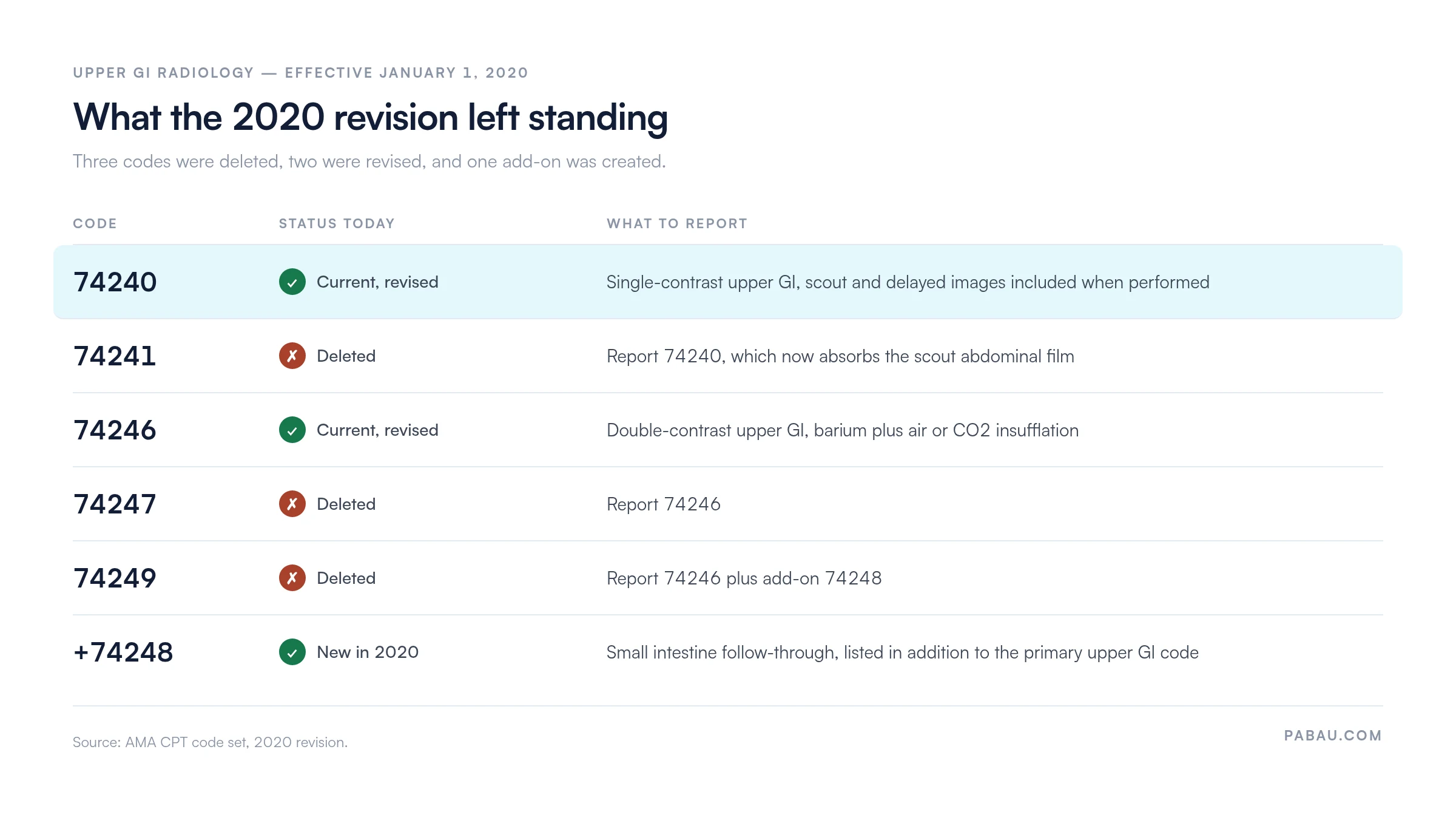
Codes 74241, 74247, and 74249 were deleted in 2020, and add-on 74248 now reports small intestine follow-through.
Modifiers 26, TC, and 52 split or reduce the payment, and each one needs its own documentation.
CPT code 74240 covers a single-contrast radiologic examination of the upper gastrointestinal tract. The American Medical Association revised the descriptor effective January 1, 2020.
It now reads: “Radiologic examination, upper gastrointestinal tract, including scout abdominal radiograph(s) and delayed image(s), when performed; single-contrast (eg, barium) study.”
The exam uses fluoroscopy to image the esophagus, stomach, and duodenum after the patient swallows contrast. That contrast is oral barium sulfate or a water-soluble agent such as gastrografin. No air or CO2 is introduced, which is what makes the study single contrast.
Two phrases in the descriptor carry weight for coders. “Including scout abdominal radiograph(s)” means a plain abdominal film no longer needs its own code. “When performed” means the scout and delayed images are optional, so the code still holds if the radiologist skips them.
Contrast technique is the whole difference between the two codes. CPT 74240 reports single contrast. CPT 74246 reports double contrast, meaning barium plus air or CO2 insufflation. No other detail of the exam changes that choice.
Payers can compare the technique described in the radiology report against the code on the claim. A report that mentions air insufflation, billed as 74240, reads as a downcode. A single-contrast report billed as 74246 reads as an upcode, and that one draws a review.
Here is the rule that settles it at the desk. If the report mentions air contrast, double contrast, or CO2 insufflation, the code is 74246. If only barium or a water-soluble agent appears, the code is CPT code 74240. Never code from the order, the schedule entry, or the radiologist’s usual technique.
The same rule governs the lower tract, where 74270 covers a single-contrast barium enema and 74280 its air-contrast counterpart. Those two are mutually exclusive on the same date, exactly like the upper GI pair.
Three codes in this family disappeared on January 1, 2020, and plenty of reference pages still list them as current. CPT 74241, 74247, and 74249 were deleted. Their work moved into the two revised codes and one new add-on, so billing a deleted code today returns an invalid-code rejection.
Use +74248 as an add-on and never on its own. It reports the small intestine follow-through on top of whichever upper GI code the session earned. The esophagram code, 74220, still stands alone when the study never reaches the stomach. The crosswalk below shows where each retired code’s work landed.
Three modifiers apply to CPT code 74240, and each one changes what lands in the bank. Which one you need depends on who owns the equipment and whether the study finished.
Under CMS Physician Fee Schedule rules, the global payment assumes a single entity supplied both the technical and the professional component.
Here is how a split-billing day runs. The hospital outpatient department supplies the room, the technologist, and the contrast, so it bills 74240-TC.
The radiology group reads the images and writes the report, so it bills 74240-26. Neither party bills the global code. When both do, the payer pays twice and later demands the money back.
Modifier 52 is the one teams over-apply. It belongs on a study the radiologist started and could not finish, usually because the patient could not tolerate the contrast or the table.
Record what was completed, record why it stopped, and reduce the charge to match. Check your MAC’s local coverage determination before you use it as routine.
Run a pre-submission edit to confirm that 74240 and 74240-TC are never billed by the same entity on the same date of service. Split-billing errors between physician groups and hospital outpatient departments are a leading cause of improper payment recovery for radiology codes.
The non-facility Medicare rate for CPT code 74240 sits at roughly $47 to $55 for 2026. That figure moves with your locality, because each Medicare Administrative Contractor applies its own Geographic Practice Cost Index.
Look up your own locality in the CMS fee schedule tool before you set a charge master amount or quote a patient.
Total RVUs for 74240 are the sum of work, practice expense, and malpractice values. Each component carries its own geographic adjustment, then the total is multiplied by the annual conversion factor.
CMS publishes that conversion factor in the fee schedule final rule each November, so the dollar figure shifts every January.
The diagnosis code on the claim is what proves the study was needed. Payers read it first, and a vague indication is the quickest route to a coverage denial.
The pairings below turn up most often on upper GI claims. None of them is automatically covered, so treat the table as a starting point.
Does a symptom code work on its own? Often it does, at least for a first study. R10.9 and codes like it support an initial diagnostic exam, while a repeat study usually needs a confirmed diagnosis behind it.
Coverage sits in your MAC’s local coverage determination, and the diagnosis codes themselves come from the ICD-10-CM code set.
A clean 74240 claim rests on a report that supports both the code and the diagnosis. Missing elements drive most pre-payment and post-payment audits on outpatient radiology. The checklist below follows CMS coding and documentation guidance.
One workflow detail decides whether that checklist gets satisfied. When contrast type is captured in a structured field at the point of documentation, the coder reads a value. When it arrives as a scanned PDF of dictated text, someone has to find it and re-type it. That is the step where 74240 quietly turns into 74246.
Denials on this code cluster around the same handful of causes. Each one is cheaper to catch before submission than to appeal afterward, and each has a different fix.
Set up a denial report filtered on CPT 74240 and split the results three ways: modifier errors, documentation errors, and coverage errors. Each category has a different root cause and a different fix, and lumping them together leads to process changes that solve the wrong problem.
The 74240 and 74246 mix-up is usually a workflow problem rather than a knowledge problem. Coders know the rule. They just receive the contrast type as free text inside a dictated report, then re-key it onto the claim. A re-keyed value is a value that can drift.
Practice management software like Pabau closes that handoff. Its pre-submission claims management fills the claim form straight from the patient record. The CPT code attached to the service lands on the charge line, and the diagnosis slots are seeded from the recorded problem list. Built-in ICD-10-CM and CPT lookup libraries sit behind a search icon, refreshed with each official release.
Before the send button unlocks, Pabau checks that the claim’s required fields are complete, then routes the submission through the regional clearinghouse. In the US that is Claim.MD, which returns eligibility checks, claim status, and electronic remittance posting.
Pabau does not choose your modifier and does not validate a code pairing clinically. What it removes is the re-typing step where the error creeps in.
The payoff is a claim that carries what the record already holds. Your coder spends the time on judgment calls, such as whether modifier 52 applies. Nobody hunts for a contrast type in paragraph four of a dictated report.

Pabau fills the claim from the patient record, keeps ICD-10-CM and CPT lookups one click away, and routes submissions through your regional clearinghouse. See how that fits a radiology billing workflow.

CPT code 74240 is a simple code with one hard edge. The choice turns entirely on what the radiology report says about contrast. The 2020 revision then moved the scout film and the delayed images inside the code. While you are in the charge master, check whether 74241, 74247, or 74249 is still sitting there.
The modifier rules are ordinary CMS policy. Split-billing errors keep happening because two organizations bill the same date of service without agreeing who owns which component. One conversation between the radiology group and the facility settles that permanently.
Re-keying contrast details from a dictated report is where many radiology claims slow down. Book a demo to see how Pabau builds the claim straight from the patient record.

Need to understand how clearinghouse claim scrubs work? Claim.MD clearinghouse guide explains how pre-submission edits catch code and diagnosis mismatches before they reach a payer.
Reporting a modified barium swallow instead? CPT 74230 covers swallowing function studies with cineradiography, which is a separate exam from the upper GI series.
Want to keep radiology claims audit-ready? Medical billing compliance guide covers the documentation and coding standards payers test during a review.
Curious how 837 electronic claims work end to end? 837 file format guide walks through the transaction that carries CPT and ICD-10 data from your system to a payer.
Usually not. An esophagram is part of the upper GI study, so payers bundle 74220 into 74240 for the same session. Check the National Correct Coding Initiative edits before you append a modifier. If the two exams happen at separate sessions for separate indications, document each order and each report.
That depends on the payer. Medicare does not require prior authorization for a diagnostic upper GI series in the office setting. Many commercial plans and Medicare Advantage plans do, often through a radiology benefit manager. Check the imaging policy before the patient arrives, because retroactive authorization is rarely granted.
Diagnostic radiology codes carry an XXX global period, so no pre-service or post-service days attach to 74240. An office visit on the same date can still be reported separately when it is distinct and documented. Confirm the indicator in the Medicare relative value file for the current year.
Most protocols ask the patient to skip food and drink for six to eight hours. An empty stomach lets the contrast coat the mucosa. Front desk teams should repeat that instruction at booking and again in the reminder. A patient who eats breakfast usually has to rebook, which costs you the slot and the claim.