

CCSD code G5100: Bypass of duodenum billing guide
CCSD code G5100 bills a bypass that leaves the duodenum in place CCSD code G5100...

Last Updated: Oct 16, 2026
74246 is the CPT code for a double-contrast radiologic examination of the upper gastrointestinal tract. The patient swallows high-density barium and an effervescent agent, and the radiologist images the esophagus, stomach, and duodenum under fluoroscopy. Scout abdominal radiographs, delayed images, and glucagon are included when used.
The contrast technique decides the code. A single-contrast study with barium alone is CPT 74240. A KUB film no longer changes the code, because the scout image is bundled into both.
Let Pabau's smart automation suggest the right codes, reduce claim denials, and keep your practice compliant—effortlessly.
Automate repetitive tasks and focus on what matters most—your patients.
Reduce coding errors and ensure compliance with the latest regulations.
Clean claims, fewer denials, and faster reimbursements.
Powerful insights and reporting to help your practice thrive.
HIPAA compliant SOC 2 certified GDPR-compliant Trusted by 4,000+ clinics worldwide

CPT code 74246 reports a double-contrast upper GI exam using high-density barium and an effervescent agent, with glucagon included when given.
CPT 74240 is the single-contrast counterpart, so the contrast technique decides between the two codes, not a KUB film.
Since 2020, scout abdominal radiographs and delayed images are bundled into both codes, and the old with-KUB codes 74241 and 74247 are deleted.
Add-on code +74248 reports a small intestine follow-through done with 74240 or 74246, and it is never billed alone.
Pabau, the practice management platform we build, validates 74246 claims and checks eligibility through Claim.MD before they reach the payer.
CPT code 74246 is the code for a double-contrast radiologic examination of the upper gastrointestinal tract. The American Medical Association places it in the diagnostic radiology section, and its full official descriptor is in the table below.
In practice, the patient swallows high-density barium and an effervescent agent that releases gas in the stomach. The gas distends the lumen while a thin barium coat outlines the mucosa, so the radiologist sees fine surface detail under fluoroscopy. The study covers the esophagus, stomach, and duodenum.
Two pieces of the descriptor matter most for billing. Scout abdominal radiographs and delayed images are included when performed, so neither changes the code or bills separately. Glucagon, often given to relax the stomach and duodenum, is also included when administered.
Knowing what the code bundles prevents both undercoding and the unbundling that triggers audits. CPT code 74246 includes the following elements in one billable unit.
What 74246 does not cover matters just as much. A small intestine follow-through after the upper GI series is reported with add-on code +74248.
A study limited to the esophagus is an esophagram, reported with 74220 or 74221, while a swallowing function study is 74230. CT of the abdomen or an endoscopy on the same date is coded on its own.
CPT 74240 and 74246 share the same stem, so both include scout and delayed images when performed. They differ in one element after the semicolon. That element is the contrast technique. A single-contrast study with barium alone is 74240. A double-contrast study with high-density barium and an effervescent agent is 74246.
The decision rule is simple: Code from the contrast agents the radiology report documents, not from the order. If the report names an effervescent agent with high-density barium, bill 74246. If it describes barium alone, bill CPT code 74240, even when the order asked for an air-contrast study.
A KUB film plays no part in this choice. Under current CPT, a scout image is bundled into both codes. Taking one, or skipping it, never moves a study from one code to the other. The diagram below walks the full choice, from the anatomy studied to the small bowel add-on.
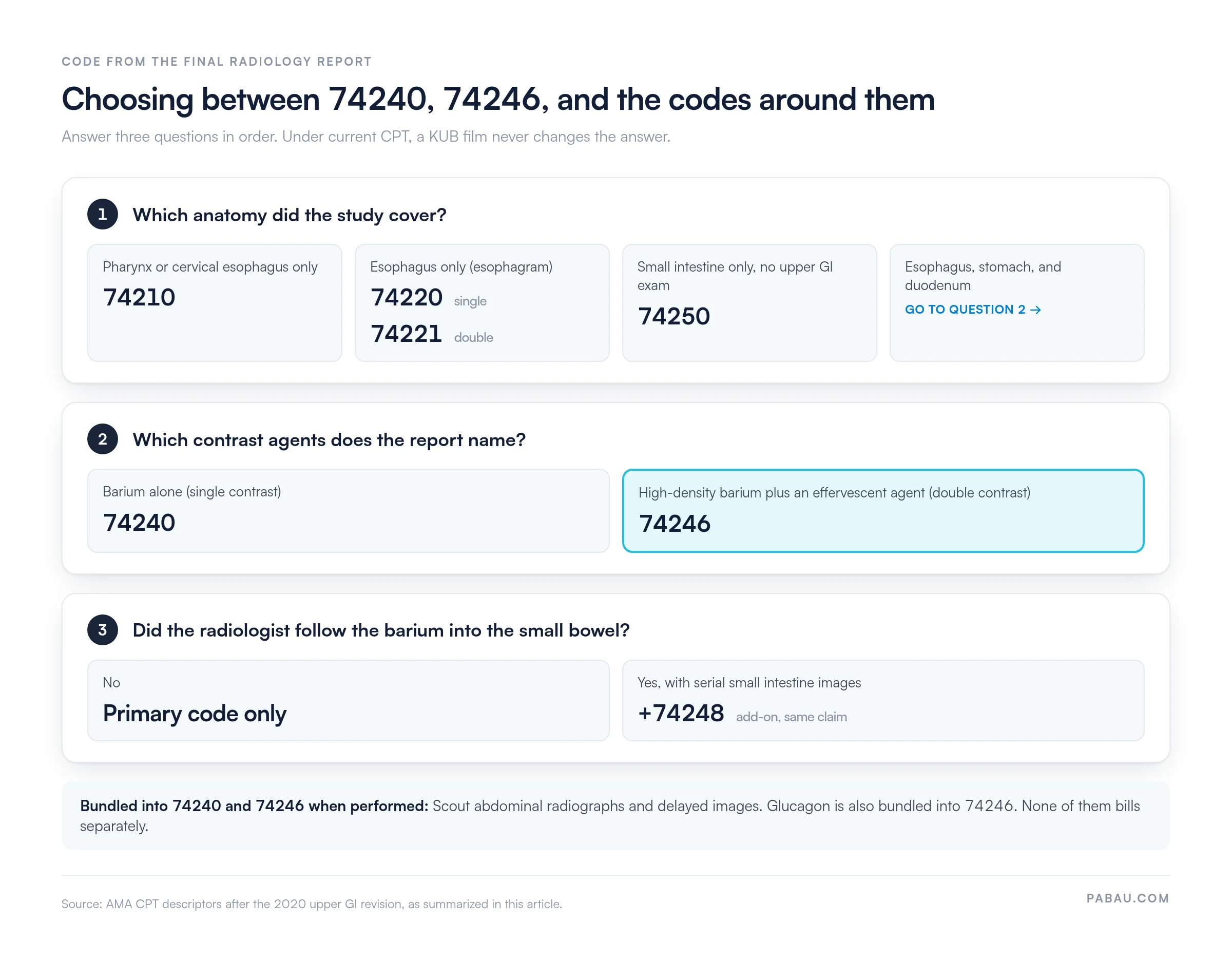
Before 2020, the upper GI family split studies by whether a KUB scout film was taken and whether a small bowel follow-through was added. CPT 2020 rewrote the family and deleted four codes: 74241, 74245, 74247, and 74249. The scout image moved into the base descriptor, and the follow-through became an add-on code.
This is why any reference that still splits 74246 by whether a KUB film was taken is out of date. Current CPT has no separate with-KUB or without-KUB upper GI code. Billing a deleted code returns an invalid-code rejection before the claim is ever reviewed.
The codes below sit in the same part of the CPT manual and are often confused with 74246. Each descriptor reflects the 2020 revision and matches the current CMS fee schedule.
Code +74248 deserves particular attention. CMS lists it with a ZZZ global period, the marker for an add-on code, and its descriptor ties it to a primary upper GI exam.
Report it on the same claim as 74246 when the radiologist follows the barium into the small bowel. A small bowel study done without an upper GI exam is 74250, not 74248.
CMS assigns 74246 a PC/TC indicator of 1, so it can be billed globally or split into its technical and professional components. The modifier tells the payer which entity performed which part.
The most common modifier error is a split service billed as global. When a hospital or imaging center performs the study and an independent radiologist reads it, both bill 74246. The facility appends TC and the radiologist appends 26. If either omits its modifier, the payer sees two global claims and denies one as a duplicate.
Medicare pays 74246 under the Medicare Physician Fee Schedule. The figures below come from the CMS 2026 PFS relative value file (October release) at the standard conversion factor of $33.4009. They are national amounts before geographic adjustment.
The global value is the work RVU (0.88), the non-facility practice expense RVU (3.09), and the malpractice RVU (0.06). The technical component carries about 69% of the total. Clinicians in a qualifying alternative payment model use the higher $33.5675 conversion factor.
Payment in your locality depends on the Geographic Practice Cost Index, so confirm it with the CMS Physician Fee Schedule lookup tool. Commercial and Medicare Advantage plans set their own rates under each contract. After adjudication, the electronic remittance advice shows the paid amount and any adjustment reason codes.
Traditional Medicare generally does not require prior authorization for a diagnostic upper GI study. Medicare Advantage and commercial plans set their own rules, and those vary by plan. Check the patient’s plan before scheduling, and record the authorization number and the representative’s name.
Run insurance eligibility verification when the study is booked and again before the appointment. Mid-year benefit changes can add an authorization step to a code that did not need one before.
The diagnosis on the claim must justify the upper GI study. Payers match it against their coverage policy, so the codes below are common pairings rather than a guaranteed list. Confirm each pairing’s full descriptor in our ICD-10-CM code library. Check your payer’s policy, because covered diagnoses vary.
Code to the highest specificity the documentation supports. If the referral documents GERD with esophagitis, bill K21.00 or K21.01 rather than R12 for heartburn. K21.0 alone is no longer a valid billing code, because it now requires a fifth character.
A complete radiology report is the base of a defensible 74246 claim. On audit, the report must prove that the study was double contrast. It should include the elements below.
Denials for 74246 cluster around a few predictable causes, and each has a documentation fix. Track claim adjustment reason codes by CPT code in your denial management workflow to see which one costs your practice most.
Build a four-point check into every 74246 claim. Confirm that the report names both contrast agents and that no deleted code or separate scout charge is billed. Check that any 74248 has its primary code. Then confirm the TC or 26 modifier with the facility.
Most denials on 74246 start before the claim leaves the practice. A coder picks the code from the order, or a deleted code lingers in an old fee sheet. Sometimes a modifier goes missing on a split service. Catching those by hand means rereading every report against every claim.
Pabau’s claims management software moves that check upstream. Claims go out as electronic claims via Claim.MD, which scrubs code and modifier combinations and returns eligibility data before submission. A superbill template that mirrors the documentation checklist above keeps the billing team and the radiology department working from the same record.
The result is fewer technique and modifier denials, and a clean claim rate you can track by CPT code.
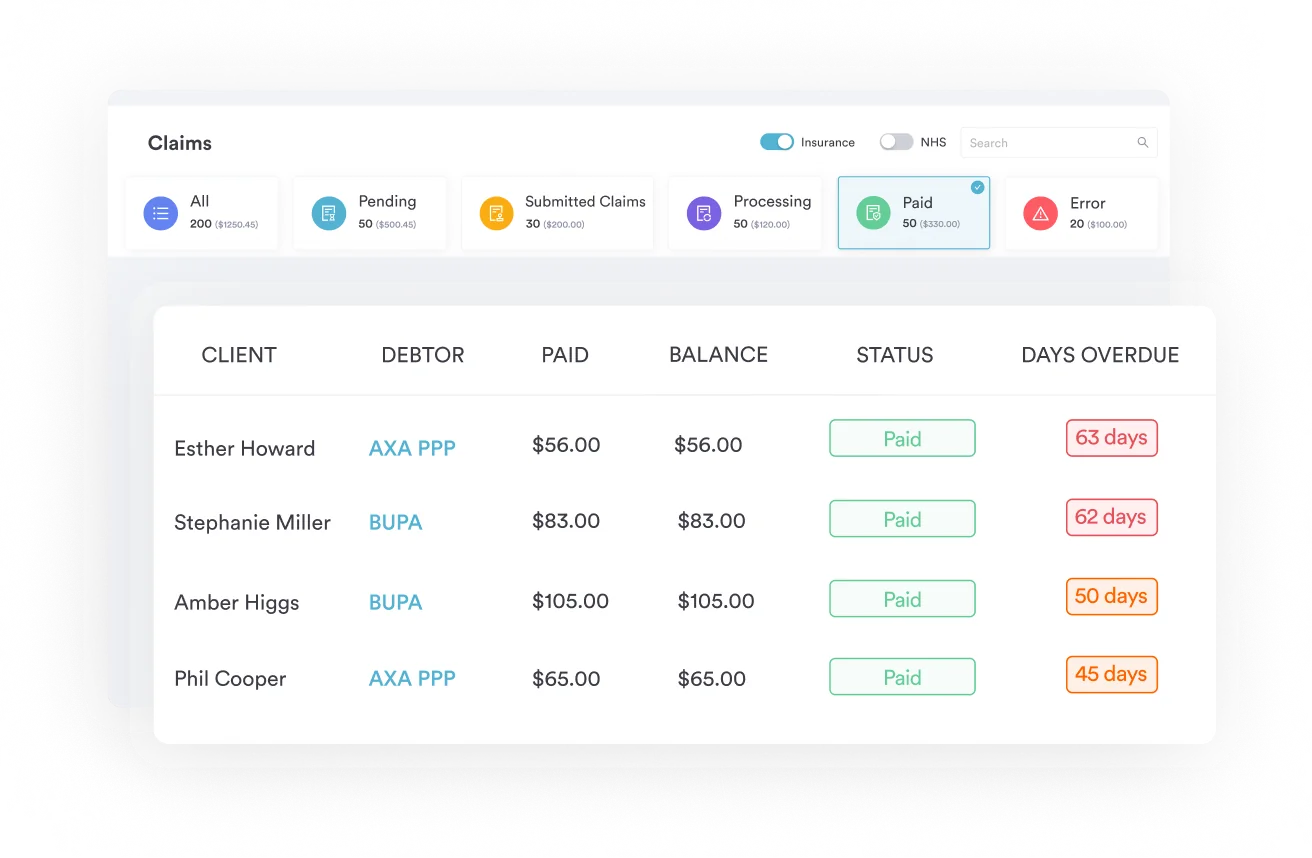

Pabau validates upper GI claims through Claim.MD, checks eligibility before the study, and surfaces denial reason codes by CPT code. See how it works for radiology and gastroenterology practices.

CPT code 74246 turns on one question: Did the study use double contrast? If the report names high-density barium and an effervescent agent, the code is 74246. If it describes barium alone, the code is 74240. A KUB film no longer moves the code either way.
The practices that get paid cleanly on this code retire the pre-2020 codes and code from the final report. They also bill 74248 only beside its primary code. That discipline costs a few minutes per claim and removes the most common reasons for denial.
Book a demo to see how Pabau keeps GI radiology claims accurate from the report to the remittance.

Need to understand how clearinghouse claim validation works? Medical claims clearinghouse overview explains how claims are scrubbed, validated, and routed to payers before adjudication.
Tracking denial reason codes across your GI radiology portfolio? Denial codes in medical billing maps CARC and RARC codes to their prevention strategies.
Looking for the 74246 billing context within revenue cycle management? Revenue cycle management explained covers the end-to-end process from eligibility check through ERA posting.
Billing a barium-only upper GI study? CPT code 74240 covers the single-contrast counterpart, with its own RVUs and documentation rules.
Was the study a dynamic swallow rather than an upper GI? CPT code 74230 explains how to code a swallowing function study with cineradiography.
CPT code 74246 covers a double-contrast radiologic examination of the upper gastrointestinal tract, which includes the esophagus, stomach, and duodenum. The patient swallows high-density barium and an effervescent agent. Scout abdominal radiographs, delayed images, and glucagon are included when used. A small intestine follow-through is reported separately with add-on code +74248.
The difference is the contrast technique. CPT 74240 is a single-contrast upper GI study using barium alone. CPT 74246 is a double-contrast study using high-density barium and an effervescent agent, with glucagon included when given. Both codes include scout and delayed images when performed.
A scout abdominal radiograph is included in CPT 74246 when it is performed, so it is never billed separately. Since 2020, the presence of a KUB film no longer changes the code. The old with-KUB codes, 74241 and 74247, were deleted.
Yes. CPT +74248 is an add-on code for a small intestine follow-through. It is reported with 74240 or 74246 when the radiologist extends the exam into the small bowel. It cannot be billed on its own. A small bowel study done without an upper GI exam is reported with 74250 instead.
For 2026, CMS assigns CPT 74246 a total of 4.03 RVUs, about $134.61 nationally at the standard conversion factor. The technical component is about $92.85 and the professional component about $41.75. Payment varies by locality, so confirm it with the CMS Physician Fee Schedule lookup tool.
CPT 74246 can be billed globally with no modifier, or split with modifier TC for the facility and modifier 26 for the interpreting radiologist. Modifier 52 applies when a study is cut short, with the reason documented in the report.
Common reflux and ulcer pairings include K21.00 (GERD with esophagitis, without bleeding), K21.9 (GERD without esophagitis), and K25.9 (gastric ulcer). Symptom and other codes include K31.89, R10.13 (epigastric pain), R12 (heartburn), and K92.1 (melena). Covered diagnoses depend on each payer’s policy, so check before you submit.



