



CCSD code G5100: Bypass of duodenum billing guide
CCSD code G5100 bills a bypass that leaves the duodenum in place CCSD code G5100...

Last Updated: Oct 16, 2026

CPT Code 73200 covers computed tomography of the upper extremity performed without contrast material, including the arm, elbow, forearm, and wrist.
Medicare payment splits into a professional component (modifier 26) and a technical component (modifier TC), and unilateral studies need modifier LT or RT.
Thin medical necessity documentation is the most common denial trigger, so the order must say why CT was chosen over MRI or plain radiography.
A study performed without contrast and then with contrast in the same session is CPT 73202, never 73200 and 73201 billed together.
Pabau’s claims management software builds the CMS-1500 claim from the recorded service and submits it through Claim.MD to thousands of US payers.
CPT Code 73200 covers computed tomography of the upper extremity performed without contrast material. It applies to the arm, elbow, forearm, and wrist, and it is billed from what the finalized radiology report says about contrast. This reference covers the AMA descriptor, Medicare payment, ICD-10 pairing, modifier rules, and the denial patterns radiology billing teams hit most.
The American Medical Association (AMA) assigns CPT Code 73200 the descriptor Computed tomography, upper extremity; without contrast material. The code applies to any upper extremity segment when no intravenous contrast agent is given during the study.
CPT Code 73200 sits in the Radiology section of the CPT codebook, under Diagnostic Radiology, Upper Extremity. Its global period is XXX (not applicable), which is standard for diagnostic imaging codes.
CPT Code 73200 is ordered when a provider needs cross-sectional bony detail of the upper extremity and intravenous contrast is not clinically indicated. Common scenarios include complex fracture characterization after inconclusive plain films, bone tumor evaluation, foreign body localization, and pre-surgical planning. Orthopedic practices also order it for post-traumatic deformity assessment.
When soft tissue pathology is the primary concern, CPT 73221 (MRI upper extremity without contrast) is usually the better study. Tendon tears, ligament injuries, and cartilage assessment all fall in that group. Choosing CT over MRI has to be supported by a documented rationale in the chart note or the referral order.
The inconclusive plain film that sends the patient to CT carries its own code. A two-view elbow study bills under CPT code 73070. A forearm film covering the radius and ulna bills under CPT code 73090.
The CMS Medicare Physician Fee Schedule (MPFS) publishes the national payment rate for CPT Code 73200 each year. The figures below come from the CMS 2025 RVU file. Geographic Practice Cost Index (GPCI) adjustments then move the allowed amount up or down by locality. Check your own MAC fee schedule before billing.
CMS does not publish a separately reduced facility total for this code. The facility and non-facility totals are both 4.89 RVUs, so the site of service does not change the global allowed amount here.
When a radiologist reads the study at a hospital or imaging center that owns the equipment, the billing splits in two. Modifier 26 covers the professional component, meaning the interpretation and the signed report. Modifier TC covers the technical component, meaning the equipment, the facility staff, and the supplies.
The 4.89 total above is the global figure for the code. On a split claim each component is paid separately, so the two line items together are what add up to the global amount.
Every CPT Code 73200 claim needs an ICD-10-CM diagnosis code that establishes medical necessity for a non-contrast CT. Code the confirmed condition rather than the symptom wherever the documentation supports it. The pairings below are the ones that come up most.
Code to the highest level of specificity available. An unspecified laterality code such as M19.029 belongs on the claim only when the documentation genuinely does not name a side. Local coverage determinations (LCDs) can also restrict which diagnoses a MAC will cover for CT upper extremity, so check the applicable LCD first.
Where the foreign body is retained metal rather than an open wound, Z18.11 or Z18.12 carries the retained fragment. Both are secondary codes, so the injury or the encounter reason still leads the claim.
A payable CPT Code 73200 claim rests on three linked pieces of documentation. The first is a valid written order. The second is a finalized radiology report. The third is a diagnosis code that justifies non-contrast CT over a cheaper or less invasive study.
Get all three in place before the claim is built, not after it comes back denied.
The claim itself needs every required data element on the CMS-1500 or the 837 electronic file. That includes the rendering provider NPI, the ordering provider NPI, and the correct place of service code. Use 11 for office, 22 for hospital outpatient, and 24 for an ambulatory surgical center.
Modifier 76 and modifier 77 are easy to swap by mistake. Use 76 when the same radiologist repeats and reads the study. Use 77 when a different physician does.
Medicare does not universally require prior authorization for CPT Code 73200, but many commercial payers and Medicare Advantage plans do. Insurance eligibility verification should confirm the plan requirement before the scan happens. The request itself needs the clinical indication, the relevant imaging history, and the ordering provider NPI.
The CMS Appropriate Use Criteria (AUC) program would require the ordering provider to consult a qualified Clinical Decision Support Mechanism for advanced imaging, including CT. Enforcement has been delayed repeatedly. Confirm the current status and any HCPCS G-code requirement with CMS before you build the claim around one.
Run a three-point check before a CPT Code 73200 claim goes out. Confirm the LT or RT modifier matches the laterality in the radiology report. Verify the ICD-10 code is the most specific one the documentation supports. Confirm prior authorization if the plan requires it. Those three checks clear most first-pass denials on this code.
Picking the right code in the CT upper extremity family is the cheapest way to prevent a contrast denial. All three codes cover the same anatomy and differ only by contrast protocol, and payers check the descriptor against the report. The chart below shows which protocol supports which code.
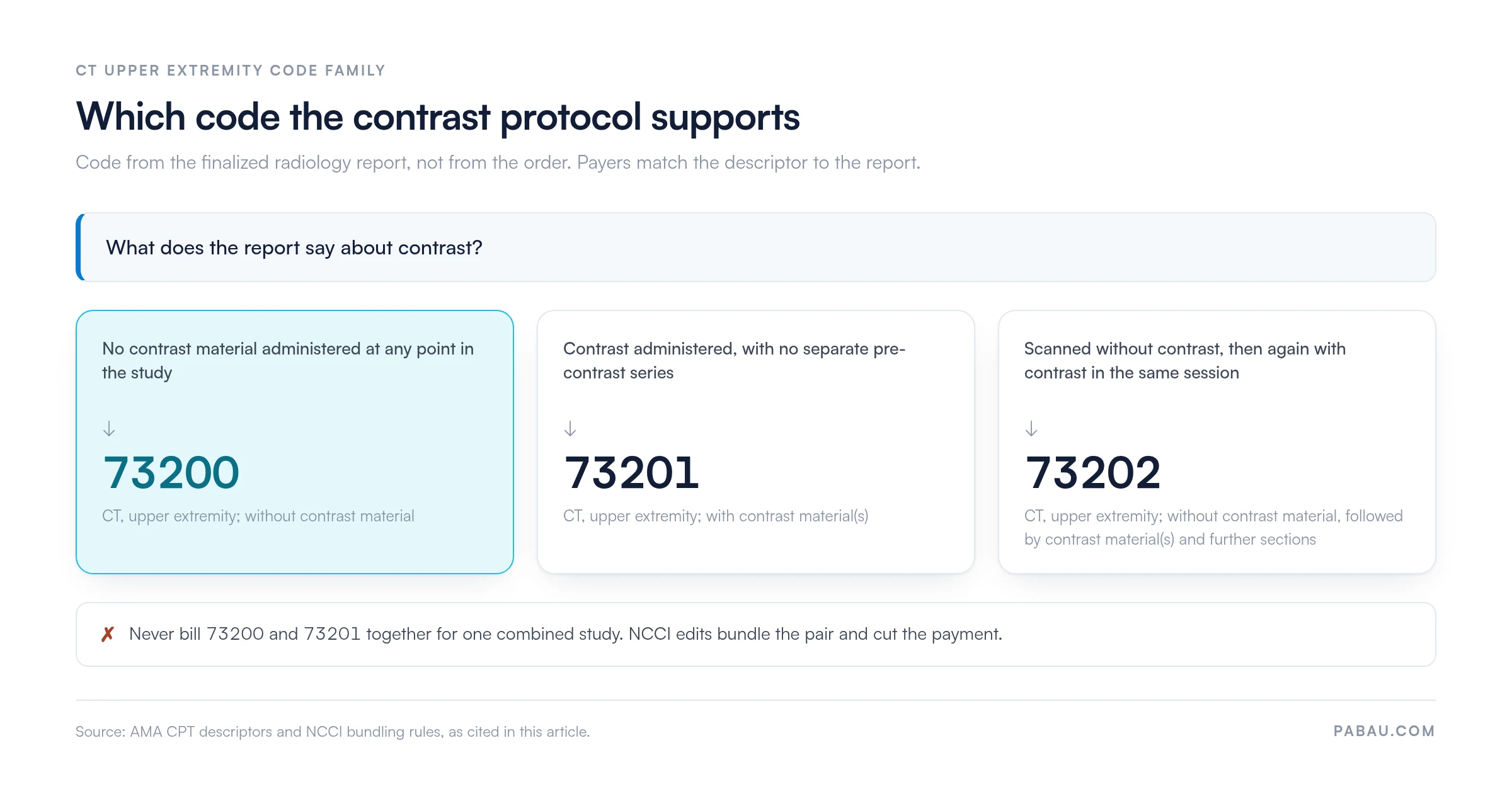
A study that begins without contrast and then adds contrast in the same session is coded 73202. Billing 73200 and 73201 separately for that study creates an unbundling edit under the National Correct Coding Initiative (NCCI).
73206 is a common mis-hit in this family. It is CT angiography of the upper extremity with contrast, which belongs on a vascular claim rather than a bone one. It is not the without-then-with study that 73202 describes.
The lower extremity family has its own version of this mis-hit. A CT angiogram of the leg bills under CPT code 73706, not the non-contrast code 73700.
Coders working with CPT Code 73200 regularly need to distinguish it from neighboring upper extremity imaging codes. The table below covers the ones that come up in this workflow.
CPT 76377 (3D rendering) can be appended to CPT Code 73200 when the radiologist separately performs and documents the reconstruction. It has to be an independent interpretive service in the written report, not a display feature of the imaging software.
Payer acceptance varies, so verify NCCI bundling edits and payer policy before adding 76377. The AAPC CPT code lookup is a quick way to cross-reference current bundling guidance.
Plain-film codes sit alongside this group because they usually come first in an upper extremity workup. A two-view hand radiograph bills under CPT code 73120, and a third view moves it to 73130.
The denial patterns below are the ones radiology and orthopedic billing teams work most often on this code. Each row pairs the cause with the fix that clears it.
Review the applicable denial codes when a CPT Code 73200 claim returns with a CARC (Claim Adjustment Reason Code). Common CARCs for radiology denials include CO-50 (not medically necessary), CO-4 (modifier missing), and CO-97 (bundled service).
Manual code selection and modifier entry are where the errors above get introduced. Practice management software with a billing module carries the order, the diagnosis and the CPT code onto the claim form as one record. The biller then works from the recorded service instead of re-keying it.
Pabau is practice management software with that billing module built in. Its claims management software builds the CMS-1500 claim from the invoice the visit already produced. A real-time eligibility check before the scan is where a missing prior authorization for advanced imaging shows up.
The claim goes out electronically through Claim.MD, Pabau’s US clearinghouse partner, which reaches thousands of US payers. Claim status comes back into the same record, and the Electronic Remittance Advice flags denied lines for rework. Your team chases exceptions instead of re-reading a payer portal.
Flag CPT 73200 claims carrying modifier 26 for a separate eligibility check against the facility’s TC claim. When the radiologist and the imaging center submit on different dates, payers sometimes apply the deductible twice. Coordinating the submission timing avoids the patient billing confusion and the appeal that follows it.

Pabau builds the CMS-1500 claim from the service already on the invoice, then submits it through Claim.MD to thousands of US payers. Eligibility checks, claim status and ERA all return to the same record.

The hard part of CPT Code 73200 is not the descriptor. It is making the claim agree with the report on contrast protocol, laterality, and the diagnosis behind the study.
Those three checks belong at order entry, not in the denial queue. A claim fixed before submission costs a minute. The same claim fixed after a CO-50 costs an appeal, a rework cycle, and weeks of aging.
Front-end checking does slow the order down slightly, and most radiology teams find that trade worth making. Book a demo to see how Pabau handles a CT upper extremity claim from order through ERA.

Need to understand clearinghouse submission for radiology claims? Pabau’s Claim.MD clearinghouse guide explains how electronic claims route from the practice out to US payers.
Working through a denial for this code? Clean claim requirements in medical billing covers the data elements payers check before processing any radiology claim.
Want to reduce prior authorization delays? Getting credentialed with insurance companies walks through the provider enrollment steps that affect authorization eligibility.
CPT Code 73200 covers computed tomography of the upper extremity performed without intravenous contrast material, including CT of the arm, elbow, forearm, and wrist. It does not cover MRI studies or CT performed with contrast, which carry separate codes (73201 and 73202).
The 2025 national Medicare rate for CPT Code 73200 is about $158. That figure is 4.89 total RVUs times the CY2025 conversion factor of $32.3465. CMS does not publish a separately reduced facility total for this code. Rates still vary by locality through GPCI adjustments, so check the CMS fee schedule lookup before billing.
Frequently paired ICD-10-CM codes include S52.309A for an unspecified radius shaft fracture and M89.8X2 for other specified disorders of bone in the upper arm. Q74.0 and D16.01 cover congenital upper limb malformations and benign bone neoplasms. The code you choose has to support medical necessity for a non-contrast CT, not just a pain or unspecified complaint.
Medicare traditional fee-for-service does not universally require prior authorization for CPT Code 73200, but most commercial payers and Medicare Advantage plans do. Verify the plan requirements at scheduling with an eligibility check. Document the authorization number on the claim when you get one.
Yes. 76377 can be appended to CPT Code 73200 when the radiologist separately performs and documents the 3D reconstruction. It has to be an independent interpretive service included in the final report. Payer acceptance varies and NCCI bundling edits may apply, so confirm with the payer before billing both codes together.



