

CCSD code G5100: Bypass of duodenum billing guide
CCSD code G5100 bills a bypass that leaves the duodenum in place CCSD code G5100...

Last Updated: Oct 16, 2026
73060 is the CPT code for radiologic examination, humerus, minimum 2 views.
It covers the proximal humerus, the humeral shaft and the distal humerus. The shoulder joint and the elbow joint fall outside it, which is why coders confuse 73060 with 73030, 73070 and 73080. Code selection turns on the body part named in the radiology report, not on the region the order described.
Let Pabau's smart automation suggest the right codes, reduce claim denials, and keep your practice compliant—effortlessly.
Automate repetitive tasks and focus on what matters most—your patients.
Reduce coding errors and ensure compliance with the latest regulations.
Clean claims, fewer denials, and faster reimbursements.
Powerful insights and reporting to help your practice thrive.
HIPAA compliant SOC 2 certified GDPR-compliant Trusted by 4,000+ clinics worldwide

CPT code 73060 covers a radiologic examination of the humerus, the upper arm bone, with a minimum of two views.
It is not the shoulder code 73030, and it is not the elbow codes 73070 and 73080.
The radiology report must document at least two projections, because a single-view study cannot be billed as 73060.
Modifier TC and modifier 26 split the technical and professional components, and they never share a claim line.
Bilateral humerus imaging pays 100% per side under Medicare, so the 150% surgical bilateral adjustment does not apply.
Practice management software like Pabau sends radiology claims to the Claim.MD clearinghouse and tracks each payer response.
CPT code 73060 is defined by the American Medical Association as a radiologic examination of the humerus, minimum two views. The humerus is the long bone of the upper arm. It runs from the shoulder joint at the proximal end to the elbow joint at the distal end. The code covers the proximal humerus, the humeral shaft, and the distal humerus. It does not extend into the shoulder joint or the elbow joint themselves.
That anatomical boundary is where the coding errors start. A radiology report describing the “distal humerus and elbow” does not by itself justify 73060. If the study captures the elbow joint space, the correct code shifts to 73070 or 73080, depending on view count. The table below maps each neighboring code to the body part it actually covers.
The same shaft-versus-joint boundary repeats one segment down the arm. A two-view study of the radius and ulna bills under 73090, not an elbow code. One segment up, a complete collarbone study bills under 73000, not a humerus code.
A plain film of the shoulder joint itself bills as 73030, or as CPT code 73020 when only one view is taken. Contrast imaging of the shoulder joint follows its own code. A fluoroscopic study with contrast injected into the glenohumeral joint is an arthrogram, and the supervision and interpretation bills as 73040.
A humerus X-ray ordered under CPT code 73060 typically includes an anteroposterior (AP) view and a lateral view as the two minimum projections. The radiographer positions the patient with the arm in external rotation for the AP and rotates to a true lateral position for the second view. Additional oblique views may be obtained when the clinical question involves a subtle fracture or periosteal reaction. The code descriptor still requires only a minimum of two.
The radiology report must explicitly document the body part imaged (humerus), the number of views obtained, and the radiologist’s clinical findings. A report that says only “right upper extremity” without specifying the humerus is insufficient to support 73060. Payer policy requires the documentation to match the code submitted on the claim line.
Modifier selection for CPT code 73060 depends on who performs the imaging and who reads it. Three scenarios cover almost every claim. One entity does both halves, two entities split them, or both arms are imaged on the same date.
The most common modifier error on a 73060 claim is appending both TC and modifier 26 to the same claim line. The two are mutually exclusive. Billing them together on one line produces an NCCI edit rejection. Where a hospital bills the technical component and a contracted radiologist bills the professional component, each party submits its own claim with its own modifier.
Bilateral humerus imaging works differently from bilateral surgery, and the difference is worth knowing before you append modifier 50. On the Medicare Physician Fee Schedule, 73060 carries bilateral surgery indicator 3. Radiology codes with that indicator pay 100% of the fee schedule amount for each side imaged. The 150% adjustment that applies to bilateral surgical procedures does not apply here. Some managed care organizations still want two claim lines, LT on one and RT on the other, so confirm the payer’s preference before submission.
Before billing CPT code 73060 with modifier TC or 26, verify whether your payer contract requires a single global bill or split-component submission. Some commercial plans default to global billing and will deny the TC and 26 components as separately billed duplicates if the same group submits both.
The 2026 Medicare Physician Fee Schedule sets payment rates for CPT code 73060 by practice setting and billing component. Non-facility rates, meaning a physician office or a freestanding imaging center, run higher than hospital outpatient facility rates. The non-facility rate carries a practice expense component for the imaging equipment and staff.
Rate ranges above are approximate and subject to geographic adjustment through the Medicare Geographic Practice Cost Index (GPCI). Practices in high-cost metropolitan areas (Manhattan, San Francisco) receive higher adjusted rates than rural localities. Always verify your exact locality-adjusted rate with the CMS Physician Fee Schedule lookup tool before building internal benchmarks or quoting patients. That tool also returns the work, practice expense, and malpractice RVUs behind the rate.
Private payer rates vary widely from Medicare. Contracted commercial rates may run 110% to 160% of the Medicare fee schedule for plain film radiology, while some managed Medicaid plans pay below it. Review your payer contracts for radiology multipliers. Confirm that 73060 is listed by its own code number rather than folded into a bundled radiology service grouping.
Medical necessity for a humerus X-ray rests on a supporting ICD-10-CM diagnosis code, which tells the payer why the imaging was ordered. Submitting CPT code 73060 without a matching covered diagnosis is the second most frequent denial cause, after anatomy mismatch.
Fracture codes from the S42 series pair most cleanly with 73060. They name the humerus explicitly and establish acute trauma necessity without extra narrative documentation. The seventh character then carries the encounter type: “A” for initial, “D” for subsequent, “G” for subsequent with delayed healing. An S42 code whose seventh character contradicts the visit type is a common payer edit trigger. Imaging a humeral shaft fracture that has failed to unite pairs with a nonunion character, such as S42.309K.
A plain-film humerus X-ray billed as CPT code 73060 is generally not subject to prior authorization under traditional Medicare fee-for-service for acute trauma. The code is a low-complexity imaging procedure with a well-established medical necessity pathway. The appropriate use criteria program created by the Protecting Access to Medicare Act covers advanced diagnostic imaging only, meaning CT, MRI, nuclear medicine and PET. Plain film radiography was never inside its scope, and CMS has paused the program indefinitely.
Medicare Advantage plans and commercial insurers follow their own prior authorization policies and may require approval for non-acute indications. Approval is likelier for a 73060 ordered without a documented acute injury. That covers a suspected osteolytic lesion, a pathologic fracture workup, or a routine follow-up study. An emergency department order for a suspected acute fracture rarely needs it. Checking the plan’s benefits before the study confirms whether a radiology prior auth rule applies to non-acute orders.
CPT code 73060 denials follow predictable patterns. Almost all of them trace back to three root causes. The wrong code was selected, the documentation was incomplete, or a modifier was misapplied. Each type has its own corrective action, and each is caught at a different point in the workflow.
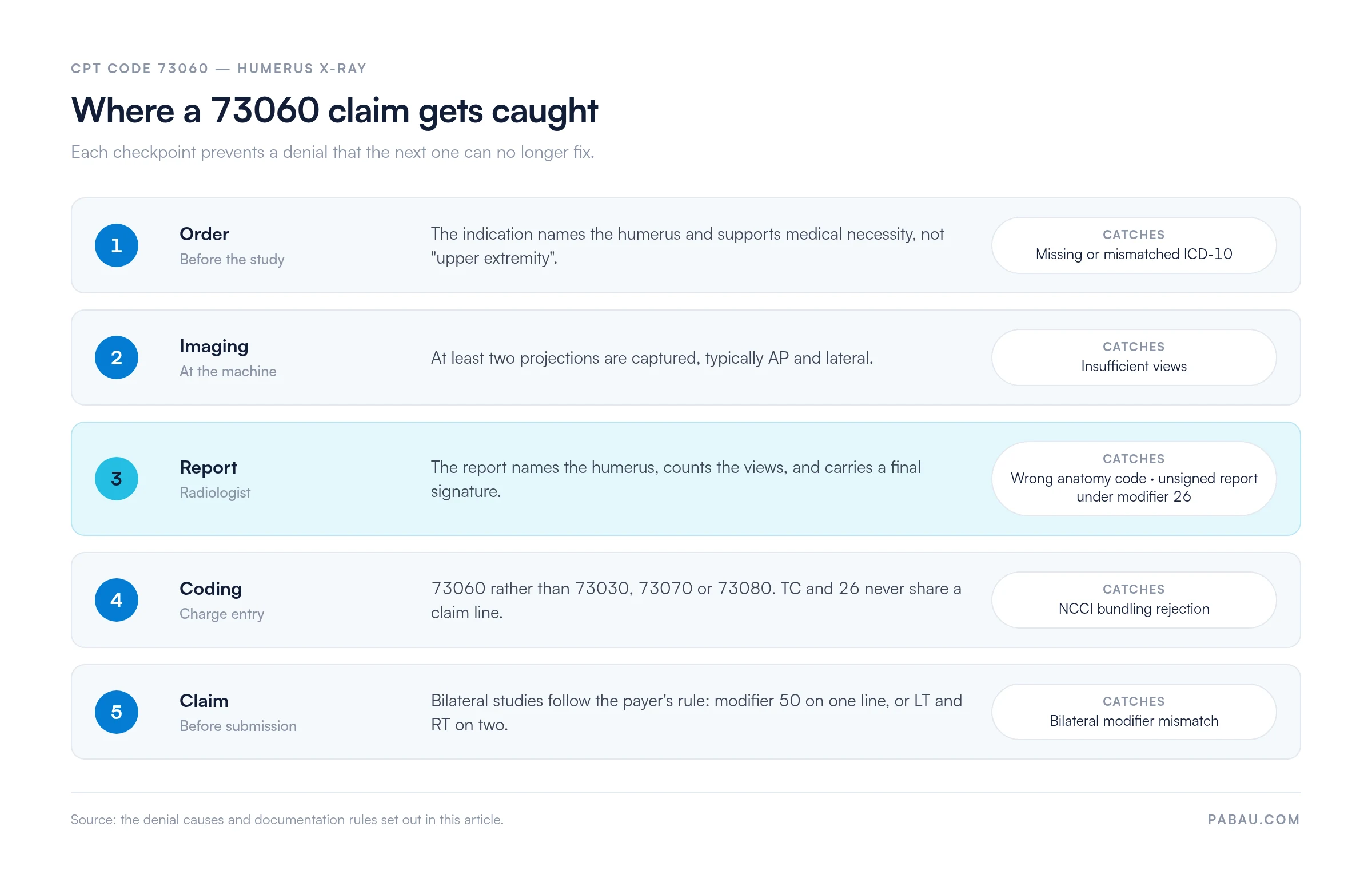
A pre-submission checklist that cross-references the report anatomy against the CPT code removes the first two denial categories before the claim leaves the billing system. Grouping rejected 73060 claims by reason code then shows which failure is costing the practice most. Reading the denial codes on each remittance separates anatomy mismatches from modifier errors, and the two need different appeals.
Run a quarterly audit of all denied 73060 claims and group them by CARC denial code. If CARC 4 (denial for late filing) appears frequently, the issue is a submission timing workflow problem, not a coding problem. CARC 50 (non-covered service) points to an ICD-10 pairing issue. Separate the denial types before assigning corrective action to the right team.
Some radiology practices record the encounter in one system, track modifiers in a spreadsheet, and submit claims in a third tool. The thread between the report and the claim line breaks somewhere in the handoffs. Pabau’s claims management software holds the encounter, the charge, the modifier and the submitted claim on one patient record.
Claims leave Pabau as 837 files through the Claim.MD clearinghouse, and every acknowledgment, rejection and remittance returns to the same screen. The clearinghouse moves and tracks the data your team entered. It does not pick the CPT code, and it does not confirm that an ICD-10 pairing supports medical necessity. That judgment stays with your coders, which is why the checkpoints above still earn their place.

For practices billing TC and modifier 26 through separate entities, Pabau keeps each component on its own claim line with its own modifier. That is what keeps the pair out of the NCCI bundling edit behind the TC-plus-26 denial pattern. Catching it at charge entry costs a few seconds. Catching it after the remittance costs an appeal.

Pabau sends your radiology claims to the Claim.MD clearinghouse and tracks every acknowledgment, rejection and remittance in one place. Your coders keep control of code selection.

CPT code 73060 is an easy code to bill correctly, provided the radiology report names the humerus and counts at least two views. Almost every denial it attracts is preventable at the desk. Three of them recur. Anatomy mismatch with the elbow codes is the first. The second is TC and 26 on one claim line. The third is a fracture code carrying the wrong seventh character.
The practical move is to put those three checks in front of the biller rather than behind the denial. Pabau submits the finished claim through the Claim.MD clearinghouse and tracks each payer response in one place. A rejection then reaches the right person the day it lands. Book a demo to see how a radiology claim moves from the signed report to a posted payment.

Need a framework for reducing claim rejections across your billing team? Medical billing fundamentals covers the end-to-end claims cycle from charge capture through remittance posting.
Want to understand how clearinghouses process radiology claims? Medical claims clearinghouse guide explains how payer-specific edits are applied before 837 transactions reach Medicare and commercial plans.
Looking for a structured approach to appeal denied radiology claims? Denial management in healthcare walks through CARC code grouping and corrective action workflows.
CPT code 73060 covers a radiologic examination of the humerus (upper arm bone) requiring a minimum of two views. It covers the proximal humerus, the humeral shaft and the distal humerus. The shoulder joint is coded 73030 instead. The elbow joint is coded 73070 for two views, or 73080 for three or more.
A minimum of two views are required. A single-view humerus study cannot be billed under 73060. The radiology report must document the specific projections obtained (typically AP and lateral) to support the claim.
Before geographic adjustment, the 2026 Medicare global rate is roughly $25 to $35 in non-facility settings. In facility settings it runs $15 to $22. Verify your exact locality-adjusted rate using the CMS Physician Fee Schedule lookup tool, as rates vary by Geographic Practice Cost Index (GPCI) locality.
No, traditional Medicare fee-for-service does not require prior authorization for CPT 73060 under acute trauma indications. Medicare Advantage plans and commercial insurers may require prior auth for non-acute indications, such as a lesion workup or a non-emergency follow-up study. Verify payer-specific policy before scheduling.
Four causes account for most of them. The elbow codes 73070 or 73080 were billed when the humerus was imaged. Fewer than two views were documented. The ICD-10 code did not support humerus imaging. Modifier TC and modifier 26 shared one claim line. Each cause needs its own corrective action and appeal strategy.



