CCSD code F3070: Suture of palate billing guide
CCSD code F3070 covers stitching a wound in the palate CCSD code F3070 is the co...

Last Updated: Oct 12, 2026
73000 is the CPT code for a complete radiologic examination of the clavicle, the standard collarbone X-ray. "Complete" means enough views for a full diagnostic read, typically an AP view plus an angled or oblique projection. The code covers the clavicle only, so a shoulder series (73030) or scapula study (73010) is billed separately.
That neighborhood, plus the -26 and -TC split between the radiologist and the equipment owner, is where 73000 claims usually go wrong. Getting the code, modifier and diagnosis to agree keeps the claim from bouncing. The sections below take each one in turn and end with a checklist to run before you submit.
Let Pabau's smart automation suggest the right codes, reduce claim denials, and keep your practice compliant—effortlessly.
Automate repetitive tasks and focus on what matters most—your patients.
Reduce coding errors and ensure compliance with the latest regulations.
Clean claims, fewer denials, and faster reimbursements.
Powerful insights and reporting to help your practice thrive.
HIPAA compliant SOC 2 certified GDPR-compliant Trusted by 4,000+ clinics worldwide

CPT code 73000 bills a complete X-ray of the clavicle (collarbone), not the shoulder joint, the scapula or the AC joint.
Modifiers -26 and -TC split the claim when one party reads the images and another owns the equipment.
Medicare rates vary by MAC locality and change every year, so pull current figures from the CMS fee schedule lookup.
The most common denials come from weak medical necessity, a missing laterality modifier, or a missing distinct-service modifier when an NCCI edit applies.
CPT code 73000 is the code for a complete radiologic examination of the clavicle, as defined by the American Medical Association.
The official descriptor reads Radiologic examination; clavicle, complete. “Complete” means enough views for a full diagnostic read. In practice that’s usually an AP view plus a tilted or oblique projection, although the descriptor sets no fixed view count.
The code sits in the 73000-73225 range for upper-extremity radiology. Orthopedic practices, urgent care centers and hospital outpatient departments bill it most often. Emergency departments order it after falls and collisions, and orthopedic surgeons order it again to follow healing after fixation.
CPT code 73000 covers the clavicle only. The shoulder joint, the scapula and the acromioclavicular (AC) joint as a standalone structure fall outside it, even when they show on the film.
If a provider orders a clavicle series and a shoulder series in the same encounter, both codes can be billed. Each one needs its own indication and documentation.
A 73000 claim needs a documented reason that points at the clavicle itself. Ordering a clavicle X-ray for general shoulder pain, with no clavicle-focused finding, is the quickest way to a payer denial.
These indications are commonly accepted:
Every 73000 claim needs an ICD-10-CM diagnosis code that establishes medical necessity. The table below lists the codes paired with it most often. For a less common diagnosis, search the full set of ICD-10-CM codes.
Local coverage determinations (LCDs) can differ by Medicare Administrative Contractor (MAC), so check the one for your jurisdiction.
Hardware follow-up is an easy row to get wrong. Clavicle plates and screws are bone implants rather than joint implants, so Z96.7 is the code to use. The fracture codes carry laterality in their sixth character. The side on the diagnosis should match the -LT or -RT on the CPT line.
Modifier choice is where 73000 claims go wrong most often. The right modifier depends on who owns the equipment and who reads the images, not only on where the patient was seen. A working grasp of medical billing compliance for split-service radiology helps before you attach anything to the code.
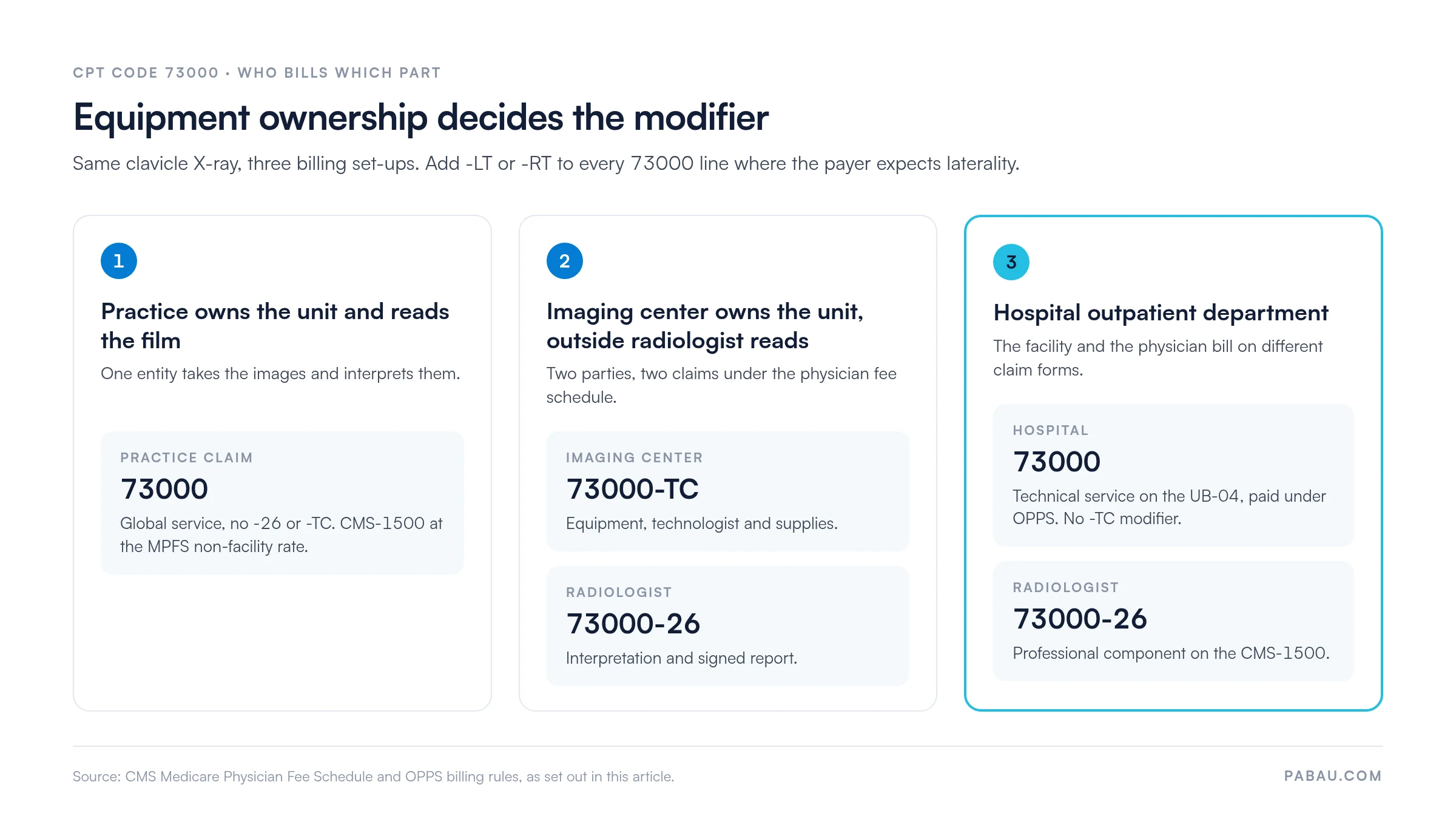
Global billing, with no modifier, applies when one provider or group owns the imaging equipment and employs the interpreting radiologist. A private orthopedic practice with its own X-ray unit and an on-site radiologist can bill this way. Once a second party touches the study, the claim splits, and the setting decides how.
In a hospital outpatient department, the hospital bills the technical service on its own facility claim, the UB-04. It’s paid under the Outpatient Prospective Payment System (OPPS). That line carries no -TC modifier. The interpreting physician then bills 73000-26 separately under the physician fee schedule.
The diagram below sets the three common arrangements side by side.
Check your payer contracts before applying modifier -50 for bilateral clavicle imaging. Some commercial payers prefer two separate line items, one with -LT and one with -RT. Sending -50 to a payer that expects two lines leads to a denial that needs a corrected claim to resolve.
Medicare sets payment for 73000 each year under the Medicare Physician Fee Schedule (MPFS), adjusted by Geographic Practice Cost Index (GPCI) locality. The CMS Physician Fee Schedule lookup tool is the authoritative source for current rates. Pull figures from it for the payment year you’re billing, since printed tables go stale quickly.
Here’s how the rate structure fits together. Treat it as orientation, and confirm current amounts at CMS.
Workers’ compensation rates are set separately by each state. Texas, for instance, sets them through the Texas Department of Insurance, Division of Workers’ Compensation.
Don’t assume the Medicare rate applies to a workers’ compensation claim without payer confirmation. The FastRVU RVU lookup tool shows the current work, practice expense and malpractice RVUs for 73000 by locality.
Orthopedic and emergency coders regularly reach for 73030 when the study was a clavicle series, and the reverse happens too.
The choice turns on what the ordering provider meant to image, not on what shows up on the film. The AAPC Codify CPT lookup lets you compare full descriptors before you pick one.
The simplest rule is to bill what the order says. A “clavicle X-ray” order is 73000, and a “shoulder X-ray” order is 73030. When a chest X-ray was ordered and the clavicle simply appears on it, bill 71046 alone.
Here’s how that plays out on a busy shift. A cyclist lands on an outstretched left arm, and the ED orders “left clavicle, two views.” The coder bills 73000-LT with S42.002A.
If the order also asks for left shoulder views to rule out a shoulder injury, 73030-LT goes on the claim with its own indication. An NCCI check then decides whether a distinct-service modifier is needed.
A 73000 claim needs specific documentation before it reaches a payer. A missing element from the list below is the usual cause of a medical necessity denial. Good superbill documentation captures most of these fields at the point of service.
Each step below hands something to the next, and a weak handoff is where denials start.
Denials on 73000 trace back to six root causes. A denial management workflow that screens for them before submission stops most rejections before they turn into corrected claims or appeals.
Run these checks before a 73000 claim leaves the practice. Each one matches a denial above, and together they describe a clean claim for this code.
Plenty of 73000 rework starts when someone keys the claim by hand from the radiology report. One dropped laterality modifier or mistyped diagnosis is enough to send it back.
Pabau, the practice management platform we build, pre-fills the claim from the patient record instead. The CPT code attached to the service lands on the charge line, and the ICD-10 slots draw from the recorded problem list. Built-in ICD-10 and CPT lookup libraries let coders search for the exact code rather than typing it from memory.
Before the Send button unlocks, Pabau’s medical claims management checks that every required claim field is filled in. US claims then go out through Claim.MD, with real-time eligibility checks before the visit and ERA posting when the payer responds. Your billing team spends less time re-keying claims and more time on the ones that need judgment.


Pabau pre-fills each claim from the patient record and checks required fields before submission. US claims go out through Claim.MD, so your billing team spends less time re-keying.

Treat 73000 as the narrow code it is, and most of its trouble goes away. Bill it only when the order names the clavicle, and let the diagnosis show why the study was needed.
The bigger risk sits in the modifiers. Agree with the facility on who bills the technical and professional parts before the first claim goes out. Then check NCCI edits whenever 73000 shares a claim with a shoulder or scapula study. That ten-minute conversation costs far less than working a stack of duplicate-service denials.
If your team still rebuilds each claim from the radiology report, that’s where the time goes. Book a demo to see how Pabau pre-fills 73000 claims from the patient record and checks them before they’re sent.

Need to understand how clearinghouse validation works? Claim.MD clearinghouse overview explains how electronic claims are validated before reaching the payer.
Want to close the loop once a claim pays? Electronic remittance advice processing covers how ERA files and 835 transactions post payment for submitted claims.
Dealing with repeated claim rejections? Denial codes in medical billing breaks down CARC reason codes and how to act on each one.
Billing the upper arm on the same visit? CPT code 73060 covers humerus X-ray billing, views and modifiers.
Use 73050, radiologic examination of the acromioclavicular joints, bilateral, with or without weighted distraction. It fits when the order targets an AC separation, often with stress views. If 73000 and 73050 are both ordered and documented, check NCCI edits before you report both.
Use 71130, radiologic examination of the sternoclavicular joint or joints, minimum of three views. Choose it when the order targets the joint where the clavicle meets the sternum. A study of the clavicle itself stays on 73000.
No. Medicare lists 73000 with a global period of XXX, which means the global surgery rules don’t apply. No postoperative window attaches to the X-ray, so each medically necessary study stands as its own service.
The 2026 Medicare fee schedule gives 73000 a work RVU of 0.16 and a total of 1.00 RVUs. At the $33.4009 conversion factor, that’s about $33.40 nationally before the locality adjustment.
Yes, on a later date of service, as long as the record explains why the repeat study was needed. Switch the diagnosis to a subsequent-encounter 7th character, such as S42.002D for routine healing. Some payers cap how often they pay for repeat films, so check their frequency limits.