

CCSD code G5100: Bypass of duodenum billing guide
CCSD code G5100 bills a bypass that leaves the duodenum in place CCSD code G5100...

Last Updated: Oct 16, 2026
73020 is the CPT code for radiologic examination, shoulder; one view. It covers a single X-ray projection of one shoulder, most often an AP view.
The view count decides the code. Once the signed radiology report lists two or more projections, the study moves to its closest neighbor, CPT 73030. A billed code that doesn't match the report invites a denial or a recoupment. Get the view count, the modifiers that can apply and the supporting diagnosis right, and the claim has a clean path to payment.
Let Pabau's smart automation suggest the right codes, reduce claim denials, and keep your practice compliant—effortlessly.
Automate repetitive tasks and focus on what matters most—your patients.
Reduce coding errors and ensure compliance with the latest regulations.
Clean claims, fewer denials, and faster reimbursements.
Powerful insights and reporting to help your practice thrive.
HIPAA compliant SOC 2 certified GDPR-compliant Trusted by 4,000+ clinics worldwide

CPT code 73020 covers one shoulder X-ray projection, and a report listing two or more views bills as 73030 instead.
Modifiers -26 and TC split the professional and technical components, while -RT and -LT show which shoulder was imaged.
Bilateral shoulder films go on two lines, one with -RT and one with -LT, because modifier -50 doesn’t apply to this code.
Pair 73020 with a side-specific ICD-10-CM code whose laterality matches the modifier on the claim line.
A view count that doesn’t match the signed report and a missing laterality modifier are two denials you can catch before submission.
CPT code 73020 reports a single-projection X-ray of the shoulder. The American Medical Association (AMA), which maintains the CPT code set, publishes the official descriptor as Radiologic examination, shoulder; one view.
That descriptor is what an auditor checks the claim against. If the radiology report documents two views, the correct code is 73030, however the order was written. The billed code has to reflect what was performed and documented.
A single view means one image acquisition in one radiographic projection. The anteroposterior (AP) view is the most common single shoulder film. A Grashey view, scapular Y or axillary projection can also be the only view taken. Only the number of distinct projections in the final report decides between 73020 and 73030.
Ordering clinicians choose one view when a quick, limited look answers the clinical question. Typical scenarios include:
A full diagnostic picture of the joint usually needs two or more projections. That moves the study to 73030.
73030 is the code most often confused with 73020. The two differ only in how many projections the signed report lists, so the comparison below comes down to one question.
Billing 73030 for one documented view is upcoding, and payers can audit the claim or recoup the payment. Billing 73020 when two views were taken is undercoding, which leaves money unpaid. In both cases, the fix is to match the code to the documented view count.
CPT code 73020 sits in a family of upper-extremity X-ray codes. Coders reach for these when a patient has several areas imaged in the same encounter.
Two neighbors cause most of the mix-ups. 73040 is shoulder arthrography, which is a contrast study rather than a plain film. 73060 images the humerus, so it isn’t a substitute for a shoulder view.
Same-day films of two areas, such as the shoulder and elbow, each get their own line. Add the right laterality modifier to each one. Cross-joint radiology codes are not normally bundled, but check current NCCI edits.
Modifiers tell the payer how the service was delivered and who is billing which component. A wrong or missing modifier on 73020 is a quick route to a denial.
In a hospital or independent imaging facility, two entities often bill for one film. The facility bills for equipment and staff, which is the technical component. The radiologist bills for the interpretation, which is the professional component.
If both parties send 73020 without a modifier, each one is billing globally for the same film. Payers typically deny one or both claims.
Many payers require -LT or -RT on shoulder imaging, so check each payer’s policy. Leaving laterality off is a common reason a 73020 claim comes back.
Payment for CPT code 73020 under the CMS Medicare Physician Fee Schedule (MPFS) is built from relative value units (RVUs). A geographic practice cost index (GPCI) then adjusts them for your area. Rates vary by locality and change every year.
Check current rates in the CMS MPFS lookup or the FastRVU lookup tool before you set fee schedules or estimate patient liability. Medicare Advantage and commercial rates can differ widely from traditional Medicare.
Every 73020 claim needs an ICD-10-CM diagnosis code to show medical necessity. The diagnosis must appear in the ordering provider’s notes and be specific enough to justify the film. An unspecified code is a common audit trigger.
ICD-10-CM codes build laterality into the code itself. The diagnosis side must match the -LT or -RT modifier on the claim line. Many payers reject a right shoulder diagnosis paired with -LT automatically.
Plain shoulder X-rays generally don’t need prior authorization under traditional Medicare fee-for-service. Requirements still vary by payer, so confirm before you assume.
Medicare Administrative Contractors (MACs) may publish Local Coverage Determinations (LCDs) with documentation rules for shoulder imaging. Review them regularly, because they can change independently of the national fee schedule.
Once the film is read, the claim follows a fixed path. Each step adds one piece of the claim line, and a denial usually traces back to one skipped step.
Steps three to five are where the coding decisions sit. The chart below runs through them in the order a coder should answer them.
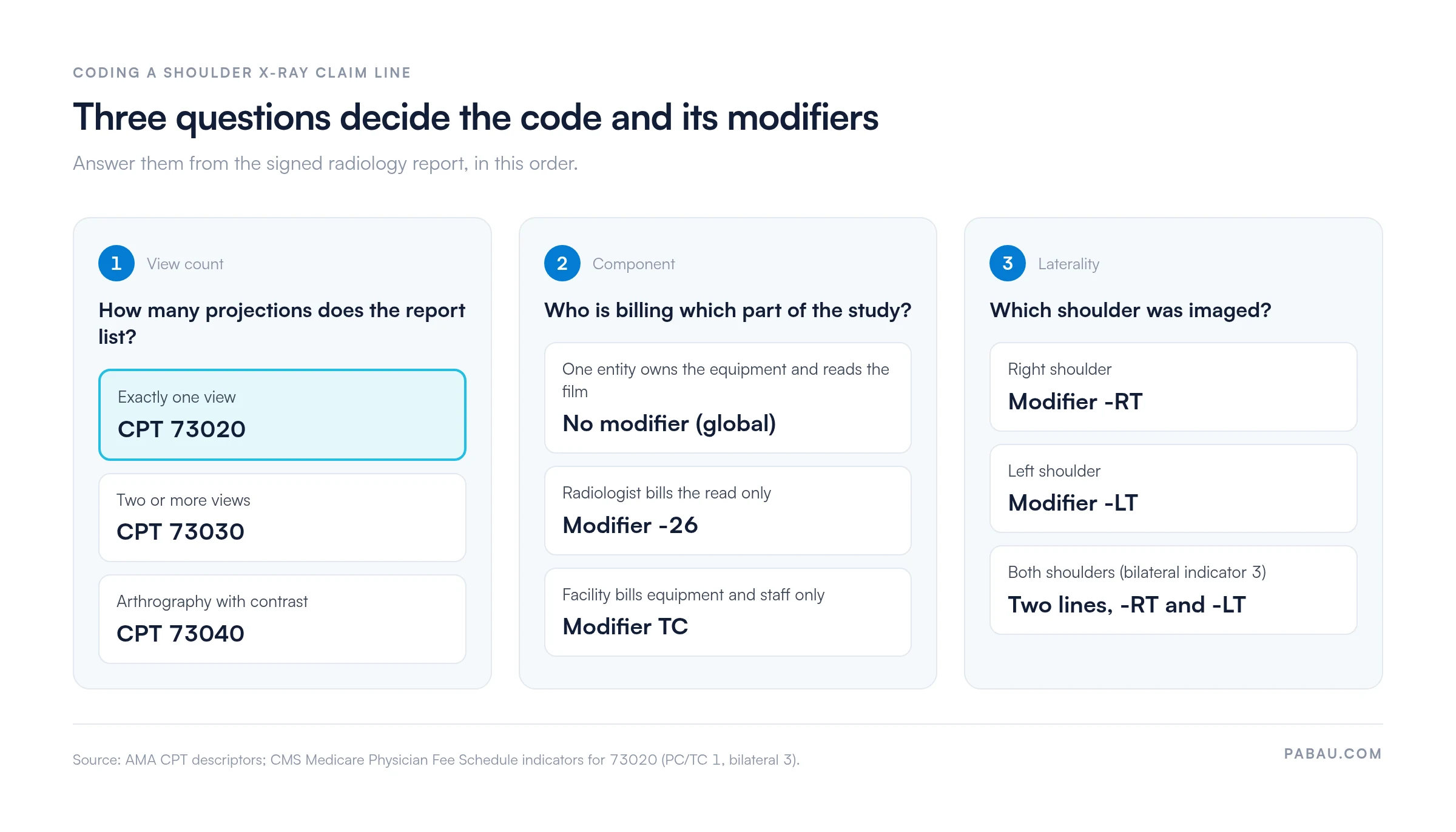
Most 73020 denials fall into a handful of preventable groups. Each one returns with a reason code on the remittance, and our guide to denial codes explains what each code means.
A patient falls and the order reads “right shoulder X-ray, one view.” The technologist takes an AP view and then adds a scapular Y view. The signed report lists both projections.
The correct line is 73030-RT with S40.011A, not 73020. Billing from the order would undercode the study, and the report would contradict the claim at audit.
When denials keep repeating, track them by reason and fix the step that causes them. This overview of denial management in healthcare shows how practices track, appeal and prevent repeat rejections.
Documentation is what defends a 73020 claim when a payer or auditor asks. The radiology report and the order together form the billing record.
An audit of a 73020 claim goes straight to the radiology report. If the report lists two projections, the auditor treats the claim as undercoded. If it lists one projection and the claim shows 73030, that is upcoding the payer can recoup.
Writing “one view” in the dictation, instead of leaving it implied, costs the radiologist a few words. It also removes doubt for coders who pick up the report later.
Without connected software, a biller copies the view count, side and diagnosis from the report into a claim form by hand. Each copied field is another chance to drop -RT or bill the wrong view count.
Pabau, the practice management and billing platform we build, pre-fills the claim form from the patient record. Its claims management software includes ICD-10 and CPT lookup libraries, so the biller finds 73020 and the diagnosis in one place. Before you press Send, Pabau checks that the required claim fields are complete.
Claims go out through the Claim.MD clearinghouse, with eligibility checks where the payer supports them. Electronic remittance advice brings each payer’s response back, including the reason code behind any denial. Your team can work a denial the day it arrives.


Pabau pre-fills each claim from the patient record and checks required fields before you send. Claims go out through Claim.MD, and remittances come back to the same record.

Treat the signed radiology report as the source for every 73020 claim line. The view count picks the code, and the side picks the modifier. The diagnosis then has to agree with both.
When those three line up, a one-view shoulder film is one of the simpler claims a practice sends. The trade-off is a short check before submission against an appeal and resubmission after a denial.
If you want those checks built into your billing day, book a demo to see how Pabau pre-fills radiology claims from the patient record.

Need to understand how electronic claims reach payers? Claim.MD clearinghouse overview explains how 837P files are validated and routed to payers.
Want to reduce denials before they happen? What makes a clean claim covers the pre-submission checks that stop the most common rejections.
Imaging the elbow in the same visit? CPT code 73070 covers the two-view elbow study and how it differs from 73080.
Looking for the broader medical billing picture? Revenue cycle management basics maps how a single claim like CPT 73020 fits the full patient-to-payment workflow.
Use 73030, radiologic examination, shoulder; complete, minimum of 2 views. Any study with two or more projections in the signed report moves from 73020 to 73030.
Yes. Medicare Part B covers a one-view shoulder X-ray when a treating practitioner orders it and the record supports medical necessity. Payment follows the MPFS rate for your locality.
Yes. Every distinct projection in the signed report counts as a view. An AP view plus a scapular Y view is two views, so the study bills as 73030.
Yes. Report two lines, 73020-RT and 73020-LT, each with a matching ICD-10-CM code. Modifier -50 doesn’t apply, because the MPFS bilateral indicator for this code is 3.
Not for the same shoulder in the same session. Bill the single code that matches the total views. Different shoulders can carry different codes, each with its own laterality modifier.



