

CCSD code G5100: Bypass of duodenum billing guide
CCSD code G5100 bills a bypass that leaves the duodenum in place CCSD code G5100...

Last Updated: Oct 16, 2026
73040 is the CPT code for radiologic examination, shoulder, arthrography, radiological supervision and interpretation. It covers the fluoroscopic imaging series and the radiologist's report, including any needle guidance. The contrast injection itself is reported separately with CPT 23350.
Coders often confuse 73040 with CPT 73221, another shoulder imaging code. The difference is the modality: 73040 captures conventional fluoroscopic arthrography, while 73221 captures MRI without contrast. The documentation most often missed is a separately signed interpretation report. Without it, payers treat the claim as lacking a professional component and deny the modifier 26 portion.
Let Pabau's smart automation suggest the right codes, reduce claim denials, and keep your practice compliant—effortlessly.
Automate repetitive tasks and focus on what matters most—your patients.
Reduce coding errors and ensure compliance with the latest regulations.
Clean claims, fewer denials, and faster reimbursements.
Powerful insights and reporting to help your practice thrive.
HIPAA compliant SOC 2 certified GDPR-compliant Trusted by 4,000+ clinics worldwide

CPT Code 73040 describes radiologic examination of the shoulder by arthrography, not MRI or ultrasound.
Needle guidance (CPT 77002 or 76942) is included in 73040, so don’t report it alongside 73040 or unbundle it with modifier 59 or XS.
Split billing requires modifier 26 for the radiologist interpretation and modifier TC for the facility equipment component.
Pabau’s claims software holds a 73040 claim back until required details, such as the prior authorization number, are in place.
CPT Code 73040 is the five-digit procedure code published by the American Medical Association (AMA) for radiologic examination of the shoulder by arthrography. It includes radiological supervision and interpretation.
The procedure involves injecting contrast medium into the glenohumeral joint space under image guidance, then acquiring a fluoroscopic series. That series evaluates the rotator cuff, labrum, glenohumeral capsule, and biceps tendon anchor.
The code sits in the Radiology section of the CPT code set, under Diagnostic Radiology (Diagnostic Imaging) Procedures of the Upper Extremities (73000-73225). It is a global code, so a single claim for 73040 normally covers both the technical imaging service and the professional interpretation. The exception is when a facility and a radiologist split the two and bill independently.
CPT Code 73040 covers the radiologic supervision and interpretation of the shoulder arthrogram. That includes the fluoroscopic imaging series, any imaging guidance used to place the needle, and the radiologist’s written report. It does not include the contrast injection itself, which is reported with CPT 23350.
Needle guidance follows a national rule set by the AMA CPT code set and the National Correct Coding Initiative (NCCI) Policy Manual. The guidance code section below covers that rule and its one exception, CT or MR arthrography.
Arthrography of the shoulder follows a structured fluoroscopy-guided protocol. Document each step as it happens, because an auditor checks the claim against every one of them.
Capture each element at the point of care, not when the claim is being built. Without a signed interpretation report, a modifier 26 claim has no record to support it.
CPT Code 73040 covers conventional fluoroscopic arthrography. CPT 73221 covers MRI of a shoulder or other upper extremity joint without contrast. The two are often confused because both may be ordered for the same shoulder complaint. Both sit in the same upper extremity radiology range, so the documented modality is what separates them.
An MR arthrogram is coded differently from a conventional one. When contrast is injected under fluoroscopy to prepare for an MRI, report CPT 23350, CPT 77002, and CPT 73222 (MRI shoulder with contrast), not 73040. Using the wrong code for the modality documented is a common reason shoulder imaging claims draw payer audits.
Needle guidance is part of CPT Code 73040, not a separate service. The AMA CPT code set instructs coders not to report CPT 77002 in conjunction with 73040.
The NCCI Policy Manual (Chapter IX, Section 12) adds that radiological supervision and interpretation codes include every radiological service needed to complete the study. It names fluoroscopic guidance (76000, 77002, 77003) and ultrasound guidance (76942, 76998) as not separately reportable.
Because the rule comes from the CPT code set itself, it doesn’t hinge on any one payer’s policy. Modifier 59 or XS does not unbundle 77002 or 76942 from 73040, because the guidance is not a separate, distinct service. Appending either modifier to force payment exposes the claim to recoupment on audit.
Instead, document the guidance inside the arthrogram report: the imaging used, the needle approach, and confirmation of intra-articular position.
Before you add CPT 77002 to a shoulder arthrogram claim, check which study the injection prepared for. A conventional radiographic arthrogram is coded 23350 + 73040, with no guidance code. A CT or MR arthrogram is coded 23350 + 77002 + the CT or MR code, with no 73040 on the claim.
CPT Code 73040 has a PC/TC indicator of 1, meaning the global payment can be split into a professional component and a technical component. Four modifiers apply most frequently to this code.
Medicare gives 73040 a bilateral indicator of 3, the category used for radiology. A bilateral study is paid at 100% for each side, not at the 150% rate used for bilateral surgery.
Medicare contractors generally want one line with modifier 50, one unit, and twice the charge. Some commercial payers prefer two lines with LT and RT instead. Confirm the payer’s format before submitting, because a mismatched format gets the claim rejected.
Most CPT 73040 claims involve split billing between a radiologist and a facility. Understanding when each component applies prevents the most common billing structure errors for this code.
Medicare pays for CPT Code 73040 under the Medicare Physician Fee Schedule (MPFS). The MPFS sets separate national averages for the global service, professional component, and technical component. Rates are adjusted annually each January and vary by geographic location using the Geographic Practice Cost Index (GPCI).
These figures are national averages only. Your reimbursement depends on your locality’s GPCI adjustment and the current year’s conversion factor. Always verify current rates with the CMS Physician Fee Schedule lookup tool, and cross-check RVU values with FastRVU’s 2026 RVU lookup. Do this before setting fee schedules or evaluating payer contract adequacy.
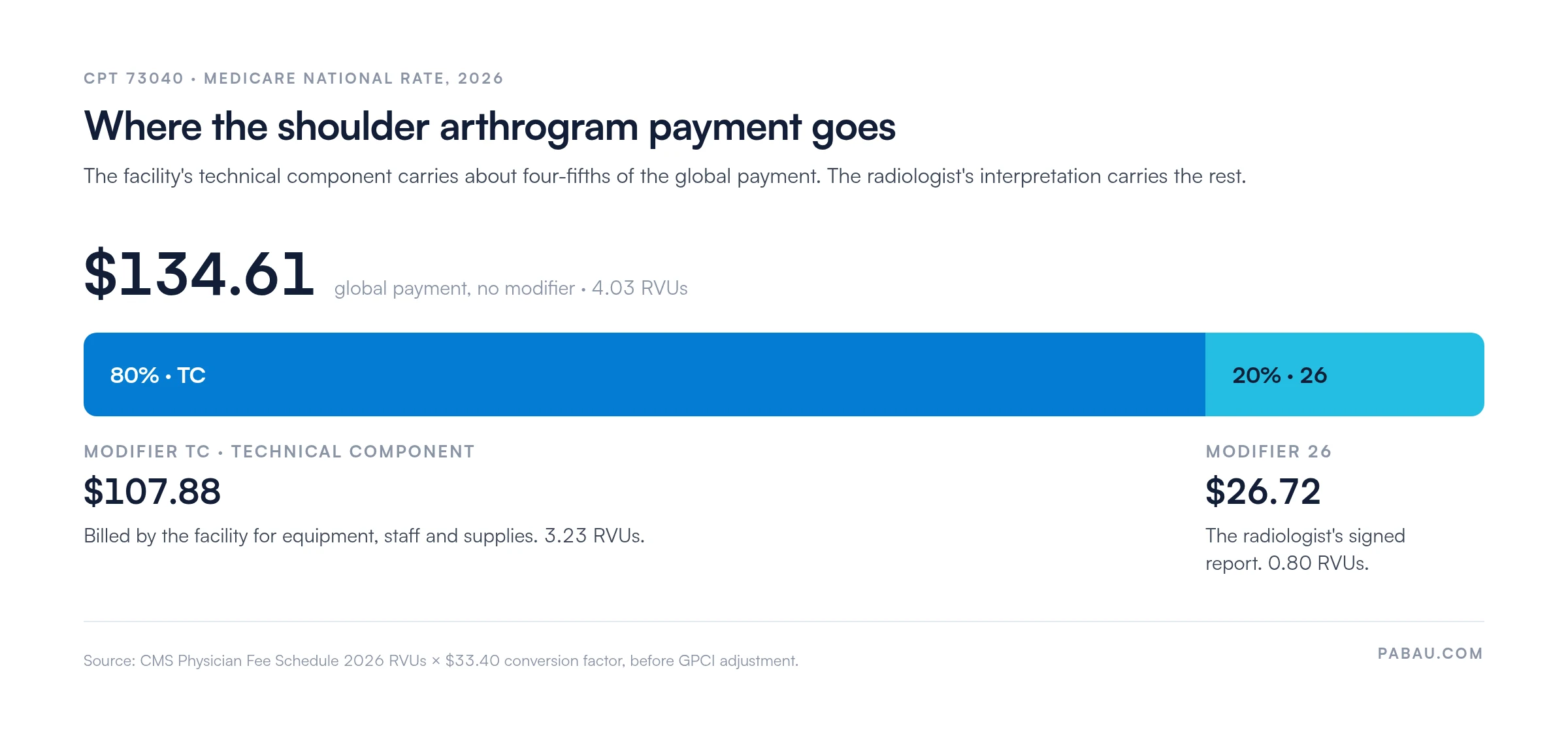
At the 2026 national rate, the global payment is about $134.61. That splits into $107.88 for the technical component and $26.72 for the professional one. So a denied TC line costs the facility about four times what a denied modifier 26 line costs the radiologist.
Prior authorization requirements for CPT Code 73040 vary by payer and are not universally mandated. Even so, most commercial plans and some Medicare Advantage plans require pre-authorization for shoulder arthrography.
Capture the clinical indication, prior treatment history, and ordering provider’s details when the study is ordered. That record speeds up the authorization request and protects the claim from a retroactive denial.
CPT Code 73040 claims are denied for a predictable set of reasons. Knowing them before submission is more efficient than working a denial queue afterward. Proactive denial management workflows reduce rework and protect revenue.
Submitting a clean claim on the first pass means checking all six of these points before transmission. A clearinghouse edit check catches many missing fields and bundling conflicts before the claim reaches the payer.
Medical necessity for CPT Code 73040 is established by the diagnosis code on the claim. Payers cross-reference the reported ICD-10-CM code against their local coverage determinations (LCDs) for shoulder imaging. The shoulder codes in category M75 carry laterality, and an unspecified-side code often draws a medical necessity denial.
Use the CrossCoder CPT-to-ICD-10 crosswalk tool to verify current payer-accepted diagnosis codes for this procedure.
Outpatient coding guidelines let you code the confirmed finding once the radiologist has interpreted the study. If the report shows a full-thickness tear of the right shoulder, that means M75.121 rather than an unspecified M75.10x code.
When the ordering diagnosis is suspected labral pathology or glenohumeral instability, document the specific clinical findings in the ordering note. Record findings such as the apprehension sign, sulcus sign, or history of dislocation episodes.
Payers reviewing arthrogram claims for medical necessity often request this documentation during pre-payment or post-payment reviews.
Always use the AAPC CPT-to-ICD-10 crosswalk to check the ICD-10-CM code you pair with CPT 73040. Confirm the specific payer accepts it under their current LCD. Generic shoulder codes like M75.100 (unspecified laterality) are frequently rejected – replace them with the laterality-specific code before submission.
Most 73040 denials trace back to a detail that was missing before the claim left the practice. A billing team working from spreadsheets usually finds out weeks later, on the remittance.
Pabau, the practice management platform we build, checks a claim before it goes out. Its claims management software keeps the Send button disabled until payer details like the authorization number are in place. US claims go to payers through the Claim.MD clearinghouse, and ERA remittances post back against the right invoice.

Your team sees the status of every claim in one dashboard, from submitted to paid or error. A rejected 73040 line gets worked the same week, instead of surfacing at month-end.

Pabau checks payer details before a claim goes out, submits it through Claim.MD, and posts ERA remittances back to the invoice. Your billing team spends less time chasing 73040 denials.

Most 73040 denials are decided before the claim is built. They come down to the order, the authorization, and who bills which component.
So agree the split with the facility before the first study, and keep 77002 and 76942 off conventional arthrogram claims. Make the signed report a hard stop before any modifier 26 claim goes out. The trade-off is a few minutes of checking at scheduling, against weeks of rework on a denied line.
Book a demo to see how Pabau keeps shoulder arthrography claims complete before they reach the payer.

Need to understand how clearinghouse submissions work for radiology claims? Medical claims clearinghouse guide explains the electronic submission pathway from practice to payer.
Want to reduce claim denials across your billing workflow? Denial codes in medical billing covers the most common CARC denial reasons and how to appeal them.
Mapping the full billing process? Revenue cycle management overview covers the end-to-end billing process from charge capture through remittance posting.
Coding an MR arthrogram instead? CPT code 73222 covers MRI of an upper extremity joint with contrast, the study an MR arthrogram is billed under.
CPT code 73040 covers radiologic examination of the shoulder by arthrography, with radiological supervision and interpretation. It includes the fluoroscopic imaging series and any needle guidance, so CPT 77002 and 76942 are not reported separately. The contrast injection itself is reported with CPT 23350.
No. The AMA CPT code set instructs coders not to report CPT 77002 with 73040. The NCCI Policy Manual also treats fluoroscopic needle guidance as part of the arthrogram, and modifier 59 or XS does not override this. CPT 77002 is reported only for CT or MR arthrography, coded as 23350 + 77002 + the CT or MR code, with no 73040.
CPT 73040 describes conventional fluoroscopic arthrography of the shoulder with intra-articular contrast injection. CPT 73221 describes MRI of the shoulder without contrast – a completely different imaging modality with no contrast injection. The two may not be used interchangeably. The correct code depends entirely on which imaging modality was performed and documented.
Yes, modifier 50 may be appended to CPT 73040 when both shoulders are imaged in the same session. Medicare pays each side at 100% because 73040 carries bilateral indicator 3, and usually wants one line at twice the charge. Many commercial payers prefer two separate line items with LT and RT modifiers. Confirm the payer’s bilateral billing policy before submission.
A complete 73040 claim needs a physician order with a diagnosis code that specifies laterality, plus signed informed consent. The procedure note must name the contrast agent and volume and record how the needle was guided. The claim also needs a signed radiologist interpretation report. For modifier 26 claims, the signed interpretation report is a non-negotiable documentation requirement.
Prior authorization requirements vary by payer. Traditional Medicare generally does not require prior auth for 73040, but Medicare Advantage plans and most commercial payers do. Most commercial payers also require documentation of medical necessity. That typically includes a record of failed conservative treatment and a clinical indication for labral or rotator cuff pathology. Always verify with the specific payer before scheduling.



