ICD-10 Code Y76.0: Diagnostic obstetric and gynecological devices
ICD-10 Code Y76.0: Definition and billable status ICD-10 Code Y76.0 is a valid, ...

Last Updated: Oct 23, 2026
Billable Code Specific Code
S42.309K is the billable ICD-10-CM code for unspecified fracture of shaft of humerus, unspecified arm, subsequent encounter for fracture with nonunion. Reach for it when a patient returns for care on a humeral shaft fracture that has stopped healing, and the note leaves the affected arm unnamed. Correct use rests on the encounter type, the healing status the 7th character encodes, and whether laterality is documented.
Let Pabau's smart automation suggest the right codes, reduce claim denials, and keep your practice compliant—effortlessly.
Automate repetitive tasks and focus on what matters most—your patients.
Reduce coding errors and ensure compliance with the latest regulations.
Clean claims, fewer denials, and faster reimbursements.
Powerful insights and reporting to help your practice thrive.
HIPAA compliant SOC 2 certified GDPR-compliant Trusted by 4,000+ clinics worldwide

S42.309K is the billable FY2026 code for a humeral shaft fracture nonunion when the record does not name the arm.
The 7th character K means nonunion, which is distinct from G for delayed healing and P for malunion.
Use S42.301K for the right arm and S42.302K for the left whenever the physician documents laterality.
Payers expect an explicit nonunion diagnosis, supporting imaging, and a clear subsequent-encounter designation before they pay.
Tracking denial patterns on nonunion claims shows which documentation habits are costing the practice money.
ICD-10 Code S42.309K describes an unspecified fracture of the shaft of the humerus, unspecified arm, subsequent encounter for fracture with nonunion. The FY2026 tabular carries that descriptor verbatim. According to the CDC/NCHS ICD-10-CM web tool, the code took effect on October 1, 2025 for the 2026 fiscal year.
The code is billable and specific, so it carries enough clinical detail to be submitted for reimbursement on its own. It applies to outpatient and inpatient claims alike. Orthopedic and musculoskeletal coders meet it most often at follow-up visits, once a humeral shaft fracture has missed its expected healing window.
A humeral shaft fracture is a break in the diaphysis, the elongated middle portion of the humerus between the shoulder and the elbow. The shaft is distinct from the surgical and anatomical neck regions coded under other S42 subcategories. Nonunion occurs when the fracture site fails to bridge with new bone inside the expected healing window. In practice that usually means six months or more after the injury with no radiographic callus.
The “unspecified arm” designation reflects a note that never records whether the fracture is on the right or the left side. Treat that as a prompt to query the physician rather than a preferred code. Per CMS ICD-10 coding guidance, coders assign the most specific code the clinical record supports.
The 7th character in ICD-10-CM fracture codes encodes the encounter type and the healing status. For S42.309K, the character K signals a subsequent encounter where the fracture has developed nonunion. Payers act on that distinction at adjudication, so submitting K where the note supports G or P invites denials and audits. The ICD-10-CM Official Guidelines require the 7th character to reflect the clinical status documented at the encounter, not the original injury.
Coders commonly confuse G and K when a note describes a “slow-healing” fracture. G applies while healing is progressing but running behind schedule. K applies once healing has stopped, the site remains unstable, and imaging shows no bridging callus. Where the physician’s note does not separate the two, query the provider before assigning the character.
The same split plays out on the laterality-specific shaft codes. A displaced segmental fracture of the right humeral shaft still healing slowly takes S42.361G, while the same fracture with documented nonunion takes S42.361K.
The choice narrows quickly once the encounter type and the imaging findings are both on the page. The chart below walks the same two questions in the order a coder asks them.
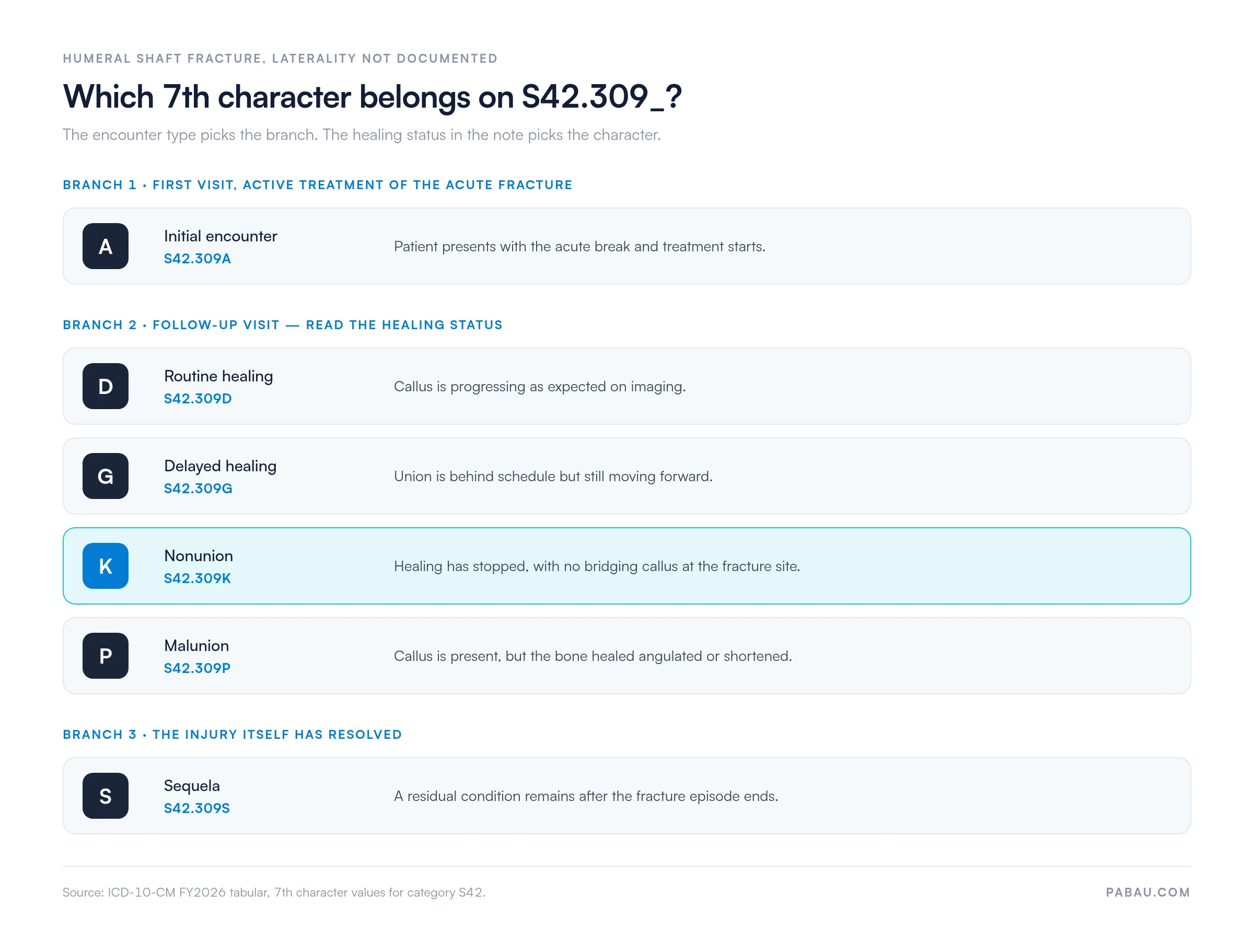
S42.309K is correct only at a subsequent encounter, never at the initial visit for the acute fracture. A subsequent encounter means the patient has already had active treatment and is back for care related to healing. Applying K at a first presentation is one of the most frequent 7th character errors in orthopedic coding. An emergency department visit for the acute break takes A instead.
Clinical documentation uses several terms that map to ICD-10 Code S42.309K. Recognizing them helps when the physician’s note does not quote the ICD-10 descriptor. They also point to the right entry in the ICD-10-CM alphabetical index, under “Fracture, traumatic, humerus, shaft”. The AAPC ICD-10-CM lookup is a quick way to check a term against the code before you submit.
S42.309K belongs to a family of codes that share the same clinical scenario but differ by laterality or healing status. Picking the most specific one lowers the risk of denials and requests for extra documentation. The rest of the family is indexed in our diagnostic code library. The CMS ICD code lists confirm that each code below is valid for FY2026 submission.
Once the operative note or the radiology report names the side, the unspecified code drops out of the running. A left-arm nonunion moves to S42.302K, and a right-arm nonunion to S42.301K.
Nonunion and malunion are separate clinical outcomes, and they carry different codes and different treatment pathways. Swapping one for the other damages both claim accuracy and the practice’s own data. S42.309K applies when the bone has not healed at all, while S42.309P applies when it healed in the wrong position.
Reading the ICD-10-CM hierarchy is how coders confirm they have reached the most specific applicable code. S42.309K sits within a six-level hierarchy under the injury and trauma chapter. Category S42 covers fractures of the shoulder and upper arm, from proximal to distal humerus injuries.
When navigating the tabular list for S42.309K, check the instructional notes at the S42.3 subcategory level before assigning the 7th character. The notes specify which 7th characters are valid for that subcategory and may include excludes1 or excludes2 notes that affect code assignment.
S42.309K supports reimbursement at subsequent encounters where nonunion is the documented clinical status. Payers treat nonunion as a complication of the original injury, so they expect the record to carry the diagnosis before the claim is processed. Validating the diagnosis and procedure pairing before submission catches most edits while the claim can still be corrected.
Nonunion of the humeral shaft often needs surgical intervention. The CPT procedure codes below are commonly paired with S42.309K as the supporting diagnosis. Confirm NCCI bundling edits and payer-specific policies before billing any combination, since compatibility varies between payers.
Payers reviewing a claim billed with S42.309K expect the record to support nonunion as the finding at the time of service. Vague notes describing “ongoing arm pain” or “slow healing” fall short of that threshold. Three documentation pillars carry this code: an explicit nonunion diagnosis, supporting imaging, and a clear encounter type.
Query the orthopedic surgeon when the note reads ‘fracture not healed’ without explicitly stating nonunion. Per ICD-10-CM Official Guidelines, coders should not assume nonunion from ambiguous language — a clarification query protects the practice from both undercoding and overcoding.
In most orthopedic practices, the nonunion diagnosis, the imaging report and the claim live in three separate places. A coder reads the note in one system, checks the X-ray in another, then keys S42.309K into billing. Every hop is a chance for the 7th character to drift away from what the surgeon actually documented.
Practice management software like Pabau keeps the chart, the imaging record and the claim in one patient file. The coder reads the follow-up note and raises the claim from the same screen. The encounter type on the claim then matches the encounter type in the record. Our streamlined claims management then submits electronically and reports what comes back.
Denial tracking is what turns a coding rule into a habit the practice can see. When three nonunion claims come back for missing imaging, the pattern is visible in the same week rather than at the end of the quarter. The surgeon gets one documentation request instead of five, and the rework stops before it becomes a write-off.

Pabau’s billing tools help orthopedic and musculoskeletal practices submit nonunion claims accurately, track denial patterns, and reduce the administrative load on coding staff.

S42.309K is the right code in a narrow set of circumstances: a follow-up visit, a documented nonunion, and a note that never names the arm. Two of those three are clinical findings you cannot change. The third one you can, and every laterality query answered moves the claim to a more specific code.
So treat the unspecified code as a working answer rather than a destination. Coders who query early submit fewer claims on S42.309K over time, and that shift is the clearest sign that fracture documentation is improving. Book a demo to see how Pabau keeps fracture coding, documentation and claims in one place for orthopedic teams.

Does the record name the affected arm? ICD-10 code S42.302K covers the same nonunion on the left arm, where laterality is documented.
Want to reduce claim denials on complex diagnoses? Denial codes in medical billing explains the most common denial reason codes and how to address them before resubmission.
Looking for guidance on clean claim submission standards? Claim.MD clearinghouse overview covers how electronic claim validation works before a claim reaches the payer.
ICD-10 Code S42.309K is a billable diagnosis code for a humeral shaft fracture with nonunion at a subsequent encounter. Its descriptor also reads unspecified arm, so laterality is not recorded. It is valid for FY2026. Use it when the physician’s documentation confirms nonunion but does not say whether the fracture is on the right or left arm.
Yes, S42.309K is a billable and specific ICD-10-CM code valid for outpatient and inpatient claim submission in fiscal year 2026. It stands on its own as a diagnosis code for reimbursement, with no further specificity characters required.
S42.309K indicates nonunion, where the bone has failed to heal and no callus bridges the fracture site. S42.309G indicates delayed healing, where the fracture is still moving toward union but more slowly than expected. The distinction drives both treatment planning and payer adjudication, so the note should be explicit about which one is present.
S42.301K covers an unspecified fracture of the shaft of the humerus, right arm, subsequent encounter with nonunion. S42.302K is the equivalent code for the left arm. Use S42.309K only when the documentation does not specify laterality, since the laterality-specific codes are preferred whenever the record supports them.
Yes, S42.309K is generally exempt from POA reporting. Subsequent encounter codes for fracture complications are exempt under CMS POA indicator guidelines. They describe conditions evaluated after the initial admission rather than conditions present on admission. Verify against the current CMS POA exempt list before finalizing an inpatient claim.
The 7th character K denotes a subsequent encounter where the fracture has developed nonunion. The bone has failed to heal, and imaging shows no bridging callus. Other subsequent-encounter characters include D for routine healing, G for delayed healing, and P for malunion. Choosing the correct one requires explicit documentation from the treating provider.