ICD-10 Code S42.444P: Medial epicondyle fracture, right humerus
ICD-10 Code S42.444P: full descriptor and code validity ICD-10 Code S42.444P car...

Last Updated: Oct 13, 2026
Billable Code Specific Code
Z96.7 is the billable ICD-10-CM code for presence of other bone and tendon implants.
It is a complete four-character code with no subcodes and no laterality, so coders report it exactly as written. Orthopedic, neurosurgical, and primary care teams add it as a secondary diagnosis. It applies when a patient's existing bone or tendon hardware, such as a skull plate, bears on the current visit.
Let Pabau's smart automation suggest the right codes, reduce claim denials, and keep your practice compliant—effortlessly.
Automate repetitive tasks and focus on what matters most—your patients.
Reduce coding errors and ensure compliance with the latest regulations.
Clean claims, fewer denials, and faster reimbursements.
Powerful insights and reporting to help your practice thrive.
HIPAA compliant SOC 2 certified GDPR-compliant Trusted by 4,000+ clinics worldwide

Z96.7 is a complete, billable ICD-10-CM code for the presence of other bone and tendon implants, including a skull plate
It has no subcodes and no fifth character, so coders report Z96.7 exactly as written on the claim
Medicare code edits bar Z96.7 as a principal diagnosis, so it belongs on the claim as an additional code
Joint prostheses belong under Z96.6-, and a documented implant complication belongs under T84-, never under Z96.7
Documentation only has to establish the implant and its relevance to the visit, since Z96.7 carries no laterality
ICD-10 code Z96.7, “Presence of other bone and tendon implants,” records that a patient carries bone or tendon hardware that is not a joint prosthesis. It sits in Chapter 21 of ICD-10-CM, the chapter for factors influencing health status and contact with health services. The tabular list gives one inclusion term beneath it: presence of skull plate.
The National Center for Health Statistics and the Centers for Medicare and Medicaid Services co-maintain ICD-10-CM. Updates publish each October 1. Z96.7 is valid for FY2026, effective October 1, 2025, and the CDC/NCHS ICD-10-CM web tool confirms its active status.
Yes. Z96.7 is a billable, specific ICD-10-CM code, and it is submitted exactly as written. The code stops at four characters, so there is no fifth character to add and no subcode to choose. A claim carrying Z96.7 will not be rejected for lack of specificity.
One restriction applies on the inpatient side. Medicare code edits list Z96.7 among the diagnoses that cannot stand as the principal diagnosis. Report it alongside the code that explains why the patient was seen. Chapter 21 status codes work this way as a rule, so the edit rarely changes day-to-day coding.
The rest of the claim still has to hold up. Denials on implant-status encounters usually trace back to the primary diagnosis or its documentation. The status code itself rarely draws the rejection.
Practice management software like Pabau sends the finished claim on to the Claim.MD clearinghouse and tracks it through to the payer response. Claim.MD applies format and eligibility edits to what it receives. Code selection stays with the coder. Pabau’s claims software for coders then reports back what the payer did with each submission.
Z96.7 covers implanted hardware that supports bone or tendon without replacing a joint. A skull plate is the example the tabular list names outright. Other typical devices include synthetic tendon grafts, bone-anchored fixation left in place after a fracture has healed, and suture anchors from a ligament reconstruction.
The code also applies well outside the operating room. A patient who comes in for a routine visit years after an Achilles repair with a synthetic graft still carries that implant. Code Z96.7 as an additional diagnosis whenever the hardware bears on the encounter, and leave it off when it does not.
Practices that treat post-surgical rehabilitation patients meet these encounters constantly. Accurate status coding supports continuity of care documentation. It also carries weight during prior authorization review for a follow-up procedure at the same site.
The line between Z96.6 and Z96.7 is the joint. Z96.6- reports the presence of an orthopedic joint implant, and every code beneath it names a joint and, in most cases, a side. Z96.7 reports every other bone or tendon implant, and it names no site at all.
Two practical points follow from that table. First, the hip and finger codes people sometimes attach to Z96.7 are not subcodes of it. Z96.641 through Z96.649 report an artificial hip joint. Z96.691 through Z96.693 report finger-joint replacement of the right hand, the left hand, or both.
Second, Z96.7 carries no laterality. There is no right-sided or left-sided version of it to look for, so a note that omits the side does not block the code. Coders used to hunting for laterality on every musculoskeletal code often query the physician here without cause. Three questions settle the choice, in the order below.
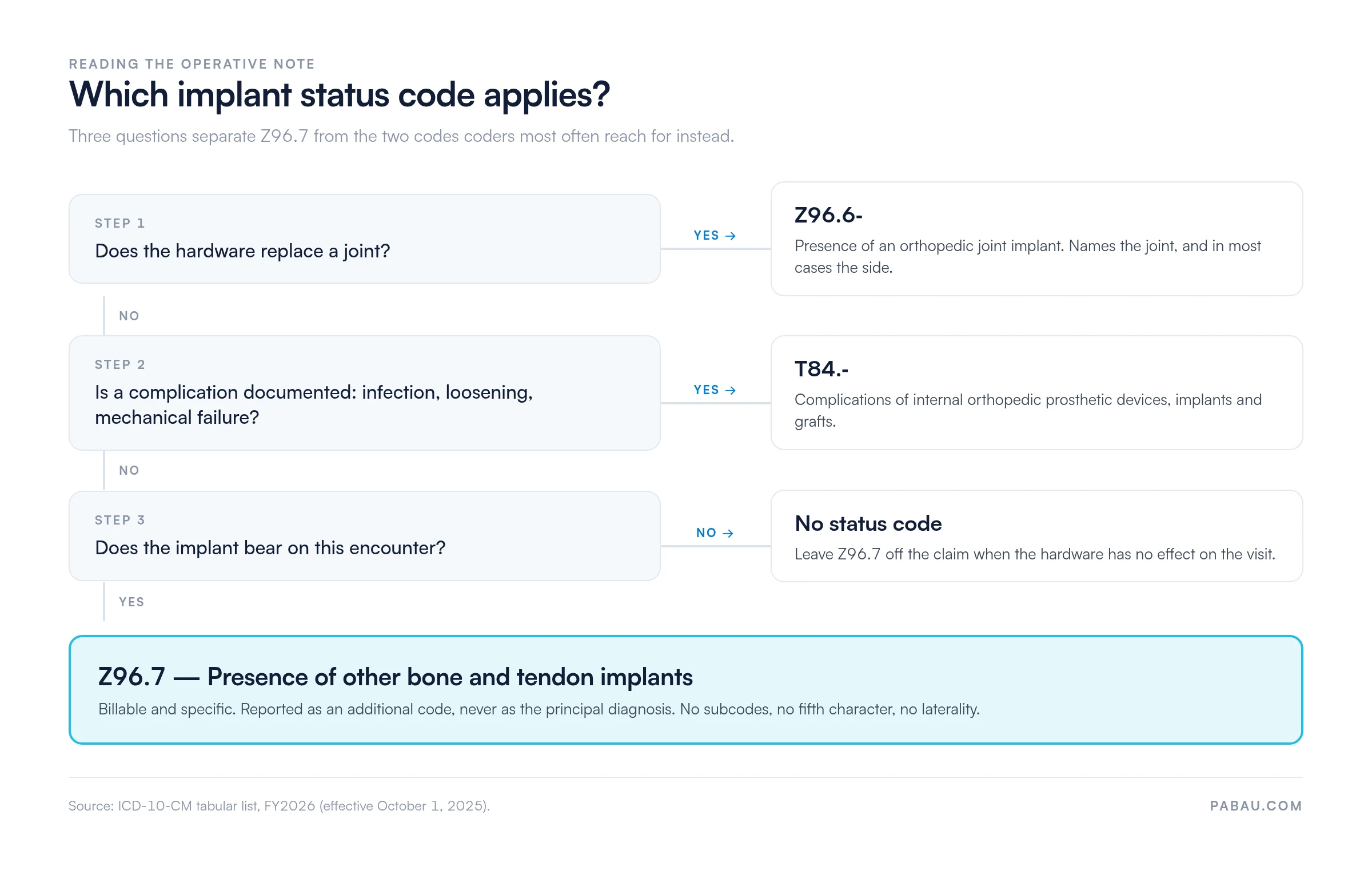
Read the operative note for what the hardware does, not where it sits. A device that carries load across a joint surface is a joint prosthesis and belongs under Z96.6-. A plate, screw, anchor or graft that holds bone or tendon belongs under Z96.7, whatever bone it is attached to.
Z96.7 sits inside the Z96 category, which covers the presence of other functional implants. Knowing the siblings keeps coders from reaching for Z96.7 when a narrower category fits. The AAPC code lookup browses the whole Z96 family in one view. Our ICD-10-CM code library sets out the neighboring Z-codes in the same detail.
The Z47.1 row is worth a second look. Its tabular entry instructs the coder to add a code for the joint prosthesis, and that code comes from Z96.6-. Aftercare on a tendon or bone implant is reported with Z47.89 instead, with Z96.7 as the status code beside it.
Z96 also carries two Excludes2 notes that reach Z96.7. Complications of internal prosthetic devices, implants and grafts are classified to T82-T85. Fitting and adjustment of a prosthetic or other device is classified to Z44-Z46. An Excludes2 note allows both codes together when both conditions are documented.
Z96.7 is a status code under Section I.C.21.c.3 of the ICD-10-CM Official Guidelines for Coding and Reporting. Status codes describe a patient circumstance that may shape care without being the reason for the visit. The principal or first-listed diagnosis therefore reflects what brought the patient in.
Three encounters take Z96.7 as an additional code most often:
Consistent status coding also supports medical billing compliance. Payers audit documentation against the codes reported, and a status code with no supporting note is an easy finding.
What the documentation has to establish before you assign Z96.7:
Verify code validity each October, since the code set turns over on the first of the month. Z96.7 is valid for FY2026, and the CDC/NCHS tool confirms it. A clean claim also depends on the supporting documentation being finished before the claim leaves the practice.
Because Z96.7 documents status rather than an active problem, it almost always functions as an additional code. The primary diagnosis reflects what brought the patient in. Below are the pairings that come up most often in orthopedic and musculoskeletal billing.
One error recurs more than any other. When the patient presents with an implant complication such as infection, loosening, or mechanical failure, the encounter belongs in the T84 range. Status codes are reserved for hardware that is behaving. Mixing the two categories is a reliable trigger for post-payment review. Billing teams guard against it with a coding checkpoint before submission.
Which T84 branch applies depends on the device. An infected joint replacement goes to T84.50XA when the record never names the joint. Infected plates, screws, and rods go to T84.6- instead.
On inpatient claims, Z96.7 maps to MS-DRGs 564, 565, and 566. That family covers other musculoskeletal system and connective tissue diagnoses, split by MCC, by CC, and by neither. That mapping comes from the CMS MS-DRG Definitions Manual version 43.0, the FY2026 grouper effective October 1, 2025. Version 43.1 replaced it on April 1, 2026.
Which of those three DRGs an encounter lands in depends on the complications and comorbidities reported beside the principal diagnosis. A status code does not supply that severity on its own. Coding teams should read the DRG family as context for where these encounters group, not as an argument for adding Z96.7 to a claim.
For outpatient and physician billing the DRG question does not arise. Accurate status coding still matters for audit risk and for data quality in value-based contracts. Implant history can affect care pathway eligibility there. The electronic remittance advice returned by the payer then shows how the claim was adjudicated.
Coders who start from physician wording rather than a known code reach Z96.7 through the ICD-10-CM alphabetic index. These are the index entries and synonyms that lead to it:
Phrases like “retained hardware” or “fixation device in situ” stop short of a code. Confirm from the note or the imaging report whether the device replaces a joint. A joint prosthesis goes to Z96.6-, and anything else that supports bone or tendon goes to Z96.7.
Add Z96.7 to your EHR code favorites with a short note attached: no subcodes, no laterality, never principal. Two mistakes cost the most time here. One is hunting for a subcode that does not exist. The other is querying the physician for a side the code never asks for.
Status codes like Z96.7 fail quietly. The implant is mentioned once in an operative note from three years ago. Nobody carries it onto the problem list, so the next coder never sees it. The encounter then goes out without the additional code that would have explained the visit.
Practice management software like Pabau keeps that history where the coder is already looking. The patient record holds the problem list, past procedures, and clinical notes in one place, so implant status stays visible at the point of coding. Templated notes can prompt the surgeon to record the device and its site while the detail is fresh.
From there the claim moves out through the Claim.MD clearinghouse. It submits the claim data your team has already entered, then tracks its status back to the practice. Remittances reconcile against the original claim, so denial patterns surface by code rather than by hunch. Your coders still choose the codes, and Pabau keeps the trail from note to payer intact.

Pabau holds problem lists, operative notes, and claim history in one patient record. Claims are then submitted and tracked through Claim.MD, so nothing gets lost on the way to the payer.

Z96.7 is a complete, billable ICD-10-CM code for the presence of other bone and tendon implants. A skull plate is the device the tabular list names. It has no subcodes, no fifth character, and no laterality, so coders report it exactly as written. Medicare code edits keep it out of the principal diagnosis field, which matches how Chapter 21 status codes behave generally.
The errors worth guarding against are the category ones. Coders reach for Z96.6- when the hardware replaces no joint. They stay on Z96.7 when a complication is documented and T84- applies. They pair Z47.1 aftercare with a bone or tendon implant. Getting the pairing right first time keeps these encounters out of the rework queue.
Practices that handle a steady flow of post-surgical orthopedic patients benefit most from keeping implant history visible in the record. Book a demo to see how Pabau carries that history through to the claim and back again.

Need guidance on clean claim submission standards? Clean claim submission best practices covers the documentation and coding requirements that keep claims out of denial.
Managing a high volume of post-surgical billing? Superbill documentation guidance explains how structured encounter data supports accurate secondary code assignment.
Want to understand how ICD-10 coding connects to reimbursement? Revenue cycle management overview traces the path from code assignment through payment posting.
Z96.7 records that a patient has a bone or tendon implant that is not a joint prosthesis. The tabular list names presence of a skull plate as its inclusion term. It sits in Chapter 21 of ICD-10-CM, the chapter for factors influencing health status, and it describes a circumstance rather than an active illness.
Yes. Z96.7 is a billable, specific code and is submitted exactly as written. It stops at four characters, so there is no subcode to select and no fifth character to add. The only restriction is that Medicare code edits will not accept it as the principal diagnosis, so it is reported as an additional code.
No. Z96.7 is a complete code with nothing beneath it. Codes such as Z96.641 and Z96.691 sit under Z96.6, the category for orthopedic joint implants, and they are not subcodes of Z96.7. Z96.641 reports a right artificial hip joint, and Z96.691 reports finger-joint replacement of the right hand.
No. Medicare code edits list Z96.7 among the diagnoses that are unacceptable as a principal diagnosis. An inpatient claim led by it will be rejected. Report the condition or encounter type that explains the visit first, then add Z96.7 as an additional code to document the implant.
Use the T84 range, which covers complications of internal orthopedic prosthetic devices, implants, and grafts. Infection, loosening, mechanical failure, and breakage all belong there. Z96.7 is reserved for hardware that is functioning as intended, and reporting it alongside a documented complication is a common trigger for post-payment review.