CPT code 92521: Speech fluency evaluation billing guide
CPT code 92521: Definition and clinical scope CPT code 92521 is defined by the A...

Last Updated: Oct 5, 2026
70492 is the CPT code for computed tomography, soft tissue neck; without contrast material(s), followed by contrast material(s) and further sections. In plain terms, the patient is scanned twice in one session, once before IV contrast and once after it.
That two-phase design decides the code. If the signed report documents only the contrast series, the claim supports 70491. Coding it as 70492 anyway is a frequent coding error on neck CT claims. The sections below cover code selection, report wording, diagnosis pairing, modifiers, 2026 Medicare rates, and the denials that follow.
Let Pabau's smart automation suggest the right codes, reduce claim denials, and keep your practice compliant—effortlessly.
Automate repetitive tasks and focus on what matters most—your patients.
Reduce coding errors and ensure compliance with the latest regulations.
Clean claims, fewer denials, and faster reimbursements.
Powerful insights and reporting to help your practice thrive.
HIPAA compliant SOC 2 certified GDPR-compliant Trusted by 4,000+ clinics worldwide

CPT code 70492 covers a soft tissue neck CT acquired without contrast, then with IV contrast, in one session.
The report must document both phases, or the claim supports 70491, a common coding error on neck CT claims.
Medicare pays more for 70492 than for 70491 because of the extra phase, about $220 nationally in 2026.
Bill modifier 26 when the radiologist only reads the scan, and TC when the facility owns the equipment.
Pabau’s claims management software pre-fills claims from the record, validates required claim fields, and submits through Claim.MD.
CPT code 70492 describes “Computed tomography, soft tissue neck; without contrast material(s), followed by contrast material(s) and further sections.” In plain terms, the patient is scanned once without contrast, then again after IV contrast, in the same session.
The AMA groups 70490, 70491, and 70492 in the Diagnostic Radiology (Diagnostic Imaging) section, under Head and Neck. The code covers the thyroid, parathyroid and salivary glands, lymph nodes, pharynx, larynx, carotid and jugular vessels, and neck muscles. It doesn’t cover the cervical spine, which has its own CT codes.
The contrast is intravenous (IV) iodinated contrast, and it must be given, absorbed, and documented. Just as important, 70492 needs the pre-contrast (unenhanced) series documented too. A scan that lacks it supports 70491 instead. Under the AMA CPT code set, you code what was performed and documented, not what was ordered.
The three neck CT codes differ only in how contrast is sequenced. Mixing up 70491 and 70492 is a frequent audit trigger, because 70492 pays more and needs two documented phases.
In practice, the choice comes down to one question you ask of the signed report.
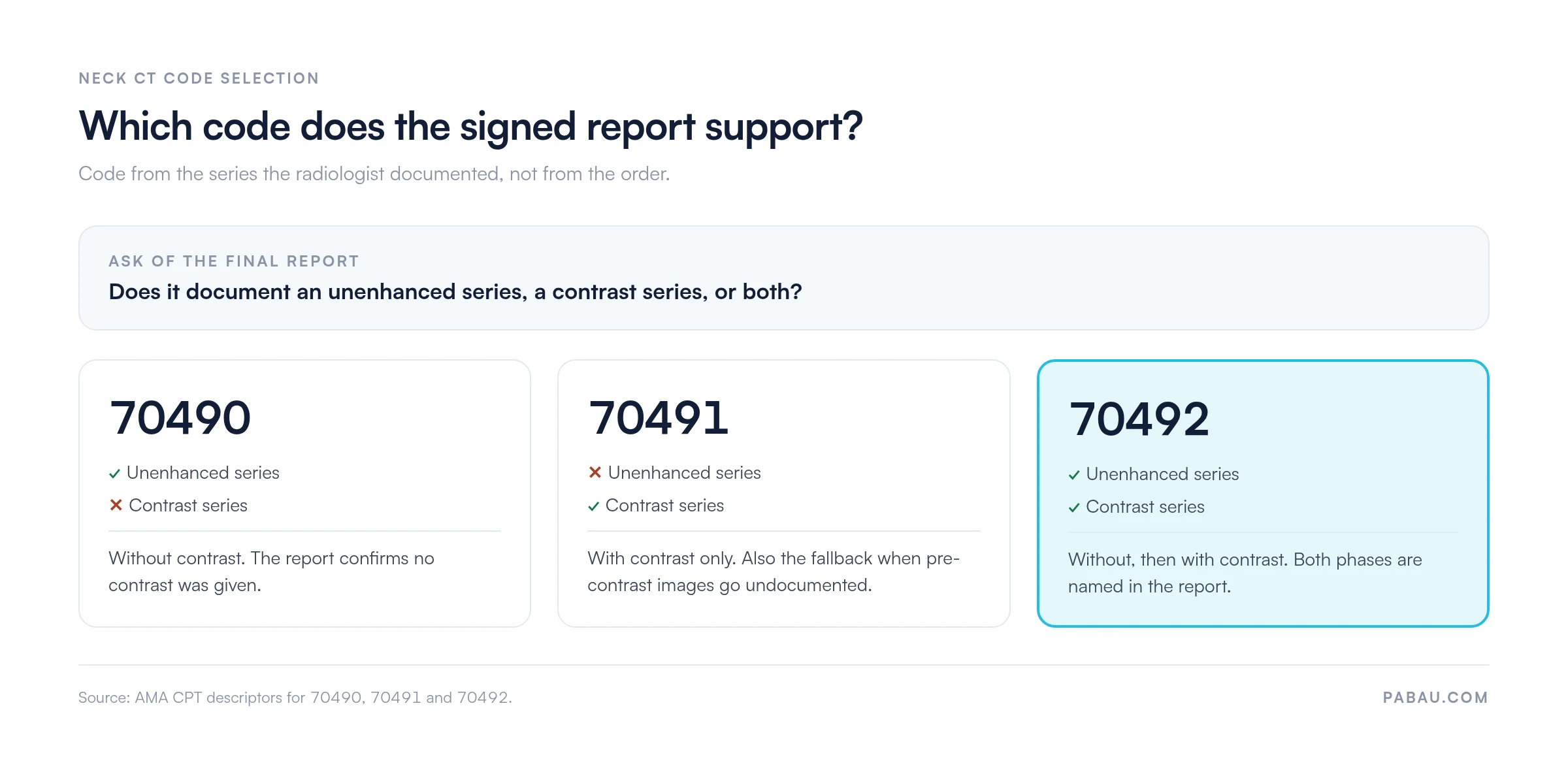
Here’s a typical mix-up. The technologist runs a pre-contrast series and then a contrast series. The dictated report, however, mentions only the contrast images. That report supports 70491, not 70492. To hold up in an audit, the report must state that unenhanced images came before the injection.
One more boundary is worth knowing. A CT angiogram of the neck vessels is a separate service, reported with CPT 70498 rather than any soft tissue code.
Knowing the steps tells you what the report has to show. A typical CPT code 70492 study runs in this order:
From there, the claim follows a set path. The coder reads the signed report and assigns the code. Next, the charge picks up its modifier, passes clearinghouse edits, and reaches the payer.
The signed report is what triggers billing. If it doesn’t document both phases, code 70491, whatever the scanner did.
A clean claim submission for CPT code 70492 starts with the radiology report. It needs every element below. A missing one can trigger a medical necessity denial or a post-payment recovery.
A two-minute check before release saves weeks of rework. Each line below maps to a denial covered later in this guide.
Medical necessity for a contrast-enhanced neck CT rests on the diagnosis. The ICD-10-CM codes below commonly pair with CPT code 70492. Codes with higher denial risk (see the Denial risk column) need extra documentation, because payers review them closely.
Watch the carotid row. I65.2 is a non-billable parent, so pick the side-specific code: I65.21 (right), I65.22 (left), or I65.23 (bilateral). Unspecified dysphagia, R13.10, often draws a records request, so code a more specific R13.1- phase when the notes support it.
Payer policies vary. A crosswalk tool such as CrossCoder helps you confirm which ICD-10 codes a payer accepts for CPT 70492 under its local coverage determination (LCD).
Modifier choice for CPT code 70492 depends on who bills what. The facility and the radiologist either bill separately (split billing) or together (global billing). A wrong modifier is a common denial reason.
Global billing, with no modifier, applies when one group bills both components. Never put 26 and TC on the same claim line, because that reads as duplicate billing.
CMS sets the national rate for CPT code 70492 in the Medicare Physician Fee Schedule (MPFS). For 2026, the non-facility total is 6.58 RVUs. At the $33.4009 conversion factor, that’s about $220 for the global service.
Your locality moves that figure up or down, and so does the setting. Check the CMS Physician Fee Schedule lookup tool before you rely on it, since rates update each January.
Hospital outpatient departments bill under the Outpatient Prospective Payment System (OPPS). It pays by ambulatory payment classification (APC), not by MPFS rate, so the facility amount for 70492 differs. Commercial rates depend on your contract, so estimate them from the payer’s fee schedule rather than Medicare’s.
Once the payer pays, the electronic remittance advice shows the allowed amount. Compare it with your fee schedule to catch underpayments early.
Compare your 70492 payments against the new fee schedules at the start of each year. CMS MPFS rates update each January. OPPS rates update annually in January, with quarterly updates in January, April, July, and October. A rate that was right in Q4 may underpay in Q1.
Prior authorization (PA) for CPT code 70492 varies by payer, plan type, and region. Traditional fee-for-service Medicare does not currently require PA for neck CT, but many Medicare Advantage plans do.
Commercial payers often route radiology PA through radiology benefit managers (RBMs). eviCore healthcare is one of the most widely used, managing PA for many commercial and Medicare Advantage plans. Check each plan’s rules before the scan, not after.
When PA is required, expect to submit:
Practices that run insurance eligibility verification before each appointment spot PA rules early. A scan done without a required PA is usually denied. That denial is hard to overturn, because the clinical decision was made without payer approval.
CMS publishes the National Correct Coding Initiative (NCCI) edits. They list code pairs that can’t be billed together for one patient on the same date of service (DOS). For CPT code 70492, three rules matter most:
NCCI edits update quarterly, so a pair you could bill last quarter may bundle in the next. Pabau, the practice management platform we build, validates required claim fields before submission. For edit checks, use the CMS NCCI tables or AAPC Codify, which list current edits by code pair.
Denials on CPT code 70492 follow a predictable pattern. Each one has a clear fix and, when the record supports it, an appeal path. Good denial management workflows catch most of them before the claim goes out.
Map every 70492 denial to its CARC/RARC code on the ERA before you appeal. CARC 50 means non-covered because the service is not deemed a medical necessity. That needs a different response than CARC 197 (prior authorization required). Misreading the root cause wastes appeal cycles.
On many imaging teams, billers key each 70492 charge by hand from the report. Missing fields then surface as rejections, and each round of rework pushes payment back.
Pabau’s claims management software pre-fills the claim from the patient record, so the CPT and diagnosis codes already sit on the charge line. It checks that required fields, such as authorization numbers, are complete before the claim can be sent. US practices then submit through Claim.MD and post ERAs in the same platform.
The result is fewer rejections for missing data and less time matching payments to claims. Coding judgment, like 70491 versus 70492, stays with your coder and the signed report.

Pabau pre-fills claims from the patient record, validates required fields, submits via Claim.MD, and reconciles ERA in one platform. See how radiology and imaging practices reduce denials and speed up reimbursement.

Treat the signed report as the deciding document for 70492. If it names an unenhanced series and a contrast series, bill 70492. If it doesn’t, bill 70491 or ask for an addendum before the claim leaves.
Most 70492 denials trace back to a short list: missing PA, a weak diagnosis, a bundled pair, or the wrong modifier. Fix those at the front desk and in the coding queue, and appeals become the exception.
Pabau pre-fills claims from the record, validates required claim fields, and connects to Claim.MD for electronic submission and ERA retrieval. Book a demo to see how it moves imaging claims from charge to payment with fewer rejections.

Need to understand how clearinghouses process CT claims? Pabau’s Claim.MD clearinghouse guide explains how electronic claim submission works end-to-end for US practices.
Getting denials with no clear reason code? Medical billing compliance best practices covers documentation standards that prevent common audit and denial triggers.
Want to compare clearinghouse options for your imaging practice? Claim.MD vs Office Ally breaks down clearinghouse features relevant to radiology billing workflows.
Was the order a CT angiogram of the neck instead? CPT 70498 covers CTA neck billing, documentation, and reimbursement.
Billing a face or sinus CT? CPT 70486 explains the maxillofacial CT code without contrast.
About $220 nationally for the global service in a non-facility setting. That figure comes from 6.58 total RVUs at the 2026 conversion factor of $33.4009. Your local rate will differ, so check the CMS Physician Fee Schedule lookup tool.
It depends on the setting. In an office or imaging center, low-osmolar contrast is billed per milliliter with HCPCS codes Q9965 to Q9967, chosen by iodine concentration. Under hospital OPPS, contrast is packaged into the scan payment.
No. CMS paused the Appropriate Use Criteria program and rescinded its regulations effective January 1, 2024. Medicare claims no longer need the MA to MH or QQ modifiers, or the G1000 to G1024 codes.
Use the maxillofacial CT family. CPT 70486 is without contrast, 70487 is with contrast, and 70488 is without and with contrast. 70492 covers the soft tissue neck only.
It means the scanner acquires additional images after the contrast injection. Those post-contrast sections, added to the unenhanced series, are what make the study a two-phase exam.