



CCSD code G5100: Bypass of duodenum billing guide
CCSD code G5100 bills a bypass that leaves the duodenum in place CCSD code G5100...

Last Updated: Oct 16, 2026

CPT code 71275 reports computed tomographic angiography of the chest for noncoronary vasculature, and contrast administration is mandatory.
The descriptor bundles noncontrast images and image postprocessing, so neither is billed separately when both happen in the same session.
Medicare’s 2026 national rate is about $280.57 for the global service, splitting into $83.50 professional and $197.06 technical.
CMS paused the appropriate use criteria program on January 1, 2024, so claims no longer carry a decision-support consultation code.
Modifier 26 and modifier TC split the claim when the radiologist and the facility bill separately. Omitting one is the most common denial trigger.
CPT code 71275 reports computed tomographic angiography of the chest, covering the noncoronary thoracic vasculature. Contrast material is required. The code also covers any noncontrast images acquired in the same session, plus all image postprocessing.
Official AMA descriptor: Computed tomographic angiography, chest (noncoronary), with contrast material(s), including noncontrast images, if performed, and image postprocessing.
The code sits in the diagnostic radiology section of the AMA CPT code set, under chest radiological procedures 71045 to 71555. One code captures the whole encounter. That includes the contrast-enhanced acquisition, any noncontrast phase from the same session, and every postprocessing step down to 3D reconstruction.
Payers cover CPT 71275 when the record shows medical necessity for imaging the thoracic vasculature outside the coronary arteries. The scenarios below are the ones payer policies name most often, and they track American College of Radiology appropriateness criteria.
Each indication has to map to a supported ICD-10-CM diagnosis code on the claim. Mismatched diagnosis codes are the second most common denial trigger for this code, after modifier errors.
Medicare pays CPT 71275 under the physician fee schedule, and the global rate divides into a professional and a technical component. Geographic practice cost indices adjust both. Rates change every January 1, so confirm the current figure in the CMS Physician Fee Schedule lookup tool.
These figures come from the January 2026 CMS relative value file at the national conversion factor of $33.4009, before geographic adjustment. Your Medicare Administrative Contractor pays the locality rate, which will differ. The split below is worth reading before you set modifier policy for a radiologist group.
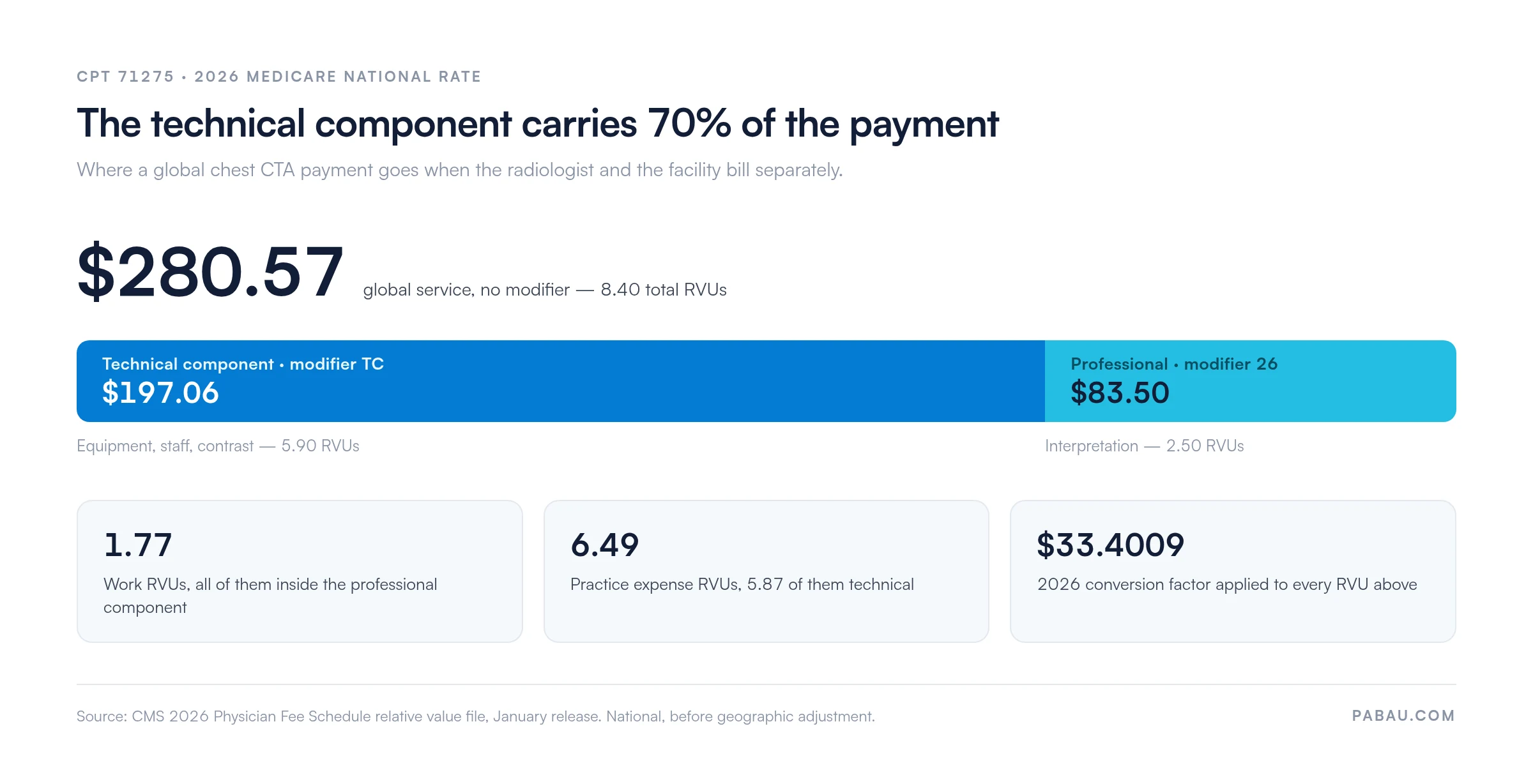
Modifier selection is where most billing errors start. The correct modifier depends on who submits the claim and where the scan was performed.
Here is the scenario that generates the most tickets. A hospital radiology group submits 71275 with no modifier, and the hospital submits the same code with modifier TC. The payer sees what looks like a double-billed global service and denies both claims. The fix is easy to describe and hard to enforce: every radiologist in the group applies modifier 26 on every hospital-based scan.
Track modifier error patterns by payer. A denial flagged as ‘incorrect modifier’ from one commercial payer often signals a group-level billing configuration problem rather than a one-off slip. Run a monthly modifier exception report across all 71275 claims before the next batch goes out.
Every CPT 71275 claim needs at least one ICD-10-CM diagnosis code that establishes medical necessity. The codes below appear most often in payer coverage articles for chest CTA. Our ICD-10-CM code reference covers the wider code set.
The two embolism codes are the pair coders most often reverse. I26 divides on whether acute cor pulmonale is documented, so read the impression before you choose the fourth and fifth characters. Submitting a diagnosis outside the payer’s covered list is the fastest route to a medical necessity denial.
The radiology report is the billing record. If a component is not documented there, it did not happen as far as the payer is concerned. Each element below has to appear explicitly in the report.
Keep the radiology report, the ordering physician’s indication note, and the contrast administration record together in the patient chart for that encounter. An auditor asks for all three at once, and pulling them from three systems is how a routine request turns into a week of work.
Prior authorization for CPT 71275 depends on the payer and on how urgent the study is. One rule changed recently enough that plenty of coding guides still get it wrong.
Most CPT 71275 denials trace back to one of four preventable errors. Each one is fixed upstream, in the documentation habit rather than in the appeal.
A pre-submission check on four items catches most of these before the claim leaves the building. Confirm contrast in the report and match the modifier to the billing context. Check the ICD-10 code against the payer’s covered list, and confirm the report describes postprocessing. Claims that clear all four deny far less often.
The distinction that matters most is between 71275 and 75574. Both describe computed tomographic angiography of structures near the heart, but they cover anatomically distinct vasculature and are never interchangeable. Confusing them is an audit risk rather than a coding inconvenience.
Each code in the table is a CT study. If a patient cannot receive iodinated contrast, 71250 gives a standard chest CT with no angiography, so the vascular question stays open. Chest MR angiography, reported with 71555, answers it without iodinated contrast or ionizing radiation.
Manual coding workflows produce the exact failures that generate 71275 denials. Modifier use drifts across a radiologist group. ICD-10 pairings fall out of step with covered diagnosis lists. Postprocessing documentation goes unchecked until a denial arrives.
Practice management software like Pabau handles this at the workflow level instead. Pabau’s claims management software sends CMS-1500 and 837P claims to payers through Claim.MD, our US clearinghouse partner. Eligibility checks run before the patient arrives, and remittance advice routes back into the same record that holds the claim.
Radiology and imaging practices get the denial reason next to the original claim. A modifier problem then reads as a pattern instead of a stack of separate appeals. You see error rates by payer and fix the configuration once, rather than appealing the same mistake all year.

Pabau sends imaging claims to payers through the Claim.MD clearinghouse, checks eligibility before the visit, and routes remittance advice back beside the original claim. Denial reasons stop arriving as a surprise.

Nothing about 71275 is difficult to code. What makes it expensive is that four small documentation habits have to hold across a whole group, every day. One radiologist dictating out of old habit breaks any of them.
The payment split is the argument for treating modifier policy as a group decision rather than an individual one. Seventy percent of the money sits on the technical side, so a hospital absorbs the damage from a mistake the radiologist made. Fix it once at the configuration level and the denial pattern stops.
Also worth a diary note: recheck your rate every January, because the conversion factor moves and the 2026 figure will not hold. Book a demo to see how Pabau tracks 71275 denials back to the payer and the modifier that caused them.

Need a complete medical billing foundation? Understanding medical billing workflows covers the end-to-end revenue cycle from charge capture through collections.
Handling denials on radiology claims? Denial management in healthcare walks through root-cause analysis and systematic resubmission processes.
Want to verify payer eligibility before imaging? Insurance eligibility verification explains real-time eligibility checks and how to reduce authorization-related denials.
CPT code 71275 reports computed tomographic angiography of the chest for noncoronary thoracic vasculature. That covers the thoracic aorta, the pulmonary arteries, and the mediastinal vessels. Contrast administration is required, and the code also covers noncontrast images and image postprocessing from the same session.
The 2026 national rate is about $280.57 for the global service, built from 8.40 total RVUs and a conversion factor of $33.4009. The professional component under modifier 26 pays about $83.50. The technical component under modifier TC pays about $197.06. Geographic adjustment applies, so check your own locality in the CMS Physician Fee Schedule lookup tool.
Original Medicare does not require prior authorization for CPT 71275, and it no longer requires an appropriate use criteria consultation. CMS paused that program on January 1, 2024 and rescinded the rule at 42 CFR 414.94. Medicare Advantage and commercial plans set their own rules. EviCore reviews many commercial plans, with expedited handling for suspected PE or aortic dissection.
Four elements have to appear in the radiology report. Name the contrast agent, its volume, and the route. State whether a noncontrast phase was acquired in the same session. Describe any postprocessing, such as 3D reconstruction, MIP, or MPR. Give the clinical indication that matches the ICD-10 code on the claim. A missing element is a common audit finding and can lead to recoupment.



