CPT code 92521: Speech fluency evaluation billing guide
CPT code 92521: Definition and clinical scope CPT code 92521 is defined by the A...

Last Updated: Oct 5, 2026
CPT code 70549 covers magnetic resonance angiography (MRA) of the neck without contrast, followed by contrast material and further sequences. It is the two-phase code in the 70547 to 70549 family, which images the carotid and vertebral arteries.
The radiology report decides whether it pays. The report must describe the non-contrast pass and the post-contrast sequences separately, or payers treat the study as 70548. Here's how to get each piece right, from the report to the appeal.
Let Pabau's smart automation suggest the right codes, reduce claim denials, and keep your practice compliant—effortlessly.
Automate repetitive tasks and focus on what matters most—your patients.
Reduce coding errors and ensure compliance with the latest regulations.
Clean claims, fewer denials, and faster reimbursements.
Powerful insights and reporting to help your practice thrive.
HIPAA compliant SOC 2 certified GDPR-compliant Trusted by 4,000+ clinics worldwide

CPT code 70549 covers MRA of the neck run as a without-then-with contrast series, billed once as one study.
The most common billing error is choosing 70548 (contrast only) when the report documents both phases.
The radiology report must describe the pre-contrast and post-contrast sequences separately before Medicare pays 70549.
Medicare coverage is contractor-specific, so check Novitas LCD L34865 or Palmetto LCD L34424 for your region.
Modifier 59 never unbundles 70549 from 70547 or 70548 billed on the same date.
CPT code 70549 describes magnetic resonance angiography of the neck without contrast material, followed by contrast material and further sequences. The American Medical Association maintains the CPT code set and publishes this descriptor.
The key phrase is “without contrast followed by contrast.” The scanner runs a baseline pass with no contrast, the patient receives gadolinium, and the post-contrast sequences follow. Both phases belong to one study, billed once.
The code covers the neck vessels: the common, internal and external carotid arteries, the vertebral arteries, and nearby cervical vessels. It stops short of the intracranial circulation. When the radiologist also images the head, that study takes a separate code from the MRA head family, such as 70544. Check NCCI edits before you bill the pair.
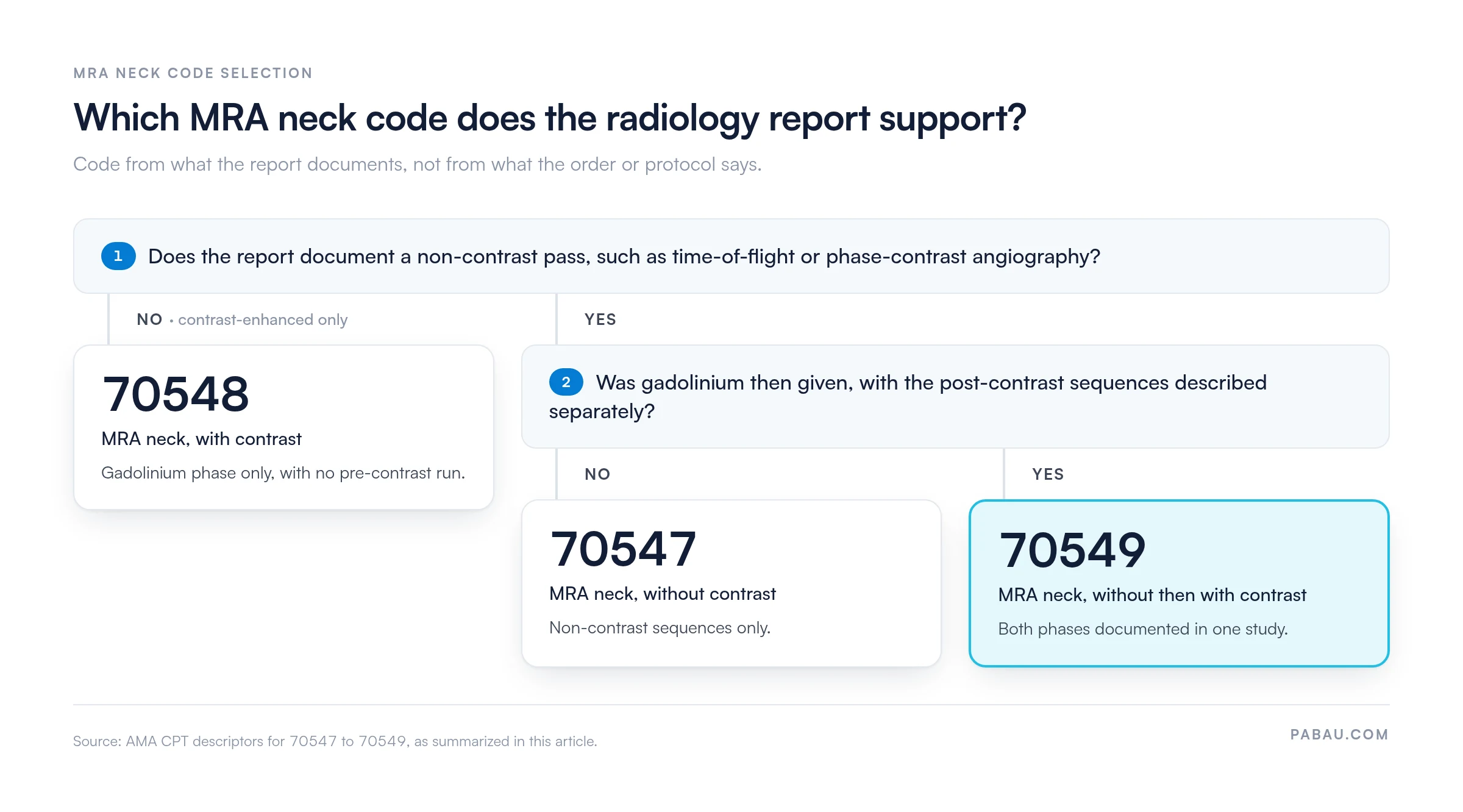
Three codes describe MRA of the neck: 70547, 70548 and 70549. Only the contrast protocol separates them. Picking the wrong one is the most common error on these claims.
The 70548 vs 70549 mix-up usually runs one way. The protocol ran both phases, but the coder or the order form defaults to 70548. The reverse happens too, and it costs more. Say the report describes only the post-contrast images. A payer reading that report will downcode a 70549 claim to 70548, or deny it outright.
Two questions about the report settle the code every time, as the diagram below shows.
Payment for CPT code 70549 rests on the radiology report confirming every phase of the study. Auditors look for these five points.
The simplest fix is upstream. Build these fields into the radiology order and the report template before the patient reaches the scanner.
Build a standard radiology report template for MRA neck studies that includes explicit checkboxes for pre-contrast acquisition, contrast agent details, and post-contrast sequences. A complete report at the point of dictation removes the most common documentation denial trigger before the claim is ever submitted.
Payers check the diagnosis paired with CPT code 70549 to confirm medical necessity. The ICD-10-CM codes below are the most commonly accepted pairings. You can look up any code’s full descriptor in our ICD-10-CM code library.
Medicare coverage guidance for MRA neck comes from Novitas LCD L34865 (billing article A56805) and Palmetto LCD L34424 (article A56775). Coverage is contractor-specific, so check the policy that applies to your region. Confirm the paired diagnosis appears on it before you submit.
Cervicalgia (M54.2) on its own is a high-risk pairing. Without clinical notes that document a vascular concern, it tends to trigger medical necessity review.
Medicare reimburses CPT code 70549 under the Medicare Physician Fee Schedule (MPFS). Rates vary by place of service and by the geographic practice cost index (GPCI). The CMS MPFS lookup tool gives current-year rates by locality.
These figures are national averages for reference only. Your 2026 payment depends on your locality’s GPCI. The FastRVU 2026 RVU lookup shows the work, practice expense and malpractice RVUs for 70549 by location.
Commercial payers usually pay above Medicare levels, either as a percentage of MPFS or at a negotiated rate. Your electronic remittance advice is the quickest way to compare what you received against what the contract promised.
Three modifiers come up most often with CPT code 70549. The right one depends on who is billing and where the study took place.
Leave LT and RT off. The neck vessels are imaged on both sides, and the code isn’t lateralized. Most payers reject a 70549 line that carries either modifier.
A freestanding imaging center that owns the scanner and employs the radiologist bills globally, with no modifier. One payment then covers both components. Split billing with 26 and TC applies only when the radiologist and the facility bill separately.
Traditional Medicare rarely asks for prior authorization on MRA neck. Medicare Advantage plans, commercial insurers and Medicaid managed care plans often do.
A missed authorization usually means a denial with no appeal path. The fix is to check at the point of ordering, not at billing. Insurance eligibility verification at scheduling catches the requirement while there’s still time to act.
A strong authorization packet for 70549 includes the ordering ICD-10 code, symptom history and duration, and any prior duplex ultrasound results. It also states the clinical question the MRA should answer.
The National Correct Coding Initiative (NCCI) decides which codes can be billed together on one date of service. For CPT code 70549, the usual same-day questions involve MRI brain codes and the other MRA neck codes.
Modifier 59 can’t break the 70549 + 70548 pair, because 70549 already includes the with-contrast phase. Billing both is unbundling. It triggers overpayment recovery and, if it keeps happening, a compliance problem.
The 70549 + 70553 pair needs a fresh look each time. Edit indicators change quarterly, so check the current NCCI table on the CMS site before you settle on a modifier strategy.
Denials on CPT code 70549 follow a predictable pattern. Once you know the common triggers, you can fix them at the source instead of working each denial by hand. Good denial management for imaging codes starts at the front desk, not with the appeal letter.
For a Medicare medical necessity appeal, quote the LCD and billing article numbers from the CMS Medicare Coverage Database. Attach the relevant sections of the policy. Appeal forms vary by payer, so read the claim adjustment reason code (CARC) on the remittance first to find the right pathway.
Flag every denial for CPT code 70549 by denial reason code, not just by dollar amount. After 90 days, sort by most common CARC code. If missing-prior-auth denials lead the list, the fix is a front-end scheduling workflow change. If wrong-code denials lead, the fix is a coder education session focused on the 70547-70549 protocol distinctions.
Run through these six checks before the claim leaves the building. Each one maps to a denial reason above.
Without a connected system, a billing team re-keys codes from the report, checks coverage by phone, and posts remittances by hand. Each handoff is a chance to drop a field or miss an approval.
Pabau, the practice management platform we build, includes claims management software for this work. It pre-fills the CPT and ICD-10 codes from the patient record. Then it checks that required claim fields are complete before sending. In the US, it submits claims to payers through Claim.MD and runs real-time eligibility checks through Claim.MD.
Built-in CPT and ICD-10 lookup libraries and required-field checks support clean claim submission on 837P electronic claims. When a 70549 claim comes back, the ERA posts back to the billing record. Corrected and secondary claims run through the same workflow.
Coding judgment still sits with your coder. Pabau doesn’t choose modifiers or evaluate NCCI pairs, so the checklist above stays part of the job.

Pabau pre-fills CPT and ICD-10 codes from the patient record and checks required claim fields before sending. US claims go through Claim.MD with real-time eligibility checks.

CPT code 70549 pays when the report proves both phases. Coders can’t fix that at billing, so the work belongs with the radiologist and the report template. If your denials cluster on 70548 downcodes, start there.
The trade-off is a few extra lines at dictation against weeks of appeals later. After that, automating eligibility checks, claim-field validation and ERA reconciliation frees your team for the coding calls that need a person. Book a demo to see how Pabau handles claims for imaging codes like 70549.

Need to understand how clearinghouse claims validation works? Claim.MD clearinghouse guide explains how Pabau’s US clearinghouse partner routes electronic claims to payers.
Dealing with claim denials across your radiology billing workflow? Denial codes in medical billing explains common CARC denial codes, what each means, and how to respond at the claim level.
Want to see how the 837 electronic claim format affects your submissions? 837 file guide walks through the 837P claim file structure and how it maps to professional billing for outpatient imaging.
Losing imaging claims to missing approvals? Prior authorization process walks through each step, from the request to the payer’s decision.
Imaging the head as well as the neck? CPT code 70546 covers the matching without-then-with contrast MRA of the head.
No, 70549 covers the imaging, not the drug. In an office or freestanding center, the agent is usually billed separately with a HCPCS Level II code, such as A9575 for gadoterate meglumine. In the hospital outpatient setting, Medicare packages contrast into the procedure payment.
No. CPT instructs coders not to report 76376 or 76377 with the MRA codes, including 70544 to 70549. The 3D reconstruction is part of the angiography itself.
Code what the report documents. If the injection fails or the patient stops after the non-contrast pass, the study supports 70547, not 70549. The radiologist should note why the contrast phase didn’t happen.
No. A carotid duplex scan is ultrasound, not MRA, and has its own code: 93880 for a complete bilateral extracranial study. Many payers expect a duplex result before they approve MRA neck, so keep it in the record.
Yes, when the diagnosis and documentation meet the local coverage policy. Coverage is contractor-specific: Novitas LCD L34865 (billing article A56805) and Palmetto LCD L34424 (article A56775). The report must also confirm both contrast phases.