CPT code 27488: Removal of total knee prosthesis
CPT code 27488: official description and procedure overview CPT code 27488 is de...

Last Updated: Oct 15, 2026
70490 is the CPT code for computed tomography, soft tissue neck; without contrast material.
Contrast level is a frequent source of neck CT denials; payers compare the billed code with the radiology report.
Let Pabau's smart automation suggest the right codes, reduce claim denials, and keep your practice compliant—effortlessly.
Automate repetitive tasks and focus on what matters most—your patients.
Reduce coding errors and ensure compliance with the latest regulations.
Clean claims, fewer denials, and faster reimbursements.
Powerful insights and reporting to help your practice thrive.
HIPAA compliant SOC 2 certified GDPR-compliant Trusted by 4,000+ clinics worldwide

CPT Code 70490 is only for CT of the soft tissue neck without contrast. If the radiology report shows contrast was given, expect the claim to be denied.
The 70490/70491/70492 triad maps to without, with, and with-and-without contrast. Never bill 70490 and 70491 together for the same neck study on the same date.
Modifier 26 (professional component) and modifier TC (technical component) split global billing when the facility and radiologist bill separately.
Pabau, the practice management platform we build, validates claims before submission and tracks their status through its Claim.MD clearinghouse integration.
CPT Code 70490 covers CT imaging of the cervical soft tissues from the base of the skull to the thoracic inlet. It carries the official AMA CPT descriptor: “Computed tomography, soft tissue neck; without contrast material.” The radiologist gives no intravenous contrast at any point during the study.
Without-contrast imaging suits evaluation of calcified structures, dense foreign bodies, and suspected thyroid or salivary gland calcification. It also provides a baseline before a contrast study. Radiologists also order 70490 when a patient has a documented contrast allergy or renal impairment that precludes contrast administration.
The code family covers only the soft tissue of the neck, not the osseous cervical spine. Cervical spine CT, however, falls under a separate code range. Correct anatomical identification in the ordering physician’s note is the first documentation requirement payers review on audit.
The three neck CT codes map directly to contrast level. In practice, billing the wrong one is a frequent cause of neck CT denials. National Correct Coding Initiative (NCCI) edits also prevent billing 70490 and 70491 together. This applies to the same anatomical region on the same date of service.
If the radiologist acquires both a non-contrast and a post-contrast series in one session, the correct code is 70492. Billing both 70490 and 70491 on the same date triggers an NCCI column 1/column 2 edit. The edit denies the lesser-valued code outright.
Modifier selection for CPT 70490 depends on the billing setting. Four scenarios arise in practice:
Independent imaging centers billing in a non-facility setting typically bill the global code without a modifier. Verify the payer’s specific modifier policy before submission. Some Medicaid managed care plans require modifier 26 even when the practice owns the equipment.
Medicare reimburses CPT 70490 under the CMS Physician Fee Schedule. Rates vary by geographic locality through the Geographic Practice Cost Index (GPCI). The figures below are 2026 CMS national amounts at the non-QPP conversion factor of $33.4009, before GPCI adjustment. Always confirm the rate for your Medicare Administrative Contractor (MAC) jurisdiction in the CMS look-up tool. The GPCI moves each local rate above or below the national figure.
When the radiologist and the facility bill separately, the global payment splits into a professional share and a technical share.
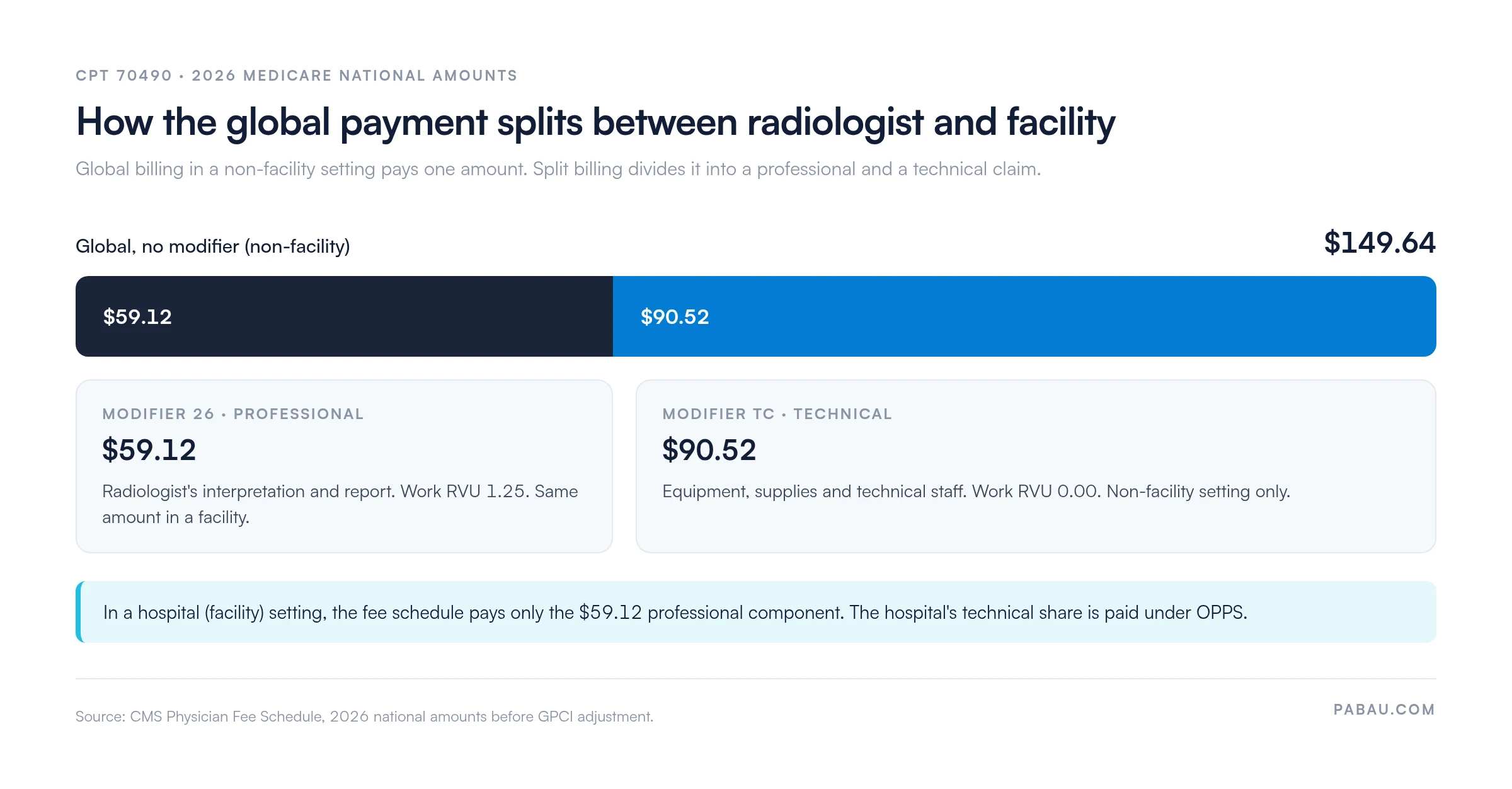
The table adds the work RVU behind each amount and shows what changes in a facility setting.
RVU data changes each January 1, and Congress can adjust it mid-year. Use the FastRVU look-up tool to confirm current work, practice expense, and malpractice RVUs for your locality. Do this before contract negotiations or fee schedule analysis.
Pull your MAC’s locality-specific GPCI from the CMS Physician Fee Schedule search tool before quoting reimbursement to ordering physicians. High-cost localities such as Manhattan are paid above the national amount, while many rural localities are paid below it. Quoting the national figure as if it applied everywhere creates scheduling friction when reimbursement falls short.
Prior authorization for CPT Code 70490 varies by payer. Medicare’s Appropriate Use Criteria (AUC) program for advanced diagnostic imaging is currently not in effect. CMS paused the program and rescinded its regulations in the CY 2024 Physician Fee Schedule final rule.
Commercial payers apply their own prior authorization rules, which change more frequently than Medicare policy. Patterns across major payers include:
Documentation that consistently supports approval starts with the ordering physician’s clinical note stating the specific indication. Add prior relevant studies and relevant labs, such as creatinine if the team considered and rejected contrast. Include the radiologist’s preliminary assessment of the imaging plan too.
The diagnosis code must support the clinical rationale for imaging the soft tissue neck specifically without contrast. Payers cross-check the diagnosis against the CPT code when they adjudicate medical necessity. Confirm the most specific code the documentation supports in the ICD-10-CM code set.
When the clinical indication calls for both pre- and post-contrast imaging, document the rationale for 70492 in the ordering note. Do not submit 70490 and assume the payer will accept it as a standalone study.
Radiology billers see a predictable set of denial patterns for CPT 70490. Each one maps to a claim adjustment reason code (CARC). As a result, the code on the remittance tells you which fix to make.
After a medical necessity denial, resubmit with an appeal (or reconsideration request) and attach an Explanation of Medical Necessity (EOMN) letter. The letter cites the specific clinical findings that support the imaging order. Track electronic remittance advice (ERA) through your clearinghouse, so CARC codes surface as soon as the ERA posts. Waiting for the paper explanation of benefits (EOB) costs days.
NCCI edits define which code pairs a provider cannot bill together for the same patient on the same date of service. Only an appropriate modifier overrides the edit.
NCCI treats the 70490-70491 pair as a column 1/column 2 relationship. The two codes are contrast-level variations of the same procedure on the same anatomical site. In fact, billing both is an unbundling attempt. The correct code depends on which series the radiologist acquired, and when:
CMS updates NCCI edits quarterly. Review the CMS NCCI Policy Manual at the start of each quarter. This confirms that the edits applicable to your CPT pairs have not changed. Our denial management guide walks through a full workflow for handling NCCI-triggered rejections.
Coders working in radiology billing need to navigate the full head and neck CT block. The table below maps the codes around CPT Code 70490. Use it to select the correct code when the study involves adjacent anatomy or a different modality.
When a patient presents with a neck mass extending toward the mediastinum, the ordering physician may request both a neck CT and a chest CT. Bill 70490 (or 70491/70492) for the neck study and 71250/71260/71270 for the chest study, with modifier 59 on the second code. The documentation must show two distinct imaging targets and clinical indications.
A structured pre-submission checklist catches most avoidable CPT Code 70490 denials before the claim reaches the clearinghouse. Run these five checks, in order, on every neck CT claim.
Electronic remittance advice through a medical claims clearinghouse posts CARC and remittance advice remark codes (RARC) automatically. Your team can then triage and resubmit without matching paper EOBs to claim lines by hand.
Without a claims system, billers check contrast level, modifiers, and authorization numbers by hand. Then they chase claim status on payer portals. A missed field only shows up weeks later as a CARC on the remittance.
Pabau pulls the patient, insurer, and treatment details from the patient record into a pre-filled claim. Validation checks run in the background for required details such as membership numbers and authorization codes. Claims go out through the Claim.MD clearinghouse integration, which also runs real-time eligibility checks.
Every claim then sits in one view by status, from pending to paid or error. Electronic remittance advice posts against the right invoice. As a result, a CARC 4 on a 70490 claim surfaces as soon as it arrives. Your team corrects and resubmits while the radiology report is still fresh.

Pabau validates radiology claims before submission and posts ERA remittances through the Claim.MD clearinghouse. Your team sees denial codes early and resubmits faster.

Treat the radiology report as the deciding document for every 70490 claim. If it doesn’t state plainly that the scan used no contrast, query the radiologist before you bill, not after the denial.
A few minutes of checking per claim costs far less than an appeal with an EOMN letter. Split-billing practices gain the most. A missing modifier 26 can get the radiologist’s claim denied or bundled with the facility’s.
Book a demo to see how Pabau validates and tracks radiology claims, so fewer 70490 denials reach your desk.

Want more claims accepted on first submission? Clean claim requirements in medical billing explains what makes a claim pass on first submission and how to build a pre-submission checklist.
Trying to reduce your practice’s denial rate overall? Denial codes in medical billing maps the most common CARC and RARC codes to their root causes and resubmission paths.
Acquired both a non-contrast and a contrast series? CPT Code 70492 covers neck CT with and without contrast, the code to bill instead of 70490 plus 70491.
Imaging the neck vessels rather than the soft tissue? CPT Code 70496 covers CT angiography of the neck.
Building a broader radiology billing workflow? What is medical billing covers the revenue cycle from order to payment posting.
CPT Code 70490 is the billing code for computed tomography of the soft tissue neck performed without contrast material. It covers the cervical soft tissues from the base of the skull to the thoracic inlet. It is one of three neck CT codes, with 70491 (with contrast) and 70492 (with and without contrast) completing the series.
The only clinical distinction is contrast level. 70490 means no IV contrast was given, and 70491 means IV contrast was administered. 70492 means both a non-contrast and a post-contrast series were acquired in the same session. Never bill 70490 and 70491 together for the same patient on the same date. Bill 70492 instead.
Yes, in most commercial payer contracts. Authorization requirements vary by payer, so verify with the specific plan before scheduling the study. Authorization obtained after the service date leads to a CARC 15 denial.
The 2026 CMS national amount for CPT 70490 is $149.64 for global billing in a non-facility setting. In a facility setting, the fee schedule pays only the professional component, at $59.12 with modifier 26. Rates vary by MAC locality through the GPCI adjustment. Use the CMS Physician Fee Schedule look-up tool to confirm your specific rate.
Modifier 26 (professional component) applies when the radiologist bills only for the interpretation. The TC modifier applies when the facility bills only for equipment and technical staff. Modifier 59 applies when 70490 is legitimately billed on the same date as another CT study of a different anatomical region. Global billing requires no modifier.
The most common reason is billing 70490 when contrast was administered (CARC 4/97). Other frequent causes are thin medical necessity documentation (CARC 50) and missing prior authorization (CARC 15). Claims also fail on a wrong or missing modifier in split billing. A same-date head CT billed without modifier 59 triggers an NCCI bundling edit.
Commonly paired ICD-10-CM codes include R22.1 (localized swelling, mass and lump, neck), R59.0 (localized enlarged lymph nodes), and E04.1 (nontoxic single thyroid nodule). Z91.041 (radiographic dye allergy status) supports the without-contrast approach. The diagnosis must directly explain why soft tissue neck CT was ordered and why without contrast was clinically appropriate.