



CCSD code G5100: Bypass of duodenum billing guide
CCSD code G5100 bills a bypass that leaves the duodenum in place CCSD code G5100...

Last Updated: Oct 16, 2026

CPT code 70496 describes computed tomographic angiography (CTA) of the head with contrast, including noncontrast images if performed and image postprocessing.
The 2026 Medicare Physician Fee Schedule pays 70496 at different rates for facility and non-facility settings. Rates vary by MAC jurisdiction and need geographic adjustment.
CPT 2026 introduced code 70471 for a combined head and neck CTA. Report 70471 instead of pairing 70496 with 70498 when a single study covers both regions.
Modifiers 26 and TC split the professional and technical components. Billing 70496 with CPT 70450 on the same encounter is not supported, because 70496 already includes noncontrast images.
Pabau’s claims management software helps radiology practices track fee schedules, flag bundling errors, and submit clean CTA head claims through the Claim.MD clearinghouse integration.
CPT code 70496 is the billable code for computed tomographic angiography (CTA) of the head with contrast. The American Medical Association (AMA) descriptor reads: Computed tomographic angiography, head, with contrast material(s), including noncontrast images, if performed, and image postprocessing.
Several elements of that descriptor have direct billing consequences. “With contrast material(s)” means contrast administration is a required component, not optional. “Including noncontrast images, if performed” covers the pre-contrast series.
If the radiologist acquires noncontrast sequences before injecting, those images are bundled into 70496. They cannot be reported separately as CPT 70450. “Image postprocessing” means 3D reconstructions, maximum intensity projections, and other post-acquisition processing are included in the single code payment.
CPT 70496 falls under the Diagnostic Radiology (Diagnostic Imaging) subsection of the AMA CPT code set. Each element of the descriptor translates into a specific billing rule, which is why coders read it line by line.
Medical necessity is the foundation of every successful 70496 claim. Payers, including Medicare Administrative Contractors (MACs), publish Local Coverage Determinations (LCDs) that define which clinical scenarios justify ordering a CTA head. The most common indications include:
Each indication must be explicitly documented in the ordering physician’s clinical notes and reflected in the radiologist’s report. Vague language such as “headache” without a specific vascular clinical question is a common trigger for medical necessity denials.
CPT code 70496 is reimbursed under the Medicare Physician Fee Schedule (MPFS), administered by the Centers for Medicare and Medicaid Services (CMS). Reimbursement varies by place of service and by MAC jurisdiction. The table below shows the 2026 national average rates.
Verify your locality-specific payment with the CMS MPFS lookup tool before you rely on any of these figures. Geographic adjustment factors (GAFs) shift them by MAC region.
These figures are national averages based on the 2026 MPFS final rule. Confirm them against your own MAC jurisdiction. Checking the remittance advice on every 70496 claim catches underpayments caused by geographic adjustment errors or the wrong place-of-service code. Use the FastRVU 2026 RVU lookup to verify work, practice expense, and malpractice RVU values for your locality.
Modifier selection for CPT 70496 directly affects which entity gets paid and how much. Applying the wrong modifier, or omitting one when billing in a split-component scenario, is a leading cause of payment delays and automated denials.
Some freestanding imaging centers employ the radiologist and run the facility inside one group practice. In that arrangement, the global rate with no modifier is typically billed. A clearinghouse that validates modifier applicability before submission cuts the rate of avoidable modifier-related rejections.
Diagnosis code selection must support medical necessity for CTA head imaging. The ICD-10-CM codes below are among those most frequently submitted with CPT 70496 across radiology billing. Using the CrossCoder CPT-to-ICD-10 crosswalk tool helps confirm that your chosen diagnosis code is accepted by the payer for this specific CPT.
Verify the patient’s insurance eligibility before the study, especially on plans with coverage restrictions on diagnostic imaging. Some payers require a specific vascular diagnosis code rather than a symptom code before they approve CTA head reimbursement.
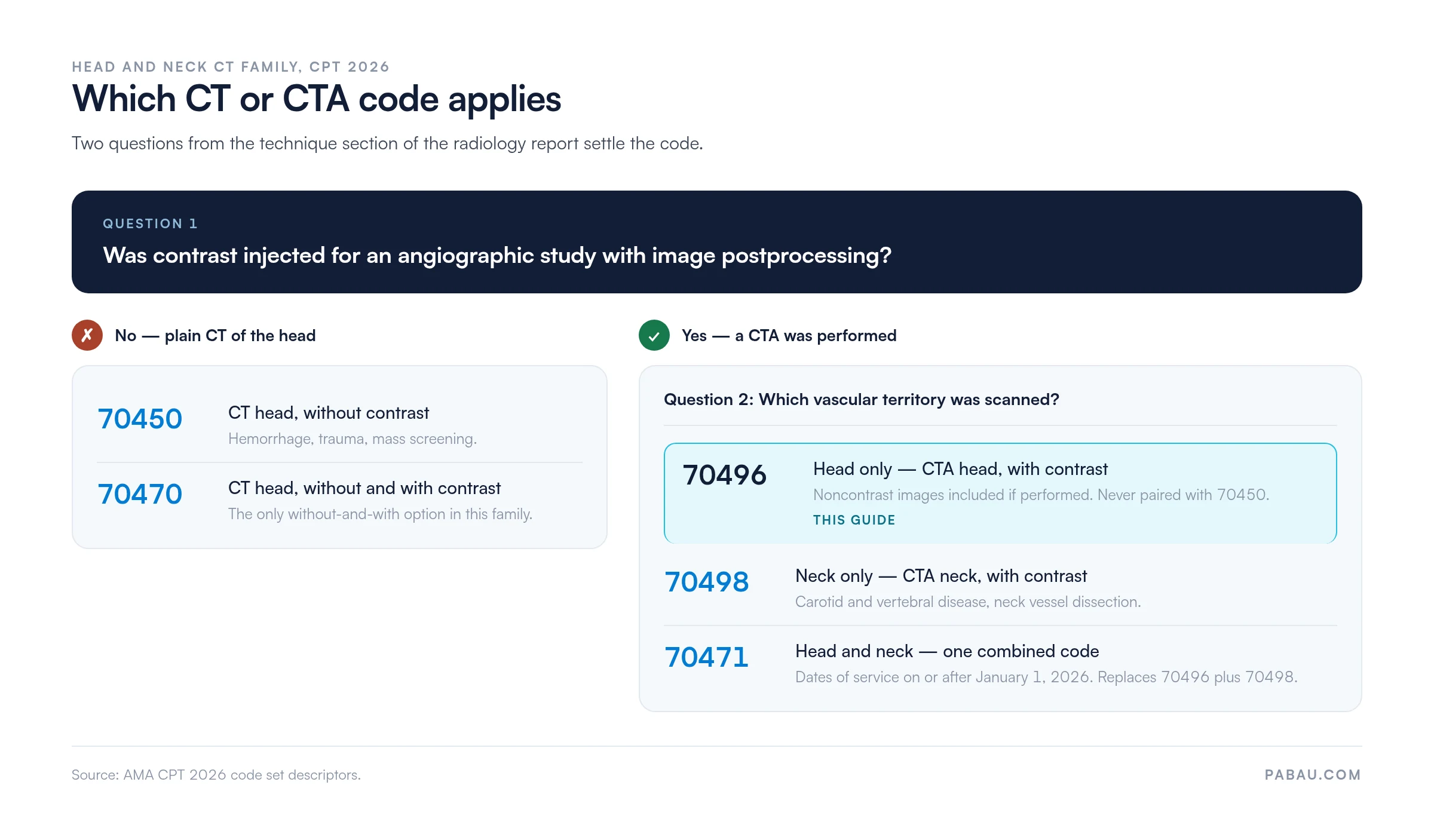
Miscoding between CT and CTA of the head is one of the most common errors in this code family. CPT 70450 is a plain CT of the head without contrast. CPT 70496 is a contrast-enhanced angiographic study of the intracranial vessels, and postprocessing is built into the code. The two protocols answer different clinical questions, so the report has to make clear which one was performed.
Two neighboring codes get pulled into the same decision, and both are frequently misread. CPT 70498 is CTA of the neck, not a second version of the head code, so it covers a different vascular territory. CPT 70471, new in the CPT 2026 code set, covers a combined head and neck CTA under one code.
Contrast alone does not make a head CT an angiographic study. A contrast-enhanced head CT without arterial-phase timing is 70460, not 70496.
There is no CPT code for a CTA of the head without and with contrast, so coders should stop looking for one. The without-and-with option belongs to plain CT of the head, which is CPT 70470. Read the technique section of the radiology report to confirm the anatomic territory and whether contrast was injected. Those two facts settle the code on their own, as the diagram below shows. The AAPC Codify CPT lookup carries the coding notes for each code in this family.
CPT 70498 describes CTA of the neck with contrast, including noncontrast images if performed and image postprocessing. Stroke protocol imaging routinely covers both territories, because the clinical question runs from the aortic arch through the intracranial vessels. Until 2026, that combined study was reported as 70496 plus 70498.
That has changed. For dates of service on or after January 1, 2026, a combined head and neck CTA is reported with a single code, CPT 70471. Its descriptor reads: Computed tomographic angiography, head and neck, with contrast material(s), including noncontrast images when performed, and image postprocessing. Report 70496 on its own only when the study is limited to the head. Use 70498 on its own only when it is limited to the neck.
The National Correct Coding Initiative (NCCI) has long carried edits across this code family, and payers apply them differently by MAC jurisdiction. Submitting 70496 and 70498 together for one combined acquisition now invites a bundling denial, because 70471 is the correct single code. Before you report either regional code on its own, work through the checks below.
Capture each code at the point of documentation rather than later in the billing cycle. A biller rebuilding the codes from memory is the one who submits the pair on a date of service where 70471 was correct.
Ask your radiologists for a report template that keeps head CTA and neck CTA technique, findings, and clinical indication in separate sections. That separation is what supports 70471 as a combined study. It is also what a payer looks for on the rarer occasions you bill 70496 and 70498 separately.
Payers that conduct claim audits for CPT code 70496 focus on four documentation elements. Missing any one of them is enough to trigger a denial or a request for additional information.
Compliance also means retaining the physician order, the imaging protocol, the raw DICOM data, and the final report. Together they form the complete claim package.
The Noridian JF Medicare Administrative Contractor publishes review findings for CPT 70496 drawn from the CMS Comprehensive Error Rate Testing (CERT) program. Those findings put documentation deficiencies behind a substantial share of claim errors in this code category.
Review the claim file before batch transmission, not after. A missing required field is far cheaper to fix in your own system than in an appeal.
A denied CTA head claim costs three people’s time before it pays. A coder investigates the reason, a clinical team member supplies the additional documentation, and a biller resubmits. The patterns below are the preventable 70496 denials, the ones you can design out of the workflow.
Categorizing each 70496 denial by root cause tells a billing manager whether the problem sits in documentation, code selection, or eligibility. That split is what decides where to spend the fix. Practice management software like Pabau tracks denial patterns by code and payer, so radiology teams work on the systemic cause instead of fighting individual claims. Our guide to denial reason codes covers the common CARC codes and their resubmission paths.

Radiology billing for CTA head codes carries more moving parts than most imaging categories:
Tracking that by hand, across spreadsheets and separate billing platforms, is what turns the documentation failures above into routine ones.
Pabau’s claims management software validates each claim against payer edits before it transmits, through our Claim.MD clearinghouse integration. The bundling errors and modifier omissions in the denial table above get flagged at that point. Your billing team finds them there rather than weeks later on a remittance advice.
Pabau also reports denial rates by CPT code as the denials land. A radiology practice can see a spike in 70496 rejections while the claims are still inside the appeal window, rather than at quarter end.
Claim-level validation cuts the hours coders spend on rework, and it raises the share of 70496 claims that pay on first submission. A practice running high volumes of CTA head studies feels that in revenue and in staff capacity.

Pabau’s claims management features help radiology practices keep fee schedules accurate and flag missing documentation before submission. Clean claims then go out through our Claim.MD clearinghouse integration.

Two facts from the technique section decide this code. The first is whether contrast went in for an angiographic study. The second is which territory the scan covered. A report template that states both takes the judgment out of the coding.
The 2026 change is the one worth putting in the calendar. A combined head and neck study now belongs on 70471. A habit of pairing 70496 with 70498 will start producing bundling denials instead of payments.
Pabau’s claims management features catch these errors before the claim transmits, through our Claim.MD clearinghouse integration. Book a demo to see how a radiology practice runs CTA head billing, documentation, and denial tracking in one system.

Need to understand how clearinghouse validation works? Medical claims clearinghouse guide explains how claim scrubbing catches coding errors before payer submission.
Confused about ERA interpretation after a 70496 denial? Electronic remittance advice explained covers how to read 835 transaction data and identify underpayment patterns.
Want a structured approach to radiology denial recovery? Denial management in healthcare outlines a systematic workflow for categorizing, appealing, and preventing claim denials by CPT code.
Coding a plain CT of the head instead? CPT code 70450 covers the noncontrast head CT that 70496 absorbs when both series are acquired.
Want fewer 70496 rejections at the clearinghouse? Clean claim submission sets out the fields and payer edits a claim has to satisfy first.
CPT code 70496 is computed tomographic angiography (CTA) of the head with contrast material. It includes any noncontrast images obtained in the same session, plus all image postprocessing such as 3D reconstructions. The code covers the complete CTA head protocol as a single billable service. Contrast administration, baseline noncontrast sequences, and postprocessing are all bundled into it and cannot be billed separately.
The 2026 Medicare national average non-facility (global) rate for CPT 70496 is approximately $260 to $310. The professional component alone, billed with Modifier 26 in a hospital setting, is typically $55 to $75. These figures vary by MAC jurisdiction due to geographic adjustment factors. Verify your specific locality rate using the CMS Physician Fee Schedule lookup tool.
CPT 70450 is a standard CT of the head without contrast, used primarily for hemorrhage, trauma, or basic mass screening. CPT 70496 is CTA of the head with contrast, a vascular-specific protocol designed to evaluate arteries for aneurysm, stenosis, AVM, or occlusion. CPT 70496 already includes noncontrast images if performed. Billing 70450 and 70496 together for the same encounter is not supported, and it will typically trigger an NCCI bundling denial.
Not for a combined study. From January 1, 2026, a CTA covering both the head and the neck is reported with the single code CPT 70471. Report 70496 alone when the study is limited to the head, and 70498 alone when it is limited to the neck. CPT 70498 is CTA of the neck, not a second head code, so it never doubles up on 70496 for the same territory.
The two most commonly applied modifiers are 26 and TC. Modifier 26 covers the professional component, when the radiologist bills interpretation only, and Modifier TC covers the technical component. Modifier 59 may apply when a payer still expects 70496 alongside 70498 for separate head and neck studies. Verify current NCCI edit status before applying it, and use 70471 when one study covers both regions. Modifiers LT, RT, and 50 are rarely applicable to CTA head and require payer-specific review before use.
Prior authorization requirements for CTA head vary by payer and health plan. There is no universal Medicare requirement for prior authorization on CPT 70496. Commercial payers and Medicare Advantage plans frequently require PA for advanced diagnostic imaging, including CTA head. Always check the specific plan’s requirements before scheduling the study. A missing PA is one of the most common and most avoidable denial causes for this code.
The most frequently paired ICD-10-CM codes are I63.9 (cerebral infarction, unspecified), G45.9 (transient cerebral ischemic attack), and I67.1 (cerebral aneurysm, nonruptured). Q28.2 (arteriovenous malformation of cerebral vessels) and I66.9 (occlusion and stenosis of unspecified cerebral artery) are also common. The chosen diagnosis code must reflect a specific vascular clinical indication supported by the referring physician’s documentation. A non-specific symptom code such as R51.9 (headache), used without additional clinical context, frequently triggers medical necessity review.
Payers require four core documentation elements. The first is a physician order specifying CTA head with the clinical indication. The second is a medical necessity statement that links the imaging to a specific vascular clinical question. The third is documentation of IV contrast administration, including agent and volume, in the technique section. The fourth is a notation of image postprocessing if performed. Missing the contrast administration notation is the single most common documentation defect that leads to 70496 claim denials.



