

HCPCS Code L0472: Hyperextension TLSO billing guide
HCPCS code L0472: Official descriptor and device definition HCPCS code L0472 des...

Last Updated: Nov 5, 2026
68815 is the CPT code for probing of nasolacrimal duct, with or without irrigation, with insertion of a tube or stent.
It sits in the lacrimal system procedures (68400-68899) of the AMA CPT code set. The tube or stent left in place is what separates it from 68810 and 68811, and irrigation plays no part in that choice. Balloon catheter dilation is reported with 68816. Denials often trace to a note that never records the stent, a missing side modifier, or a sibling probing code billed for the same duct.
Let Pabau's smart automation suggest the right codes, reduce claim denials, and keep your practice compliant—effortlessly.
Automate repetitive tasks and focus on what matters most—your patients.
Reduce coding errors and ensure compliance with the latest regulations.
Clean claims, fewer denials, and faster reimbursements.
Powerful insights and reporting to help your practice thrive.
HIPAA compliant SOC 2 certified GDPR-compliant Trusted by 4,000+ clinics worldwide

CPT code 68815 covers nasolacrimal duct probing with insertion of a tube or stent, and the stent placement is included in the code.
Irrigation does not separate 68815 from 68810 or 68811, because all three descriptors read “with or without irrigation.”
Report 68815 whenever a tube or stent is left in place, under local or general anesthesia, while balloon catheter dilation moves the claim to 68816.
The operative note must record the tube or stent type, the side treated and the anesthesia used, or the claim can’t support 68815.
Pabau, the practice software we build, submits lacrimal probing claims electronically with their modifiers and tracks each one to payment.
The American Medical Association (AMA) defines CPT code 68815 as: Probing of nasolacrimal duct, with or without irrigation; with insertion of tube or stent. The code applies when the surgeon probes the duct and leaves a tube or stent in place at the end of the procedure.
The nasolacrimal duct (NLD) is the channel that drains tears from the inner corner of the eye into the nasal cavity. Obstruction (NLDO) is common in infants, whose membranous valve at the duct’s lower end fails to open spontaneously. It can also occur in adults from infection, trauma or scarring.
Probing opens the obstruction with a fine metal probe, and a silicone tube or stent then holds the passage open while it heals.
The stent placement is part of 68815, so it isn’t billed under a separate code. Surgeons typically choose a stent after a failed first probing, or when they expect a higher risk of recurrence. The decision is often made during the procedure, so the operative note has to record both the probing and the device left in place.
The procedure is performed in an office, ambulatory surgical center (ASC) or hospital outpatient department. Adults and cooperative older children may tolerate office-based probing. Infants usually need general anesthesia in an ASC or hospital, which adds a separate anesthesia claim but doesn’t change the procedure code (covered below).
CPT 68815 bundles the probing, any irrigation and the insertion of the tube or stent into a single billable unit. Billing these components separately for the same duct on the same date is unbundling.
Included in 68815:
Not included:
The four nasolacrimal duct probing codes share one parent descriptor: Probing of nasolacrimal duct, with or without irrigation. Irrigation is optional in every one of them, so it never moves a claim from one code to another. The codes split on three other questions instead.
Ask the questions in order. A tube or stent left in place makes the claim 68815, whatever anesthesia was used. A child probed and intubated under general anesthesia is therefore 68815, not 68811. A balloon catheter dilation makes the claim 68816. The flow below runs the three questions in that order.
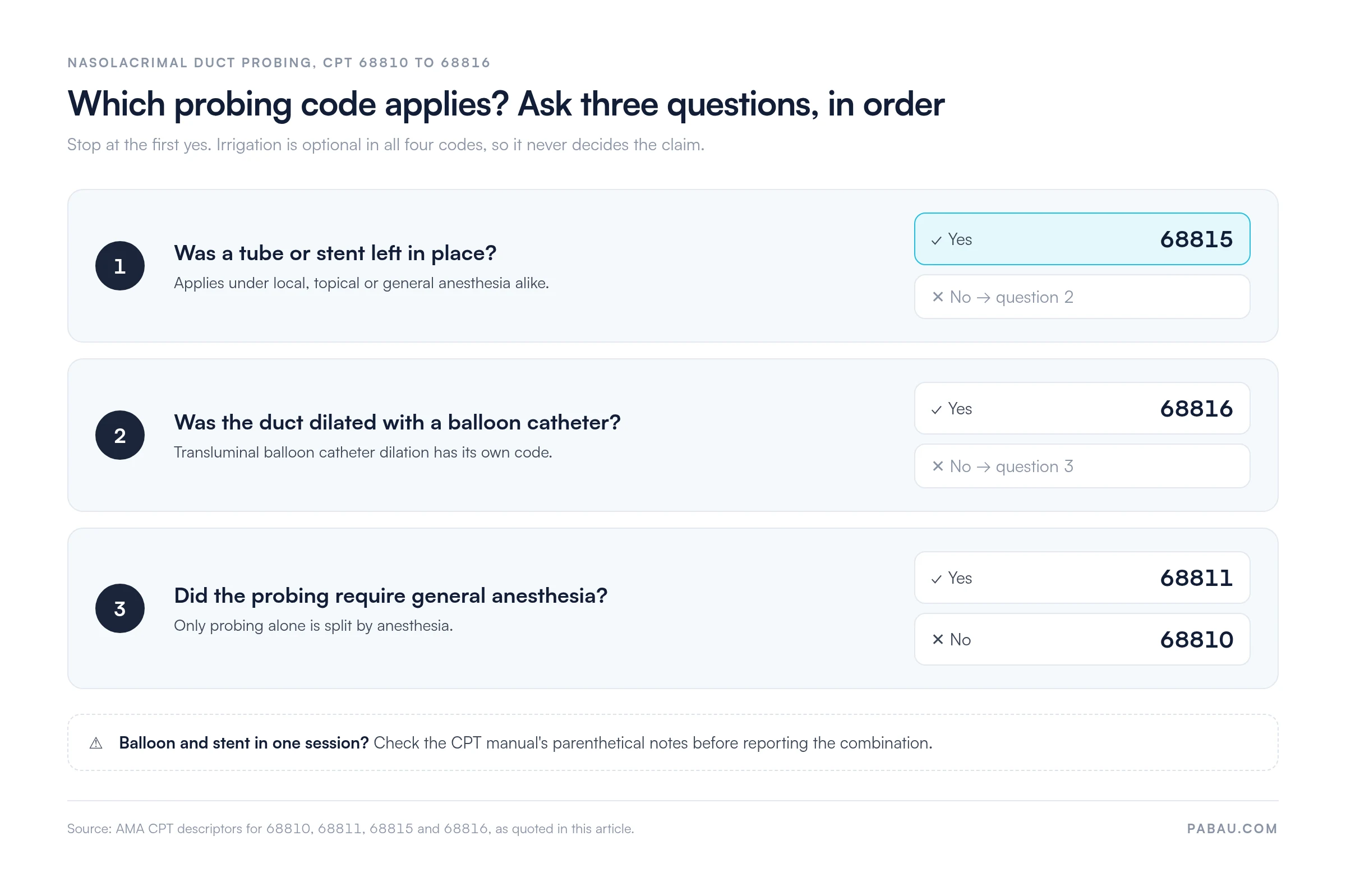
Only when neither a stent nor a balloon was used does anesthesia decide between 68810 and 68811. Check the CPT manual’s parenthetical notes before reporting a session that combined balloon dilation with a stent.
CPT 68815 already includes the probing and any irrigation. So 68810 or 68811 is never billed alongside it for the same duct on the same date. Billing both is an unbundling error, and billing 68810 when a stent was placed is a downcoding error.
Dacryocystorhinostomy (DCR) is a different case. It is reported with 68720. The current National Correct Coding Initiative (NCCI) procedure-to-procedure (PTP) edit for that pair decides whether a same-session 68815 is payable. Codes 68760 and 68761 are sometimes grouped with DCR, but they describe closure of the lacrimal punctum.
Check the quarterly PTP table before appending modifier 59 or XS to any same-day lacrimal pair. A pair with a modifier indicator of 0 can’t be unbundled with any modifier. An indicator of 1 allows a modifier only when the services were distinct and the record shows it.
Good medical billing compliance means running this edit check before submission rather than on appeal.
Document the date of service carefully when a patient has NLD probing with a stent and a DCR at a later visit. Procedures on different dates go on their own claim lines with their own dates of service. A DCR that follows a failed stent may also need a staged or related-procedure modifier, depending on timing and payer policy.
Accurate ICD-10 pairing establishes medical necessity and prevents laterality-based denials. The diagnosis code laterality must match the side documented in the operative note and on the claim form.
Verify all ICD-10-CM codes against the current year’s code set using the CDC/NCHS ICD-10-CM web tool before billing. Code descriptions and validity change with each October 1 update.
Modifier selection for CPT code 68815 depends on the side treated, whether both ducts were done, and whether the procedure was completed as planned. Incorrect modifier use is a common denial driver alongside missing stent documentation.
For bilateral billing, Medicare contractors generally expect one line with modifier 50. Some commercial payers want two lines instead, 68815-RT and 68815-LT. Confirm the payer’s bilateral billing policy before submitting.
Medicare reimbursement for CPT code 68815 varies by year, locality and place of service. Non-facility rates (office, POS 11) are typically higher than facility rates (ASC or hospital outpatient), because the practice carries the overhead in an office setting.
Use the CMS Physician Fee Schedule lookup tool to retrieve the current-year facility and non-facility amounts for your locality. FastRVU’s 2026 RVU lookup shows the work, practice expense and malpractice RVUs from the same CMS data. Rates change with each January update, so check them before quoting patients or forecasting revenue.
Commercial rates vary by contract and are often benchmarked to the Medicare fee schedule.
The tube or stent is the only element that separates 68815 from 68810 and 68811. A note that never records it leaves the code unsupported. The operative note must contain all of the following to support a clean claim and survive a payer audit.
Pair the operative note with a superbill workflow that carries the stent line through to the claim. That way no coder has to search the operative note to tell 68815 from 68810.
Prior authorization requirements for CPT code 68815 vary by payer class. Medicare does not typically require prior authorization for NLD probing but does require documented medical necessity in the record. Commercial and Medicaid pediatric plans commonly require pre-authorization before the procedure.
Clinical criteria that commonly satisfy medical necessity for pediatric NLD probing include:
For adult acquired NLDO, the medical necessity bar is generally lower. Symptom duration, failed conservative treatment, and the clinical finding of obstruction on irrigation testing are typically sufficient. Confirm prior authorization requirements with each individual payer before scheduling, as requirements vary by state and plan type.
Insurance eligibility verification at the time of scheduling helps identify plans that require pre-authorization and prevents unexpected denials.
Run an eligibility check 48-72 hours before the procedure date rather than at scheduling. Plans change between booking and service. A check close to the date of service flags a new prior-auth rule or a lapsed policy before the patient arrives.
Six denial patterns are common on 68815 claims. Each has a specific documentation or workflow fix. The denial codes on the payer’s remittance usually point to the pattern.
Structured denial management that sorts 68815 denials by root cause reduces rework. They also show which of these six patterns is most frequent for a practice’s payer mix.
When an infant or young child needs general anesthesia for NLD probing and a tube or stent is placed, the surgeon bills CPT 68815. CPT 68811 applies only when the child is probed under general anesthesia without a stent or balloon. General anesthesia doesn’t change 68815. It changes how anesthesia services are billed and what payers require for authorization.
Anesthesia billing (separate claim): The anesthesia provider bills independently using anesthesia CPT codes from the 00100-01999 range. For eye procedures, the relevant base unit code is typically 00140 (anesthesia for procedures on the eye). The anesthesia charge is base units plus time units, multiplied by the anesthesia conversion factor, and goes on a separate claim from the surgeon’s 68815.
Prior authorization for GA in pediatric lacrimal probing: Plans that require prior authorization for pediatric lacrimal probing often add criteria when general anesthesia is requested. Common requirements include:
Some payers apply age thresholds when assessing whether GA is medically necessary for NLD probing, but these thresholds vary by plan. Document the clinical rationale for general anesthesia in every pediatric case rather than relying on age alone. Confirm the age criteria a given payer applies directly with that payer before scheduling.
Claims for 68815 tend to fail on details fixed before submission: The side, the stent documentation and the authorization number. Without a connected system, staff re-key each claim into a payer portal and chase its status by phone.
Pabau’s claims management software submits claims electronically from the patient’s billing record and tracks each one after it leaves. Its Claim.MD integration adds eligibility checks and ERA remittances. Coverage is confirmed before the procedure, and payments reconcile against expected rates.
The result is fewer re-keyed claims and a clear view of which 68815 claims are paid, pending or denied.

Pabau helps eye care practices submit clean claims, apply modifiers correctly and track reimbursements automatically. See how it works for your practice.

Once the operative note names the tube or stent left in place, the choice between 68815 and its sibling codes is settled. Irrigation never enters that decision, and neither does the patient’s age.
The harder work sits upstream: Confirming the payer’s criteria and authorization before booking. Any same-day lacrimal code pair also needs checking against the current NCCI edits. Book a demo to see how Pabau submits and tracks lacrimal probing claims electronically, from eligibility check to payment.

Need to understand claim denial patterns across procedure codes? Denial management in healthcare covers root-cause analysis methods and appeal workflows for common payer denials.
Submitting claims electronically and tracking ERA responses? Electronic remittance advice (ERA) explains how 835 remittance files work and how to reconcile payments against expected allowables.
Looking for guidance on medical billing fundamentals? Revenue cycle management outlines the end-to-end process from eligibility verification through final payment posting.
CPT code 68815 covers probing of the nasolacrimal duct, with or without irrigation, with insertion of a tube or stent. The code includes the probe passage, any irrigation and the stent placement itself, so the stent is not billed separately. Balloon catheter dilation (68816), anesthesia services and dacryocystorhinostomy are reported under other codes.
Both codes describe probing of the nasolacrimal duct, with or without irrigation, so irrigation doesn’t separate them. CPT 68815 adds the insertion of a tube or stent left in place, while 68810 is probing alone without general anesthesia. If a stent was placed, bill 68815 only and never both codes for the same duct.
The neonatal obstruction codes paired with CPT 68815 are H04.531 (right), H04.532 (left) and H04.533 (bilateral). For acquired stenosis, use H04.551, H04.552 or H04.553 by side, and Q10.5 covers congenital stenosis of the lacrimal duct. Laterality must match the operative side documented in the note.
Yes, CPT 68815 can be billed bilaterally when both nasolacrimal ducts are probed and stented in the same session. Medicare contractors generally expect one line with modifier 50, while some commercial payers want two lines with RT and LT. Check the payer’s bilateral billing policy before submitting.
Dacryocystorhinostomy (DCR) is reported with 68720. The current NCCI procedure-to-procedure edit for that pair decides whether a same-session 68815 is separately payable. Check the quarterly table and its modifier indicator before billing both. Codes 68760 and 68761 describe punctal closure, not DCR.
Medicare reimbursement for CPT 68815 depends on the year, the locality and whether the procedure took place in a facility or an office. Use the CMS Physician Fee Schedule lookup tool for the current facility and non-facility amounts. Rates change with each annual update, so don’t rely on figures from earlier years.
Yes. CPT 68815 is the correct code whenever a tube or stent is left in place, whether the patient had local or general anesthesia. Don’t switch to 68811, which covers probing under general anesthesia without a stent. The anesthesia provider bills separately, typically with code 00140, and many plans require prior authorization for general anesthesia.



