

CCSD Code D1010: Radical mastoidectomy including meatoplasty
CCSD Code D1010: Definition and clinical scope CCSD Code D1010 is the UK private...

Last Updated: Nov 25, 2026
90283 is the CPT code for immune globulin (IgIV), human, for intravenous use. It reports the IVIG product only, and its descriptor names no dose or unit.
The infusion is billed separately with 96365 and 96366. Medicare and many payers want the brand-specific HCPCS J-code for the drug instead, such as J1459 for Privigen. Use 90281 for intramuscular and 90284 for subcutaneous immune globulin.
Let Pabau's smart automation suggest the right codes, reduce claim denials, and keep your practice compliant—effortlessly.
Automate repetitive tasks and focus on what matters most—your patients.
Reduce coding errors and ensure compliance with the latest regulations.
Clean claims, fewer denials, and faster reimbursements.
Powerful insights and reporting to help your practice thrive.
HIPAA compliant SOC 2 certified GDPR-compliant Trusted by 4,000+ clinics worldwide

CPT code 90283 reports the intravenous immune globulin (IVIG) product itself, described as “Immune globulin (IgIV), human, for intravenous use.”
The infusion is billed separately, with 96365 for the first hour and 96366 for each additional hour.
Medicare and many commercial payers want the brand-specific HCPCS J-code for the drug, such as J1459 for Privigen, rather than 90283.
Report the product once per dose, with either 90283 or the J-code the payer names, never both.
Pabau’s practice software records the IVIG lot against the appointment and tracks the prior authorization on the patient’s case.
CPT code 90283 is the product code for intravenous immune globulin (IVIG). Its official descriptor reads “Immune globulin (IgIV), human, for intravenous use.” The descriptor names no dose and no unit, as the coding table in Premera Blue Cross’s immune globulin policy shows beside the brand J-codes.
The American Medical Association (AMA) places 90283 in the Immune Globulins, Serum or Recombinant Products range (90281-90399) of the CPT Medicine section. The infusion itself is reported with 96365 and 96366. Many payers also want a brand J-code instead of 90283 for the drug. Most of the work on an IVIG claim is getting that pairing right.
Because 90283 is a product code, its line reports the immune globulin and stops there. Each service around the infusion is coded on its own line.
What 90283 reports:
What 90283 does not report:
The three human immune globulin codes split by route, and only 90284 carries a unit in its descriptor. A subcutaneous product billed under 90283 describes the wrong drug, whatever the diagnosis.
The order and the administration record must state the route. A patient moved from IVIG to subcutaneous therapy changes product code, administration code and J-code, even when the diagnosis stays the same.
Medicare prices Part B drugs by HCPCS code, and every IVIG brand has its own J-code with a fixed unit. CMS policy article A52509 for home IVIG lists the brands this way. One unit equals 500 mg or 100 mg, depending on the product.
Commercial policies follow the same pattern. Premera’s policy lists 90283 beside more than a dozen brand J-codes, and only the J-code says which product the patient received. Work through these checks before the first claim:
Descriptors and effective dates follow Premera policy 8.01.503 and CMS article A52509. J1572, the Flebogamma code, was terminated on January 1, 2026.
J-code units equal the milligrams given divided by the code’s unit size. A 10 g dose is 20 units under J1459 for Privigen or J1569 for Gammagard Liquid, but 100 units under J1553 for Yimmugo. That fivefold swing is why the unit size gets checked before the claim goes out.
IVIG comes in single-dose vials. Medicare asks for the JW modifier on a separate line for any amount discarded, and the JZ modifier when none was discarded.
The infusion is reported with 96365, intravenous infusion for therapy, prophylaxis or diagnosis, initial, up to 1 hour. Each additional hour is 96366, an add-on code reported with 96365.
Time drives the add-on units. CPT counts an additional hour only when more than 30 minutes run past the previous full hour. The documented start and stop times decide the claim.
An infusion of 15 minutes or less is reported as an IV push, 96374, instead of 96365. Only one initial service code is reported per encounter, unless a second IV site is medically necessary.
Put together, one IVIG visit becomes a product line, one or more administration lines and a covered diagnosis.
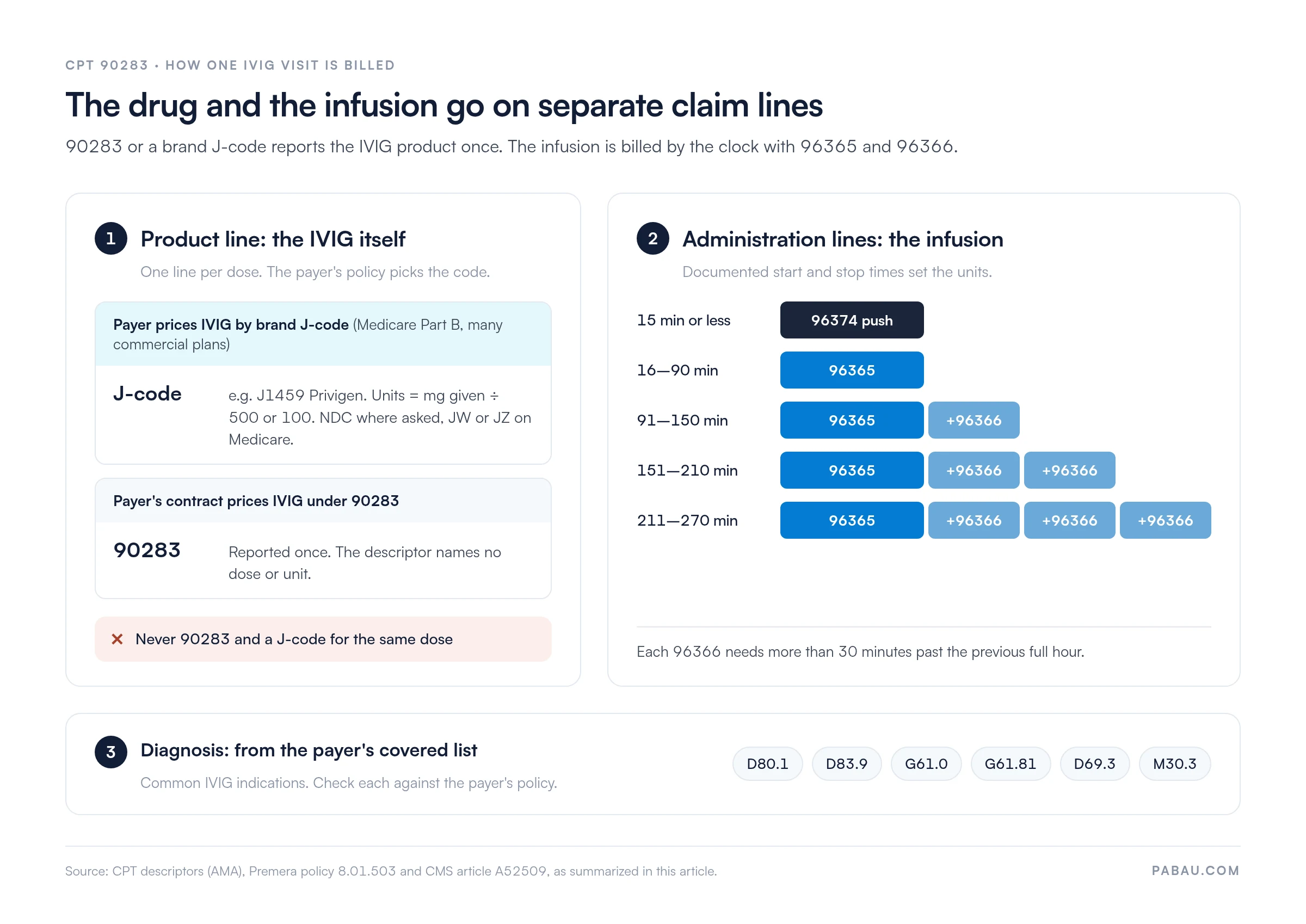
Coverage turns on the diagnosis, and each payer publishes its own list of covered indications. The codes below are common IVIG indications, so check them against the payer’s policy before the first infusion.
IVIG is dosed by weight and priced by the gram, so reviewers read the record for dose, product and time. CMS’s compliance tips for IVIG list the records it asks for on home infusion claims, and the same records support an office claim.
Medicare fee-for-service judges IVIG against its coverage criteria at claim review, with no blanket prior authorization step. Medicare Advantage and commercial plans usually require authorization before the first dose.
Request authorization as soon as the order is signed, because IVIG courses are booked weeks ahead. Record the authorization number, its dates and its approved sessions before the first appointment is confirmed. Retroactive requests take longer and are not guaranteed.
Most IVIG denials trace back to the product line, because it has to agree with the payer, the dose and the administration record at once.
Structured denial management workflows track each reason code against the IVIG claim line it hit. That shows patterns early, such as one payer rejecting 90283 every time. Cross-checking the remittance against published claim adjustment reason codes speeds up the fix.
The drug and the infusion are paid separately. Under Medicare Part B, the brand J-code is paid at average sales price (ASP) plus 6%, using the quarterly CMS ASP pricing files.
The infusion codes are paid under the Medicare Physician Fee Schedule. Look up 96365 and 96366 in the CMS Physician Fee Schedule Look-Up Tool, because rates vary by locality and change every year.
Where a commercial payer accepts 90283, the allowed amount comes from that contract. The drug line is usually the largest on an IVIG claim, so an error there costs more than an administration mistake.
On infusion days, product details sit on the vial label, times sit in the nursing notes, and the authorization sits in an email. The biller rebuilds the claim from three places, which is how a J-code ends up with the wrong units.
Pabau, a practice management platform with US claims through Claim.MD, keeps those details on one record. IV sessions record the lot against the patient and the appointment. The prior authorization code, dates and sessions sit on the patient’s case, with a warning when one is missing.
Pabau’s claims management software sends CMS-1500/837P claims and brings ERA remittances back to the same record. Your team checks the product code, units and infusion times against one source before the payer does.

Pabau keeps the IVIG lot, the infusion notes and the prior authorization on the patient record. Each claim then reports the drug once and the infusion in full.

Most 90283 problems go away once the code is treated as a product code. Report the drug once, with the code the payer names, and bill the infusion on 96365 and 96366 by the clock.
Before the first infusion, confirm from the payer’s policy which product code it wants, that code’s unit size and the covered diagnoses. A claim built on those three answers leaves the payer far fewer reasons to send it back.
Book a demo to see how Pabau keeps IVIG authorizations, lots and claims on one patient record.

Need a clearinghouse for IVIG claims? Claim.MD clearinghouse review explains how claims reach payers electronically and how rejections come back for correction.
Want to understand how remittances map back to your 90283 claims? Electronic remittance advice explains how 835 ERA files carry denial reason codes back to your billing system for faster correction.
Building an infusion billing compliance checklist? Medical billing compliance outlines the documentation and coding standards that apply to physician-administered biologicals.
CPT code 90283 covers the intravenous immune globulin product only. Its descriptor is “Immune globulin (IgIV), human, for intravenous use.” The infusion is billed separately with 96365 and 96366.
No. CPT 90283 identifies the IVIG product, not the work of giving it. Report the infusion with 96365 for the first hour and 96366 for each additional hour.
CPT 90283 is immune globulin for intravenous use, with no unit in its descriptor. CPT 90284 is immune globulin for subcutaneous infusion, billed per 100 mg. The route decides which code applies.
Bill the code the payer names. Medicare and many commercial payers price IVIG by its brand J-code, such as J1459 for Privigen or J1569 for Gammagard Liquid. Never bill 90283 and a J-code for the same dose.
The 90283 descriptor has no dose, so it does not count grams the way a J-code does. Follow the payer’s unit instruction. On a J-code, units equal the milligrams given divided by 500 or 100, depending on the code.
Medicare Part B covers IVIG when the diagnosis meets its coverage criteria, and it pays the drug by brand J-code at ASP plus 6%. Home IVIG for primary immunodeficiency is billed to the DME MAC, with Q2052 for the items and services.
Common causes are a product billed twice, the wrong product code for the payer, or miscounted J-code units. A missing NDC, an uncovered diagnosis or no prior authorization also trigger denials. The reason code on the remittance shows which one applies.




