

CCSD code G5100: Bypass of duodenum billing guide
CCSD code G5100 bills a bypass that leaves the duodenum in place CCSD code G5100...

Last Updated: Oct 16, 2026
67105 is the CPT code for repair of retinal detachment; photocoagulation (including drainage of subretinal fluid when performed). It covers laser repair of a confirmed detachment in one eye and carries a 10-day global period.
The code sits in the Retina or choroid subsection (67101-67229) of the AMA's Surgery section. Choosing it over 67101, 67113 or 67145 depends on whether the retina has detached, whether the repair needed vitrectomy, and which technique sealed the break.
Let Pabau's smart automation suggest the right codes, reduce claim denials, and keep your practice compliant—effortlessly.
Automate repetitive tasks and focus on what matters most—your patients.
Reduce coding errors and ensure compliance with the latest regulations.
Clean claims, fewer denials, and faster reimbursements.
Powerful insights and reporting to help your practice thrive.
HIPAA compliant SOC 2 certified GDPR-compliant Trusted by 4,000+ clinics worldwide

CPT code 67105 covers laser repair of a confirmed retinal detachment in one eye, including subretinal fluid drainage when performed.
The code carries a 10-day global period, so routine post-op visits in that window can’t be billed separately.
Every claim needs an LT or RT modifier, and a missing one is a leading cause of rejection.
A tear without detachment is prophylaxis, coded 67145 for laser or 67141 for cryotherapy, not 67105.
A complex detachment repaired with vitrectomy and membrane peeling is 67113, not 67105.
Pabau’s claims management software flags missing modifiers and bundling conflicts before submission, so fewer retinal surgery claims come back denied.
CPT code 67105 reports laser repair of a retinal detachment, with drainage of subretinal fluid bundled in when the surgeon performs it. The CPT code set is maintained by the American Medical Association. Within it, 67105 sits in the Surgery section, under the Retina or choroid subsection (codes 67101-67229).
The code is unilateral by definition. Bilateral repairs on the same date need two line items, each with its own laterality modifier.
Official AMA descriptor: Repair of retinal detachment; photocoagulation (including drainage of subretinal fluid when performed)
Three elements must all be present for 67105 to apply:
Photocoagulation uses a laser to create controlled retinal burns. These form chorioretinal adhesions that seal retinal tears and stop further fluid from collecting. The steps covered by 67105 are:
Payers treat photocoagulation and cryotherapy as different procedures. Billing 67105 when the operative note names cryotherapy as the primary technique misrepresents the service and can trigger a refund demand on audit.
Reimbursement for CPT code 67105 under the Medicare Physician Fee Schedule differs by place of service. The non-facility rate (office) is higher because the physician carries the practice expense overhead. The facility rate (hospital outpatient or ASC) is lower because the facility bills its own costs separately. The 2026 MPFS values are below.
RVU values are updated annually in the Medicare Physician Fee Schedule addendum. Verify current figures with the FastRVU 2026 lookup tool or the CMS MPFS search tool before quoting payment amounts. Private payer contracts set their own rates, often as a percentage of Medicare, so those figures come from the individual contract.
Pabau, the practice management platform we build, sends claims through its Claim.MD clearinghouse integration, which runs payer-specific edits before a claim reaches the payer. Claims management software that surfaces those checks at submission saves you from appealing a denied 67105 claim later.
CPT code 67105 carries a 10-day global surgery period. Routine post-operative care on the day of surgery and the 10 days that follow is bundled into the procedure payment and can’t be billed separately.
The window is short, so the date of each post-op visit decides how it’s billed. A check on day 7 falls inside the global period. A visit on day 14 sits outside it and is billed on its own medical necessity. Services inside the 10-day window that must not be billed separately include:
Services that can be billed separately during the global period need a modifier to show they fall outside the bundle. The next section covers the key modifiers.
Every 67105 claim needs at least one modifier. CMS requires laterality modifiers on eye codes, and leaving them off is a leading cause of rejection for retinal procedure codes.
Document the laterality in the operative report header, the procedure note body, and the postoperative diagnosis. Payers that auto-adjudicate claims without human review reject mismatches between the modifier and the documented eye. A single consistent reference across all three sections of the note is the fastest way to pass automated edits.
An operative note that supports a clean claim submission for 67105 must address seven elements. Reviewers use the absence of any one of them to deny medical necessity or to classify the procedure as incorrectly coded.
The superbill submitted with the claim should list every ICD-10-CM diagnosis code that establishes medical necessity. Missing diagnosis codes are audited separately from documentation problems, but they end in the same denial.
Medical necessity for 67105 requires a diagnosis from the ICD-10-CM H33 category (Retinal detachments and breaks). The table below lists the codes most commonly paired with CPT code 67105.
H33.30x paired with 67105 is a frequent audit finding. Retinal breaks without detachment justify prophylactic treatment under 67145 or 67141, not active repair under 67105. For a detachment that fits no standard category, check the criteria for H33.8 before you code it.
A payer’s Local Coverage Determination (LCD) may list exactly which H33 subcodes it covers for 67105. Confirm against the relevant MAC’s LCD before billing.
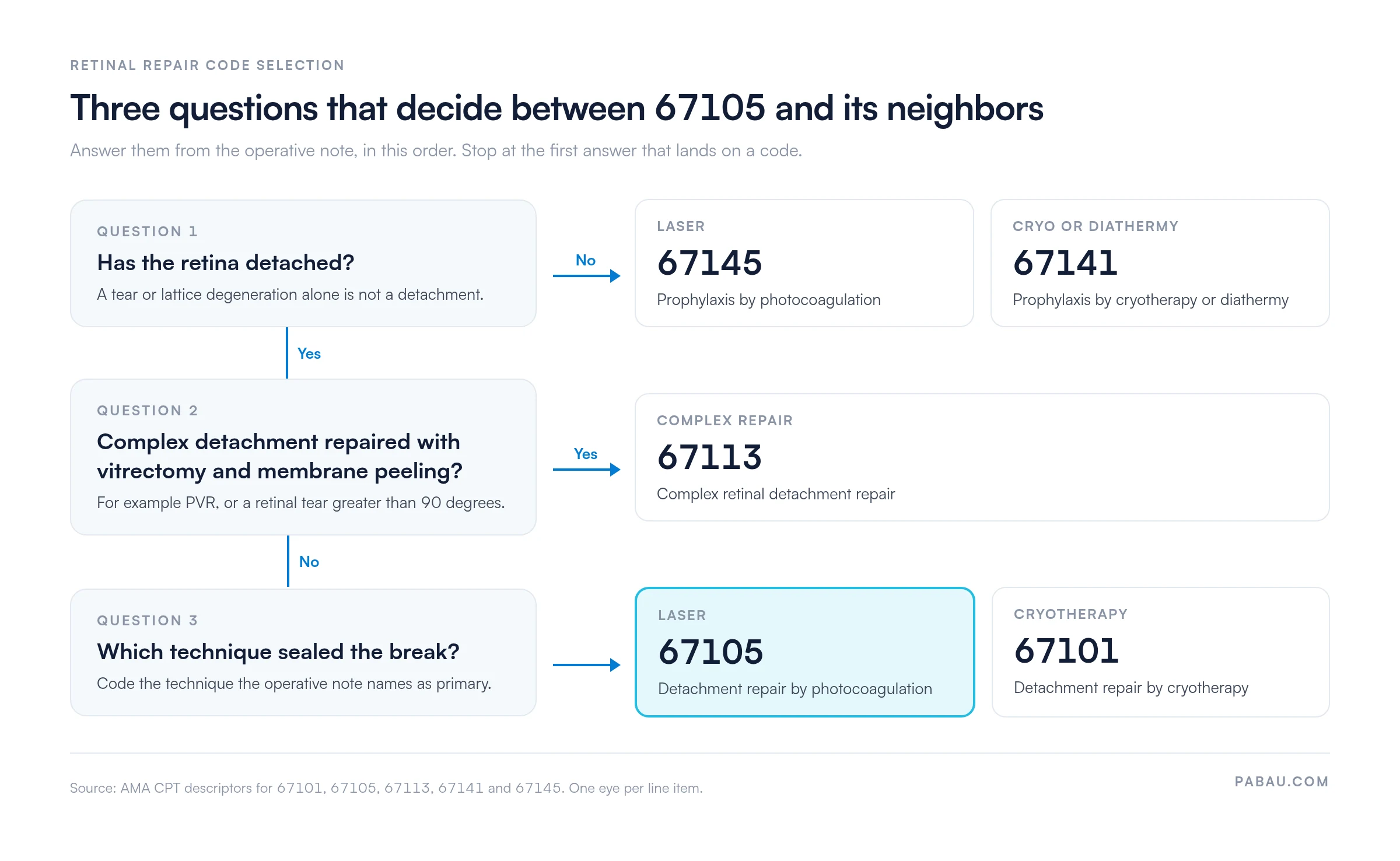
The retinal procedure codes (67101-67229) include several that overlap clinically with 67105. Picking the wrong one is a common source of retinal claim errors, alongside missing laterality modifiers. The decision tree below shows the order in which the operative note settles the choice.
See the AAPC CPT code reference for the full descriptor of each adjacent code.
67113 applies to a complex retinal detachment repaired with vitrectomy and membrane peeling. Its descriptor gives proliferative vitreoretinopathy (PVR) and a retinal tear of greater than 90 degrees as examples of complexity. Without that complexity and that surgical approach, 67105 is the right code for a laser repair. Billing 67113 without documented complexity is a classic upcoding pattern that auditors look for in operative notes.
The deciding factor is whether the retina has detached. 67145 covers prophylactic photocoagulation of retinal breaks or lattice degeneration while the retina is still attached. When that prophylaxis uses cryotherapy or diathermy, the code is 67141 instead.
67105 covers repair of a detachment that has already happened. Using 67105 when the note shows only breaks or tears (no fluid under the retina, no lifted edge) bills for more than was performed.
Effective denial management workflows for retinal surgery start with the errors behind the most denials. For CPT code 67105, those patterns are consistent across payers.
The National Correct Coding Initiative (NCCI) edits govern code pairs that CMS considers inherently bundled. For CPT code 67105, the highest-risk pairings involve vitrectomy codes on the same eye and date of service. Medical billing compliance for retinal surgery means checking these edits before each claim goes out:
Always verify current NCCI edit tables on the CMS website before submitting bundled code pairs. Edits update quarterly, so a pair that could be unbundled in 2025 may be locked as column 1 and column 2 in 2026.
The place of service (POS) code on the CMS-1500 claim form determines which RVU rate Medicare applies. Retinal detachment repair can be performed in three settings, each with different reimbursement implications:
A mismatch between the POS code on the claim and where the procedure took place is both a billing error and a compliance risk. Say the claim shows POS 11, but the surgery happened in a hospital or ASC. The physician is then paid the non-facility rate for a facility case. That’s an overpayment, and Medicare can demand a refund.
Many ophthalmology billing teams find 67105 errors only after a denial arrives. Someone then pulls the operative note, corrects the claim, and resubmits it weeks later.
Pabau’s claims management software moves those checks to charge entry. A missing LT or RT modifier, a POS mismatch, or a same-day vitrectomy pair gets flagged before the claim is submitted. Clean claims then go out through the Claim.MD clearinghouse integration, which applies payer-specific edits.
Your team works fewer denials, and each retinal repair gets paid sooner. That leaves billing staff free for the claims that need a person’s judgment.

Pabau’s claims management tools flag missing modifiers, POS mismatches, and NCCI bundling conflicts before your 67105 claims leave the practice. See how it works for ophthalmology practices.

Coding 67105 correctly comes down to three facts in the operative note. The retina has detached, the repair didn’t need vitrectomy with membrane peeling, and laser did the primary work. Make every retinal note state those three facts plainly, and the code choice defends itself on audit.
The bigger billing risk lives on the claim itself. Missing laterality modifiers, visits billed inside the 10-day global, and same-day vitrectomy edits cause most of the rework. Checking them at charge entry takes minutes, while working a denial can take weeks.
Book a demo to see how Pabau catches modifier and bundling errors on retinal surgery claims before they reach the payer.

Need to understand how clearinghouse submission works for retinal codes? Medical claims clearinghouse overview explains how electronic claims validation reduces retinal surgery denials before they reach payers.
Reconciling 67105 payments against your fee schedule? Electronic remittance advice setup covers how ERA files help practices match each payment to the expected rate.
Preparing for a payer audit on retinal procedure codes? Revenue cycle management fundamentals walks through the documentation and appeal steps that protect ophthalmology practices during post-payment review.
Repairing the detachment with vitrectomy instead? CPT code 67108 covers retinal detachment repair with vitrectomy and the components bundled into it.
CPT code 67105 covers repair of retinal detachment using photocoagulation, including drainage of subretinal fluid when performed. It applies when a confirmed detachment is present and laser is the primary repair technique. Prophylactic treatment of a tear without detachment is 67145 (laser) or 67141 (cryotherapy), and cryotherapy-primary repair is 67101.
CPT code 67105 has a 10-day global surgery period. Routine post-operative care on the day of surgery and the 10 days that follow is bundled into the procedure payment. An unrelated E/M visit needs modifier 24 to be paid. A return to the OR for a complication takes modifier 78, and an unrelated procedure takes 79.
Modifier LT (left eye) or RT (right eye) is required on every 67105 claim, and omitting it is a common rejection trigger. Other modifiers depend on the situation. Use 54 when the operating surgeon hands off post-op care, and 55 when a second physician takes it on. Use 78 for an unplanned return to the OR within the 10-day global period, and 79 for an unrelated procedure in that window.
67113 covers repair of a complex retinal detachment with vitrectomy and membrane peeling. Its descriptor names proliferative vitreoretinopathy and a retinal tear of greater than 90 degrees as examples. 67105 covers a laser repair without that complexity or surgical approach. Billing 67113 for a routine repair is upcoding, and billing 67105 for a documented complex vitrectomy repair is undercoding.
No. The AMA descriptor for 67105 includes drainage of subretinal fluid “when performed” as a bundled component. Billing the drainage separately on the same claim as 67105 will trigger an NCCI edit denial.
The usual causes are a missing LT or RT modifier, or an H33.30x diagnosis that points to prophylaxis (67145) instead of repair. A same-day vitrectomy code billed without a valid unbundling modifier also triggers denials. So does a routine post-op visit billed inside the 10-day global period, or an operative note that skips technique, laterality or findings.



